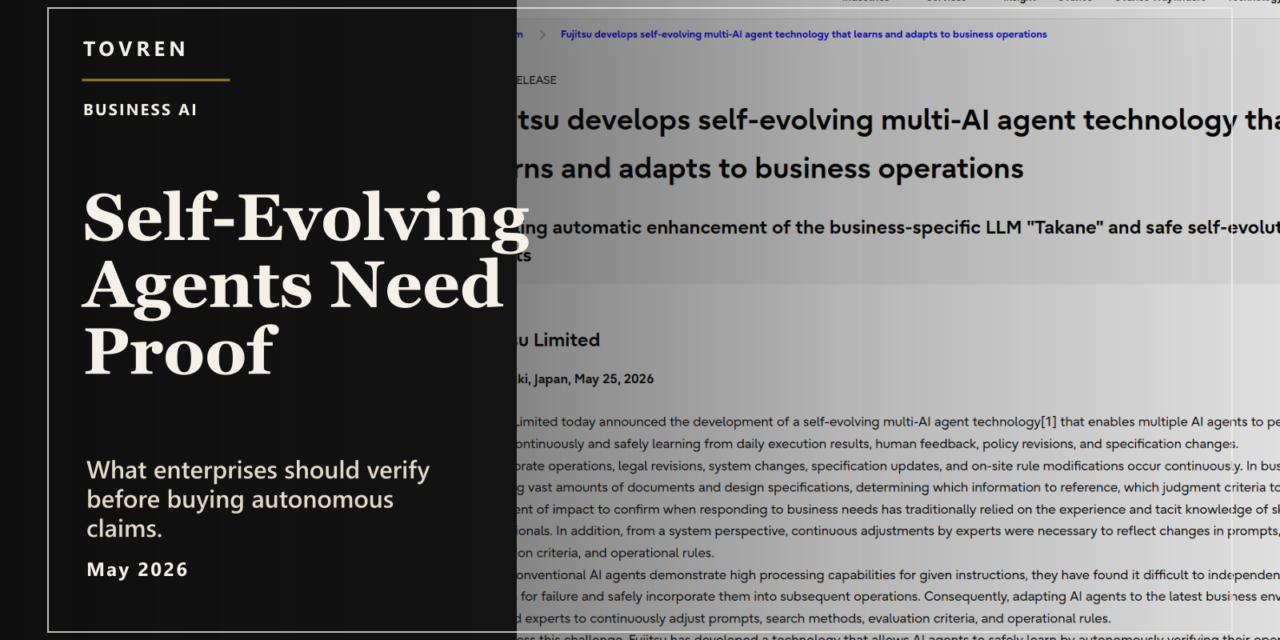
Short answer: Self-evolving agents are not ready for blind enterprise trust. Before buying, demand clear boundaries: what the agent may change, who approves updates, how behavior is logged, and how the system rolls back a bad self-improvement.
Practical verdict: self-evolving AI agents are not yet a reason to hand over your operations to a vendor black box. They are a reason to update your procurement checklist. The best version of this technology is not an AI that improves itself forever. It is a controlled system that learns from failures, human corrections, policy changes, retrieval misses, and business exceptions while preserving evidence, approval gates, rollback paths, and audit logs.
That distinction matters because the market is getting loud. Fujitsu announced self-evolving multi-AI agent technology on May 25, 2026. The EVE-Agent paper submitted on May 21, 2026 argues that self-evolving search agents should not train on examples they cannot justify. IBM’s Think 2026 announcement frames the next enterprise problem as governing agentic systems at scale, not merely building more demos. Anthropic and PwC’s expanded partnership shows large services firms pushing agentic systems into production work, not just innovation labs. Community tracking, including a Reddit AI_Agents thread about new 2026 agent products, points to the same buyer pressure: agents are being packaged as products, workflows, and outcomes. Treat Reddit as signal, not verified market data.
The danger is obvious. “Self-evolving” is a beautiful phrase for a sales deck and a dangerous phrase for a regulated workflow. Enterprises should ask a colder question: what exactly is allowed to evolve, who approves it, what evidence proves the change helped, and how quickly can the system be rolled back?
Why Self-Evolving Agents Are Suddenly Hot
Agents are moving from prompt-and-response tools toward operational systems that plan, retrieve, call tools, route work, check outputs, and interact with enterprise data. Once agents are embedded in claims processing, software maintenance, underwriting, finance analysis, HR casework, or security triage, static behavior becomes a liability. Business rules change. Policies change. Source systems change. Edge cases accumulate. Human operators correct the same mistakes repeatedly.
That creates the commercial opening for self-evolving agents: systems that capture operational experience and use it to improve future behavior. The idea is credible in narrow domains. A search agent can learn that a certain document family matters for a specific compliance question. A software maintenance agent can learn which repositories, test suites, and review paths are relevant for a class of changes. A finance agent can learn the difference between a normal variance explanation and a material exception requiring escalation.
| Market pressure | Why it favors self-evolving agents | Buyer caution |
|---|---|---|
| Enterprise pilots are becoming production programs | Static prompts break as workflows meet real exceptions. | Production requires change control, not “learning” as a slogan. |
| Agent products are multiplying | Vendors need differentiation beyond chat and workflow automation. | Community product counts are useful signals, not verified market data. |
| Large firms are training workforces around agents | More usage creates more feedback and correction data. | Training users is not the same as proving autonomous improvement. |
| Multi-agent orchestration is becoming a platform category | Many agents require shared policy, memory, routing, and audit systems. | Orchestration without governance creates faster failure, not safer scale. |
What Fujitsu Actually Announced
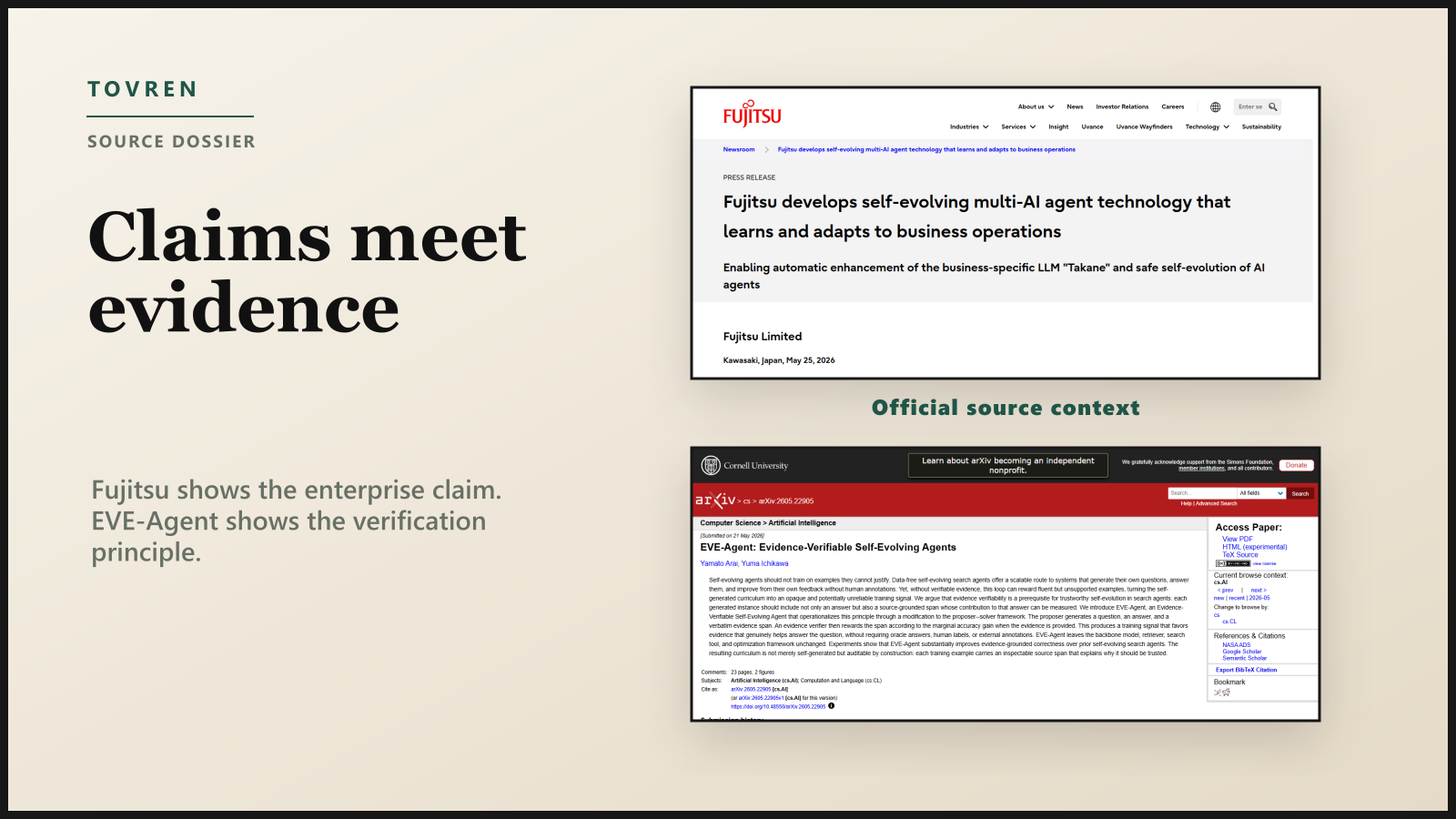
Fujitsu’s announcement is important because it connects self-evolving agents to concrete enterprise operations rather than general-purpose chatbot behavior. The company says its technology lets multiple AI agents work as a team and continuously learn from business execution results, human feedback, policy revisions, specification changes, and other environmental changes. It also says the system identifies reasons for success and failure, extracts operational insights, and verifies improvements before reflecting them in future behavior.
Two application areas matter for buyers. First, Fujitsu says the technology can support the automated enhancement and continuous evolution of its business-specific LLM, Takane, including domains such as manufacturing, healthcare, finance, and public administration. The company reports an average accuracy improvement of 28 points compared with pre-specialization performance. Second, Fujitsu applied the approach to design specification search for large business systems, including electronic health record systems and local government solutions. The practical claim is that agents can learn from past searches, failure cases, and human corrections to improve search expansion and document extraction strategies.
Still, this is not a blank check for procurement. Fujitsu announced developed technology and future integration plans, including use in its AI platform and Fujitsu Kozuchi. The public announcement does not give every detail an enterprise buyer needs: public pricing, full availability, contractual service levels, indemnity, customer-controlled evaluation methods, or detailed rollback mechanisms.
| Fujitsu claim | Why it matters | What buyers should request |
|---|---|---|
| Agents learn from execution results and human feedback | Turns repeated corrections into reusable operating knowledge. | Examples of accepted, rejected, and rolled-back improvements. |
| Agents adapt to policy revisions and specification changes | Useful for regulated and document-heavy operations. | Versioned policy ingestion, effective dates, conflict handling, and approval logs. |
| Business-specific model improvement | Suggests measurable gains after domain-specific optimization. | Benchmark design, baseline definition, domain split, sample size, and error analysis. |
| Design specification search improvement | Strong fit for software maintenance and impact analysis. | Trace examples showing source documents, retrieval expansion, and final decision basis. |
What The EVE-Agent Paper Adds
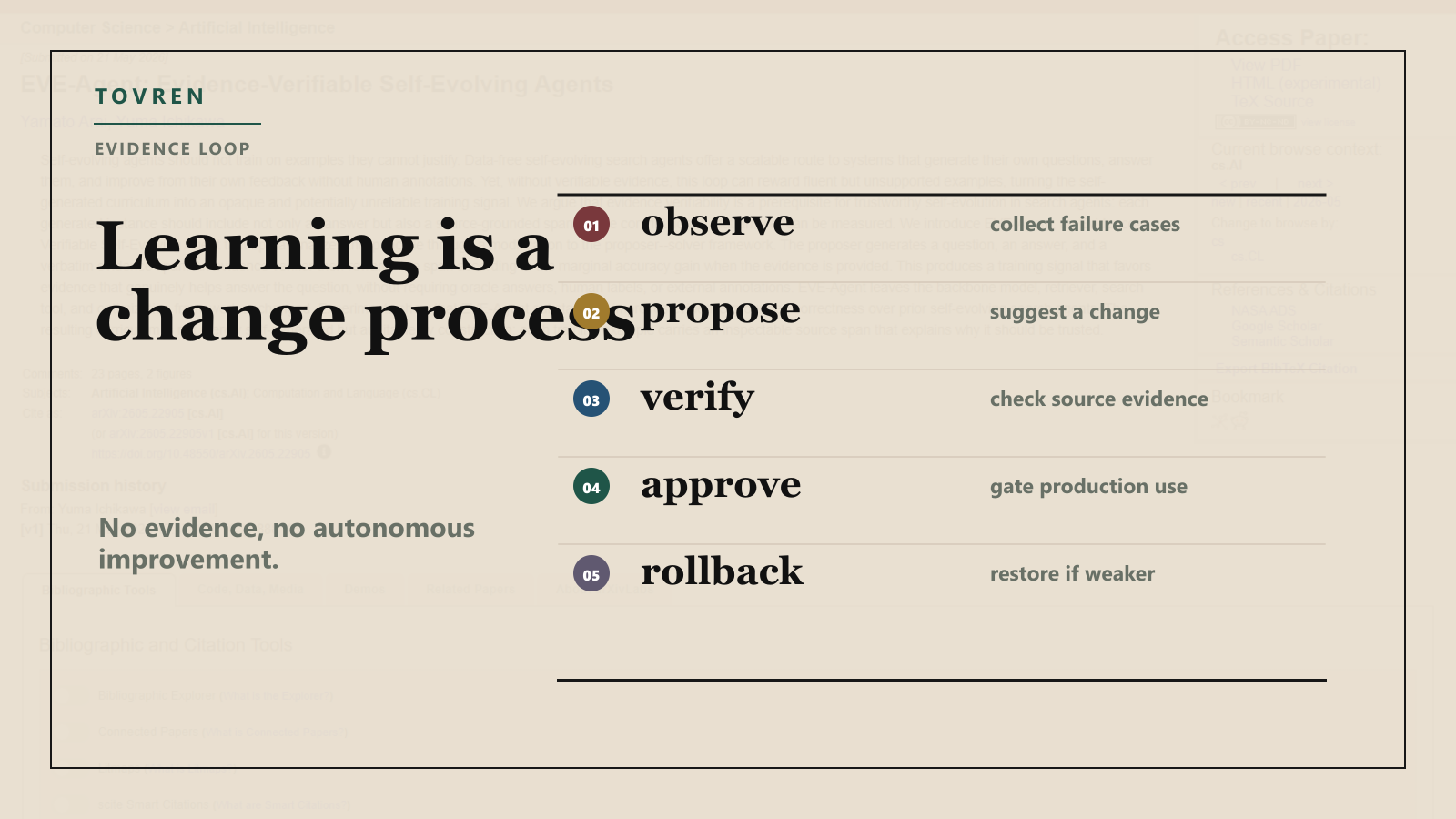
The EVE-Agent paper adds the discipline behind the buzzword. Its core argument is simple: a self-evolving agent should not train on examples it cannot justify. In EVE-Agent, a proposer generates a question, an answer, and a verbatim evidence span. An evidence verifier then rewards the span when providing it improves the solver’s answer accuracy. The system is designed to keep the backbone model, retriever, search tool, and optimization framework unchanged, while changing the reward so evidence quality becomes part of learning.
For enterprises, the paper’s most useful contribution is the governance pattern: self-improvement should be evidence-linked. If an agent updates its behavior after a failure, the organization should be able to inspect the case, the source span, the proposed change, the evaluation result, and the reason the change was accepted.
| Research idea | Enterprise translation | Procurement question |
|---|---|---|
| Self-generated questions and answers | The agent can build its own improvement cases. | How do you stop low-quality synthetic cases from corrupting behavior? |
| Verbatim evidence span | Each learning example should point to source-grounded proof. | Can every accepted change be traced to supporting evidence? |
| Evidence verifier | Learning should reward evidence that actually improves answer quality. | Who owns the verifier, and how is it tested for bias or blind spots? |
| Unchanged backbone and retriever | Improvement can happen around the system, not only by retraining the model. | Which system components can evolve in your product? |
That limitation is crucial. EVE-Agent is a research result, not a complete enterprise operating model. It helps define what good evidence-aware self-evolution can look like. It does not remove the need for access controls, human approval, validation datasets, legal review, data retention policy, or incident response.
Real Capability Versus Vendor Theater
The real version of self-evolving agents is boring in the best possible way. It looks like evaluation pipelines, source-grounded updates, human feedback review, change windows, canary deployment, rollback, monitoring, and audit. The theater version sounds more exciting: agents that “rewrite themselves,” “learn from every interaction,” or “autonomously optimize your business” without showing the evidence chain.
| Vendor statement | Likely meaning | Ask this before buying |
|---|---|---|
| “The agent learns continuously” | It may store feedback, update prompts, alter retrieval, or fine-tune a model. | Which components can change: prompt, memory, retrieval policy, tools, weights, routing, or permissions? |
| “The system improves from failures” | Failures may be labeled and reused as evaluation or training data. | Who labels failure causes, and what prevents the agent from learning the wrong lesson? |
| “Autonomous optimization” | May mean background recommendations, not approved production changes. | Can any change affect live users, money, legal commitments, security controls, or customer data without approval? |
| “Audit-ready” | Could mean basic logs, not decision-grade traceability. | Can auditors see inputs, retrieved sources, tool calls, model versions, approvals, and rejected alternatives? |
For related implementation context, Tovren’s guides on Anthropic, Stainless SDK, and MCP for agent developers, the Claude Agent SDK and credits, and the AI browser agent prompt pack are useful companion reading. The pattern is the same: agents become valuable when they are wired into real tools, but they become risky when tool access outruns control design.
Enterprise Buying Checklist
Do not ask vendors whether their agent self-evolves. Ask how the evolution is constrained, measured, and governed. A mature buyer should treat self-evolution as a change-management capability, not a personality trait.
| Checklist item | Pass condition | Reject or delay if |
|---|---|---|
| Defined learning boundary | The vendor clearly separates memory, prompt updates, retrieval tuning, policy updates, and model fine-tuning. | “Learning” is used without naming what changes. |
| Evidence-linked improvement | Every accepted improvement links to source material, failure case, metric movement, and approval. | The system cannot explain why a change was made. |
| Evaluation before deployment | Changes are tested against regression suites, adversarial cases, and business KPIs before release. | Production behavior changes immediately after user feedback. |
| Rollback | Prompts, policies, tools, memory, retrieval indexes, and model versions can be restored quickly. | The vendor treats rollback as manual engineering work. |
| Cost visibility | Pricing separates seats, model usage, tool calls, storage, retrieval, evaluation, and training. | The pilot cannot forecast monthly production cost. |
| Data isolation | Customer data, feedback, traces, and generated training examples are tenant-isolated by contract and architecture. | Operational data may improve shared models without explicit agreement. |
| Tool permissions | Agents use least-privilege access, scoped credentials, approval gates, and action limits. | The agent can modify records, send messages, execute code, or spend money without controls. |
Governance And Audit Requirements
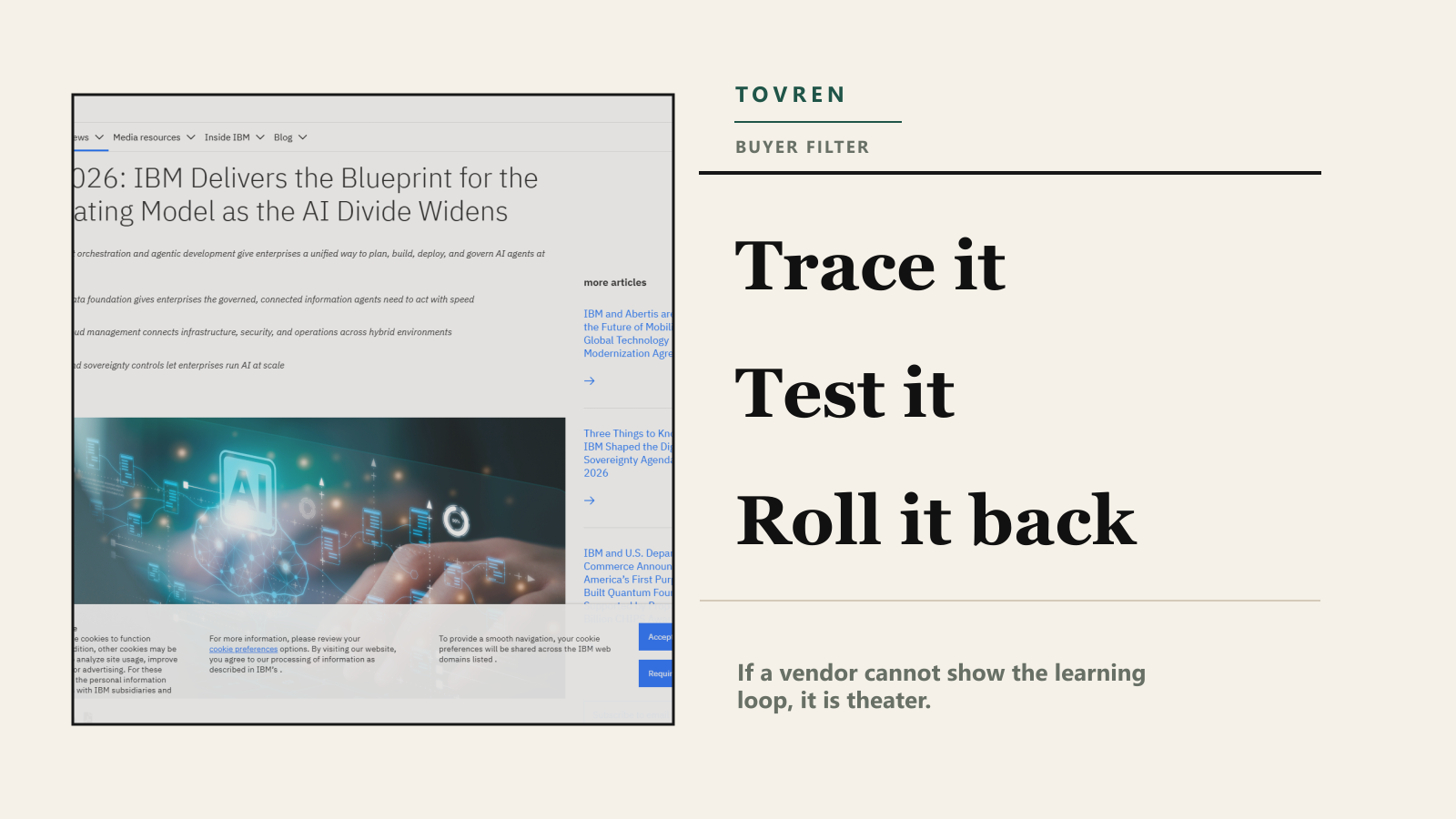
IBM’s Think 2026 framing is useful here: the enterprise problem is shifting from building a handful of agents to managing many agents with consistent policy enforcement and accountability. That is the right mental model. A self-evolving agent is not just an AI feature. It is a production actor inside a business process.
The governance stack should cover three moments: before the agent acts, while it acts, and after it learns. Before action, the system needs identity, access, policy, risk classification, and approved tools. During action, it needs trace capture, evidence capture, permission checks, and escalation triggers. After action, it needs evaluation, change approval, rollback, and retention.
| Governance layer | Minimum requirement | Evidence to collect |
|---|---|---|
| Identity and access | Agent identities, scoped credentials, and per-tool permissions. | Credential logs, tool grants, approver records, and expiry dates. |
| Decision trace | Full trace of user request, retrieved sources, tool calls, and final output. | Trace ID, model version, prompt version, source IDs, timestamps. |
| Learning control | No production update without evaluation and approval. | Change proposal, test results, approver, deployment window, rollback plan. |
| Auditability | Auditors can reconstruct why the system changed and why it acted. | Evidence spans, rejected alternatives, evaluation scores, human corrections. |
| Incident response | Kill switch, containment plan, customer notification path, and post-incident review. | Incident timeline, affected records, root cause, remediation, follow-up tests. |
30-Day Pilot Plan
A good first pilot should be narrow, measurable, and deliberately unglamorous. Pick a workflow where the business already has enough historical cases to evaluate quality: policy search, support triage, software impact analysis, contract clause extraction, finance variance explanations, or security alert summarization. Do not start with irreversible actions.
| Days | Workstream | Output | Go/no-go metric |
|---|---|---|---|
| 1-5 | Scope and baseline | One workflow, approved data set, human baseline, risk classification. | Baseline quality, cycle time, cost, and error categories documented. |
| 6-10 | Evidence and evaluation setup | Gold cases, source documents, success metrics, failure taxonomy, regression set. | Every answer must link to source evidence or be marked unsupported. |
| 11-15 | Shadow-mode runs | Agent outputs compared with human decisions without production action. | Measurable lift or time saving without unacceptable error types. |
| 16-22 | Controlled learning loop | Human corrections converted into proposed improvements, not automatic changes. | Accepted improvements pass regression tests and reduce repeated errors. |
| 23-27 | Limited approved actions | Low-risk actions allowed with human approval, full trace capture, rollback tested. | No unauthorized tool call, missing evidence, or unreviewed production change. |
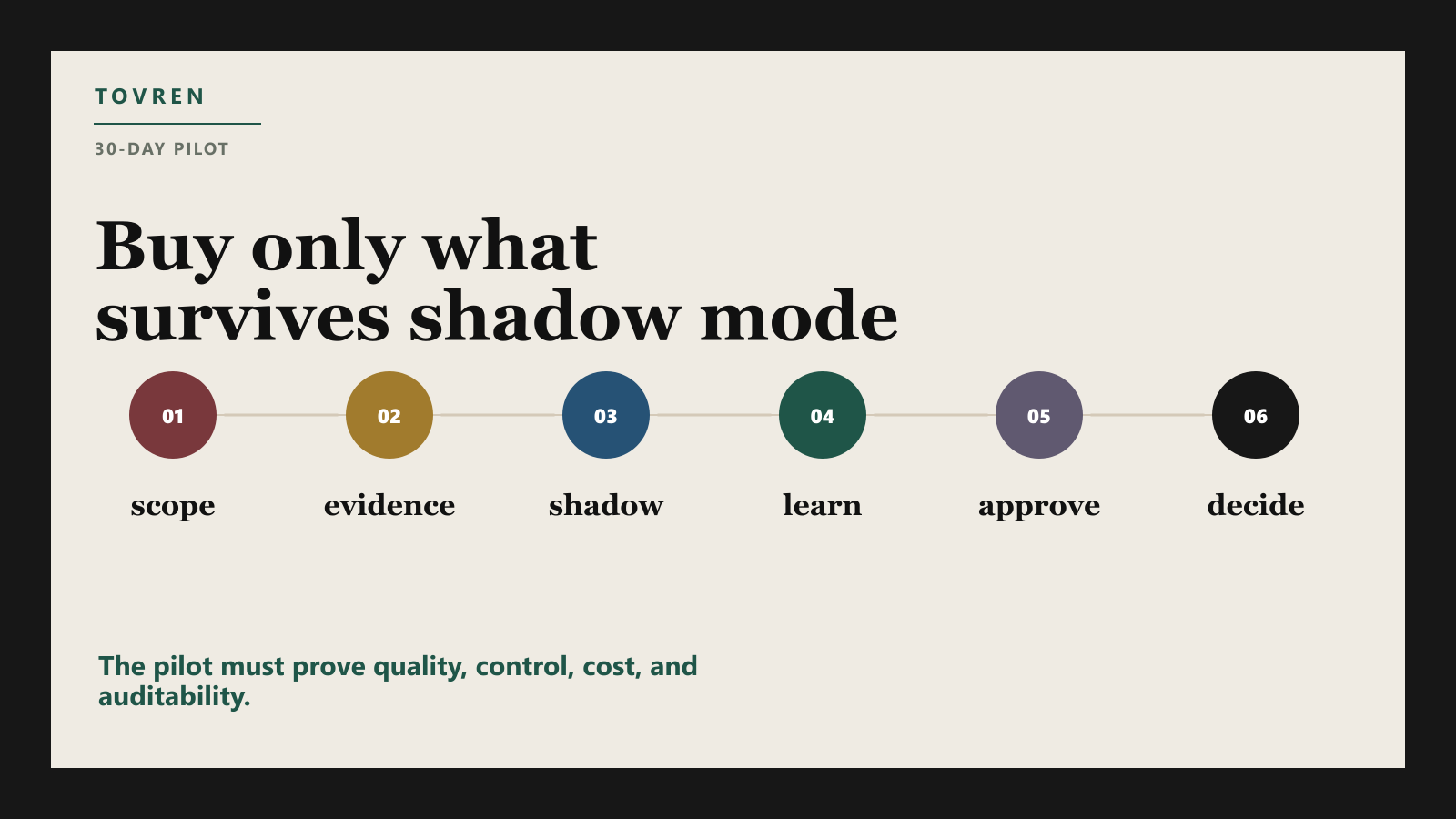
| 28-30 | Procurement decision | Cost model, risk report, audit sample, roadmap, and expansion decision. | Proceed only if quality, control, cost, and auditability all clear the threshold. |
The strongest pilot question is not “did the agent impress people?” It is: after 30 days, can you show exactly what the agent learned, why those changes were justified, which changes were rejected, how much performance improved, what the residual risks are, and what it would cost to run at scale?
Self-evolving agents are arriving, but enterprise buyers should be blunt about the details. Ask for traces. Ask for failed cases. Ask for rollback. Ask for the evaluation set. Ask what happens when a policy update conflicts with old memory. Ask whether the vendor can prove improvement without silently weakening controls.
The enterprises that benefit first will not be the ones buying the most autonomous story. They will be the ones buying the most inspectable learning loop.
FAQ
What is a self-evolving AI agent?
It is an agent that can change its own instructions, tools, workflows, or behavior based on feedback or environment signals.
What should buyers demand before approval?
Demand permission boundaries, change logs, approval gates, rollback, evaluation results, and clear ownership.
What is the biggest enterprise risk?
The biggest risk is uncontrolled behavior drift where the agent changes how it works without a reviewable governance trail.