
Short answer: SAP teams should pilot autonomous enterprise features where the workflow is repetitive, auditable, and already inside SAP data. Start with approvals, reporting, service tasks, or finance operations before attempting broad end-to-end autonomy.
Do this now: do not buy SAP’s “Autonomous Enterprise” story as a broad transformation program yet. Pick one narrow SAP-heavy workflow with visible leakage, run it for 30 days with human approval, and measure whether Joule agents reduce rework, cycle time, and exception backlog without creating audit or access risk. The best first pilots are invoice exception handling, procurement intake, supplier risk review, HR case routing, customer support triage, and finance close support. Ignore vendor demos that cannot show live SAP context, role-based access, execution logs, cost tracking, and rollback controls.
SAP’s Sapphire 2026 announcements matter because they are not only another chatbot wrapper. In its official Sapphire press release, SAP introduced a unified SAP Business AI Platform and positioned it as the foundation for the Autonomous Enterprise. SAP says the platform unifies SAP Business Technology Platform, SAP Business Data Cloud, and SAP Business AI in one governed environment. It also says SAP Knowledge Graph gives AI agents a structured map of business entities, processes, and relationships across a customer’s SAP landscape.
That is the credible part: SAP is trying to make agents understand business context, not just text. The part customers still need to validate is whether those agents can execute safely in your messy process reality: incomplete master data, custom fields, local approvals, supplier edge cases, exceptions, regional compliance rules, and the non-SAP tools where work actually leaks.
Executive summary for CFOs, CIOs, operations, and procurement
| Role | What to care about | What to ask before approval |
|---|---|---|
| CFO | Finance close, invoice exceptions, working-capital leakage, manual reconciliation. | Which KPI moves in 30 days, and who signs off before an agent posts, changes, or escalates anything? |
| CIO | Identity, SAP and non-SAP data access, runtime isolation, observability, lifecycle management. | Can SAP AI Agent Hub, LeanIX, Signavio, and runtime logs show every agent, tool, permission, action, cost, and owner? |
| Operations | Cycle time, exception queues, handoffs, process adherence, user adoption. | Can the pilot handle real exceptions, not only clean demo paths? |
| Procurement | Licensing, partner scope, implementation risk, support model, lock-in. | What is included, what needs a separate subscription, and what happens when an agent recommendation is wrong? |
The buying principle is simple: pilot SAP agents where SAP already has the system of record, where the action can be bounded, and where humans can approve before irreversible steps. Do not start with a “multi-agent autonomous enterprise” program. Start with one queue, one owner, one KPI, one control set.
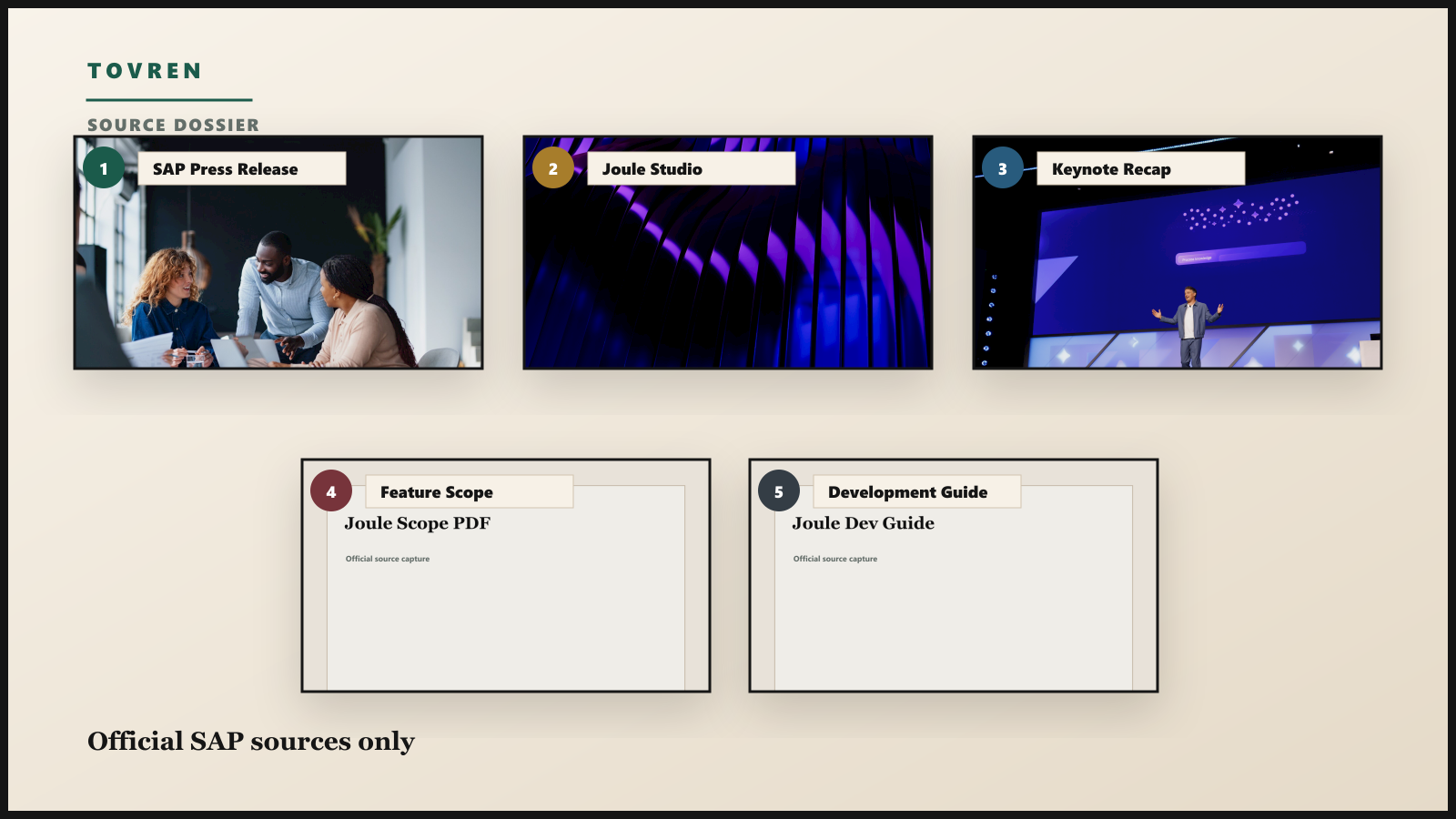
What SAP actually announced
SAP’s Sapphire keynote recap describes SAP Business AI Platform as a place to “build, contextualize, reason, and govern” AI. SAP says the platform has a context layer, a build layer, and a governance layer. The context layer includes SAP Knowledge Graph, SAP Domain Models, and SAP Business Data Cloud so agents can work with business meaning rather than isolated prompts.
The build layer centers on Joule Studio. SAP’s Joule Studio announcement describes it as a fully managed offering for building and managing the life cycle of AI agents, applications, and workflows. SAP says users can begin with intent-based development: describe a business goal, then have Joule Studio use SAP Signavio Process Consultant Agent, SAP Knowledge Graph, SAP Domain Models, and SAP LeanIX context to generate artifacts such as a product requirements document, technical specifications, code scaffolding, test artifacts, and a live working preview.
SAP also says developers can build with no-code, pro-code, and AI frameworks on SAP-managed infrastructure. The same announcement names pro-code support for LangChain, Pydantic AI, and LlamaIndex, plus embedded n8n for visual workflow orchestration and Vercel for custom digital experiences.
SAP also announced more than 50 domain-specific Joule Assistants and more than 200 specialized agents across finance, supply chain, procurement, human capital management, and customer experience. One named example is Autonomous Close Assistant, which SAP says can compress financial close from weeks to days by automating journal entries, reconciliation, and error resolution across the process.
The partnership slate is broad: SAP named Anthropic, AWS, Google Cloud, Microsoft, Mistral AI, Cohere, n8n, NVIDIA, Parloa, Palantir, Accenture, and Conduct across platform, implementation, migration, model, runtime, workflow, and service scenarios. Treat that as optionality, not proof of production fit.
There is also a real developer surface. The SAP Joule Development Guide describes pro-code development using the Joule Studio CLI and code editor, including compiling assistants and deploying them in an SAP BTP tenant. It also describes YAML-based design-time artifacts, capability files, scenarios, dialog functions, and agent integration. This matters because serious enterprise agents need versioning, testing discipline, deployment gates, and audit trails; they cannot remain as prompt experiments in a browser tab.
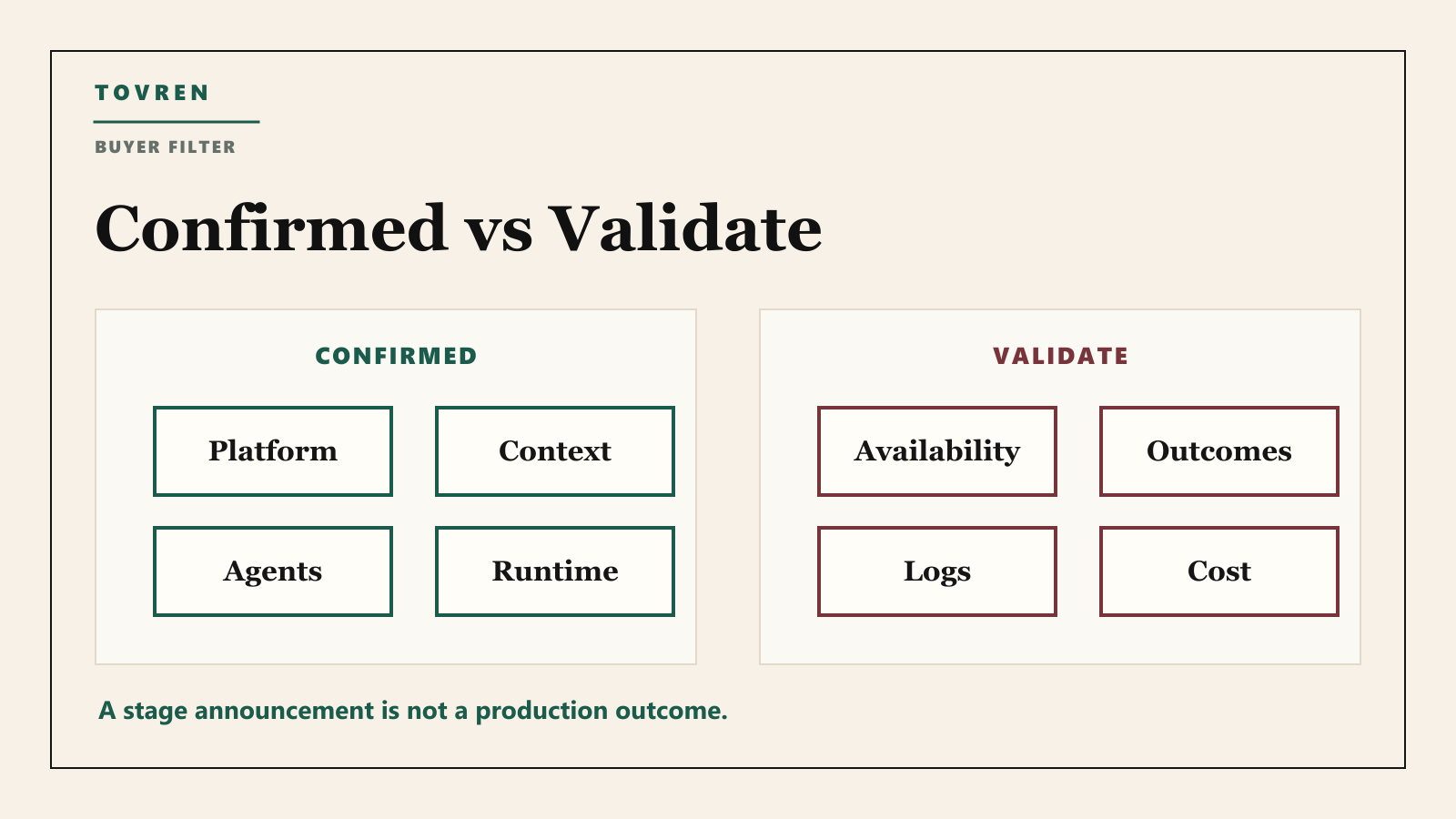
Confirmed versus hype
| Claim | Confirmed by SAP sources | What customers must still validate |
|---|---|---|
| Unified platform | SAP says Business AI Platform unifies SAP BTP, SAP Business Data Cloud, and SAP Business AI. | Whether your current licenses, cloud ERP roadmap, and data architecture actually expose the context agents need. |
| Business context | SAP says Knowledge Graph maps business entities, processes, and relationships across SAP landscapes. | How well it reflects custom fields, local processes, non-SAP systems, and dirty master data. |
| Agent building | Joule Studio supports intent-based development plus pro-code options and AI frameworks such as LangChain, Pydantic AI, and LlamaIndex. | Whether your team can maintain generated artifacts safely after the demo. |
| Workflow orchestration | SAP announced embedded n8n and Vercel partnerships inside Joule Studio. | Tool access boundaries, data movement, cost, and production support ownership. |
| Runtime controls | SAP says Joule Studio runtime uses NVIDIA OpenShell for isolated, sandboxed environments with policies and guardrails. | Whether logs, approvals, least privilege, rollback, and incident response meet your risk model. |
| Governance | SAP says SAP AI Agent Hub, LeanIX, Signavio, and lifecycle tools support governance and observability; SAP said AI Agent Hub is planned for Q3 availability. | Coverage for non-SAP agents, retention rules, evidence export, and integration with your security tools. |
| Autonomous outcomes | SAP has announced assistants and agents mapped to business domains and KPIs. | Actual cycle-time reduction, error rate, user adoption, and exception handling in your environment. |
The useful interpretation is not “SAP solved enterprise autonomy.” It is: SAP now has a more coherent agent stack for SAP-centered processes. That makes SAP a stronger candidate for pilots where business context, access control, and process governance matter more than generic model cleverness.
What to pilot first
Start with workflows where the agent can classify, summarize, recommend, draft, route, reconcile, or prepare an action while a human retains final approval. These are practical because the success criteria are measurable and the downside can be contained.
| Pilot | Agent task | Human control | Primary KPI |
|---|---|---|---|
| Invoice exception handling | Group exceptions, retrieve purchase order and receipt context, draft resolution notes. | AP specialist approves changes or escalations. | Exception backlog and average resolution time. |
| Procurement intake | Interpret requests, identify missing fields, suggest category, policy, supplier, and next step. | Buyer approves sourcing path. | Intake-to-triage time and rework rate. |
| Supplier risk | Summarize supplier records, flag incomplete data, route for review. | Procurement or risk owner approves risk status. | Review cycle time and false-positive rate. |
| HR case routing | Classify employee questions, retrieve policy context, route cases. | HR owner approves sensitive responses. | First-touch routing accuracy and time to assignment. |
| Customer support triage | Summarize case history, classify priority, suggest next action. | Agent or service manager approves customer-facing response. | Time to first useful action. |
| Finance close | Prepare reconciliation support, identify anomalies, draft journal-entry rationale. | Controller approves postings and close decisions. | Close task duration and manual rework. |
Avoid pilots where the first version must negotiate contracts, approve payments, terminate employees, commit inventory, or make customer promises without human approval. Those may become later-stage candidates, but they are bad first tests because one bad action can destroy trust in the program.
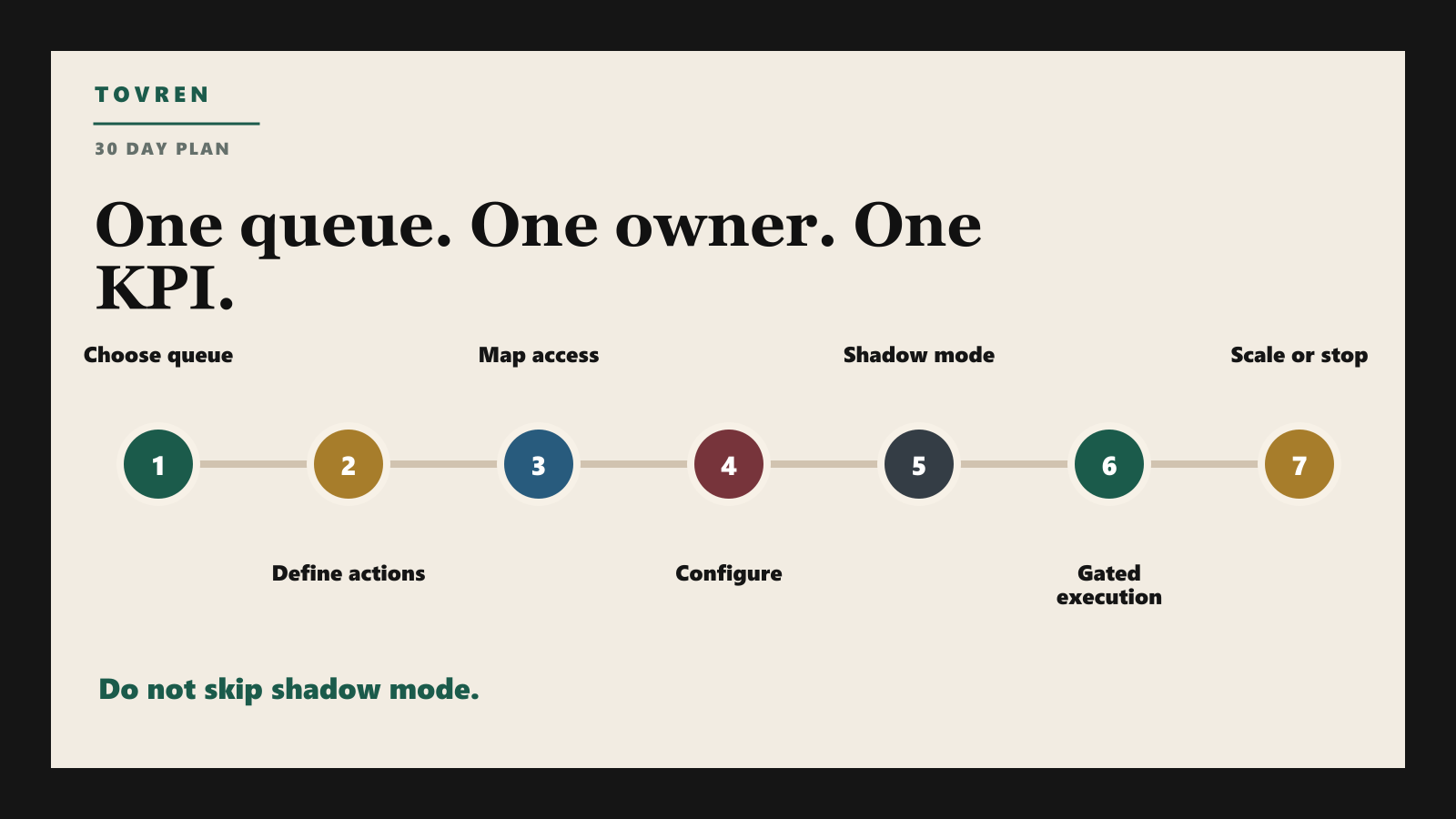
The 30-day SAP agent pilot plan
| Days | Step | Concrete output |
|---|---|---|
| 1-3 | Choose the queue. | Pick one process queue with at least 100 recent cases, a named business owner, and a measurable pain point: blocked invoices, procurement intake tickets, HR service cases, customer support triage, or close checklist items. |
| 4-6 | Define allowed actions. | Create a one-page agent charter covering read-only sources, allowed recommendations, approval gates, prohibited actions, escalation triggers, and rollback owner. Use the same discipline recommended in Tovren’s enterprise agent buying checklist. |
| 7-10 | Map context and access. | Identify SAP objects, documents, repositories, and non-SAP systems required. SAP’s Joule Feature Scope Description says Joule supports document grounding from repositories including Microsoft SharePoint, Google Drive, and SAP Build Work Zone, and supports DOCX, PDF, PPTX, and HTML. |
| 11-15 | Build or configure. | Use a prebuilt Joule Assistant if it covers the workflow. Use Joule Studio only when you need custom routing, custom context, or a workflow that cannot be handled by the standard assistant. |
| 16-20 | Run shadow mode. | Let the agent produce recommendations without executing them. Compare outputs to human decisions and tag disagreement reasons: missing context, wrong policy, ambiguous data, stale master data, or excessive confidence. |
| 21-25 | Add gated execution. | Permit low-risk actions such as drafting notes, preparing summaries, assigning categories, or creating approval-ready tasks. Do not allow irreversible execution until accuracy, auditability, and rollback are proven. |
| 26-30 | Decide scale, fix, or stop. | Expand only if the pilot improves the KPI, users keep using it, logs are reviewable, and the business owner can explain what changed operationally. |
Do not skip shadow mode. A demo can make an agent look autonomous; shadow mode shows whether it understands the boring details that actually run the business.
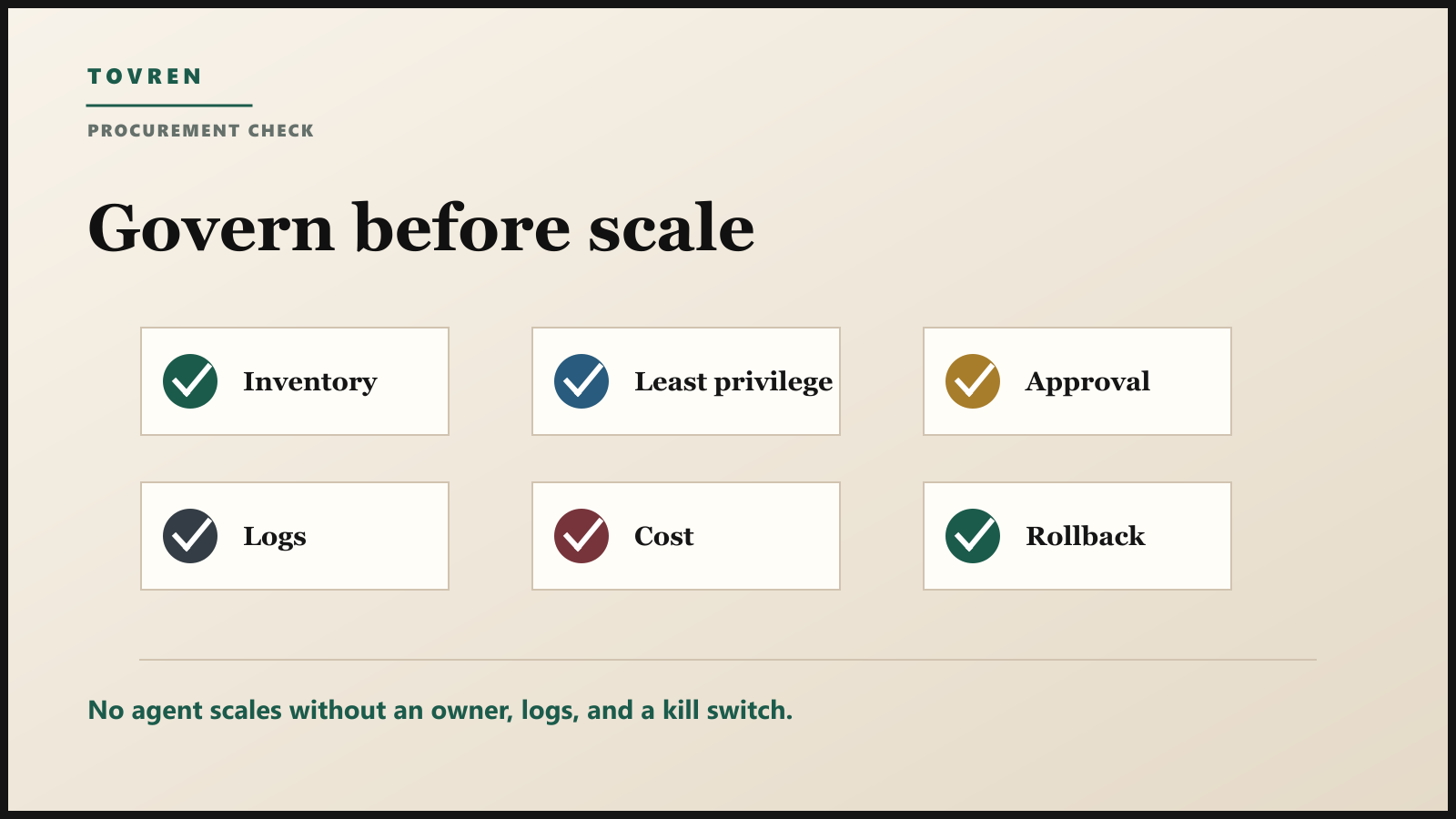
Governance controls and KPIs
SAP’s governance message is stronger than most agent announcements because it connects agent development to SAP AI Agent Hub, SAP LeanIX, SAP Signavio, SAP Cloud Application Lifecycle Management, managed runtime, and observability. SAP also says Joule captures conversation history, analytics, feedback, and data management functions for auditability and controlled scaling. Still, buyers should treat governance as something to verify, not admire.
| Control | Minimum requirement | Evidence to request |
|---|---|---|
| Agent inventory | Every SAP and non-SAP agent has an owner, purpose, data scope, tools, and status. | SAP AI Agent Hub or equivalent inventory export. |
| Least privilege | Agents inherit appropriate identity and authorization boundaries. | Role mapping, access test, denied-action logs. |
| Human approval | Material actions require approval until risk is accepted. | Approval workflow, timestamped evidence, approver identity. |
| Observability | Usage, cost, failures, business impact, and drift are visible. | Dashboard screenshots and raw log export. |
| Testing | Regression cases cover normal, exception, and adversarial inputs. | Test set, pass/fail history, release notes. |
| Rollback | Agent changes and actions can be paused or reversed. | Kill switch, deployment history, incident playbook. |
Measure both productivity and risk. Useful KPIs include cycle time, backlog, touchless recommendation rate, human override rate, false-positive rate, escalation rate, user adoption, cost per resolved case, audit exceptions, access denials, and post-action corrections. For a deeper operating model, pair this pilot with Tovren’s guide to AI agent evaluations and runtime governance.
Procurement checklist: what to ask SAP and partners
| Question | Why it matters |
|---|---|
| Which announced assistants and agents are available in our region, tenant, products, and contract tier today? | Availability can differ from stage announcements and roadmap language. |
| Which features require a separate subscription license? | SAP’s Joule feature document says certain features may require separate subscription licensing. |
| What is included in design-time access, and what production runtime, model, orchestration, data, storage, and partner costs are excluded? | A cheap build phase can still lead to expensive production operation. |
| Can SAP AI Agent Hub discover and govern non-SAP agents as well as SAP agents in our environment? | Agent sprawl usually crosses platform boundaries. |
| How does Joule Studio runtime enforce sandboxing, policies, guardrails, and tool restrictions? | SAP says NVIDIA OpenShell supports isolated, sandboxed runtime environments, but buyers need tenant-specific evidence. |
| Can we export logs, decisions, prompts, tool calls, approvals, cost, and business outcomes for audit? | Audit evidence matters more than dashboard screenshots. |
| How are SAP Knowledge Graph and SAP Domain Models adapted to custom fields, extensions, local processes, and non-SAP data? | The agent is only as reliable as its business context. |
| Who supports embedded n8n, Vercel-built interfaces, third-party frameworks, and partner-built agents in production? | Mixed stacks create support seams unless ownership is explicit. |
| What is the deactivation, rollback, and incident response process for each agent? | Autonomy needs a kill switch before it needs scale. |
Also ask about developer readiness. SAP documentation describes pro-code tools, CLI-based workflows, Visual Studio Code support, templates, validation, quick fixes, compilation, deployment to SAP BTP, and content-based or code-based agent integration. That is useful, but it means your pilot needs real engineering ownership. The development guide also notes that content-based agent testing/debugging features for checking execution traces or logs are not supported in that section, so buyers should verify what observability is available for their specific runtime and release before relying on custom agents in production.
What to ignore for now
Ignore any proposal that starts with “autonomous enterprise roadmap” before it names the first queue, KPI, control owner, and approval gate. Ignore agent marketplaces unless each agent has a business owner and measurable outcome. Ignore interoperability claims until the vendor shows how Joule, Microsoft 365 Copilot, external agents, MCP-style tool access, and workflow tools are governed in one inventory. Tovren’s MCP server and shadow IT audit guide is a useful companion here, especially if teams are connecting agents to tools faster than IT can govern them.
Also ignore “we can build anything with LangChain” as a procurement answer. SAP’s support for frameworks such as LangChain, Pydantic AI, and LlamaIndex is useful for developers, but framework openness does not replace access control, test coverage, data contracts, or lifecycle management. For developer teams comparing agent access patterns, see Tovren’s analysis of agent developer infrastructure and MCP-style integration pressure.
The bottom line
SAP’s Sapphire 2026 announcements are worth taking seriously because they connect agents to ERP context, process semantics, governed runtime, and enterprise lifecycle tooling. That is closer to what business AI needs than a generic chatbot with API access.
But the Autonomous Enterprise is not something to purchase as a slogan. It is something to earn, one controlled workflow at a time. Pilot SAP Joule agents first where SAP owns the context, humans can approve the output, and success can be measured in 30 days. Treat broader autonomy as a scaling decision after the agent proves it can reduce real work without weakening control.
For teams also comparing Microsoft workflow automation, Tovren’s Copilot Studio pilot guide is the right counterpoint: use it to decide whether the first workflow belongs closer to SAP process data or closer to Microsoft work surfaces.