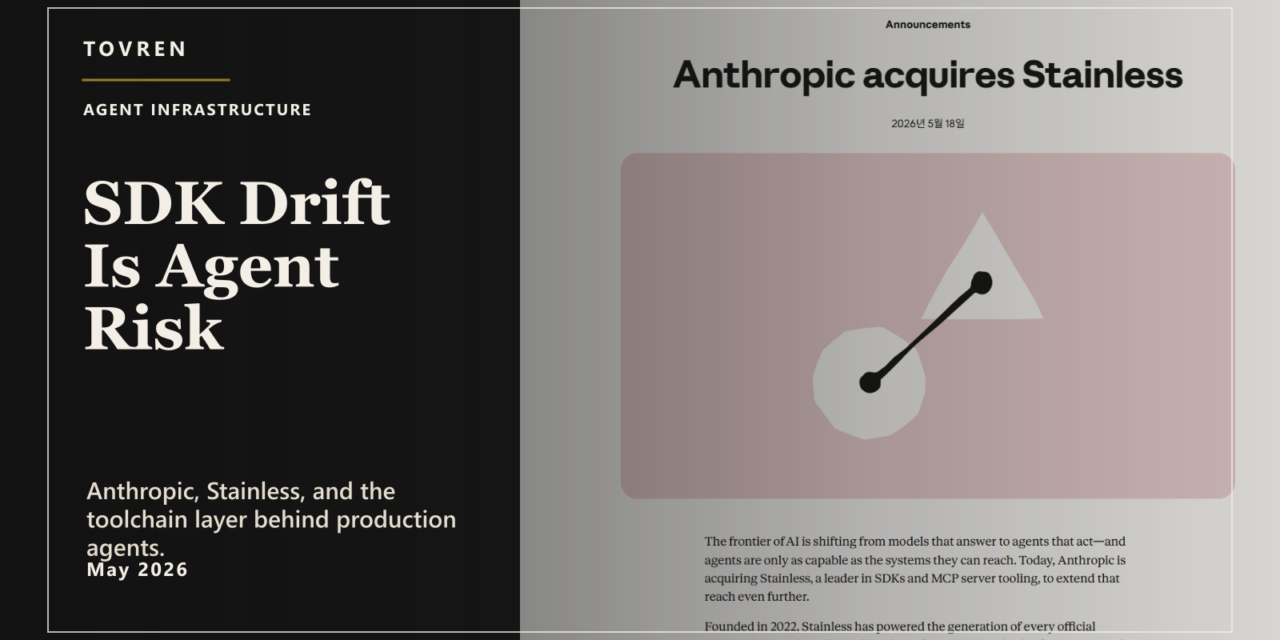
Short answer: Anthropic buying Stainless matters if it makes SDKs, APIs, and MCP tooling easier for developers to ship safely. Watch for practical changes: better generated SDKs, cleaner agent tool contracts, and fewer brittle integration steps.
Verdict: Anthropic’s Stainless acquisition matters less because one AI lab bought one developer-tooling company, and more because SDK generation and MCP servers are becoming the control plane for agent software. For startup teams, the immediate action is not panic. It is a dependency audit: who generates your SDKs, who publishes your MCP servers, how fast your OpenAPI spec drifts from production, and what security gates exist before an agent can touch customer data.
On May 18, 2026, Anthropic announced that it was acquiring Stainless, describing Stainless as a leader in SDKs and MCP server tooling. Anthropic also said Stainless had powered the generation of every official Anthropic SDK since the early days of its API, while hundreds of companies use Stainless to generate SDKs, CLIs, and MCP servers across languages including TypeScript, Python, Go, and Java.
That framing is the point. Agents do not become useful just because the model is stronger. They become useful when they can safely call APIs, read current documentation, authenticate as the right user, execute bounded actions, handle pagination and errors, and recover when an API changes. In that world, the SDK and the MCP server are not docs plumbing. They are agent infrastructure.
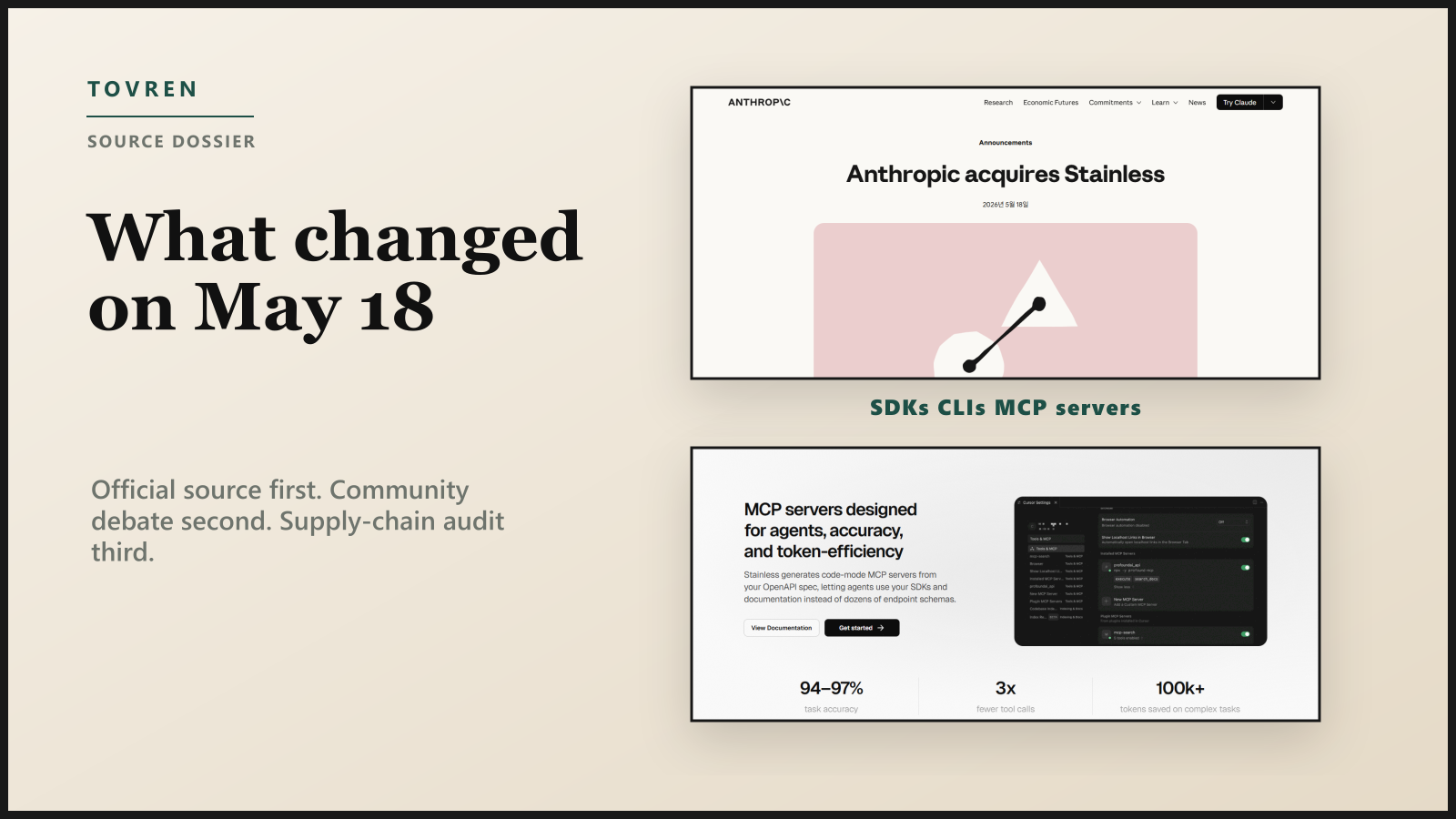
What Changed After Anthropic Acquired Stainless On May 18, 2026
The acquisition puts a major SDK and MCP-generation team inside Anthropic’s platform organization. It does not automatically mean every Stainless-generated SDK changes overnight. It does not prove that a competitor’s SDK is broken, exposed, or being manipulated. The official announcement says Anthropic is bringing the Stainless team in to advance Claude’s ability to connect to data and tools; it does not publish a shutdown timeline, competitor-impact list, customer migration policy, or deal terms.
The practical change is strategic: Anthropic now has direct ownership of a toolchain that turns API specifications into the interfaces developers and agents actually use. That matters because agents are increasingly judged by whether they can complete workflows inside SaaS tools, developer platforms, databases, ticketing systems, and internal APIs. The model is only one piece. The callable surface around the model is becoming the moat.
| Change | Why it matters for agent teams | What not to assume |
|---|---|---|
| Stainless joins Anthropic | Anthropic gains deeper control over SDK and MCP-server generation used in Claude developer workflows. | Do not assume competitor SDKs are compromised or deprecated without direct evidence. |
| SDKs, CLIs, and MCP servers are framed together | The developer interface and agent interface are converging around the same API source of truth. | Do not treat MCP as a side project owned only by AI-tool hobbyists. |
| Agent connectivity becomes a platform priority | Tool calling, docs search, generated clients, and auth boundaries become product infrastructure. | Do not assume a stronger model can compensate for stale SDKs or unsafe tools. |
| Claude Agent SDK economics are changing | Anthropic says eligible Claude subscriptions can claim separate monthly Agent SDK credits starting June 15, 2026. | Do not use plan credits as the cost model for shared production automation; Platform API billing is the predictable path. |
Why SDK Generation And MCP Servers Are Agent Infrastructure
The Model Context Protocol docs describe MCP as a standard for connecting AI applications to external systems: data sources, tools, and workflows. For developers, the relevant point is direct: MCP defines a way for an AI host and a tool server to negotiate what can be read, called, or returned.
Stainless’s MCP product page pushes a more specific architecture. Instead of exposing one MCP tool per API endpoint, Stainless describes a code-mode MCP server with two main capabilities: a docs-search tool and a code-execution tool that lets the agent write TypeScript against a generated SDK in a sandbox. The Stainless MCP docs also describe MCP server generation from an OpenAPI specification, with the MCP server generated as a subpackage of the TypeScript SDK.
That is a different mental model from a long list of brittle tool schemas. In a traditional endpoint-per-tool approach, a large API can flood the model context with hundreds of static tool definitions. In a code-mode approach, the agent searches focused documentation, writes a small SDK program, type-checks or executes it, and returns a distilled result. Whether a team buys Stainless, builds an internal generator, or uses another vendor, this is the infrastructure pattern to study.
It also explains why the acquisition triggered discussion beyond Anthropic users. Developers on Reddit and technical forums are debating whether competitor SDK supply chains are now more exposed when a shared generator is owned by a model vendor. Treat that debate as a useful prompt for governance, not as a fact claim about any named competitor. The official sources do not establish that any rival SDK has been tampered with, cut off, or made unsafe. The responsible conclusion is narrower and more actionable: if your company depends on generated SDKs or generated MCP servers, you need to know exactly how that generation pipeline works.
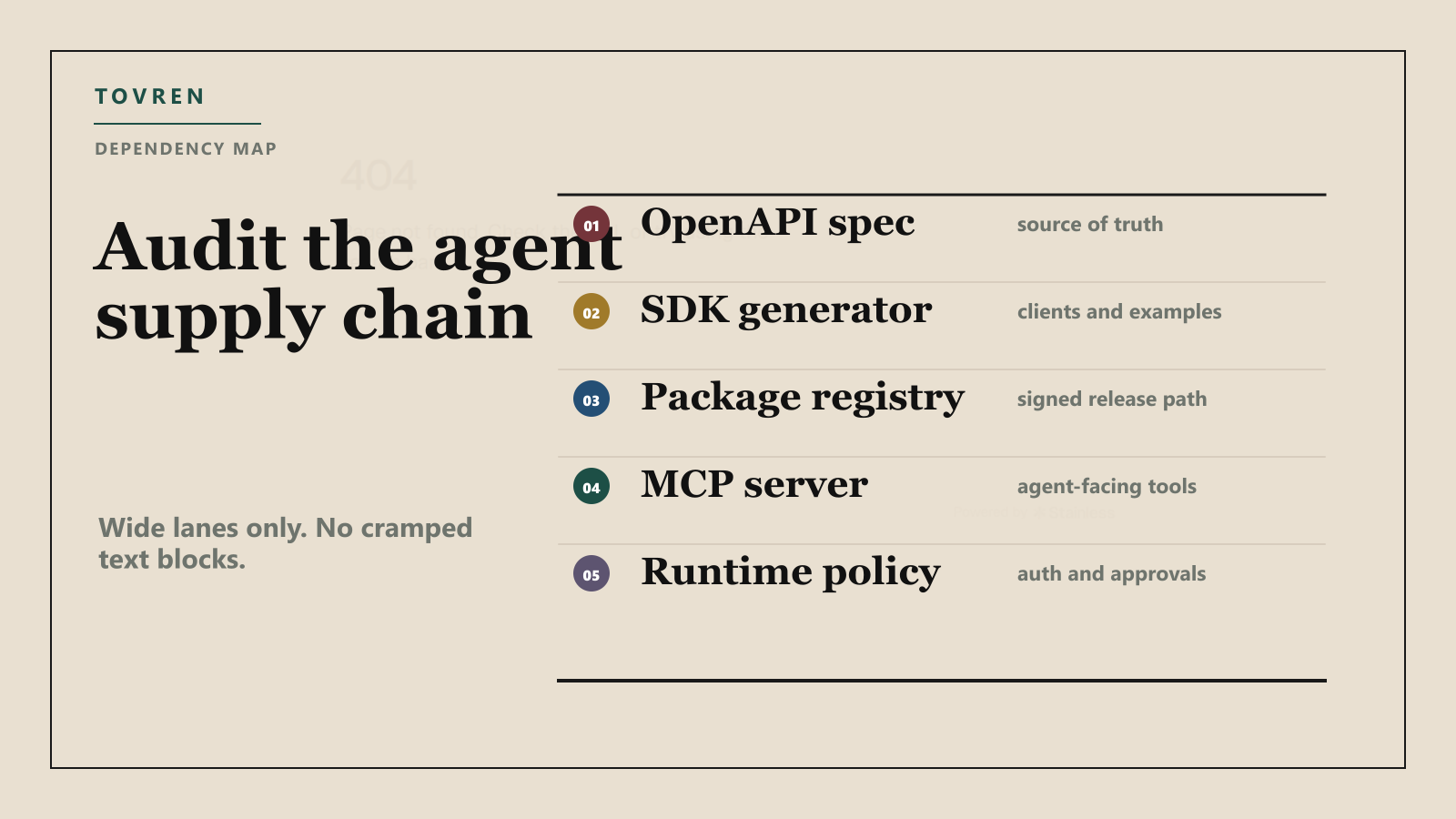
The Real Risk Is SDK Drift Not The Acquisition Headline
The loud headline is ownership. The quiet operational risk is SDK drift. SDK drift happens when the OpenAPI spec, generated client, docs, examples, MCP server, auth scopes, error handling, and live API behavior stop matching each other. Humans can often work around drift by reading an issue thread or testing in a console. Agents are much less forgiving. They may call a deprecated method, miss a required parameter, paginate incorrectly, over-fetch private data, or retry an unsafe write operation because the generated interface told them the wrong thing.
For startups building agents, this should change the audit priority. Do not begin by asking whether the acquisition is good or bad. Ask: can we prove that our agent-facing interfaces match production today? If the answer is no, your risk is already present regardless of who owns the generator.
| Drift point | How it breaks agents | Audit evidence to collect |
|---|---|---|
| OpenAPI spec vs live API | The agent generates syntactically valid calls that fail in production. | Spec contract tests against staging and production-like fixtures. |
| SDK version vs MCP server version | The MCP server exposes behavior from an older or newer SDK than the agent expects. | Version pinning, release notes, package provenance, and rollback path. |
| Docs search vs current auth model | The agent finds examples that use stale scopes or unsafe admin credentials. | Docs build timestamp, scope map, and example tests for least privilege. |
| Generated examples vs real data boundaries | The agent writes code that over-fetches records or returns sensitive raw payloads. | Redaction tests, data minimization checks, and approval gates. |
| Error handling vs retry policy | The agent retries writes or payment-like actions when the correct response is stop-and-escalate. | Idempotency rules, unsafe-action labels, and retry allowlists. |
What Teams Should Audit This Week
Use this week’s audit to build a dependency map, not a panic memo. The goal is to know which parts of your agent stack are generated, which are hand-maintained, which vendors can change them, and which credentials an agent can reach. This is especially important for teams adopting the Claude Agent SDK, because Anthropic’s plan-change page says Agent SDK usage, claude -p, GitHub Actions integration, and third-party apps built on the Agent SDK are covered by new plan-specific credits for eligible subscription users starting June 15, 2026.
That may accelerate experimentation, but it should not blur the line between a developer’s personal automation and production automation owned by the company. If your team is already using Claude Code or browser-based agents, pair this audit with prompt and permission hygiene. Tovren’s AI browser agent prompt pack is useful for defining what an agent should ask before it acts. If you are evaluating the plan-credit impact, read our Claude Agent SDK credits guide alongside your finance and platform owners.
| Audit item | Question to answer | Owner | Good result |
|---|---|---|---|
| SDK generator | Who generates each official SDK, and can we rebuild it from source? | Platform engineering | Documented generator, reproducible build, pinned template version. |
| MCP server inventory | Which MCP servers can agents install or call? | Security and DevOps | Registry with owner, version, transport, auth method, and data scope. |
| Package publishing | Who controls npm, Docker, GitHub release, and signing credentials? | Release engineering | 2FA enforced, separate bot credentials, signed artifacts, emergency revoke process. |
| Docs search endpoint | Is agent-readable documentation public, current, and safe? | Developer experience | No secrets in examples, timestamped docs build, tested against latest spec. |
| Agent cost path | Are experiments billed through user credits while production uses API keys? | Finance and platform | Separate budgets, alerts, and approval for production workloads. |
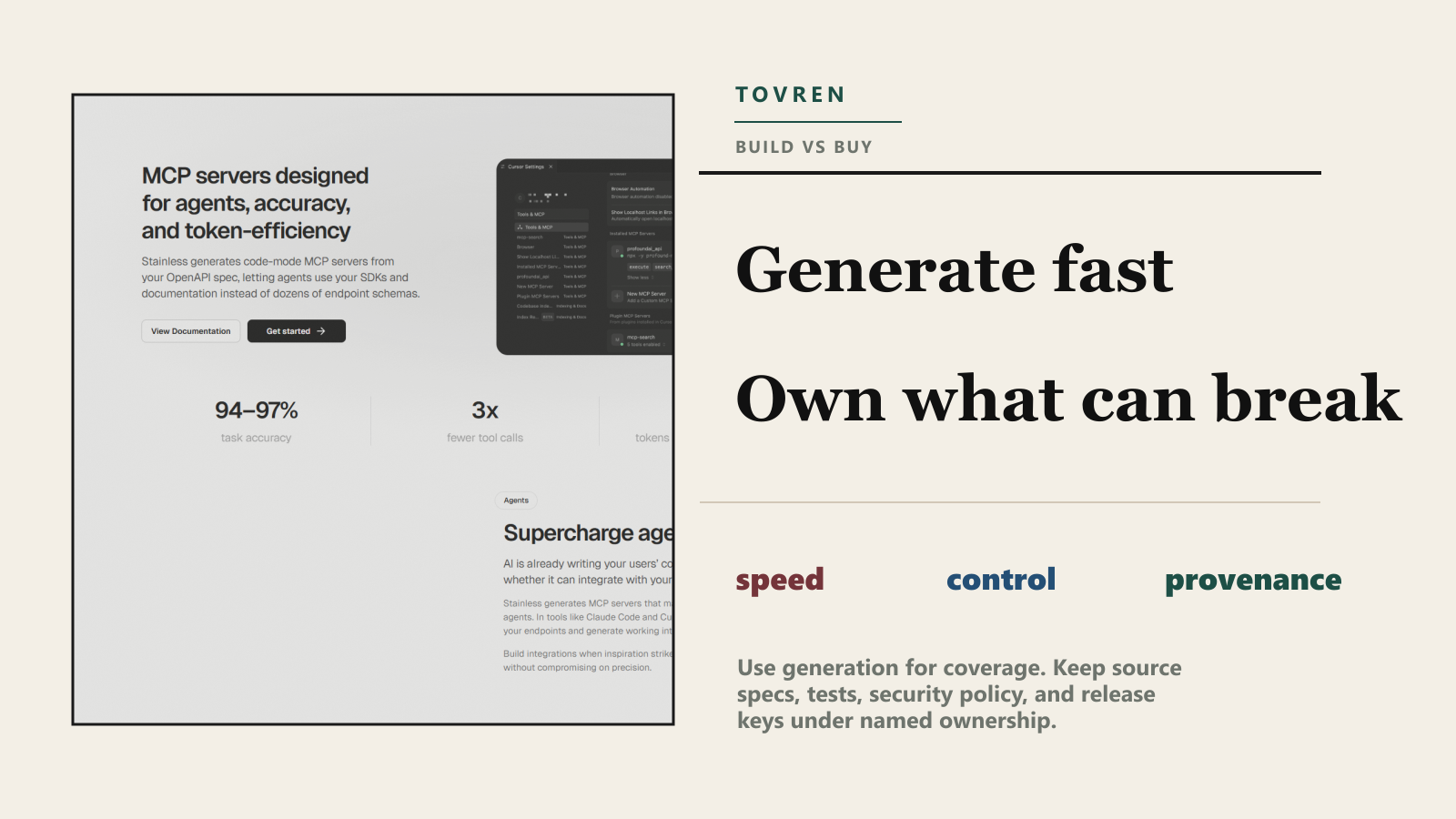
Build Versus Buy Decision Table
Most startups should not build a full SDK and MCP generator on day one. They should buy or generate when speed, language coverage, and docs consistency matter more than deep customization. But teams handling regulated workflows, high-risk writes, or strategic developer platforms should avoid a single-path dependency. A hybrid model is often best: use generation for consistency, but keep the source spec, tests, security policy, and artifact publishing under your control.
| Situation | Buy or generate | Build or self-host | Recommended move |
|---|---|---|---|
| You need TypeScript and Python SDKs this month | Strong fit | Usually too slow | Use a generator, but require reproducible builds and version locks. |
| Your API changes weekly | Strong fit if the OpenAPI spec is disciplined | Risky unless you have a dedicated DX team | Automate contract tests before every SDK and MCP release. |
| Your agent can perform destructive actions | Only with strict policy controls | Often justified | Self-host or wrap the generated server with approval and audit layers. |
| You sell to enterprises | Useful for language coverage | Necessary for governance differentiation | Document provenance, scopes, logs, and support SLAs. |
| Your product moat is developer experience | Good starting point | Worth investing in over time | Begin generated; gradually own templates, examples, and evals. |
MCP Security Checks Before Shipping
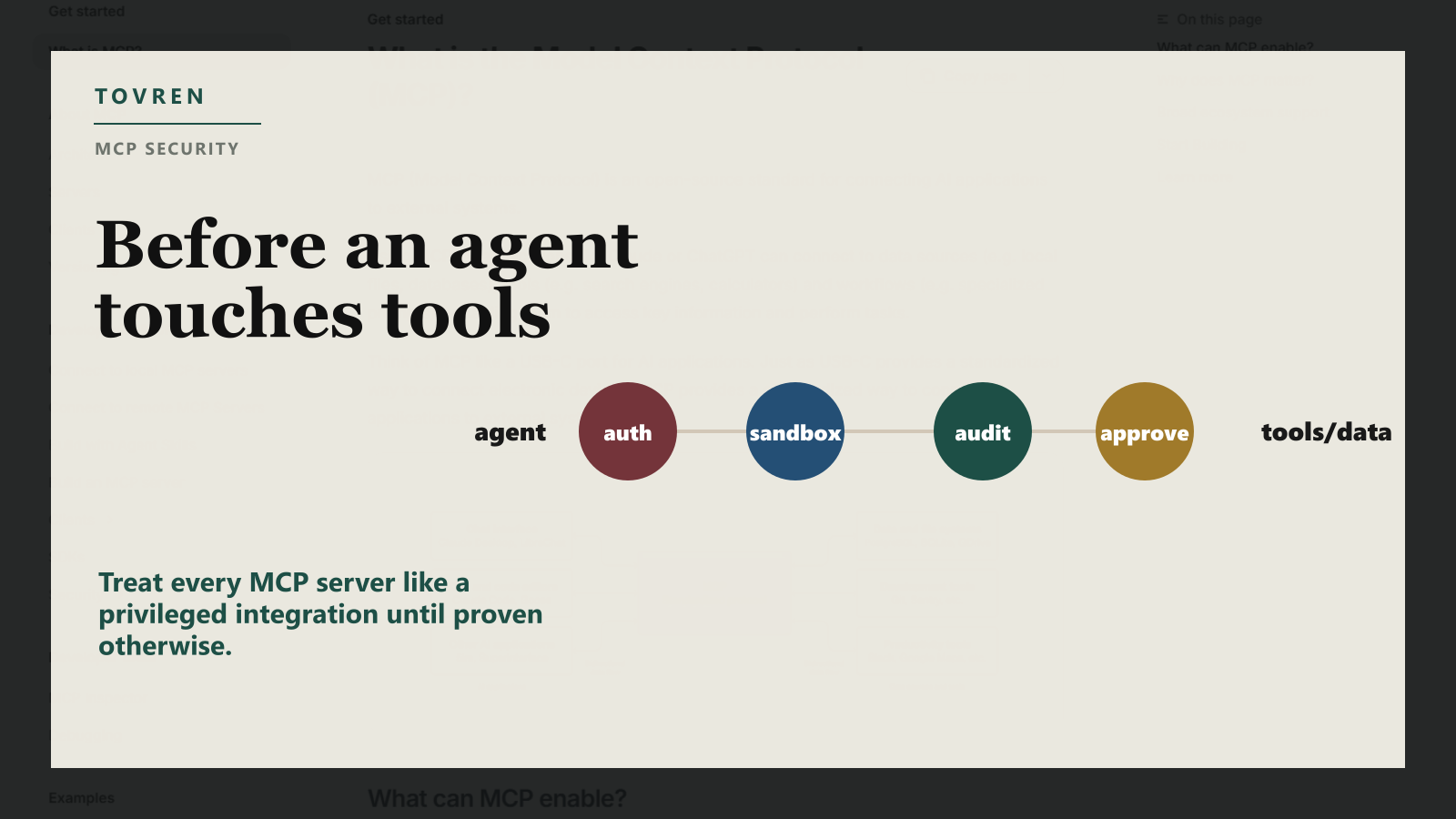
MCP servers turn an agent from a chat interface into software that can touch systems. That deserves the same seriousness as any API gateway. The MCP documentation emphasizes connections to external data, tools, and workflows. For a startup, the safe default is to assume every MCP server is a privileged integration until proven otherwise.
| Security check | Why it matters | Ship only when you can prove |
|---|---|---|
| Least-privilege auth | Agents should not inherit admin credentials for ordinary tasks. | Scopes map to user roles, and sensitive actions require separate approval. |
| Per-user accountability | You need to know who caused a read, write, export, or deletion. | Logs link action, user, tool, request ID, and downstream API call. |
| Package and version pinning | npx @latest style installs are convenient but risky for production. |
Production uses pinned versions, signed artifacts, and rollback tests. |
| Sandbox boundaries | Code-mode agents can be powerful, but execution needs containment. | The runtime cannot access unrelated secrets, filesystem paths, or network targets. |
| Data minimization | Agents often need answers, not entire raw objects. | Tools return filtered fields, redact secrets, and cap result sizes. |
| Human approval for high-risk writes | Deletes, payments, permission changes, and outbound messages need friction. | High-risk actions require explicit confirmation and idempotency protection. |
How To Act Now
The right response to Anthropic buying Stainless is neither dismissal nor conspiracy. The responsible response is to treat SDK generation, docs search, MCP packaging, auth, and billing as one operational surface. Your agent is only as reliable as the generated interfaces it trusts.
For early-stage teams, start with three decisions. First, name one source of truth for your API surface and test it against production behavior. Second, decide which generated artifacts you can reproduce without a vendor dashboard. Third, decide which MCP servers are allowed in developer experiments, internal workflows, and customer-facing production. Those should be three different permission tiers.
For content and developer-growth teams, the lesson is similar. AI search and agent traffic reward pages that answer operational questions, not vague commentary. If your docs or blog explain tool setup, pricing, limits, and failure modes clearly, agents and humans can use them. That is also the broader editorial lesson behind Tovren’s Google May 2026 core update recovery guide for AI blogs: practical pages that solve real tasks have a better chance than abstract trend posts.
Anthropic’s Stainless acquisition is a signal about where the agent stack is going. Models still matter. But the teams that win with agents will also own their SDK quality, MCP security, docs freshness, and release provenance. Audit those now, before an agent learns the wrong interface and starts acting on it.
FAQ
Why does Stainless matter to developers?
Stainless is relevant because SDK generation and API ergonomics can reduce integration friction for agent and tool developers.
What should developers watch after the acquisition?
Watch for better SDKs, cleaner API contracts, stronger MCP support, and easier tool integration patterns.
Does this change production decisions immediately?
Not by itself. Developers should wait for shipped tooling changes and test them in real integrations.