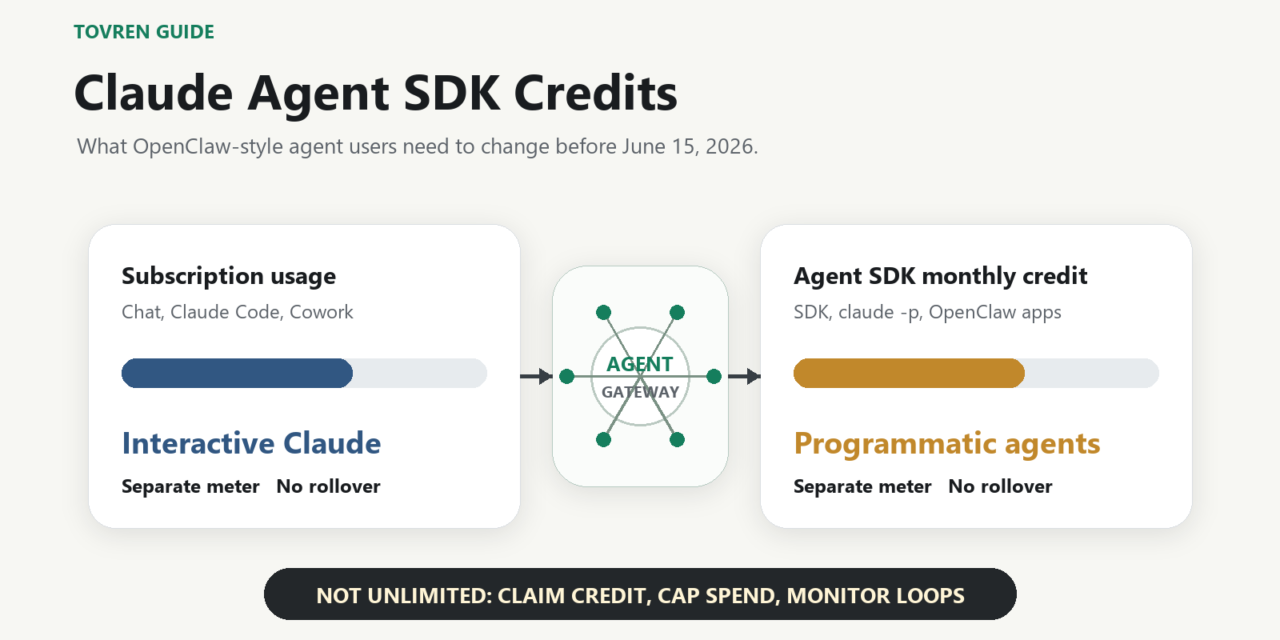
Bottom line: Claude’s $20 Pro plan is not an unlimited agent loophole. Anthropic has reopened a path for Claude Agent SDK and OpenClaw-style third-party agent use on Claude subscriptions, but that path now runs through a separate monthly credit meter, not the normal subscription usage pool.
Starting June 15, 2026, Claude Agent SDK usage and claude -p non-interactive usage no longer count toward a Claude plan’s regular usage limits. Instead, eligible Pro, Max, Team, and Enterprise users can claim a separate monthly Agent SDK credit. Anthropic says regular subscription limits remain reserved for interactive Claude Code, Claude Cowork, and Claude conversations.
The change in one sentence
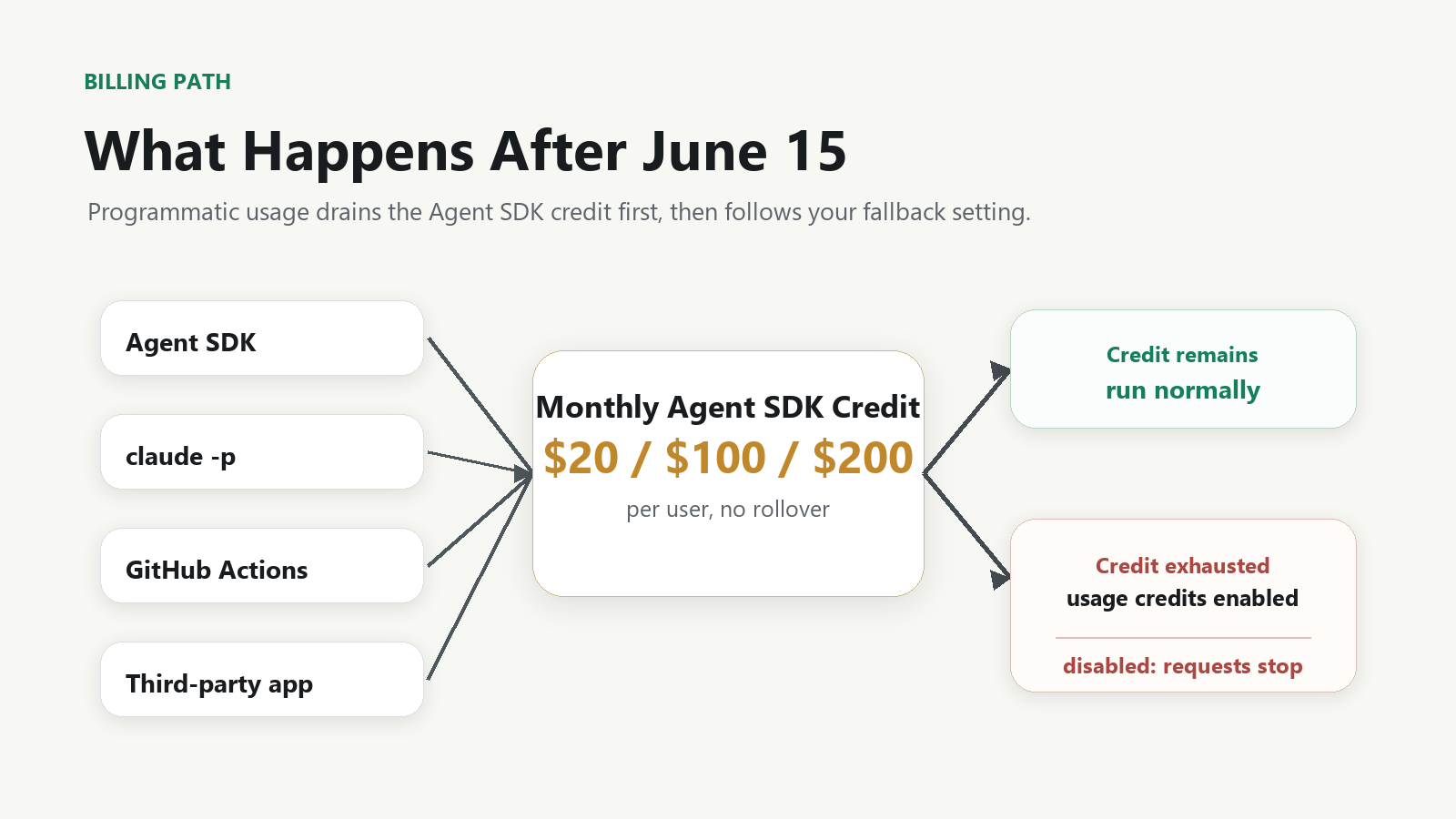
Anthropic is not putting OpenClaw-style agent use back into the “all you can eat” subscription bucket. It is giving subscribers a fixed monthly Agent SDK credit, after which usage either stops or moves to usage credits at standard API rates if the user has enabled them.
What changes on June 15, 2026
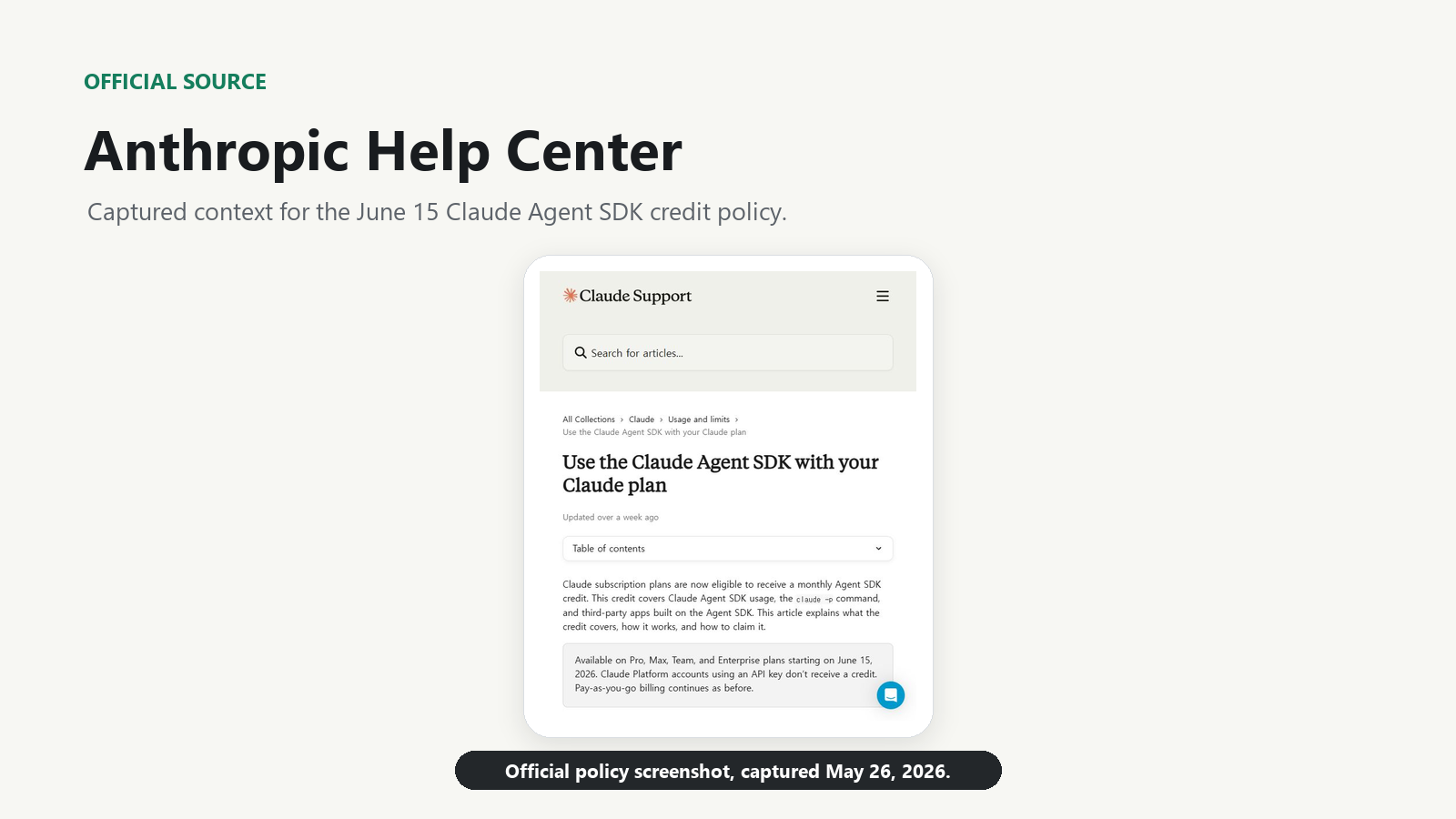
Confirmed: from June 15, Claude Agent SDK and claude -p usage on subscription plans draw from a new Agent SDK monthly credit that is separate from interactive plan limits. The eligible plans are Pro, Max, Team, and Enterprise. Claude Platform accounts using an API key do not receive this credit; API key billing continues as pay-as-you-go.
The credit applies to four categories: Claude Agent SDK usage in your own Python or TypeScript projects, the claude -p command in non-interactive mode, Claude Code GitHub Actions, and third-party apps that authenticate with a Claude subscription through the Agent SDK. It does not apply to interactive Claude Code in the terminal or IDE, Claude web/desktop/mobile chats, Claude Cowork, other usage-credit-backed features, or Claude Platform API-key usage.
The important billing mechanics are simple but easy to miss: credits are per user, not pooled across a team; they refresh monthly; unused credits do not roll over; users claim once and then the credit refreshes automatically; Agent SDK usage drains the monthly credit first; and after the credit runs out, usage moves to usage credits at standard API rates only if usage credits are enabled. If usage credits are not enabled, Agent SDK requests stop until the next refresh.
Cost decision table: use the monthly credit or API billing?
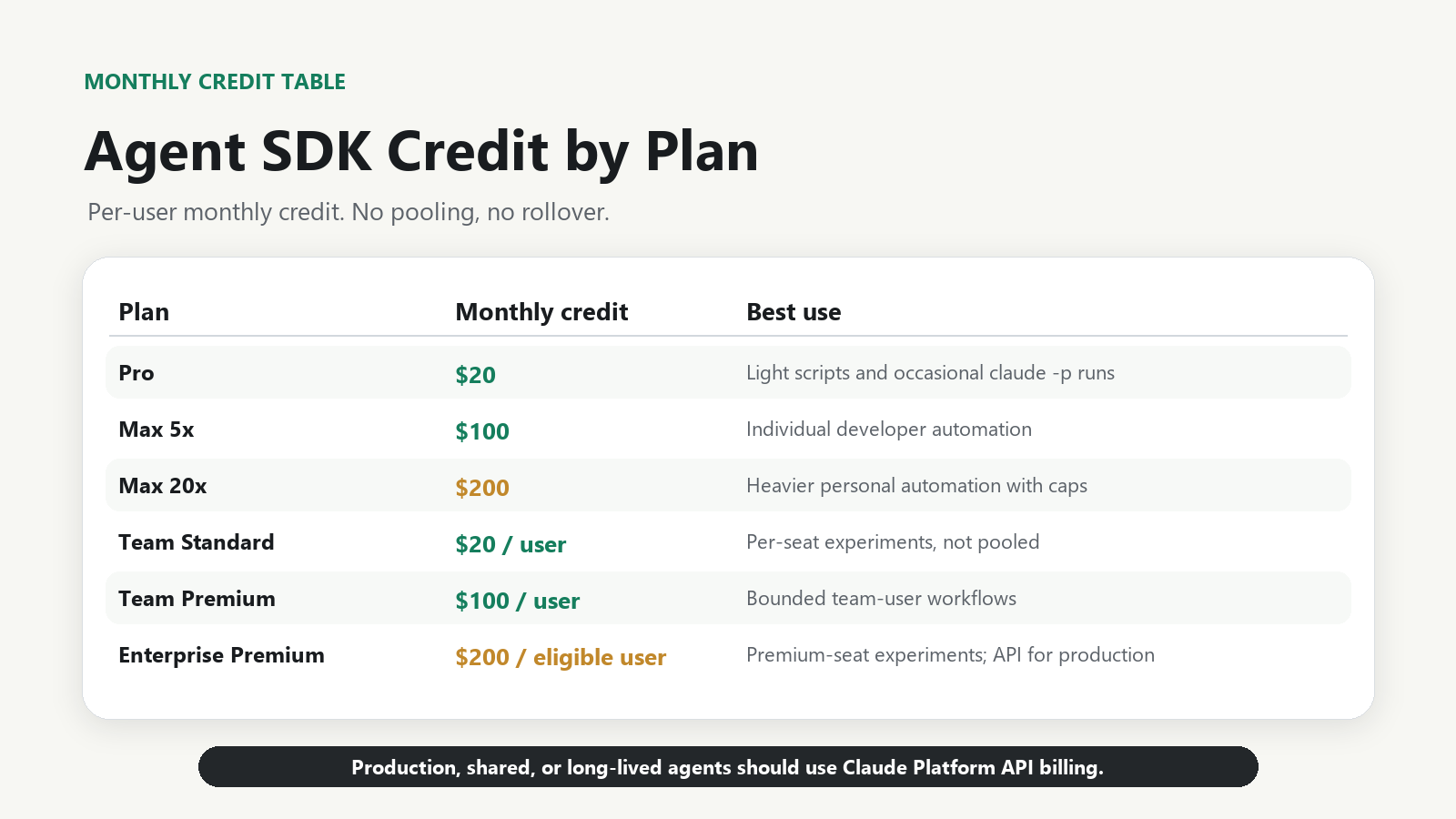
Use this table as the practical decision rule. The dollar amounts below are Anthropic’s stated monthly Agent SDK credit amounts by plan.
| Plan or workload | Monthly Agent SDK credit | Good fit for the credit | Use API billing instead when… |
|---|---|---|---|
| Claude Pro | $20 per user | Light personal scripts, occasional claude -p runs, small Agent SDK experiments. |
You expect an OpenClaw-style assistant to run daily, monitor channels, browse, code, or stay alive for hours. |
| Claude Max 5x | $100 per user | Individual developer automation, small GitHub Actions use, bounded coding or research agents. | Your agent runs continuously, fans out into subagents, or regularly processes large repositories and long contexts. |
| Claude Max 20x | $200 per user | Heavier personal automation with clear monthly caps and monitoring. | You are treating the account as infrastructure for a product, team bot, multi-user gateway, or customer-facing workflow. |
| Team Standard seat | $20 per user | Per-seat experimentation and small personal automations inside a team. | The automation is shared by the team, triggered by many users, or needs central billing and admin controls. |
| Team Premium seat | $100 per user | Heavier individual team workflows, still owned by one user. | You need pooled spend, predictable production billing, auditability, or a service account pattern. |
| Enterprise usage-based | $20 per eligible user | Small per-user Agent SDK experiments alongside enterprise usage billing. | The workload is already an organization-scale automation; treat it as API consumption from the start. |
| Enterprise seat-based Premium | $200 per eligible user | Premium-seat experiments and bounded personal automations. | The workload is a shared production agent, persistent gateway, or business process automation. |
For builders, the clean rule is this: use the Agent SDK monthly credit for individual experimentation; use API billing for production, shared, long-lived, or customer-facing agents. Anthropic says the monthly Agent SDK credit is sized for individual experimentation and automation, while teams running shared production automation should use Claude Platform with an API key for predictable pay-as-you-go billing.
Where OpenClaw fits
VentureBeat reported that Anthropic “reinstates OpenClaw and third-party agent usage on Claude subscriptions — with a catch”: programmatic usage is no longer subsidized by the general subscription pool, but restricted to a fixed monthly credit that does not roll over and is billed at API rates once extra usage is needed.
Axios framed the earlier April shift as the closure of the “AI agent buffet,” arguing that autonomous agents can run continuously and burn far more compute than ordinary chatbot use. Axios also reported that Anthropic pushed third-party agent users toward API billing or extra usage rather than flat-rate subscription limits.
OpenClaw’s own docs now describe two Anthropic routes: direct API-key access with usage-based billing, and Claude CLI reuse on the same host. OpenClaw says Anthropic staff told it OpenClaw-style Claude CLI usage is allowed again, but OpenClaw still recommends API keys as the clearest and most predictable production path for long-lived gateway hosts. Treat that as OpenClaw’s documentation and operational guidance, not as a substitute for Anthropic’s official billing terms.
There is also one important developer-policy wrinkle. Anthropic’s Agent SDK overview says that, unless previously approved, third-party developers should not offer claude.ai login or rate limits for their own products, including agents built on the Agent SDK, and should use API-key authentication methods instead. That means a personal OpenClaw-style setup and a commercial third-party product are not the same billing or policy problem.
Who benefits from the new credit?
Light individual users benefit most. If you run a few claude -p commands, use the Agent SDK for personal scripts, test a small OpenClaw-style assistant, or trigger occasional Claude Code GitHub Actions, the credit gives you a defined monthly allowance without consuming your interactive Claude chat and Claude Code limits.
Developers who want separation benefit too. Interactive Claude Code and chat usage remain in the normal subscription bucket, while programmatic usage gets its own meter. That makes it easier to tell whether your agent experiments are what burned the budget. Anthropic’s usage-credit docs say users can track included usage separately from usage-credit consumption, and the Agent SDK docs provide per-step and per-model usage data, although SDK cost fields are client-side estimates rather than authoritative billing records.
Small teams get a safer experimentation lane. A Team Standard or Premium user can claim a per-user credit for their own bounded automations. But because credits are not pooled, this is not a shared team automation budget. If one person owns a bot used by ten people, the economics should be treated as infrastructure, not as a personal subscription perk.
Who should use API billing instead?
Use Claude Platform API billing instead of the monthly Agent SDK credit if the agent is long-lived, shared, customer-facing, budget-sensitive, or important enough to need clear observability. That includes always-on OpenClaw gateways, background assistants connected to messaging apps, agents that monitor repositories or inboxes, multi-agent coding loops, CI systems that run on many pull requests, and internal automations used by multiple employees.
API billing is also the better default when you need service accounts, central spend controls, predictable rate-limit behavior, prompt caching strategy, logs, or formal cost ownership. Anthropic’s API pricing page lists current model rates, including Opus 4.7 at $5 per million input tokens and $25 per million output tokens, Sonnet 4.6 at $3 per million input tokens and $15 per million output tokens, and Haiku 4.5 at $1 per million input tokens and $5 per million output tokens.
The uncomfortable part is that API billing may feel more expensive than a subscription. That is the point of the change. Agent loops can read files, run commands, search, call tools, and keep context alive, which is a very different cost profile from a human typing into a chat box. Anthropic’s Agent SDK docs describe the SDK as a way to build agents that autonomously read files, run commands, search the web, edit code, and use the same agent loop and context management that power Claude Code.
Practical setup checklist before running long-lived agents
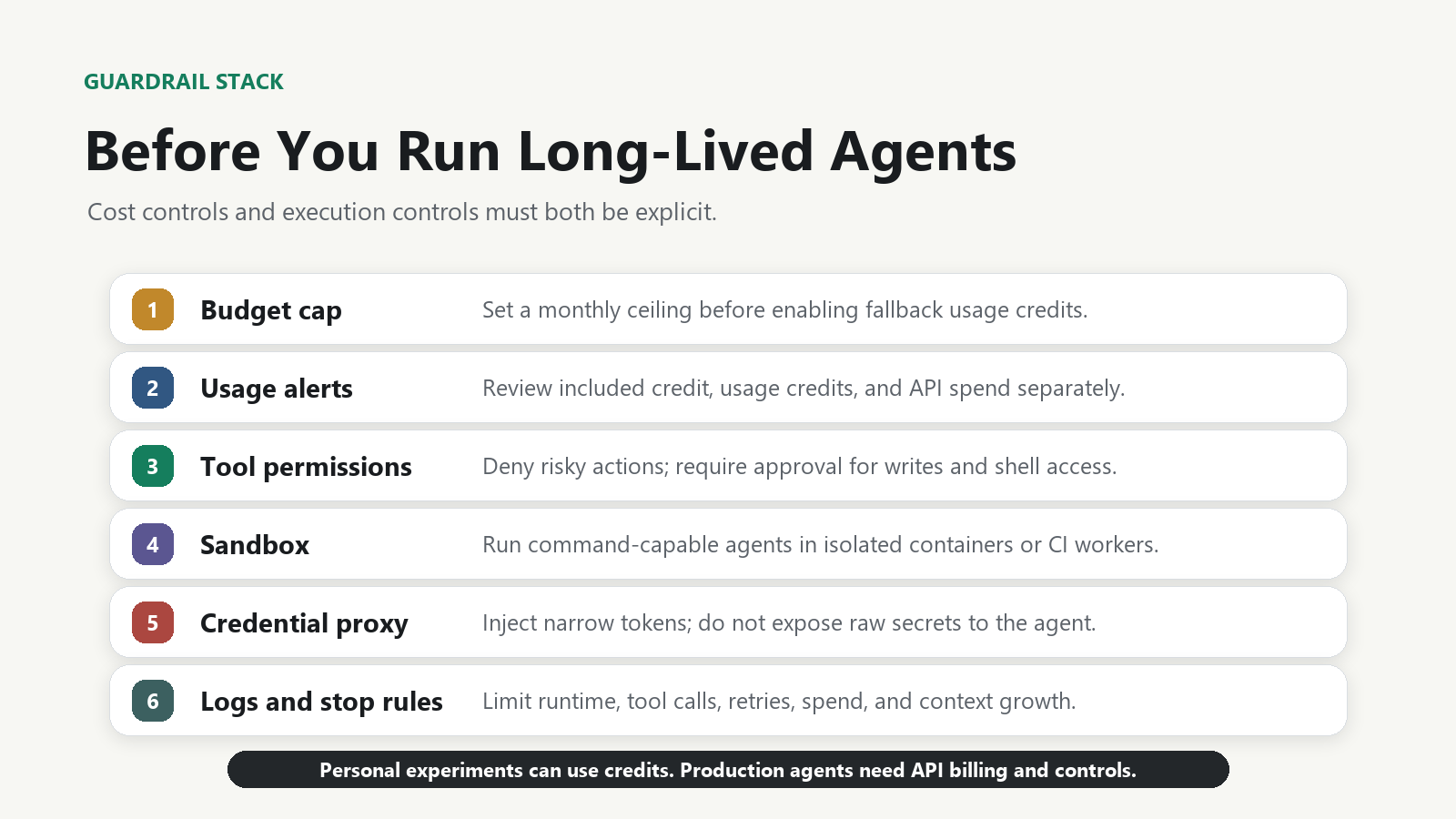
- Pick the billing path first. Use the monthly Agent SDK credit only for personal, bounded usage. Use an Anthropic API key for production, shared, customer-facing, or long-lived OpenClaw-style gateways.
- Claim the Agent SDK credit once when eligible. After that, Anthropic says it refreshes automatically each billing cycle. Do not build around rollover, pooling, or cash value; the credit is per user and unused credit expires monthly.
- Decide whether usage credits should be enabled. If disabled, Agent SDK requests stop when the monthly credit runs out. If enabled, usage continues at standard API rates. Set a conservative monthly cap before enabling. Anthropic’s usage-credit docs support monthly spending caps, auto-reload settings, and usage alerts.
- For OpenClaw gateways, prefer API keys for persistent hosts. OpenClaw’s docs call Anthropic API keys the clearest and most predictable production path for long-lived gateway hosts.
- Limit tools before the first run. Start with read-only tools where possible. Add edit, shell, browser, or external-service tools only when the workflow needs them.
- Use permission rules, deny rules, and approvals. Anthropic’s Agent SDK permissions system evaluates hooks, deny rules, permission mode, allow rules, and then a
canUseToolcallback where needed. Deny rules still matter even when broader permission modes are used. - Sandbox anything that can run commands. Anthropic’s hosting docs say the SDK should run inside a sandboxed container environment for process isolation, resource limits, network control, and ephemeral filesystems.
- Keep secrets outside the agent boundary. Anthropic’s secure deployment guide recommends isolation, least privilege, defense in depth, read-only mounts where possible, and proxy-based credential injection so the agent never sees raw credentials.
- Track real billing, not just local estimates. The Agent SDK exposes cost fields, but Anthropic says they are client-side estimates and should not be used for billing end users or triggering financial decisions. Use the Claude Console or Usage and Cost API for authoritative billing.
- Put hard stop conditions on every loop. Define max runtime, max tool calls, max retry count, max spend, and a success condition before launching an autonomous or recurring agent.
Failure modes and guardrails
| Failure mode | Why it happens | Guardrail |
|---|---|---|
| The monthly credit disappears faster than expected. | Agent loops use long context, repeated tool calls, large files, web fetches, and output-heavy reasoning. | Set per-run step limits, use cheaper models where acceptable, reduce context, cache stable prompts, and review usage after each test run. |
| The agent stops mid-workflow. | Monthly Agent SDK credit runs out and usage credits are not enabled. | Choose intentionally: hard stop for experiments, or usage credits with a low monthly cap for important workflows. |
| Unexpected extra charges appear. | Usage credits or auto-reload are enabled after the Agent SDK credit is exhausted. | Set a monthly cap, disable unlimited reloads, and add usage alerts before running background jobs. |
| A team assumes credits are shared. | Agent SDK monthly credits are per user and not pooled. | Do not run shared bots from a personal credit. Use API billing or enterprise-controlled spend for shared automation. |
| OpenClaw auth breaks or becomes hard to reason about. | CLI reuse, subscription auth, token expiry, and provider policy changes are less predictable than API keys. | Use Anthropic API keys for long-lived gateways; monitor auth status and have a fallback provider plan. |
| The agent executes an unsafe command. | Tool permissions are too broad, or bypassPermissions is used outside a hardened sandbox. |
Use deny rules, allow only required tools, require approvals for risky actions, and reserve bypass modes for isolated CI or locked-down containers. |
| Prompt injection causes data leakage. | The agent processes untrusted files, webpages, issues, emails, or chat messages and has network or credential access. | Use network allowlists, read-only mounts, proxy-based credential injection, and separate sensitive resources from the agent environment. |
| Cost estimates do not match the invoice. | SDK cost fields are local estimates and can drift when prices, models, or billing rules change. | Use SDK costs for debugging only; use the Claude Console or Usage and Cost API for billing decisions. |
Confirmed facts vs community reaction
Confirmed by Anthropic: the Agent SDK monthly credit starts June 15, 2026 for eligible Pro, Max, Team, and Enterprise users; it covers Agent SDK usage, claude -p non-interactive mode, Claude Code GitHub Actions, and third-party apps built on the Agent SDK; it is per-user, refreshes monthly, does not roll over, drains first, and falls back to usage credits only if enabled.
Confirmed by Anthropic: normal subscription limits continue to apply to interactive Claude Code, Claude Cowork, and Claude web/desktop/mobile conversations. The Agent SDK credit does not apply to API-key usage on Claude Platform.
Press framing: VentureBeat describes the move as a reinstatement of OpenClaw and third-party agent usage “with a catch,” while Axios framed the earlier April move as the end of the low-cost agent “buffet.” Those are useful summaries, but the operative billing details should come from Anthropic’s own Help Center.
Community sentiment: Reddit threads in Claude, Claude Code, and OpenClaw communities are split. Some users see the change as a fair way to stop round-the-clock programmatic use from consuming flat-rate subscription capacity; others see it as a downgrade for indie developers and power users who built workflows around claude -p, OpenClaw, or Agent SDK harnesses. Treat these posts as sentiment, not policy.
Practical recommendation
If you are a Claude Pro user testing a small personal agent, claim the credit, keep usage credits disabled at first, and see how quickly your workload drains the $20. If it runs out in a few days, that is your signal that the workload belongs on API billing.
If you are on Max, the credit buys more room, but it still does not turn your account into unlimited infrastructure. Put hard limits on long-running loops, especially if you use claude -p, OpenClaw, GitHub Actions, or multi-agent coding flows.
If you are building for a team, a customer, or a business process, skip the loophole mindset entirely. Use an API key, set budgets, log usage, sandbox execution, and make the unit economics visible before the agent becomes important.
The June 15 change is best understood as a compromise: Anthropic is allowing a subscription-linked path for individual Agent SDK and OpenClaw-style use, but it is moving agent economics into a meter. That is better than a hard block for tinkerers, but it is not the return of unlimited subscription-powered agents.
FAQ
Does the $20 Claude Pro plan still cover OpenClaw-style agent use?
Only up to the separate Agent SDK monthly credit. Pro receives a $20 monthly Agent SDK credit. After that, usage stops unless usage credits are enabled, in which case additional usage is billed at standard API rates.
Does claude -p count toward the new credit?
Yes, Anthropic’s Help Center lists the claude -p command in Claude Code non-interactive mode as covered by the Agent SDK monthly credit. Some community comments misread this point, so use the official Help Center as the source of truth.
Are Agent SDK credits pooled across a Team plan?
No. Anthropic says credits are per user and cannot be pooled, transferred, or shared across the organization.
Should OpenClaw production gateways use Claude subscription auth or API keys?
Use API keys for production. OpenClaw’s own docs say API keys are the clearest and most predictable production path for long-lived gateway hosts, and Anthropic’s docs point production automation at Claude Platform API billing.
Further reading on Tovren
- Claude Code Opus 4.7, xhigh, 1M context, and Auto mode
- Claude Code pricing and setup guide
- Best AI coding agent in 2026: Codex, Claude Code, Cursor, Gemini
- Microsoft WinUI Agent Plugin and the desktop-agent shift