Short answer: GH-600 is worth your time if you already build, supervise, or govern coding agents inside GitHub. It is not worth it if you only want a generic AI badge for your LinkedIn profile.
GitHub and Microsoft have quietly made the job title official: agentic AI developer. The new GitHub Certified: Agentic AI Developer beta certification is not about writing better prompts in a chatbot. It is about operating AI agents inside the software development lifecycle with GitHub as the control plane.
That matters because the coding-agent market has moved from autocomplete to production workflow. GitHub’s May 14, 2026 Copilot app technical preview describes a GitHub-native desktop experience where work starts from issues, pull requests, prompts, or prior sessions, then moves through isolated sessions, review, validation, and pull request flow. That is exactly the kind of world GH-600 is trying to certify.
This guide gives you the practical answer: who should take GH-600, what the exam is really testing, what to study first, and how to turn the study plan into a useful internal agent-governance playbook.
What GH-600 is actually testing
The official certification page says candidates should be able to operate, integrate, supervise, and govern AI agents inside production-grade SDLC workflows. The tested work includes agent workflows, GitHub controls, scans and artifacts, custom agents, and safe multi-agent execution.
| Official exam domain | Weight | Plain-English meaning | What to practice |
|---|---|---|---|
| Prepare agent architecture and SDLC processes | 15-20% | Design where agents fit in a real repo workflow | Issues, branches, PRs, checks, review gates, ownership |
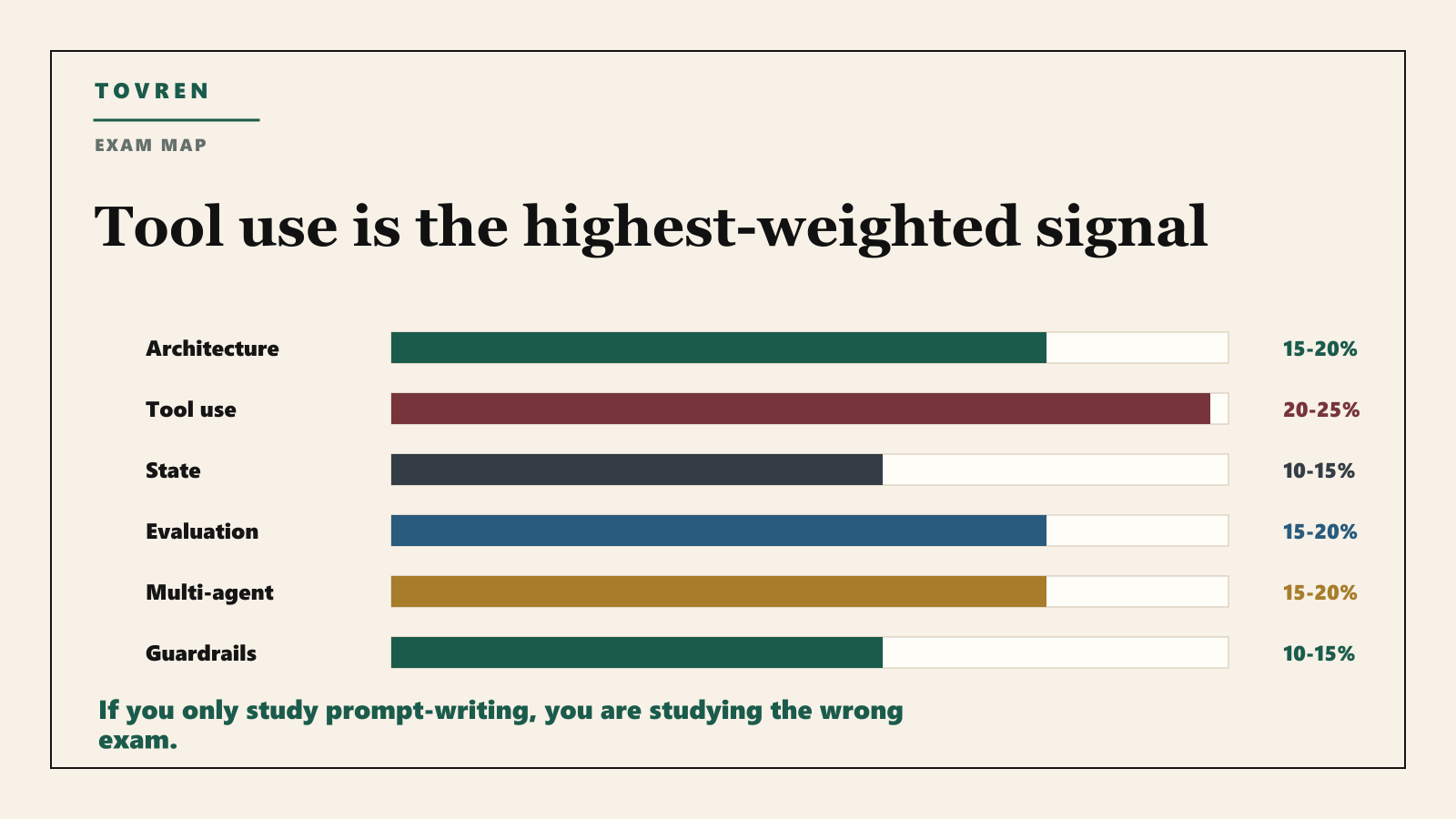
| Implement Tool Use and Environment Interaction | 20-25% | Give agents tools without giving them unlimited access | MCP, tool scopes, GitHub Actions, file access, command execution |
| Manage Memory, State, and Execution | 10-15% | Keep sessions resumable and controlled | Session state, artifacts, logs, context boundaries |
| Perform Evaluation, Error Analysis, and Tuning | 15-20% | Prove the agent output is good enough | Scans, test evidence, failed run analysis, review comments |
| Orchestrate Multi-Agent Coordination | 15-20% | Run more than one agent without chaos | Reviewer, auditor, fixer, consolidator, dependency patterns |
| Implement Guardrails and Accountability | 10-15% | Make agents auditable and safe | Permissions, approvals, logs, artifacts, policy, rollback |
The important signal is the second domain. Tool use and environment interaction has the highest official weighting at 20-25%. That tells you what GitHub thinks the market needs: developers who can connect agents to real systems without creating a security and review mess.
Who should take it
| Person | Recommendation | Reason |
|---|---|---|
| Platform engineer | Take it | You will likely be responsible for agent policy, GitHub controls, and workflow integration. |
| DevOps engineer | Take it | The exam maps directly to Actions, checks, logs, artifacts, and release gates. |
| Security engineer | Take it or at least study the outline | The guardrail and tool-access sections are a useful checklist for agent risk reviews. |
| Senior developer using Copilot daily | Probably take it | It helps turn personal agent use into repeatable team workflow. |
| Junior developer learning AI basics | Wait | The exam assumes SDLC, GitHub, review, and workflow experience. |
| Nontechnical AI enthusiast | Skip it | This is not a broad AI fundamentals exam. |
The beta details that matter
From the official Microsoft Learn page, GH-600 is currently a beta exam. You get 120 minutes. The exam is proctored. Results are not immediate; Microsoft says scores are released approximately eight weeks after the beta period concludes. It is offered in English. The certification is provided through Microsoft, while the exam and credential are maintained by GitHub.
That means you should not take the beta if you need a score tomorrow for a job application. You should take it if you want early signal, lower competition for current prep material, and a reason to learn the agentic SDLC stack before it becomes a standard hiring filter.
Why developers are suddenly talking about it
The strongest community posts are not treating GH-600 as another high-level certificate. They are saying the exam feels practical and artifact-heavy. One public Reddit write-up from r/AzureCertification said the exam felt less about broad definitions and more about reading YAML, JSON, CLI logs, session logs, MCP config, GitHub Actions snippets, hooks, and artifacts.
That matches the direction of the actual product. The GitHub Copilot app technical preview emphasizes isolated sessions, repository context, issue and PR workflows, validation, terminal and browser checks, pull request creation, and Agent Merge follow-through. If the product is becoming workflow-native, the exam has to test workflow literacy.
Your 10-day GH-600 prep plan
| Day | Focus | Concrete output |
|---|---|---|
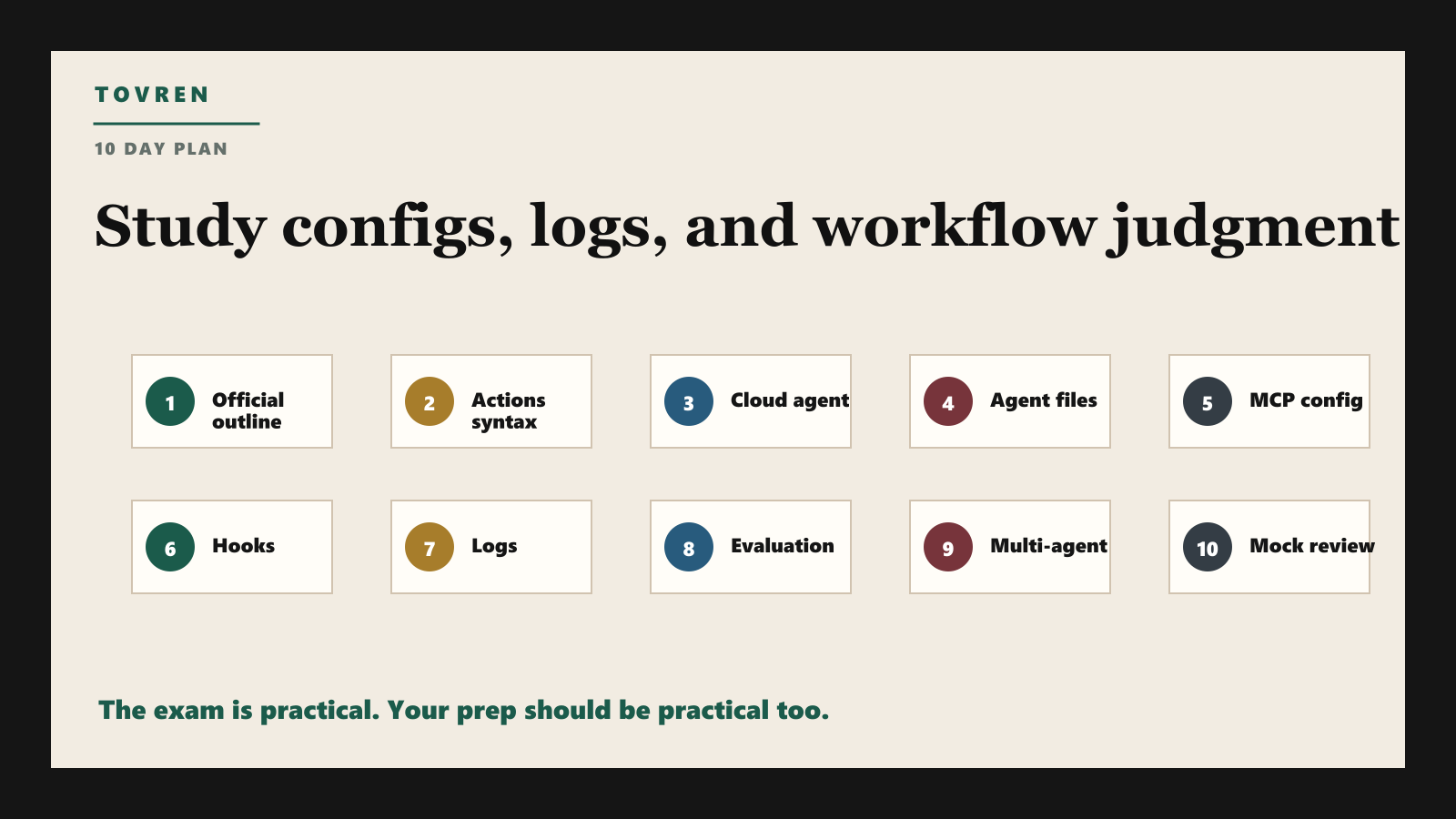
| 1 | Read the official certification page and study guide | One-page map of the six exam domains |
| 2 | Review GitHub Actions syntax | Cheat sheet for jobs, permissions, artifacts, outputs, needs, matrix, concurrency |
| 3 | Study Copilot cloud-agent lifecycle | Diagram from issue assignment to PR review and merge |
| 4 | Study custom agent files | Example .github/agents/*.agent.md structure with tools and target |
| 5 | Study MCP configuration | Examples of local stdio transport, remote HTTP/SSE transport, and tool allowlists |
| 6 | Study hooks and guardrails | Pre-tool, post-tool, approval, and audit checkpoints |
| 7 | Practice logs and artifacts | Explain three workflow logs and one artifact chain |
| 8 | Practice evaluation and error analysis | Classify failed agent output into test, spec, context, permission, or review failure |
| 9 | Practice multi-agent orchestration | Design reviewer, fixer, auditor, and consolidator flow for one PR |
| 10 | Mock review | Read five snippets and explain the safest next action |
What to memorize versus what to understand
Do not spend most of your time memorizing marketing terms. Spend it on configuration and workflow judgment.
| Memorize | Understand deeply |
|---|---|
| The six official exam domains and weight ranges | Why tool access is more dangerous than chat output |
| Common GitHub Actions fields | How needs, outputs, artifacts, permissions, and concurrency shape agent workflows |
| Where custom agent files live | How instructions, tools, prompts, skills, hooks, and MCP servers change behavior |
| MCP transport terms | The security difference between local process, private gateway, remote server, and broad tool allowlist |
| Audit log and artifact vocabulary | How to prove what an agent did and who approved it |
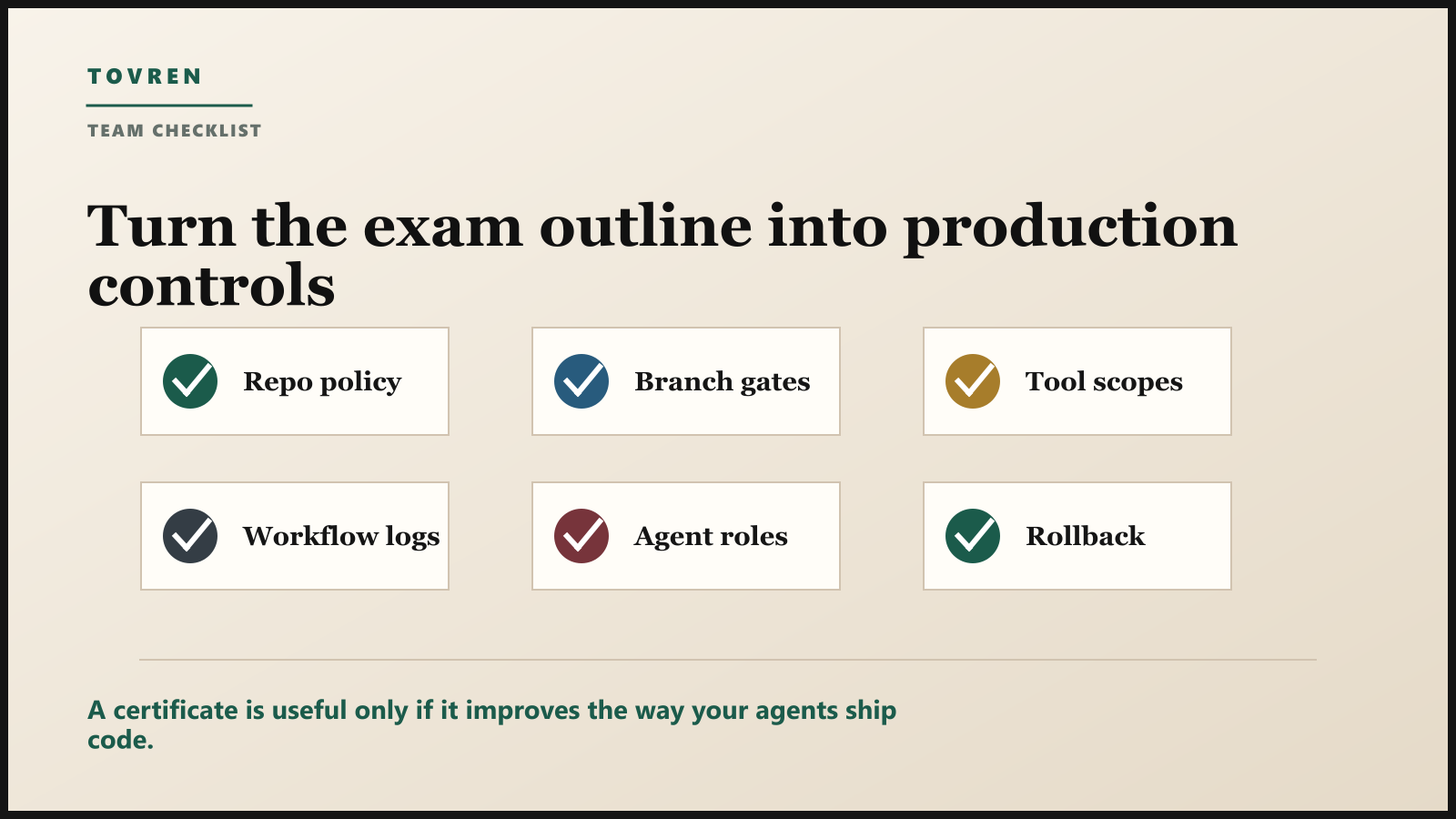
Use GH-600 as an internal team checklist
The best use of GH-600 may not be the badge. It may be the outline. If your company is adding coding agents, use the exam domains as a readiness checklist.
- Do we know which repositories can use coding agents?
- Do we require branch protection and review for agent-generated PRs?
- Do agents have limited permissions in GitHub Actions?
- Can an agent modify workflow files without a special approval gate?
- Do we log session IDs, workflow runs, artifacts, and final PR state?
- Do we separate agent roles such as implementer, reviewer, auditor, and release helper?
- Do we know how to revoke or pause stuck agent sessions?
- Do we track pass/fail rates for AI-generated changes?
The part most people will underestimate
Multi-agent coordination sounds futuristic, but in practice it is mostly operations discipline. One agent writes code. Another reviews it. A workflow runs tests. A human approves high-risk changes. A release gate blocks deployment until required checks pass.
If you cannot explain who owns the branch, who owns the artifact, who owns the final decision, and which system records the audit trail, you are not ready for production agentic development. That is the real point of the certification.
Should you take GH-600 now?
Take it now if you work with GitHub Copilot Business or Enterprise, GitHub Actions, internal developer platforms, agent governance, MCP, or platform-security reviews. Even if you fail the beta, the study process will expose gaps your team probably needs to fix anyway.
Wait if you have not used GitHub Actions, pull request workflows, Copilot agent features, or MCP-style tool integration. You will get more value by building one real agent workflow first, then coming back to the certification.
The bottom line
GH-600 is a sign that “AI developer” is splitting into two jobs. One job is writing code with AI. The harder job is making AI agents reliable, reviewable, auditable, and safe inside real software teams.
If you want the first job, use Copilot, Claude Code, Cursor, Codex, or Qwen Code and ship more work. If you want the second job, study GH-600. That is where the market is going.
Related Tovren reading
- Your AI Agent Should Never Hold the Credential
- MCP Server Sprawl Makes Agents Dangerous
- AI Agent Evaluations Are the New Runtime Governance Layer
- Should Windows Developers Use Copilot, Claude Code, or WinUI Agents?
- Qwen3.7-Max After Launch: Should Developers Use It?
Source log
- Microsoft Learn: GitHub Certified Agentic AI Developer beta – official certification overview, 120-minute exam, beta score delay, role description, and domain weights.
- Microsoft Learn: GH-600 study guide – official study outline and skill areas.
- GitHub Changelog: Copilot app technical preview – context for GitHub-native agentic development sessions.
- Microsoft Tech Community: New GitHub Certified Agentic AI Developer – beta announcement context.
- r/AzureCertification GH-600 beta experience thread – community signal that the exam is practical and artifact-focused.