Short answer: Your website now needs to work for AI agents as well as humans. Product pages, pricing, policies, comparisons, and support content should be structured enough for search agents to understand, cite, and route users toward a clear next action.
Updated: May 28, 2026.
Verdict: if your website sells, explains, documents, supports, or compares anything, you should now treat your important pages as source data for AI agents. That does not mean replacing SEO with buzzwords. It means making your facts clear, current, crawlable, structured, and auditable.
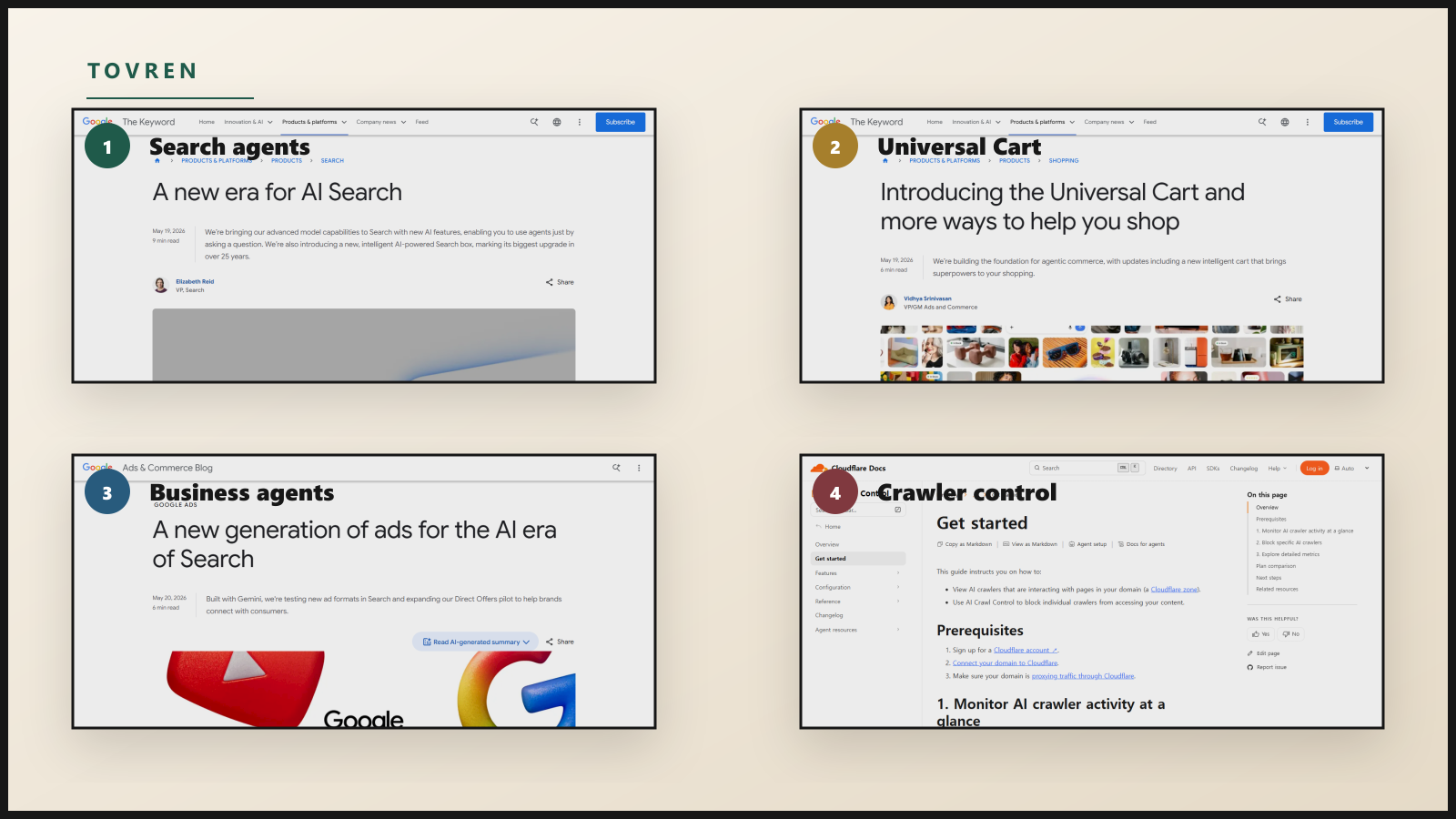
Google’s 2026 announcements make the direction obvious. Search is becoming more conversational, more agentic, and more capable of taking action after the answer. At Google I/O 2026, Google described AI Mode upgrades, an AI-first Search box, information agents that can monitor the web, expanded agentic booking, and shopping agents inside Search. In Shopping, Google introduced Universal Cart, an intelligent cart designed to work across merchants and Google surfaces. In Ads, Google introduced Business Agent for Leads, AI-powered Shopping ads, Conversational Discovery ads, Highlighted Answers, Direct Offers, and native checkout integrations for Universal Commerce Protocol merchants.
The practical implication is simple: your website is no longer only a destination for human visitors. It is also becoming an evidence layer that agents may read, summarize, compare, monitor, and use to send users into carts, lead chats, bookings, or checkout paths.
For related context, read Tovren’s breakdown of Google Search agents, AI Mode, and shopping agents, the AI browser agent prompt pack, and the Google May 2026 core update recovery guide.
What changed after Google I/O 2026
The change is not one feature. It is a stack of interfaces that can interpret your site differently from a classic blue-link search result.
| Google change | What it means | What site owners should do now |
|---|---|---|
| AI Mode and the intelligent Search box | Users can ask longer, more specific, multimodal questions instead of typing short keywords. | Create pages that answer specific buyer, support, comparison, and troubleshooting questions in direct language. |
| Information agents in Search | Google described agents that can monitor information in the background and send synthesized updates. | Make dates, availability, changelogs, feeds, canonical pages, and update history easy to detect. |
| Agentic booking and business calls | Search can help users complete tasks such as local bookings or asking Google to call businesses in selected categories. | Keep local business details, service areas, hours, pricing ranges, cancellation rules, and booking constraints current. |
| Agentic shopping in Search | Google is extending AI capabilities into product discovery, comparison, price monitoring, and shopping decisions. | Audit product pages for exact specs, compatibility, variants, inventory, shipping, warranty, and returns data. |
| Universal Cart | Google says Universal Cart can work across merchants and surfaces such as Search and Gemini, with YouTube and Gmail to follow. | Prepare clean product data, offer data, cart handoff logic, promotion rules, and post-purchase support paths. |
| Business Agent for Leads | Google says advertisers can place a smart brand agent inside an ad, with answers based on the website. | Treat your site as a lead-agent knowledge base. Remove vague claims, stale pricing, buried terms, and unsupported guarantees. |
| Native checkout and Direct Offers | Google says Direct Offers are expanding with promotion bundling and native checkout integration for UCP merchants. | Define merchant-of-record responsibilities, refund paths, customer support ownership, and conversion tracking before scaling. |
The new job of a web page: be useful to humans and extractable by agents
A human can tolerate some ambiguity. An agent often cannot. A person may read three paragraphs and infer that “30-day returns” excludes opened software, final-sale items, or international orders. An agent may extract only the headline and give a wrong answer.
That is the core risk. Agent traffic rewards pages that are not merely persuasive, but unambiguous.
| Old web page habit | Agent-readable replacement |
|---|---|
| Marketing copy says “fast shipping” | State shipping regions, methods, typical delivery windows, cutoff times, free-shipping thresholds, and exclusions. |
| Product page says “works with most tools” | List compatible platforms, versions, integrations, exclusions, and unsupported edge cases. |
| Pricing page says “from $19/month” | Show plan price, billing period, currency, included limits, overage fees, trial terms, renewal terms, and last-updated date. |
| Support page says “contact us for details” | Publish support channels, expected response time, escalation path, refund path, and account cancellation steps. |
| Schema contains facts not visible on the page | Keep structured data aligned with visible page content. Google’s AI Search guidance says structured data should match visible content. |
Do not start with llms.txt as a ranking hack
There is a lot of confusion around llms.txt. Use it carefully.
What it is:
llms.txt is an emerging, draft-style convention for giving AI tools a curated Markdown guide to important site content. The llms.txt reference site describes it as a draft proposal with emerging adoption. X’s developer docs use llms.txt and llms-full.txt to give AI tools structured access to X API documentation.
What it is not: it is not confirmed as a Google ranking factor. It is not a replacement for robots.txt, sitemap.xml, canonical URLs, Search Console, Merchant Center, structured data, or clean page content. Google’s own Search Central guidance for AI features says there are no additional technical requirements to appear in AI Overviews or AI Mode, and that site owners do not need to create new machine-readable files or AI text files for those features.
Practical recommendation: create /llms.txt if you have documentation, product explainers, support policies, API docs, comparison pages, or a small curated set of source-of-truth pages that agents should read first. Do not spend weeks maintaining one for a massive ecommerce catalog unless you can automate accuracy and keep it fresh.
| Use llms.txt when… | Skip or delay it when… |
|---|---|
| You have stable docs, product explainers, pricing pages, API docs, or support policies. | Your only goal is improving Google rankings. |
| Your site has a manageable number of source-of-truth pages. | Your catalog changes hourly and you cannot keep the file accurate. |
| You want agents to find official answers instead of old blog posts or outdated help pages. | Your core pages are already inaccurate, thin, or inconsistent. Fix those first. |
| You can assign ownership for monthly review. | No one owns product, pricing, policy, or docs freshness. |
The AI-readable page implementation checklist
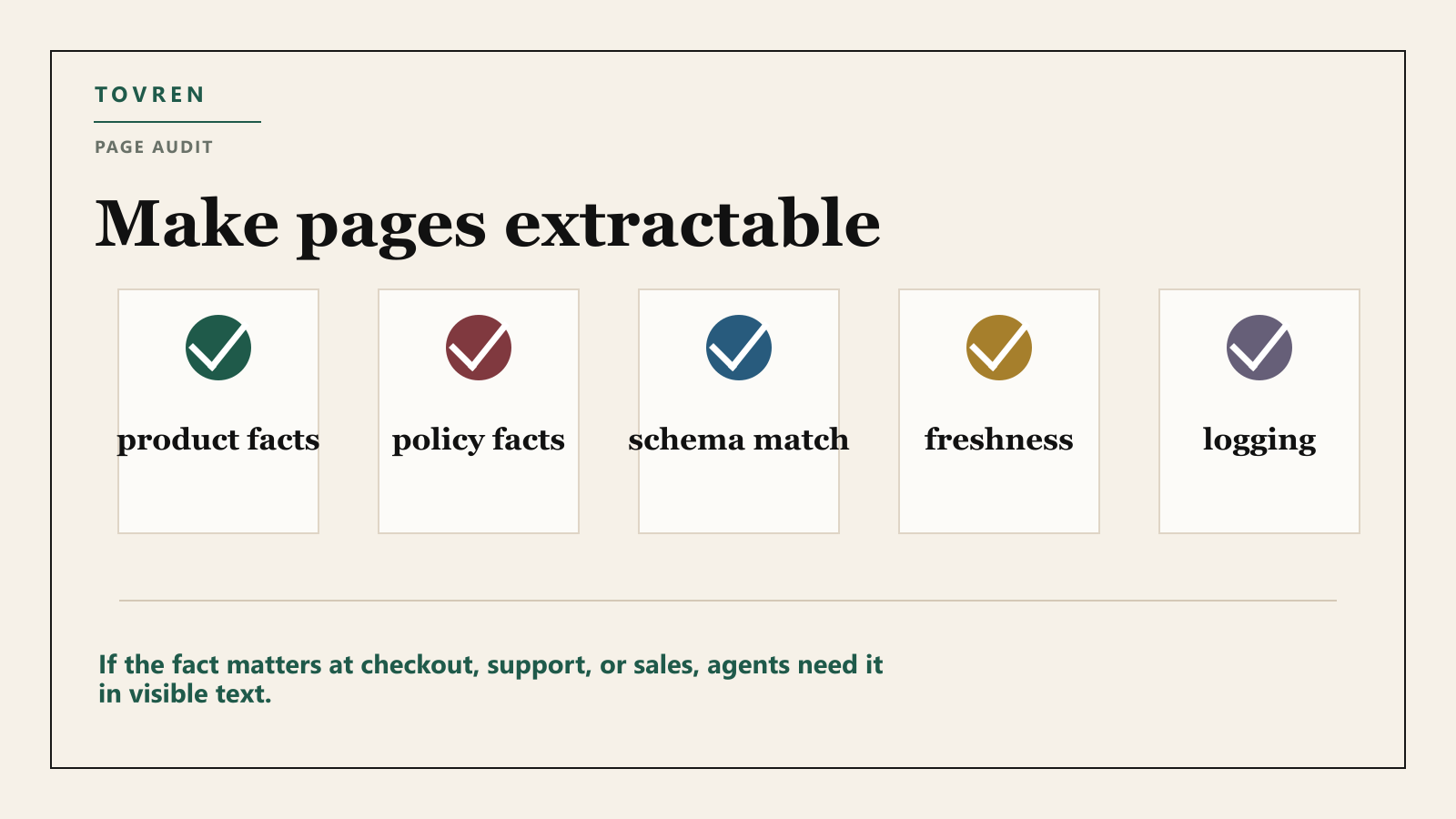
Use this checklist before worrying about new labels like GEO, AEO, or agent optimization. A page that is vague to humans will be worse for agents.
| Area | What to check | Owner | Priority |
|---|---|---|---|
| Crawlability | Important pages return HTTP 200, are not blocked unintentionally by robots.txt, CDN rules, login walls, or JavaScript-only rendering. | SEO / Engineering | Critical |
| Canonical source | Each product, policy, plan, or support answer has one canonical URL. Duplicates, filtered URLs, and expired pages point clearly to the correct version. | SEO | Critical |
| Visible facts | Important facts appear as readable text, not only in images, tabs that fail to render, PDFs, or scripts. | Content / Product | Critical |
| Structured data | Use relevant structured data where appropriate, and make sure it matches the visible page. Do not add invisible claims in markup. | SEO / Engineering | High |
| Product facts | Include product name, brand, SKU, model, variant, dimensions, compatibility, package contents, materials, warranty, price, currency, availability, and update date. | Ecommerce / Merchandising | Critical |
| SaaS facts | Include plans, usage limits, integrations, data retention, security posture, admin controls, trial terms, renewal rules, and cancellation path. | Product Marketing | Critical |
| Shipping and returns | State delivery regions, shipping methods, delivery estimates, thresholds, return window, exceptions, restocking fees, damaged-item handling, and refund timing. | Operations / Legal | Critical |
| Freshness | Add last-updated dates to pricing, policy, docs, compatibility, and product availability pages. Keep feeds and Merchant Center data current where relevant. | Growth / Ops | High |
| Comparison clarity | Explain who the product is for, who should avoid it, what alternatives exist, and where the product is weaker. | Content / Product Marketing | Medium |
| Agent answer QA | Run extraction tests with AI tools. Ask the model to summarize your price, returns, eligibility, compatibility, and warranty. Compare against source facts. | SEO / Support | High |
| AI crawler controls | Monitor AI crawler activity through logs or tools such as Cloudflare AI Crawl Control. Decide which crawlers to allow, rate-limit, or block. | Engineering / Security | Medium |
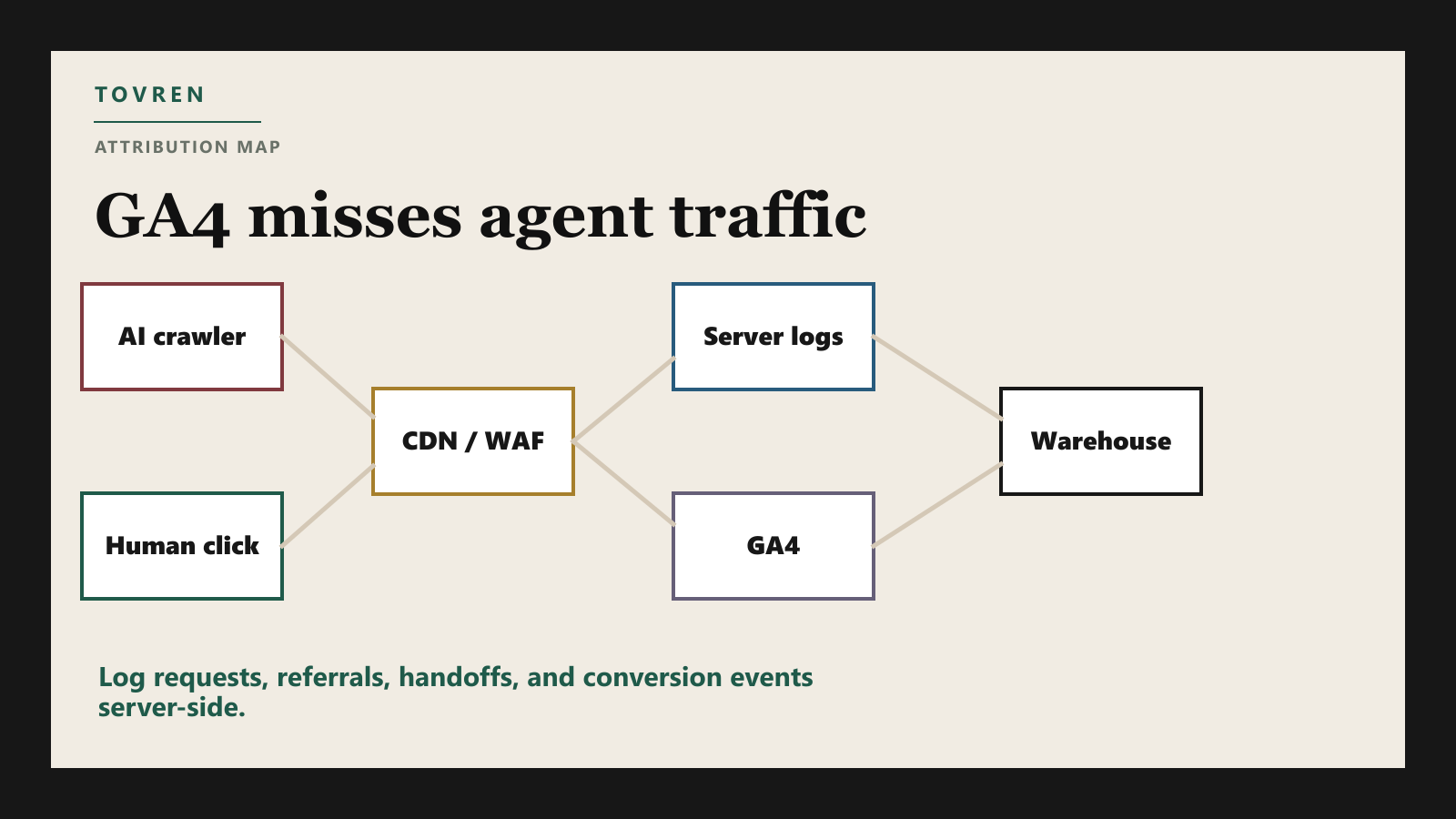
| Attribution | Log AI crawler requests, AI referrals, cart handoffs, lead-agent handoffs, and checkout events server-side. Do not rely only on GA4. | Analytics / Engineering | High |
Page sections agents should be able to extract
For important commercial pages, add short, explicit sections that can be extracted without interpretation.
For ecommerce product pages
- Best for: the exact buyer or use case.
- Not for: excluded use cases, incompatible systems, or buyer mismatches.
- Key specs: dimensions, model, size, color, material, performance, battery, capacity, or other decision-critical attributes.
- Compatibility: platforms, devices, accessories, operating systems, versions, or regional restrictions.
- What is included: box contents, licenses, accessories, support, onboarding, or services.
- Current price: currency, tax/shipping exclusions, promotion window, and last updated date.
- Shipping: regions, estimates, free-shipping threshold, cutoff time, and exclusions.
- Returns and warranty: return window, exceptions, process, refund timing, warranty coverage, and support contact.
For SaaS pricing and product pages
- Plan comparison: monthly and annual prices, included seats, usage limits, overages, and trial terms.
- Security and compliance: only list certifications and controls you can verify.
- Integrations: supported apps, version limitations, API access, webhooks, and data sync direction.
- Implementation: setup time, technical requirements, onboarding support, and admin permissions.
- Cancellation and data export: export formats, retention period, deletion path, and refund policy.
For publishers and content sites
- Author and reviewer details: expertise, role, and update responsibility.
- Source notes: primary sources, publication dates, and what each source supports.
- Answer-first summaries: direct answer, caveats, and “who this applies to.”
- Change log: what changed since the last update.
- Internal links: related explainers, reviews, comparisons, and templates.
Warnings: where AI agents can create real business risk
| Risk | How it happens | Prevention |
|---|---|---|
| Hallucinated product claims | An agent combines your product with similar products, old reviews, or outdated pages and invents a feature. | Publish explicit specs, unsupported use cases, comparison notes, changelogs, and clear “not included” sections. |
| Outdated prices | Cached pages, stale schema, old ads, expired promotions, or inconsistent Merchant Center data conflict with the live page. | Synchronize price data across page text, feeds, structured data, ads, and checkout. Add promotion end dates and last-updated dates. |
| Returns policy ambiguity | “30-day returns” appears in one place, while exceptions are buried elsewhere. | Create a structured returns table by product type, region, condition, deadline, fee, and refund method. |
| Checkout accountability risk | Agentic carts and native checkout flows may compress the purchase journey, but customers still expect clear support and refund ownership. | Make merchant-of-record, receipt, refund, tax, support, cancellation, and escalation responsibilities explicit. |
| Lead-agent misqualification | A chat agent answers based on vague website copy and sends low-quality or misinformed leads to sales. | Publish qualification rules, eligible industries, minimum requirements, plan limits, pricing ranges, and sales handoff criteria. |
| Attribution blind spots | AI systems may summarize without a click, route through generic referrers, use crawlers, or strip referral context. | Combine GA4, Search Console, CDN logs, server logs, ad platform data, and owned conversion events. |
Analytics: GA4 bot filtering is not AI-agent attribution
Google Analytics says traffic from known bots and spiders is automatically excluded from GA properties “to the extent possible,” and that site owners cannot disable this known-bot exclusion or see how much known-bot traffic was excluded. That is useful for cleaning some reports. It is not a complete system for measuring AI-agent impact.
Why not? Because AI visibility and agent traffic are not one thing. They can include crawler fetches, answer citations, referral clicks, product-feed usage, ad interactions, lead-agent chats, cart handoffs, checkout handoffs, and zero-click summaries. Some will appear in analytics. Some will appear only in logs. Some may not appear as traffic at all.
Your minimum analytics stack should include:
| Layer | What it can tell you | What it cannot tell you alone |
|---|---|---|
| GA4 | Human sessions, conversions, landing pages, campaign traffic, and some referrals. | Full bot activity, excluded known-bot volume, zero-click AI answers, or agent reads without visits. |
| Google Search Console | Search clicks and impressions reported under Search performance views, including AI features as Google documents them. | Detailed AI Mode query paths, all answer appearances, or non-Google agent activity. |
| CDN and WAF logs | Requests by user agent, IP range, path, status code, cache status, and bot rule action. | Downstream conversion unless joined with commerce or CRM data. |
| Server logs | Exact page requests, response codes, content versions, and request headers. | User intent or AI answer content unless tested separately. |
| Commerce or CRM events | Add-to-cart, checkout, lead, booking, refund, support, and revenue events. | Which AI answer influenced the user unless you add handoff parameters and attribution rules. |
Server-side fields to log for AI-agent readiness
Do not overcollect personal data. Hash or truncate IPs where appropriate, follow privacy law, and avoid storing unnecessary PII. The point is operational visibility, not surveillance.
| Field | Why it matters |
|---|---|
| Timestamp | Needed for crawl spikes, freshness checks, and incident review. |
| Request ID | Lets engineering connect CDN, app, checkout, and error logs. |
| Path and canonical page ID | Shows which products, docs, policies, or support pages agents request. |
| HTTP method and status code | Identifies failed fetches, redirects, blocked content, and bot-triggered errors. |
| Raw user agent | Needed for identifying self-declared AI crawlers, SEO crawlers, browsers, and unknown automation. |
| Bot category or WAF detection result | Separates known bots, likely automation, humans, blocked requests, and rate-limited requests. |
| Referrer | Captures visible referral paths from search, AI tools, ads, and partner surfaces when available. |
| Query parameters and UTM values | Needed for Universal Cart, ads, lead-agent, campaign, and checkout handoff tracking. |
| Cache status | Shows whether agents are hitting cached or origin-rendered pages, which affects cost and freshness. |
| Response content version or hash | Helps prove which price, policy, or product description was served at the time of extraction. |
| Page type | Groups product, category, pricing, docs, blog, support, policy, and checkout pages. |
| SKU, plan ID, or content ID | Connects agent activity to inventory, revenue, support, and content performance. |
| WAF action | Shows whether a crawler was allowed, challenged, rate-limited, or blocked. |
| Conversion handoff event | Tracks lead chat start, cart transfer, checkout start, booking start, or support escalation. |
Tools such as Cloudflare AI Crawl Control can help teams review AI crawler activity, filter by crawler or path, and block specific crawlers. Cloudflare notes that free-plan detection relies on user-agent strings for well-known, self-identifying AI crawlers, while more advanced detection uses Bot Management fields on enterprise plans. That distinction matters: user-agent-based detection is useful, but it is not perfect attribution.
How to create a practical llms.txt file
Keep it small, curated, and maintained. Think of it as an agent guide to your official sources, not as a dump of every URL.
- Place it at
https://example.com/llms.txt. - Use plain Markdown and UTF-8 encoding.
- Start with a single H1 naming the site or product.
- Add a short blockquote explaining what the site is and which pages are source-of-truth.
- Create sections such as Docs, Products, Pricing, Policies, Support, Changelog, API, and Examples.
- Use absolute HTTPS URLs.
- Do not include stale, low-quality, duplicate, noindex, gated, or legally risky pages.
- Assign an owner and review date.
Example structure:
# Example Store > Official product, pricing, shipping, returns, and support sources for Example Store. Product pages are the source of truth for specs and current availability. Policy pages are the source of truth for returns, warranty, and shipping rules. ## Products - [Laptop Stand Pro](https://example.com/products/laptop-stand-pro): Specs, compatibility, variants, price, availability, warranty. - [USB-C Dock Max](https://example.com/products/usb-c-dock-max): Ports, compatibility, power limits, included accessories. ## Policies - [Shipping Policy](https://example.com/shipping): Regions, delivery windows, thresholds, restrictions. - [Returns Policy](https://example.com/returns): Return window, exceptions, refund timing, restocking fees. - [Warranty Policy](https://example.com/warranty): Coverage, exclusions, claim process. ## Support - [Contact Support](https://example.com/support): Support channels, hours, escalation path. - [Compatibility Guide](https://example.com/compatibility): Device and software compatibility matrix. ## Changelog - [Product Updates](https://example.com/changelog): Product, pricing, and policy update history.Reusable prompt templates
Use these prompts with the page text, URL, HTML export, product feed row, or policy copy. For sensitive data, use an approved internal model or remove confidential information first.
Prompt 1: Product page audit for AI-agent extraction
You are auditing a product page for AI-agent extraction accuracy. Goal: identify whether an AI shopping agent, search agent, or browser agent can accurately understand this product without inventing claims. Inputs: - Product page URL: - Product name: - Target buyer: - Page text or HTML: - Product feed row, if available: - Known source-of-truth specs: Audit the page for: 1. Product identity: name, brand, model, SKU, GTIN, variants. 2. Price and offer clarity: currency, sale price, regular price, promotion end date, tax and shipping exclusions. 3. Availability: in stock, preorder, backorder, region restrictions. 4. Compatibility: devices, software, operating systems, accessories, versions, exclusions. 5. Differentiators: what is actually unique and supported by page evidence. 6. Unsupported claims: claims that are vague, exaggerated, or not backed by visible facts. 7. Returns, warranty, shipping, and support visibility. 8. Structured data consistency with visible content. 9. Missing facts that could cause hallucinated recommendations. Return: - Extraction-ready summary in 150 words. - Critical missing facts table. - Claims likely to be hallucinated or misread. - Recommended page edits, ranked by risk. - A final pass/fail rating for agent readiness.Prompt 2: Support policy audit
You are auditing support policy pages so an AI support agent can answer accurately. Inputs: - Support policy page URL: - Support page text: - Product or service category: - Regions served: - Current support channels: - Internal support rules, if available: Tasks: 1. Extract all support channels, hours, response times, escalation paths, and eligibility rules. 2. Identify ambiguous phrases such as "soon," "usually," "standard support," "premium support," and "contact us." 3. Identify missing rules for weekends, holidays, enterprise customers, international customers, refunds, account lockouts, and urgent incidents. 4. Compare the policy against any pricing or plan pages included in the input. 5. Flag contradictions between support promises and plan limits. 6. Rewrite the policy into an agent-readable table. Return: - Clean support policy summary. - Ambiguity table. - Contradiction table. - Questions support agents might answer incorrectly. - Recommended edits for the website.Prompt 3: Return and shipping extraction audit
You are testing whether an AI shopping agent can correctly extract shipping and returns rules. Inputs: - Shipping policy text: - Returns policy text: - Product page text: - Product type: - Customer region: - Example order value: - Example product condition after delivery: Extract: 1. Eligible shipping regions. 2. Shipping methods and delivery estimates. 3. Free-shipping thresholds and exclusions. 4. Return window. 5. Return eligibility by product type and condition. 6. Final-sale or non-returnable items. 7. Restocking fees. 8. Who pays return shipping. 9. Refund method and timing. 10. Damaged, defective, late, or missing-item process. Then answer these customer questions: - Can this product be returned after opening? - Can an international customer return it? - When does the return window start? - Will the customer pay return shipping? - When will the refund arrive? - What proof is required? Return: - Structured policy table. - Ambiguous or missing rules. - Exact page copy that should be rewritten. - Suggested agent-safe wording.Prompt 4: llms.txt draft prompt
You are creating a concise llms.txt file for a website. Goal: produce a curated AI-agent guide to official source-of-truth pages. Do not include every URL. Do not include stale, thin, duplicate, noindex, private, or legally risky pages. Inputs: - Website name: - One-sentence description: - Primary audience: - Business model: - Source-of-truth pages: - Product pages: - Pricing pages: - Policy pages: - Support pages: - Docs or API pages: - Changelog pages: - Pages to exclude: - Review owner and review frequency: Rules: 1. Use Markdown. 2. Use one H1. 3. Add one short blockquote that explains the site and source-of-truth policy. 4. Group links under practical sections. 5. Use absolute HTTPS URLs. 6. Add short descriptions after each link. 7. Keep the file short enough for agents to scan. 8. Do not claim this improves Google rankings. Return: - Final llms.txt draft. - Pages excluded and why. - Monthly maintenance checklist. - Risks if this file becomes stale.Prompt 5: Agent answer QA prompt
You are QA-testing how an AI agent answers questions using our website. Inputs: - Source page URL: - Source page text: - Product, service, or policy being tested: - Intended correct answer: - User question: - High-risk facts: - Claims the agent must not make: Tasks: 1. Answer the user question using only the supplied source page text. 2. Identify any answer details that are uncertain, missing, or inferred. 3. List the exact source sentences used. 4. Flag any hallucinated or unsupported claim. 5. Rewrite the answer in a safe version for an AI shopping, search, or support agent. 6. Suggest edits to the source page that would reduce ambiguity. Return: - Agent answer. - Evidence table. - Unsupported claims. - Safer answer. - Source page edits.Prompt 6: Attribution and logging prompt
You are designing server-side logging for AI-agent traffic and agentic commerce attribution. Inputs: - Website type: - CDN or WAF: - Analytics tools: - Ecommerce platform or CRM: - Key conversions: - Known AI referrals: - Known bot user agents: - Privacy constraints: - Data warehouse or log destination: Design a logging plan that captures: 1. AI crawler requests. 2. Human referral visits from AI search or assistants. 3. Product page requests by suspected agents. 4. Cart handoffs. 5. Checkout handoffs. 6. Lead-agent chat starts. 7. Conversion events. 8. Support escalation events. 9. WAF allow, block, challenge, or rate-limit actions. Return: - Recommended event schema. - Required fields. - Optional fields. - Privacy safeguards. - Dashboard views. - Alert rules for abnormal crawler load. - Attribution limitations we must disclose to leadership.Prompt 7: Checkout accountability risk prompt
You are reviewing checkout accountability for agentic commerce. Inputs: - Product category: - Checkout path: - Merchant of record: - Payment processor: - Cart handoff process: - Refund policy: - Support owner: - Tax and shipping calculation process: - Confirmation email copy: - Customer service scripts: Audit: 1. Who is merchant of record? 2. Where is final price confirmed? 3. Where are taxes, fees, shipping, discounts, and promotions confirmed? 4. Who handles refunds? 5. Who handles failed payments? 6. Who handles partial shipments, cancellations, and backorders? 7. What proof does support need to resolve disputes? 8. What could an AI cart or agent misstate? Return: - Accountability map. - Checkout risk table. - Customer-facing copy fixes. - Internal logging requirements. - Go/no-go recommendation for agentic checkout expansion.A 30-day implementation plan
| Week | Work | Output |
|---|---|---|
| Week 1 | Inventory top commercial, support, pricing, policy, and documentation pages. Pull server logs for AI crawler and bot activity. | Priority page list, traffic baseline, crawler baseline. |
| Week 2 | Run extraction audits on the top 20 pages using the prompts above. Fix missing product, pricing, shipping, returns, and support facts. | Page edit backlog, critical ambiguity fixes, updated source-of-truth pages. |
| Week 3 | Validate structured data, internal links, canonical URLs, crawl access, Merchant Center or product feed consistency, and visible page/schema alignment. | Technical SEO fixes, feed fixes, schema validation notes. |
| Week 4 | Add or update server-side logging, create dashboards, draft llms.txt if useful, and run agent-answer QA on the updated pages. | Agent-readiness dashboard, llms.txt draft, QA report, monthly review process. |
What good looks like
A prepared site does not need to look “AI-optimized.” It should look clear.
- A shopping agent can extract the correct product, variant, price, availability, compatibility, shipping, returns, and warranty without guessing.
- A search agent can summarize who the product or article is for, who should avoid it, and what facts support the recommendation.
- A lead agent can answer qualification questions without inventing pricing, guarantees, compliance claims, or support promises.
- A cart or checkout handoff can preserve offer details, customer expectations, merchant responsibility, and support records.
- Your analytics team can separate human sessions, visible AI referrals, crawler activity, WAF actions, and conversion handoffs.
- Your legal, support, and operations teams can prove which policy or product description was live when a customer acted.
Source and fact-check notes
| Source | Used for | Editorial note |
|---|---|---|
| Google Search I/O 2026 updates | AI Mode, AI-first Search box, information agents, agentic booking, and Search agent context. | Primary source from Google, published May 19, 2026. |
| Google Shopping Universal Cart announcement | Universal Cart, agentic shopping, UCP, Google Pay checkout, merchant-of-record context. | Primary source from Google, published May 19, 2026. |
| Google Ads and Commerce AI Search ad formats | Business Agent for Leads, AI-powered Shopping ads, Conversational Discovery ads, Highlighted Answers, Direct Offers, native checkout. | Primary source from Google, published May 20, 2026. |
| Google Search Central: AI features and your website | AI features eligibility, query fan-out context, no special AI files required for AI Overviews or AI Mode, structured data alignment guidance. | Primary Google Search documentation. |
| Google Analytics known bot-traffic exclusion | GA known-bot exclusion limits and why GA4 is not enough for AI-agent attribution. | Primary Google Analytics support documentation. |
| Cloudflare AI Crawl Control docs | AI crawler monitoring, blocking, user-agent detection limits, metrics, and plan differences. | Primary Cloudflare documentation, last updated April 23, 2026. |
| X docs llms.txt example | Real-world use of llms.txt and llms-full.txt for agent-readable developer documentation. | Primary documentation example from X. |
| llmtxt.info | llms.txt status, draft proposal context, example structure, and validation framing. | Reference context; not treated as a Google ranking source. |
| Reddit SEO and PPC community discussions | Qualitative signal that practitioners are debating AI citation tracking, bot traffic, llms.txt, Universal Cart, and attribution uncertainty. | Used as community signal only, not as proof of product behavior or ranking impact. |
Bottom line
The safest preparation for AI Search and agentic commerce is not a secret file or a new acronym. It is operational clarity.
Make your pages answerable. Make your product and policy facts explicit. Keep prices and availability current. Align structured data with visible content. Use llms.txt only as a lightweight guide to source-of-truth pages. Add server-side logging so you can see what agents and crawlers are actually doing. Then test your pages with the same prompts a buyer, search agent, shopping agent, support agent, or lead agent might use.
In the agentic web, vague pages become bad data. Clear pages become infrastructure.
FAQ
Why should websites prepare for AI agents?
Search and shopping agents need clear product data, pricing, policies, comparisons, and next actions to route users accurately.
What pages matter most for agent visibility?
Product pages, pricing pages, comparison pages, support docs, policy pages, and category hubs matter most.
What is the first fix?
Make key facts explicit in text, add structured tables where useful, keep dates current, and remove ambiguity from next-step actions.