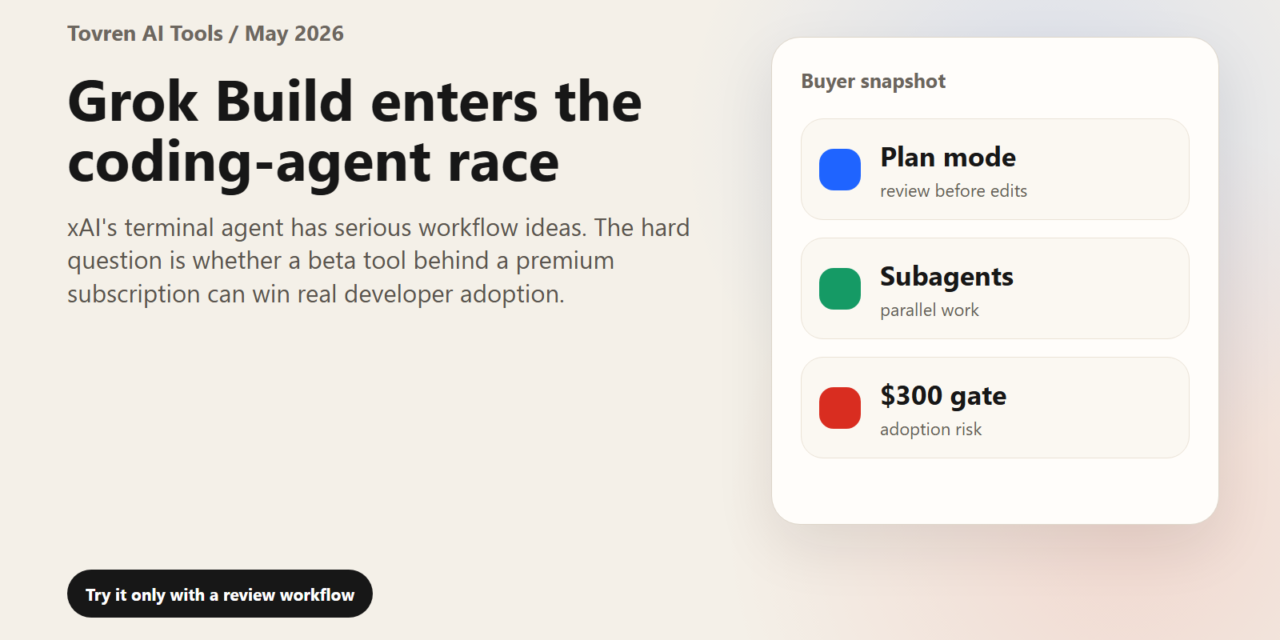
Short answer: Grok Build is worth considering only if it improves daily developer throughput enough to justify the price. Test it on your own repo, compare against existing coding agents, and measure accepted diffs rather than demo output.
Verdict first: Grok Build looks serious on paper. xAI has shipped a terminal coding agent with plan mode, clean diffs, plugin support, hooks, MCP servers, AGENTS.md compatibility, headless mode, Agent Client Protocol support, enterprise controls, and parallel subagents. That is not a toy chatbot stapled onto an IDE. But the early beta is gated to SuperGrok Heavy users, and the reported $300/month access tier makes this a selective pilot tool, not an obvious team-wide default.
For developers already paying for SuperGrok Heavy, Grok Build is worth testing on real repositories. For founders, engineering managers, and AI tool buyers, the better answer is: run a one-seat evaluation, compare it against your current coding-agent stack, and wait for broader access before standardizing.
What xAI Actually Announced
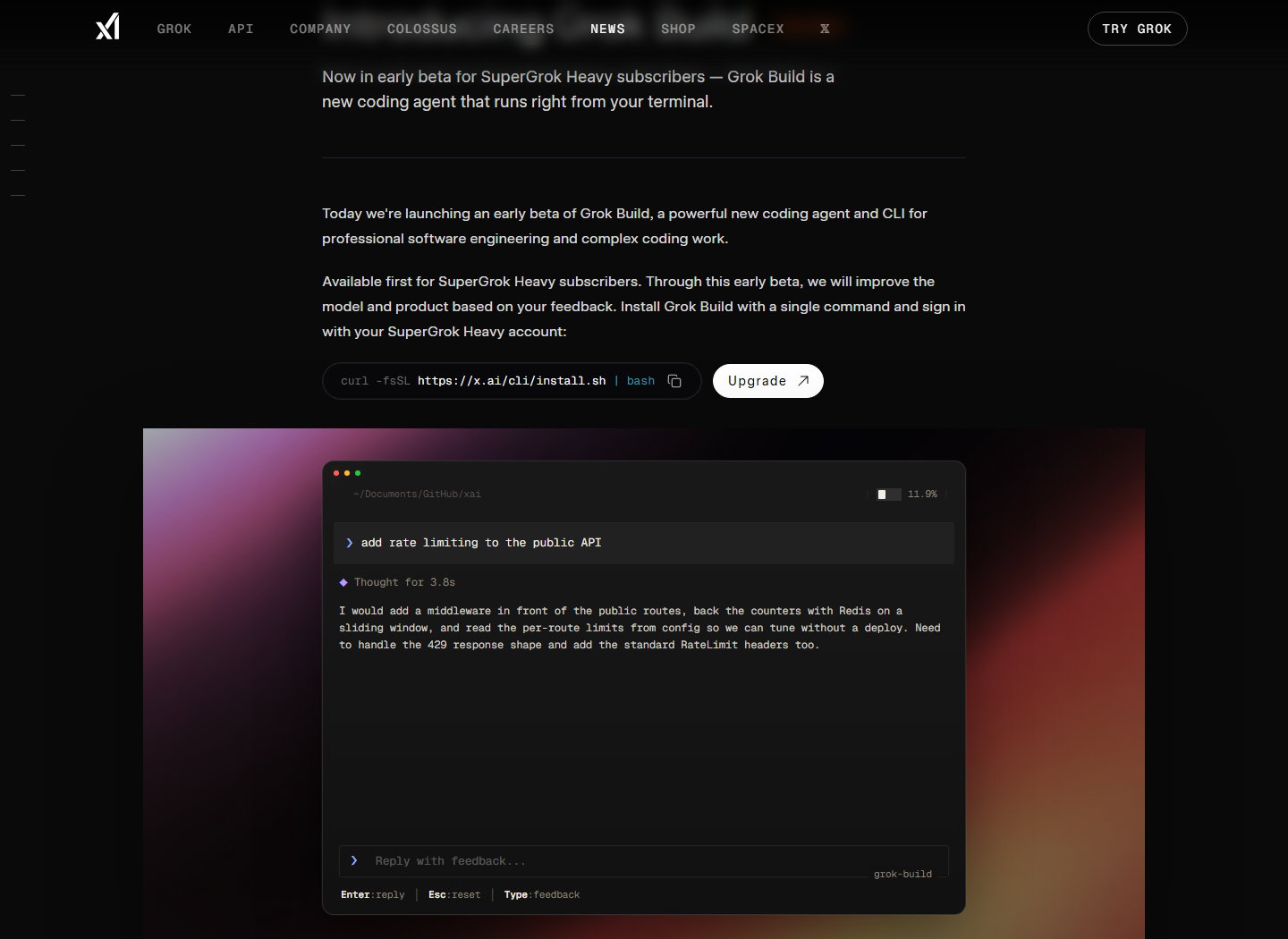
xAI introduced Grok Build Early Beta on May 14, 2026, describing it as a coding agent and CLI for professional software engineering and complex coding work. The company says it is available first to SuperGrok Heavy subscribers and installs with a terminal command. In xAI’s docs, Grok Build can run through an interactive terminal UI, headless scripts, bots, or ACP integrations in other apps.
The strongest product signals are workflow-level. Grok Build supports plan mode, where write tools are blocked except for the session plan file, so the agent can outline work before editing code. Once execution begins, changes show as diffs. It also reads AGENTS.md instruction files and is compatible with Claude Code-style instructions, plugins, skills, hooks, MCP servers, and marketplaces. Plugins can add skills, agents, hooks, MCP servers, and LSP servers; subagents can spawn independent child sessions to work in parallel.
Confirmed xAI Facts vs Third-Party Commentary vs Tovren Analysis
| Confirmed xAI facts | Third-party commentary | Tovren analysis |
|---|---|---|
| Grok Build is in early beta and available first to SuperGrok Heavy subscribers. | CIO Dive, eWeek, AI Business, and AgentRiot frame the release as xAI entering a crowded coding-agent race. | The launch is credible, but early access limits adoption and makes independent evaluation more important. |
| Grok Build supports plan mode, clean diffs, headless mode, ACP, plugins, hooks, MCP servers, AGENTS.md, and subagents. | AgentRiot argues the feature set is technically competent but constrained by price. | The architecture is promising because it aligns with how serious coding agents are evolving: planning, permissions, extensibility, and parallel work. |
| xAI documents enterprise configuration, authentication options, sandbox profiles, permissions, and data lifecycle controls. | AI Business notes that xAI has disclosed limited product detail compared with more mature rivals. | Teams should not approve production use until they test security behavior, logs, data handling, and tool permissions in their own environment. |
| xAI documents Grok Build 0.1 as an early-access coding model available through the xAI API. | Coverage focuses on the $300/month SuperGrok Heavy gate for CLI access. | Buyers should separate CLI subscription access from API experimentation; both have different cost and governance models. |
How It Compares at a High Level
Grok Build is entering a field that already has strong options. Claude Code is mature, terminal-native, and deeply adopted by many developers. OpenAI Codex offers CLI, IDE, web, app, and cloud workflows, with multi-agent coordination becoming a major theme. Cursor is still the editor-first choice for teams that want AI built into the daily coding surface. Google’s Antigravity and Antigravity CLI are moving toward a unified agent-first platform after Gemini CLI’s consumer transition.
Do not read this as a benchmark claim. Tovren is not saying Grok Build writes better code than Claude Code, Codex, Cursor, or Antigravity. The practical difference today is access, ergonomics, integration, and governance. Grok Build’s advantage is that it appears designed for agent workflows from the start. Its disadvantage is that competitors already have distribution, user habits, team admin stories, and more public evaluation.
Buyer Decision Matrix
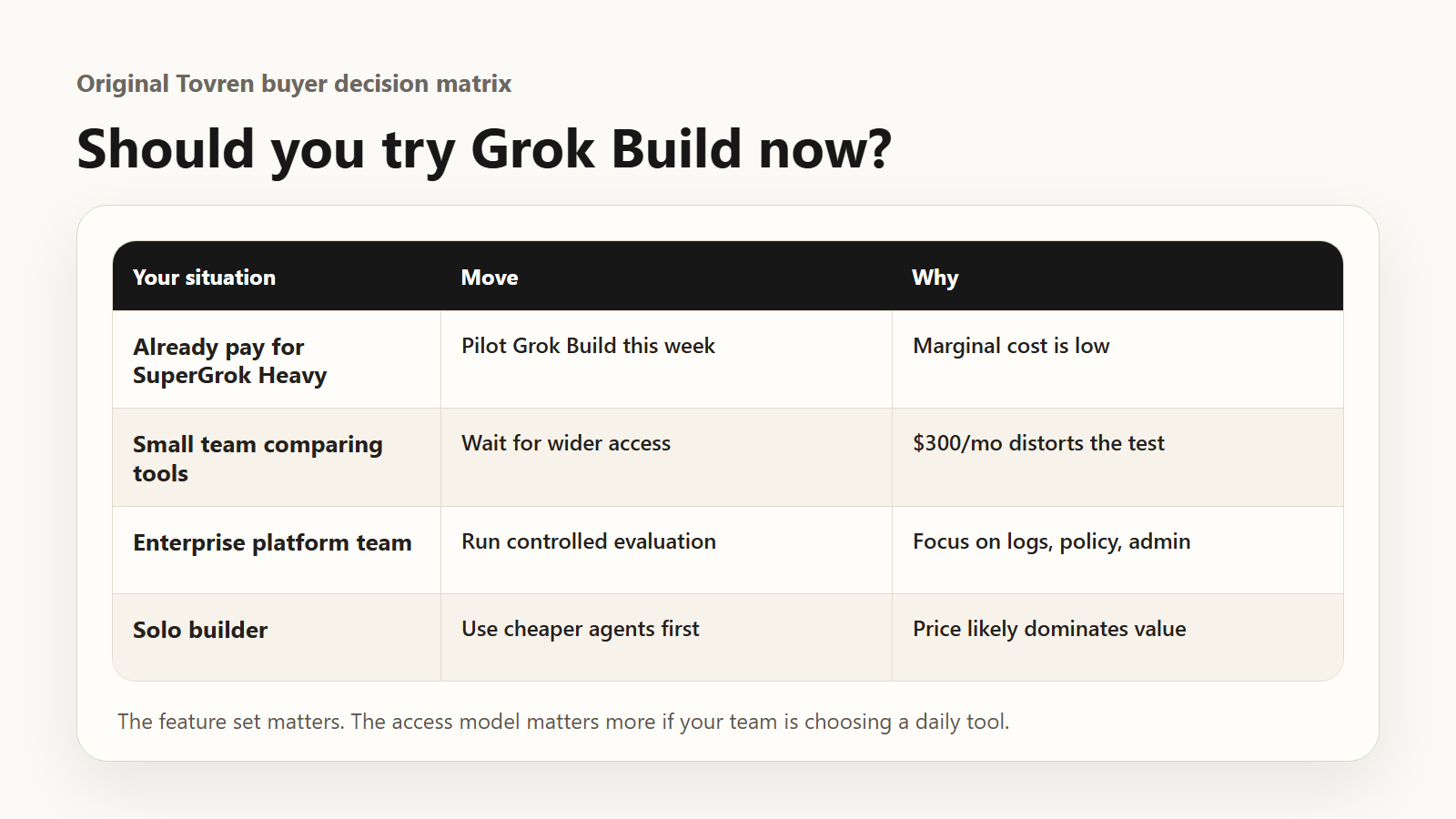
| Buyer | Best action | Why |
|---|---|---|
| Solo developer already on SuperGrok Heavy | Try it now | You already have access, and the opportunity cost is low. |
| Founder paying personally | Pilot one month only | $300/month needs a measurable productivity win, not curiosity. |
| Engineering manager | Run a one-seat comparison | Compare output quality, review time, test pass rate, and developer acceptance against your current tool. |
| Enterprise security team | Wait or sandbox tightly | Review data lifecycle, permissions, sandbox behavior, MCP risk, and admin controls first. |
| Team already standardized on Claude Code, Codex, Cursor, or Antigravity | Do not switch yet | Grok Build needs proof on your workloads before disrupting a working agent stack. |
Install and First-Run Checklist
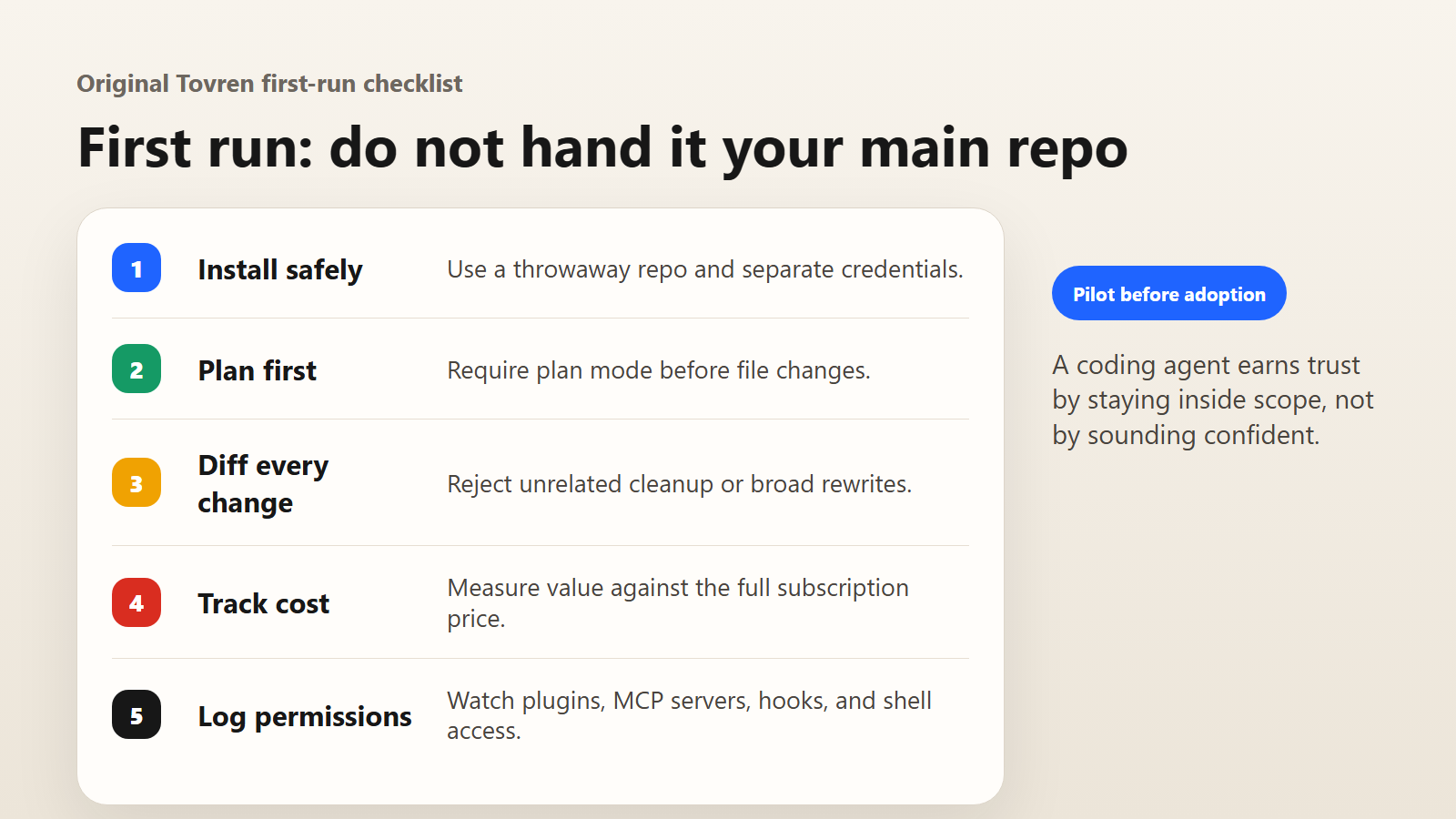
- Confirm access: verify SuperGrok Heavy or xAI API eligibility before planning a team rollout.
- Use a test repository first: avoid production repos until permissions and data handling are reviewed.
- Start in plan mode: ask Grok Build to explain the repo, map the feature, and produce a plan before edits.
- Check configuration discovery: run inspection to see which instructions, skills, plugins, hooks, and MCP servers are loaded.
- Disable broad auto-approval: keep permission mode on ask unless the task is sandboxed and low-risk.
- Review diffs manually: judge output by changed code, tests, and regressions—not by the confidence of the explanation.
- Log cost and usage: track sessions, token or credit usage, elapsed time, accepted diffs, and reverted changes.
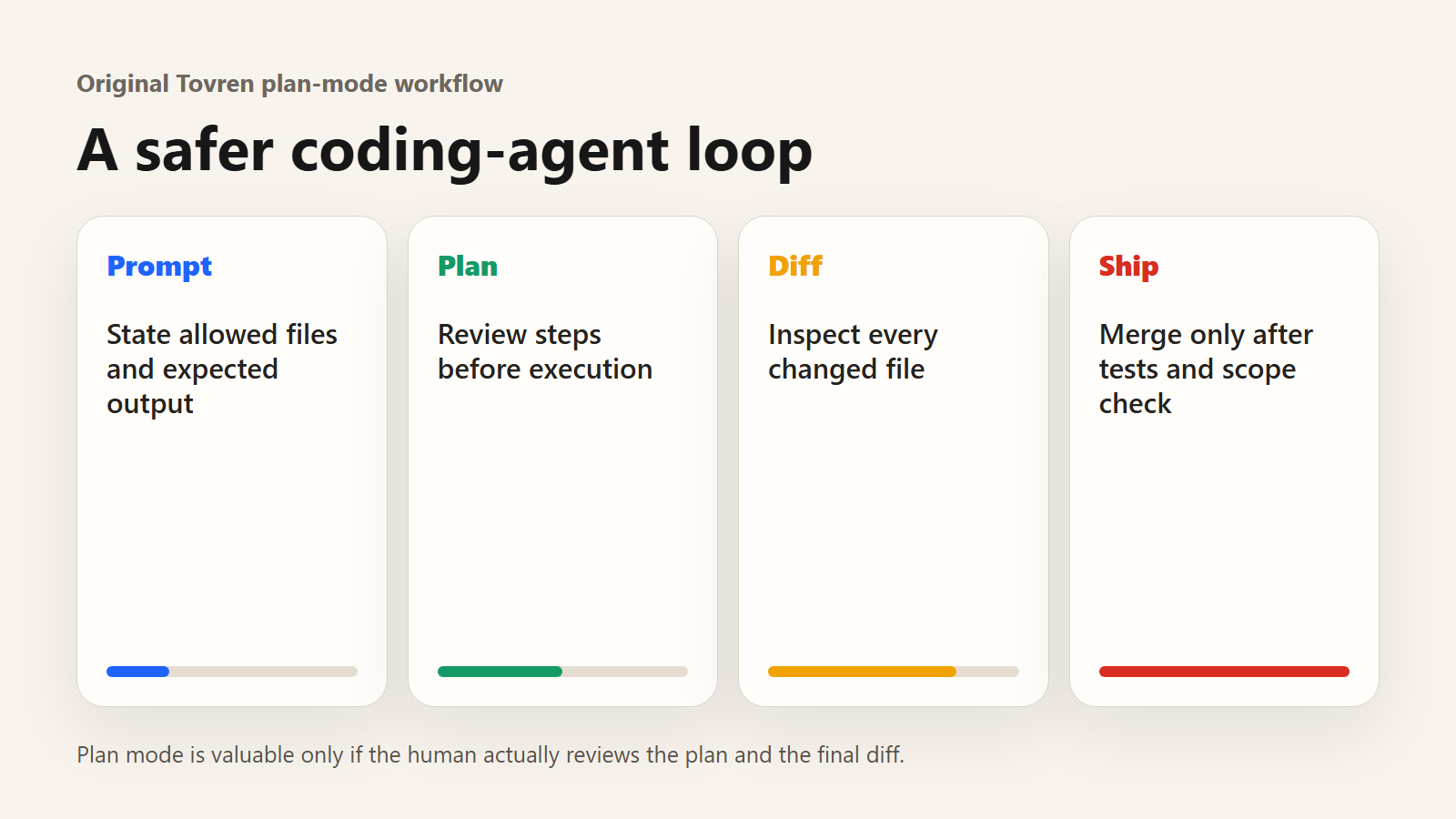
A Safe Plan-Mode Workflow
The strongest way to test Grok Build is not “build my app.” Use a constrained workflow:
- Repo orientation: ask it to explain architecture, key files, test commands, and risk areas.
- Task framing: give a narrow feature or bug, acceptance criteria, and files it should avoid.
- Plan mode: require a plan, ask clarifying questions, and block edits until the plan is acceptable.
- Execution: allow edits only after plan approval, then inspect every diff.
- Verification: run tests, linting, type checks, and a manual review.
- Postmortem: record what it got right, where it hallucinated, and whether it saved real engineering time.
Pricing and Access Risk
The $300/month issue is not just sticker shock. It changes adoption math. A five-developer trial becomes $1,500/month if every tester needs the highest tier. A 20-seat rollout becomes a serious budget line before the tool has public proof comparable to incumbents. For many teams, Claude Code, Codex, Cursor, or Antigravity will be easier to justify because they already sit in common developer workflows or broader subscriptions.
That does not mean Grok Build is overpriced for everyone. If one senior engineer saves several hours per week on high-value code review, refactoring, migration, or test generation, the monthly cost can be defensible. But that has to be measured. Do not approve it because parallel subagents sound advanced. Approve it because accepted diffs, test results, and cycle-time reduction beat your current tool.
Red Flags
- You cannot access it without buying a plan you otherwise do not need.
- Your team wants to enable always-approve before understanding permissions.
- Your current coding agent already performs well and costs far less.
- You cannot define success metrics beyond “developers like it.”
- Your repositories contain sensitive data and you have not reviewed data lifecycle or ZDR options.
- Your engineers are spending more time supervising agents than shipping code.
FAQ
Is Grok Build generally available?
No. xAI describes it as an early beta available first to SuperGrok Heavy subscribers.
Does Grok Build replace Claude Code or Codex?
Not yet for most teams. It may be worth testing, but replacing an established coding-agent workflow requires evidence on your repositories, tests, review process, and security requirements.
What makes Grok Build interesting?
The serious pieces are plan mode, diff review, AGENTS.md and Claude Code compatibility, plugins, hooks, MCP support, headless operation, ACP support, permissions, sandbox options, and parallel subagents.
Who should try it now?
Developers already paying for SuperGrok Heavy, teams evaluating multiple terminal agents, and AI tooling leads who can run a controlled one-seat pilot.
Who should wait?
Budget-sensitive developers, teams already satisfied with Claude Code, Codex, Cursor, or Antigravity, and enterprises that need more procurement, compliance, and security validation.
Source Log
- xAI: Introducing Grok Build Early Beta — May 14, 2026. Supports launch date, early beta status, SuperGrok Heavy access, plan mode, clean diffs, plugins, AGENTS.md, MCP, subagents, and install command.
- xAI: Grok Build Beta product page — accessed May 22, 2026. Supports product positioning, terminal workflow, skills, plan viewer, plugins, Q&A, and subagents.
- xAI Docs: Grok Build Getting Started — accessed May 22, 2026. Supports TUI, headless usage, ACP, API-key use, custom models, and Grok Build 0.1 API access.
- xAI Docs: Skills, Plugins & Marketplaces — accessed May 22, 2026. Supports skills, plugins, hooks, MCP servers, marketplaces, subagents, Claude Code compatibility, and AGENTS.md compatibility.
- xAI Docs: Modes and Commands — accessed May 22, 2026. Supports plan mode, always-approve mode, permission behavior, and slash commands.
- xAI Docs: Headless & Scripting — accessed May 22, 2026. Supports headless mode, output formats, and ACP agent mode.
- xAI Docs: Enterprise Deployments — accessed May 22, 2026. Supports enterprise configuration, authentication, sandbox, permissions, and data lifecycle controls.
- xAI Docs: Grok Build 0.1 — accessed May 22, 2026. Supports early-access model details, context, pricing, and model aliases.
- CIO Dive: xAI joins crowded coding agent race with Grok Build — May 15, 2026. Supports market framing, $300 tier context, and comparison to rival coding agents.
- eWeek: Elon Musk’s xAI Launches Grok Build, a Coding Agent for Developers — May 18, 2026. Supports third-party summary of capabilities, access, headless mode, ACP, AGENTS.md, and pricing commentary.
- AI Business: Musk’s xAI Launches Grok Build to Take on Claude Code, Codex — May 18, 2026. Supports third-party launch coverage and limited-detail caution.
- AgentRiot: Grok Build Is Here, But It Costs $300 a Month — May 16, 2026. Supports pricing commentary and adoption-risk framing.
Monetization and Internal Links
- Best AI Coding Agents for Developers
- Claude Code vs Codex: Which Coding Agent Should Teams Use?
- Cursor Review for Engineering Teams
- MCP Security Checklist for AI Coding Tools
- AI Tool Procurement Checklist for CTOs
Refresh Triggers
- xAI opens Grok Build beyond SuperGrok Heavy.
- xAI changes Grok Build pricing, rate limits, or promotional access.
- Independent benchmarks compare Grok Build against Claude Code, Codex, Cursor, or Antigravity.
- xAI publishes enterprise security, logging, privacy, or compliance updates.
- Grok Build exits beta or adds stable team administration features.