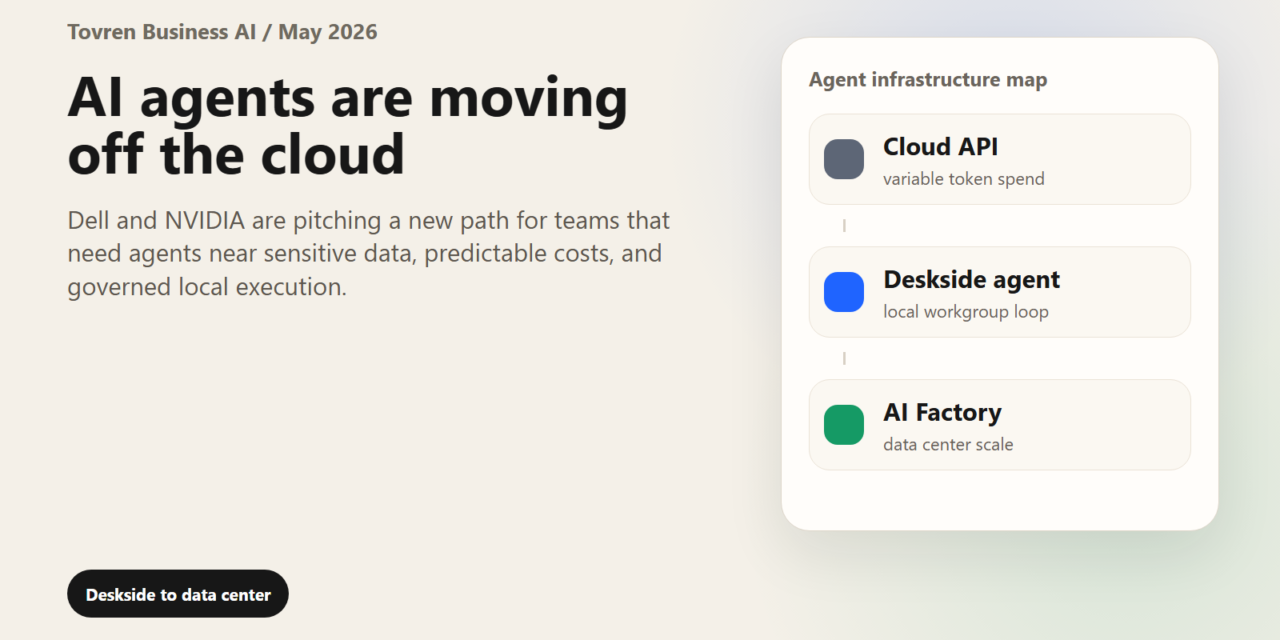
Short answer: Dell and NVIDIA deskside AI matters for teams that need local agents near private data. The right pilot is not a generic chatbot; it is a controlled workflow where local compute reduces latency, privacy risk, or cloud cost.
Verdict first: Dell Deskside Agentic AI is not a reason to abandon cloud APIs. It is a reason to stop treating cloud APIs as the only sensible place to run AI agents. For teams with sensitive code, regulated documents, high-frequency agent loops, or unpredictable token bills, a local deskside agent workstation can be worth piloting. For occasional chat, light research, or teams that need frontier models all day, cloud-only still wins.
What Dell and NVIDIA announced
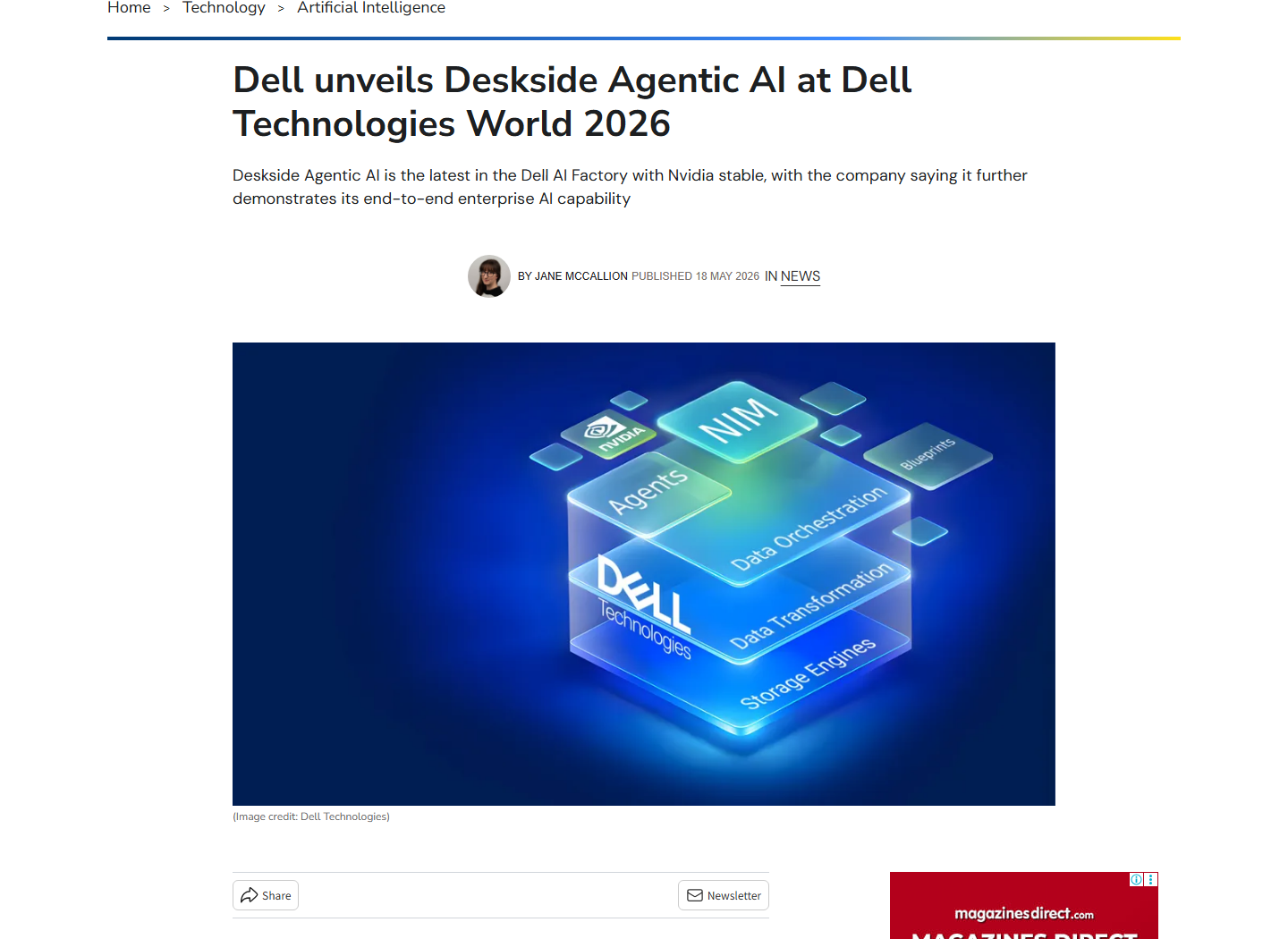
At Dell Technologies World 2026, Dell expanded the Dell AI Factory with NVIDIA with a new deskside tier for agentic AI. The idea is simple: put serious AI agent infrastructure near the workgroup, not only in a cloud account or centralized data center. Dell says Deskside Agentic AI is available now and combines Dell high-performance workstations, NVIDIA NemoClaw, NVIDIA OpenShell, NVIDIA Nemotron models, and Dell Services.
The pitch is aimed at founders, IT leaders, developers, and AI operators who are discovering that agents behave differently from chatbots. A chatbot may be one prompt and one response. An agent may plan, call tools, write code, test outputs, search documents, retry failed steps, and run for hours. That multiplies inference usage and makes per-token billing harder to forecast.
Dell’s stated model coverage runs from 30B to 1T parameters across three deskside options: Dell Pro Max with GB10 for roughly 30B to 200B models, Dell Pro Precision 9 towers for 30B to 500B models, and Dell Pro Max with GB300 for 120B to 1T models. Dell also says OpenShell is supported across the Dell AI Factory with NVIDIA, so agents can be developed at the workstation and governed or scaled toward PowerEdge servers later.
Confirmed facts vs Tovren analysis
| Confirmed fact | Tovren analysis |
|---|---|
| Dell Deskside Agentic AI is available now and is part of Dell AI Factory with NVIDIA. | This creates a new “workgroup AI infrastructure” tier between laptops and data centers. |
| The stack includes NVIDIA NemoClaw and OpenShell for agent workflows, sandboxing, privacy controls, and governance. | Useful, but buyers still need their own security review, audit logging policy, and approval workflow. |
| Dell lists GB10, Pro Precision 9, and GB300 systems for different model ranges from 30B to 1T parameters. | Do not buy the largest box first. Match the workstation to the repeatable workflow and model size. |
| Dell cites breakeven in as little as three months and up to 87% two-year savings versus public cloud APIs. | Treat these as vendor/analyst claims, not guaranteed ROI. Validate against your own token logs and utilization. |
| Dell frames the architecture as deskside-to-data-center scaling. | This is strongest for teams already standardizing on Dell/NVIDIA infrastructure or regulated on-prem workflows. |
What “deskside agentic AI” really means
Deskside does not mean a normal office PC running a toy model. It means a dedicated local AI workstation close to the people and data involved in the workflow. A software team might run coding agents against private repositories. A research team might analyze pre-publication papers or confidential lab notes. A legal, healthcare, defense, or finance team might need AI assistance without pushing sensitive context into a public API.
NVIDIA NemoClaw is the agent stack. OpenShell is the runtime layer that sandboxes agent sessions, meters resources, verifies permissions, and can route inference according to policy. The important buyer question is not “Can it run agents?” The question is: can your team define what the agent may read, write, execute, install, and send outside the environment?
Buyer matrix: should you pilot it?
| Team type | Best fit | Recommendation |
|---|---|---|
| Founder or small startup | Occasional coding, research, or customer ops agents | Stay cloud-first unless monthly agent spend is already painful. |
| Software engineering team | Private repo coding agents, test generation, CI support | Pilot GB10 or Pro Precision if agent loops are frequent and measurable. |
| R&D or university lab | Large document analysis, local models, sensitive research | Strong pilot candidate, especially where data cannot be uploaded. |
| Regulated enterprise | Legal, healthcare, finance, defense workflows | Consider deskside only with security, compliance, and audit ownership defined. |
| Large enterprise AI platform team | Workstation prototyping plus data-center scaling | Best fit if Dell AI Factory is already on the roadmap. |
Cost-risk checklist before buying
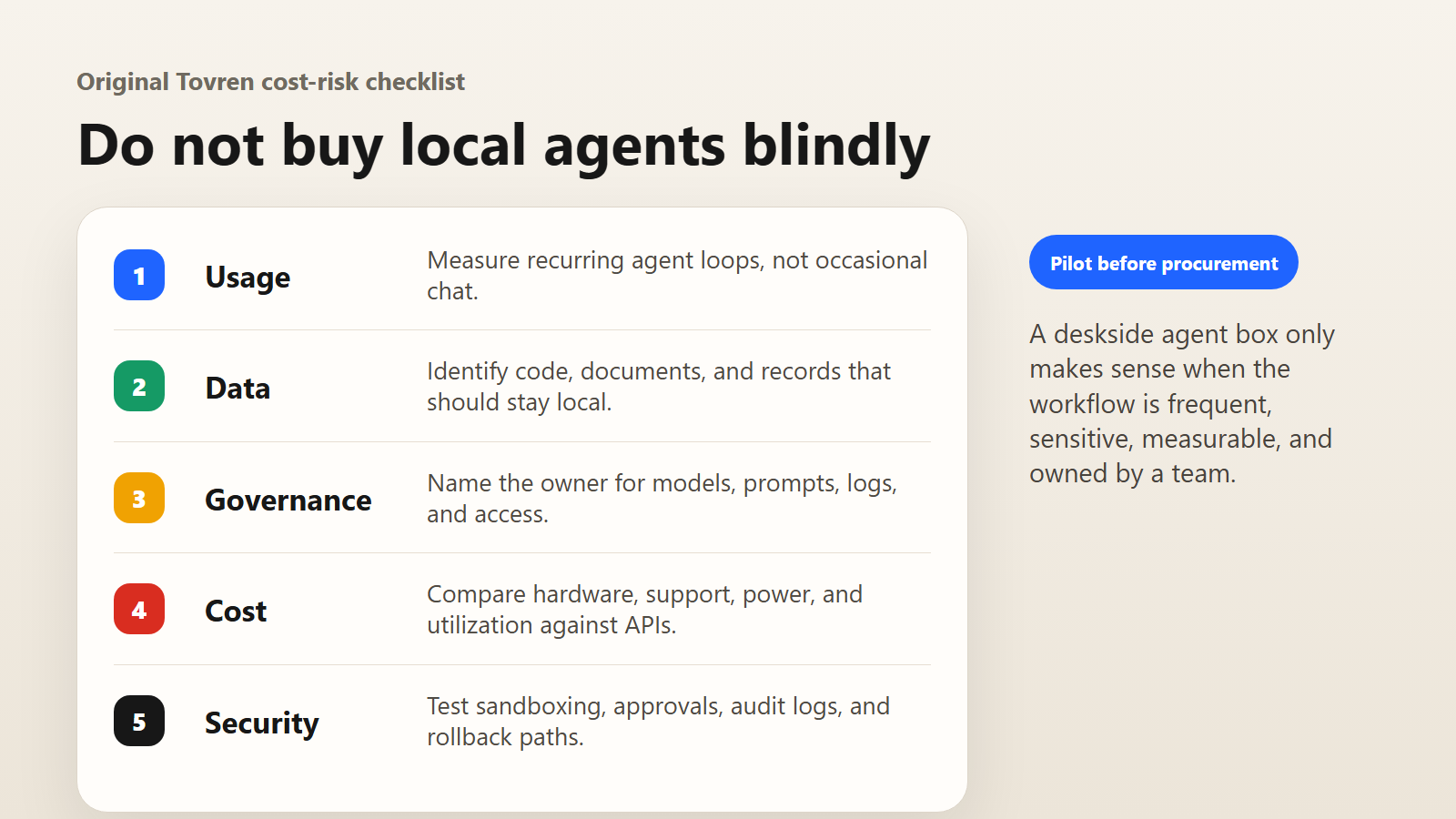
- Current cloud baseline: Pull 30 days of token, tool-call, and model-routing data.
- Utilization: A local box only pays off if agents run often. Idle hardware kills the ROI story.
- Concurrency: Count how many agents and users need simultaneous runs.
- Security labor: Include policy design, approvals, logging, patching, and incident response.
- Support and power: Include support contracts, energy, desk space, cooling, and admin time.
- Model fit: Confirm whether your workload works on open or workhorse models, not only frontier cloud models.
- Refresh risk: AI hardware ages quickly. Model your payback before the next upgrade cycle.
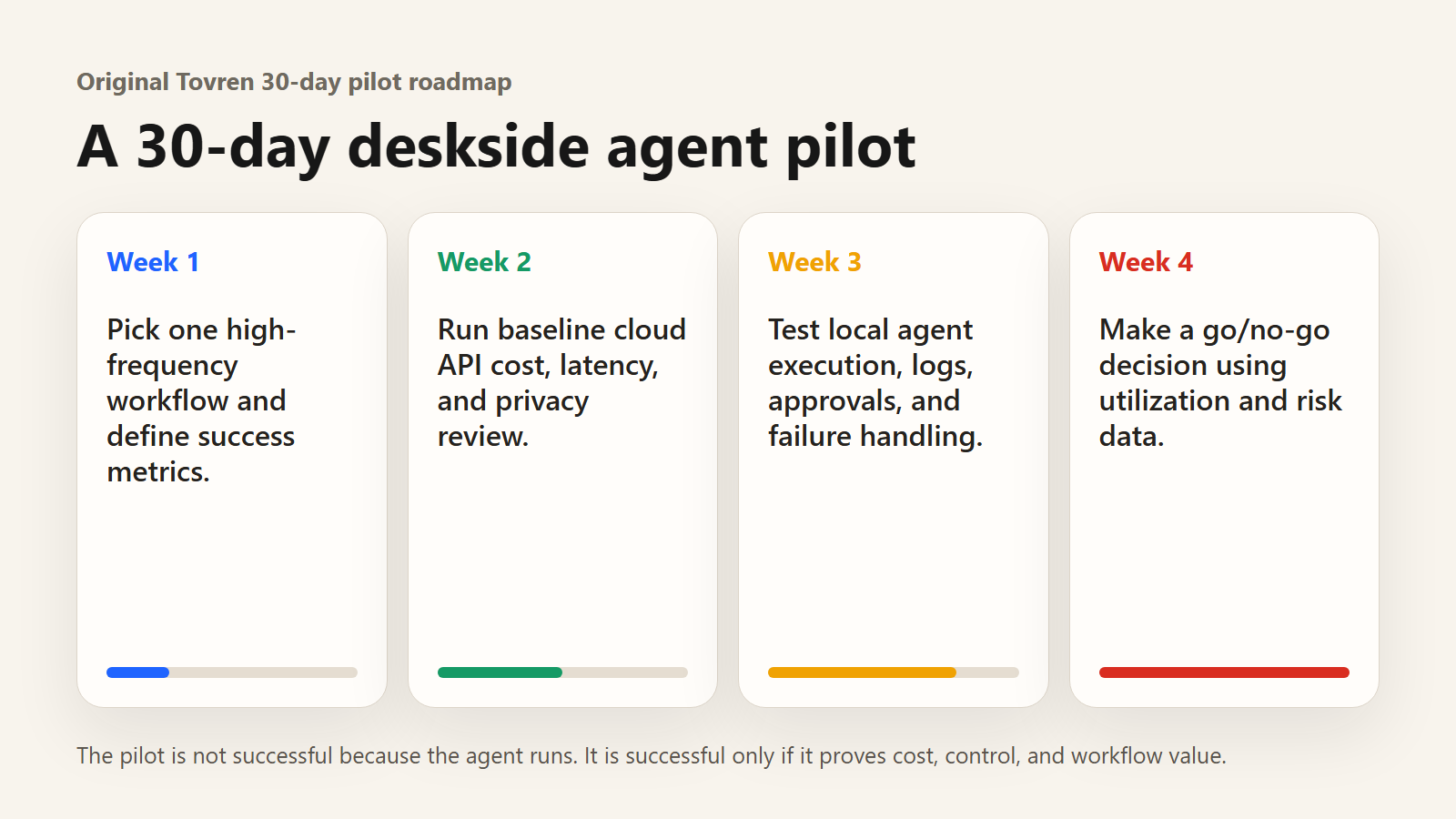
A practical 30-day pilot plan
| Phase | What to do | Success metric |
|---|---|---|
| Days 1–7 | Choose two workflows: one coding or research task, one sensitive-data task. Log current cloud cost and quality. | Clear baseline for cost, latency, quality, and security exposure. |
| Days 8–14 | Set up the deskside environment, model, agent permissions, and OpenShell policy boundaries. | Agent can run without broad host access or uncontrolled network calls. |
| Days 15–21 | Run parallel tests against the cloud setup. Track completion rate, retries, hallucinations, human corrections, and time saved. | Local workflow is at least good enough for one production-adjacent use case. |
| Days 22–30 | Calculate total cost, utilization, security findings, and user adoption. Decide: stop, expand, or move to data-center scaling. | Named owner, measured savings, and a repeatable operating model. |
Red flags: stay cloud-only for now
- Your team has no repeatable agent workflow yet.
- You cannot name a security owner for local agent permissions.
- Your use case needs the largest frontier models for most tasks.
- Your monthly cloud API bill is predictable and small.
- You cannot keep the workstation busy enough to justify capex.
- Your procurement team wants the hardware before your operators define the workflow.
What this means for real teams
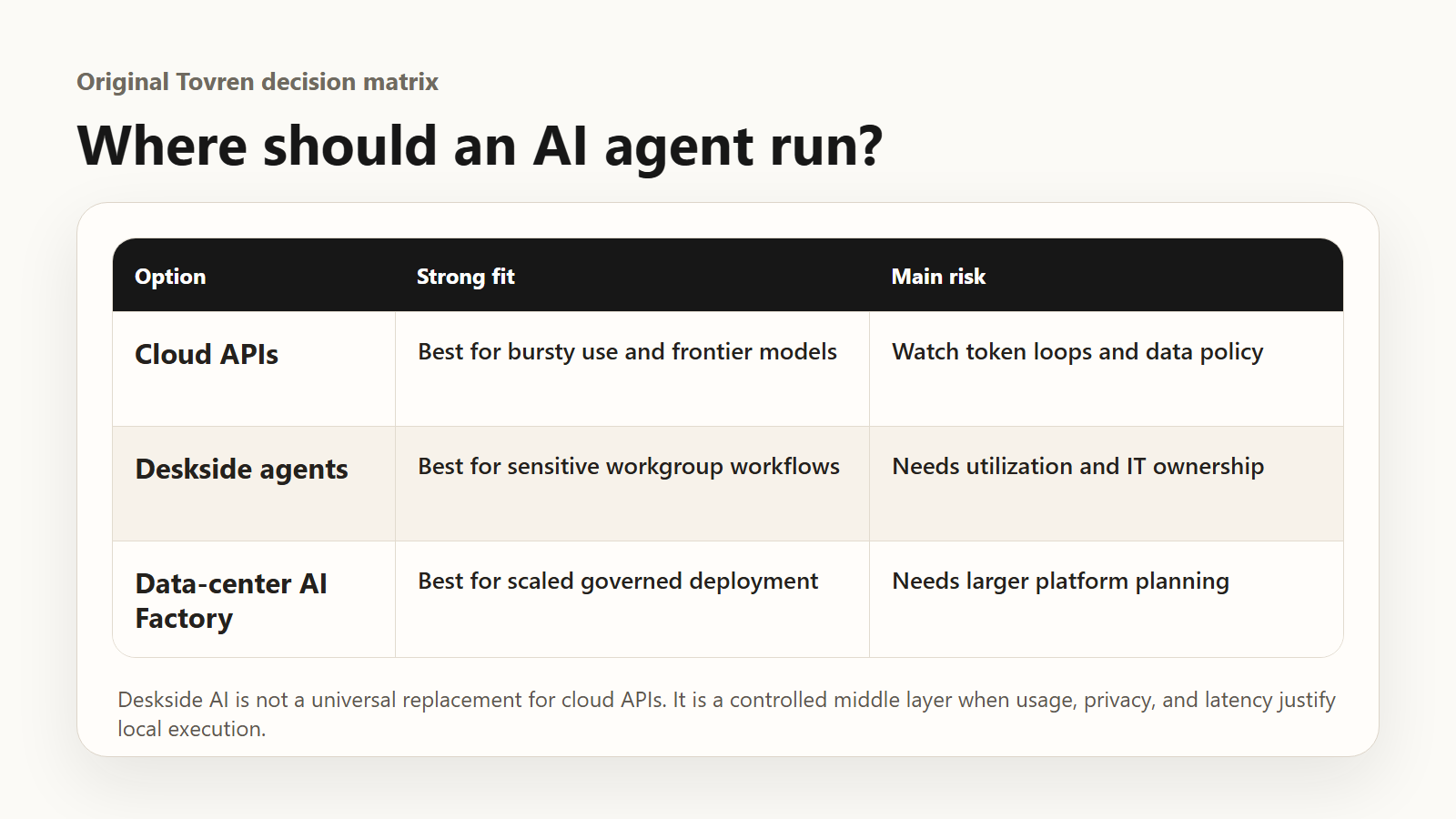
The most practical reading is not “cloud versus local.” It is workload placement. Cloud APIs remain excellent for bursty usage, model variety, and frontier-model access. Data-center AI infrastructure makes sense for centralized enterprise services. Deskside agentic AI sits between them: close to the people, code, documents, and regulated context that agents need to touch repeatedly.
Dell and NVIDIA are also making a broader point: agentic AI is becoming infrastructure, not just software. Once agents begin running long workflows, using tools, and generating constant inference demand, the location of compute becomes a business decision. The teams that benefit most will not be the ones buying the biggest workstation. They will be the ones measuring which tasks should run locally, which should call the cloud, and which should scale into the data center.
FAQ
Is Dell Deskside Agentic AI a replacement for cloud AI APIs?
No. It is better understood as a local tier for frequent, sensitive, or cost-volatile agent workloads. Cloud APIs still make sense for bursty usage and frontier-model access.
What is NemoClaw?
NVIDIA describes NemoClaw as an open source stack for running more secure, always-on AI assistants with privacy and security controls for OpenClaw-based agents.
What is OpenShell?
OpenShell is NVIDIA’s autonomous-agent runtime. It is designed to sandbox sessions, enforce policy, meter resources, and route inference based on privacy and cost rules.
Should founders buy a GB10 immediately?
Only if agent workloads are already frequent, measurable, and tied to sensitive data or high cloud spend. Otherwise, start with cloud APIs and collect usage data first.
Are Dell’s 87% savings and three-month breakeven guaranteed?
No. They are vendor/analyst claims based on specified assumptions. Treat them as a hypothesis to test with your own workload, quote, support costs, and utilization.
Source log
- Dell Technologies Delivers Production-Ready Agentic AI from Deskside to Data Center — Dell Technologies, May 18, 2026. Supports availability, model ranges, GB10/Pro Precision 9/GB300 positioning, OpenShell support, and vendor/analyst cost claims.
- Dell Technologies Closes the Gap Between AI Ambition and AI Outcomes — Dell Technologies, May 18, 2026. Supports Dell AI Factory updates, data platform, OpenShell scaling, AI-Q, and broader ecosystem claims.
- Dell Deskside Agentic AI Platform — Dell product page, accessed May 21, 2026. Supports product positioning, included components, use cases, and who it is for.
- The Agentic AI Continuum: Bringing AI Where Your Data Lives — Dell Blog, May 18, 2026. Supports hybrid/deskside-to-data-center analysis from Dell’s perspective.
- Join NVIDIA at Dell Technologies World 2026 — NVIDIA event page, accessed May 21, 2026. Supports event timing and Dell AI Factory framing.
- NVIDIA CEO Jensen Huang at Dell Technologies World — NVIDIA Blog, May 2026. Supports NemoClaw, OpenShell, Nemotron, GB10/GB300, and Dell AI Factory context.
- NVIDIA NemoClaw and OpenShell — NVIDIA product pages, accessed May 21, 2026. Supports sandboxing, privacy routing, and policy-control descriptions.
- Dell unveils Deskside Agentic AI at Dell Technologies World 2026 — ITPro, May 18, 2026. Supports independent event coverage and reported Dell cost/security claims.
Refresh triggers
- Dell publishes regional pricing or updated GB300 availability.
- NVIDIA changes NemoClaw, OpenShell, Nemotron, or AI-Q availability.
- Independent benchmarks compare deskside systems against cloud APIs.
- Signal 65/Futurum publishes more detailed public methodology.
- Dell changes model ranges, support terms, or AI Factory reference architectures.