Short answer: The useful takeaway is not that religious leaders oppose AI. It is that powerful AI systems are becoming a governance issue for labor, dignity, education, and platform power, so companies should expect more moral and policy scrutiny.
What happened: Pope Leo XIV released Magnifica Humanitas, his first encyclical, on May 25, 2026. The document was signed on May 15, the 135th anniversary of Pope Leo XIII’s Rerum Novarum, and is formally framed around “safeguarding the human person in the time of artificial intelligence.”
Why it matters: This is not a narrow religious-news event. The Vatican has placed a major institutional moral framework around the same issues now shaping AI policy: labor displacement, opaque automated decisions, AI-enabled war, truth decay, child safety, surveillance, and the concentration of data, compute, infrastructure, and rule-setting power in a small number of private actors.
What it does not mean: Magnifica Humanitas is not an anti-AI manifesto. It explicitly treats technology as capable of healing, educating, connecting, and protecting. Its warning is sharper: AI is not neutral once it enters decisions about jobs, credit, public services, reputation, security, education, media, and war. The document is not saying “stop AI.” It is saying: stop pretending AI deployment is merely technical.
That is why the most revealing detail from the launch was not only the encyclical itself, but who was in the room. Christopher Olah, Anthropic co-founder and head of AI interpretability research, was listed among the speakers at the Vatican presentation and was thanked directly by Pope Leo XIV in the Pope’s address. That does not turn the event into Anthropic public relations. It does something more interesting: it shows that the frontier-AI debate has moved beyond labs, product roadmaps, and regulatory hearings into older institutions that specialize in moral legitimacy, social order, and human dignity.
For AI labs and Big Tech companies, the message is uncomfortable: voluntary safety statements will not be enough if the systems they build restructure work, truth, education, military judgment, and public access to opportunity. For regulators, the message is equally direct: law cannot abdicate responsibility to technical insiders. For workers and users, the message is practical: ask who benefits, who is exposed, who can appeal, and who is accountable when AI decisions go wrong.

The real target of Magnifica Humanitas
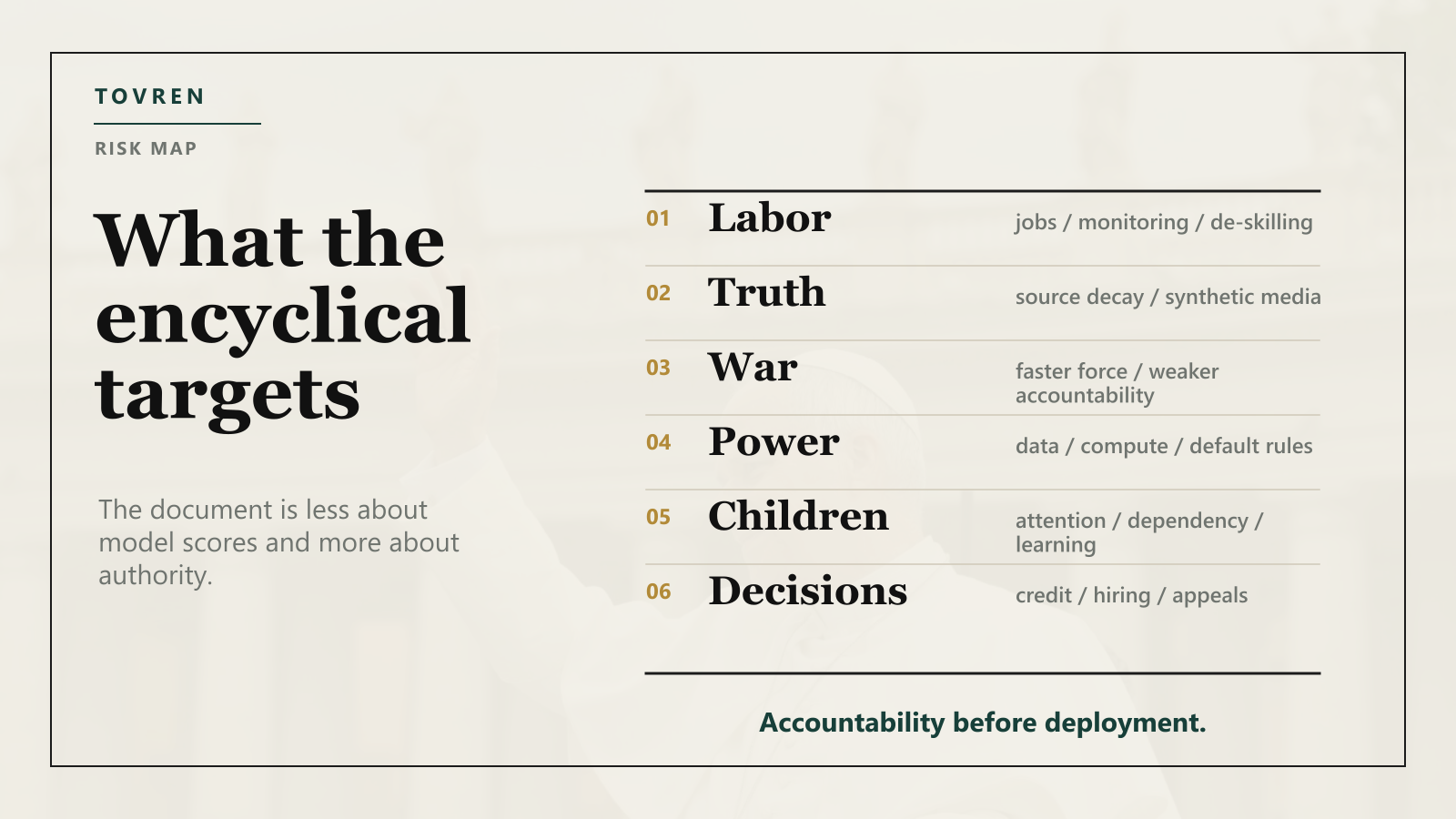
The encyclical’s central move is to shift the AI conversation away from abstract “ethics” and toward power. It asks who designs AI systems, who finances them, who controls the data and infrastructure, who sets the default values, and who is left with no meaningful way to object.
| Area targeted by Magnifica Humanitas | What the document is warning about | Practical AI-policy implication |
|---|---|---|
| Labor | AI and automation can de-skill workers, intensify surveillance, shrink employment, and turn productivity gains into insecurity. | AI deployment should be judged not only by output gains, but by job quality, retraining, wage effects, worker agency, and local economic impact. |
| Truth and public communication | AI can amplify disinformation, blur fact and fiction, and allow powerful actors to shape the collective imagination. | Platforms, media tools, and generative systems need provenance, verification workflows, transparent ranking logic, and stronger support for serious journalism and source-checking. |
| War and security | AI can make military force faster, more automated, less accountable, and easier to initiate. | Lethal or irreversible decisions should remain under responsible human control, with traceable decision chains and international limits on AI arms races. |
| Opaque decisions | AI systems can affect employment, credit, public services, healthcare, security, reputation, and other life opportunities while hiding responsibility behind “the machine.” | High-impact AI needs accountability owners, auditability, recourse, error correction, and clear explanations of what the system measures and optimizes. |
| Concentration of power | Data, platforms, compute, regulatory influence, and technical expertise are concentrated among a small number of highly resourced actors. | AI governance should address data ownership, interoperability, public oversight, access to compute, procurement concentration, and the ability of communities to contest standards set elsewhere. |
| Children and education | AI and digital platforms can weaken attention, judgment, relationships, and the desire to ask hard questions, especially among young users. | Schools and families need AI-use boundaries, age-appropriate safeguards, teacher training, verification habits, and policies that do not put all responsibility on parents. |
| AI labs | Developers carry responsibility because design choices embed assumptions about what humans are, what matters, and what should be optimized. | Labs should treat safety, interpretability, deployment review, social impact, and external criticism as core infrastructure, not communications work. |
Why this is a warning shot for Big Tech
The encyclical does not name a single AI company. That is part of its strength. It is not written as a complaint about one model, one chatbot, or one executive. It is aimed at a structure of power.
The document repeatedly focuses on control over platforms, infrastructure, data, compute, visibility, and participation. In plain AI-policy language, that means the Vatican is treating the AI race as a governance problem, not just a safety or product-design problem.
That matters because the most powerful AI systems are not only tools users choose. They are becoming layers inside search, browsers, coding environments, office suites, education products, customer-service systems, hiring workflows, public administration, security analysis, and military decision support. Once AI becomes infrastructure, “just don’t use it” stops being a serious answer.
This is where Magnifica Humanitas lands hardest on Big Tech. It challenges the idea that the companies with the data, compute, deployment channels, and capital should also get to define the moral defaults of the systems everyone else must live under.
For readers tracking agentic tools, this is not abstract. Browser agents and work agents already create new questions about delegation, oversight, and user trust. Tovren’s AI browser agent prompt pack is useful at the workflow level, but Magnifica Humanitas asks the upstream governance question: what should an agent be allowed to do, who verifies its actions, and what happens when its optimization target conflicts with human judgment?
Chris Olah and Anthropic: significant, but not a PR victory lap
Christopher Olah’s role at the Vatican presentation is significant for one reason: interpretability is one of the few technical fields that directly touches the encyclical’s concern about opacity. If frontier models remain partly mysterious even to their builders, then “trust us” is a weak governance model.
Olah’s published remarks are also notable because they do not pretend labs operate in a pure moral vacuum. He acknowledged that frontier AI labs, including Anthropic, face commercial pressure, frontier-research pressure, geopolitical pressure, pride, and ambition. That is the point. Even sincere labs operate inside incentives that can conflict with the public good.
But this should not be read as a Vatican endorsement of Anthropic, Claude, or any specific company’s safety posture. The better reading is tougher: one of the people building frontier AI publicly accepted that external critics are necessary because insiders cannot fully see what their incentives hide.
That is exactly why the encyclical matters. It does not ask whether one lab is nicer than another. It asks whether any private lab should be allowed to define the social terms of AI deployment without strong public oversight, worker protection, democratic contestation, and moral scrutiny from outside the industry.
This has practical consequences for developers building on frontier systems. For example, if a company is adopting agent frameworks such as Claude-based tooling, the governance work is not finished when the API works. Teams also need permission boundaries, logging, review queues, escalation paths, and rollback plans. Tovren’s Claude Agent SDK and credits guide covers implementation concerns; this encyclical explains why implementation must be paired with accountability.
Risk matrix: who should pay attention now?
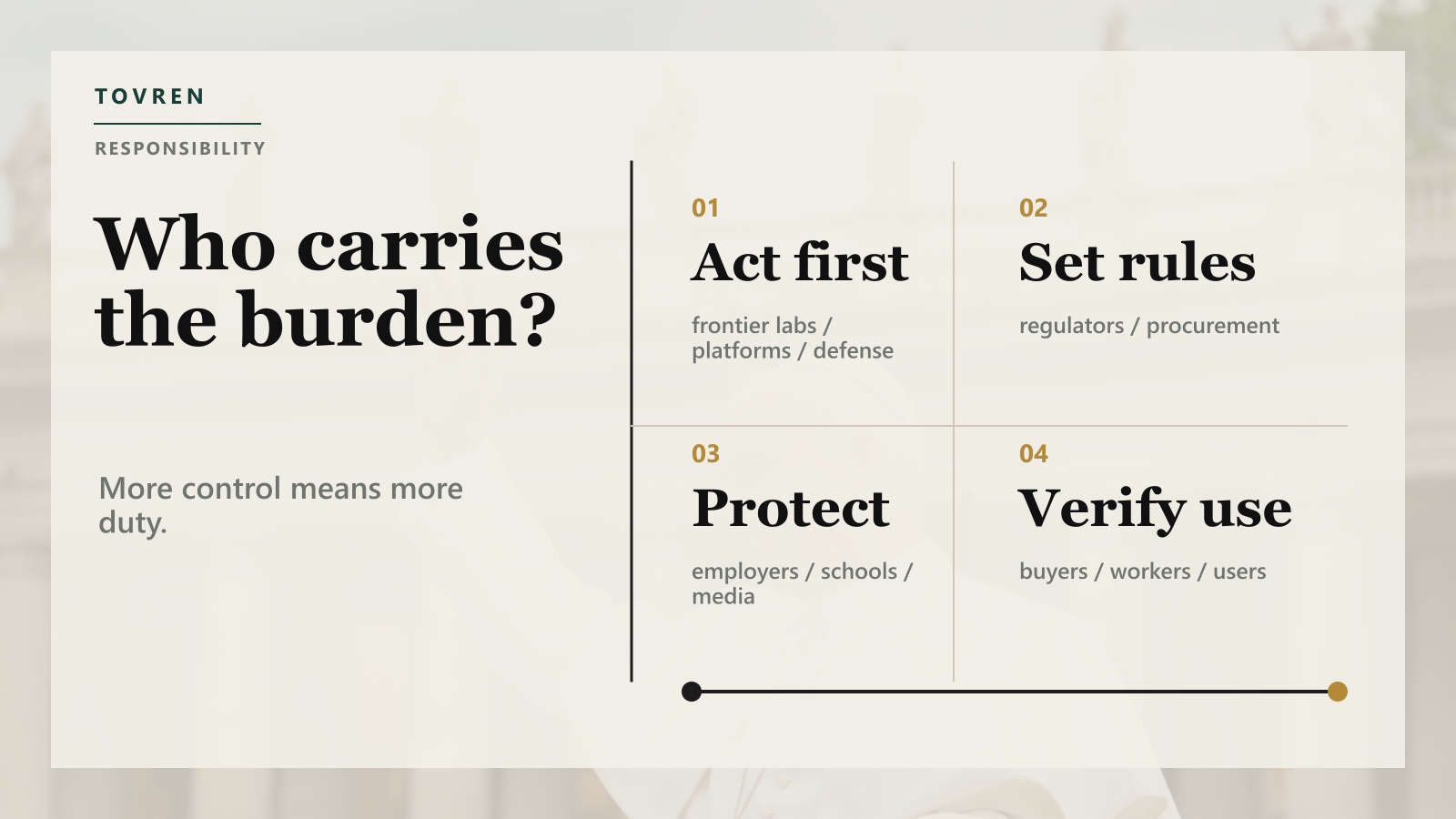
| Stakeholder | Risk highlighted by Magnifica Humanitas | What to do now |
|---|---|---|
| Frontier AI labs | Opaque systems, concentrated power, weak external accountability, and incentive conflicts. | Fund interpretability, publish deployment-risk criteria, invite independent review, document failure modes, and create real routes for outside criticism to change product decisions. |
| Big Tech platforms | Control over visibility, attention, distribution, data, and default user behavior. | Make ranking, recommendation, AI-summary, and content-generation systems more transparent; add provenance; reduce manipulative engagement loops; and separate child-safety obligations from parental burden alone. |
| Employers | Using AI to intensify monitoring, automate judgment, reduce worker agency, or cut labor without a transition plan. | Run a labor-impact review before deployment, involve affected teams, protect appeal rights, and measure whether AI improves work quality rather than only reducing headcount. |
| Workers and unions | De-skilling, job insecurity, surveillance, and opaque productivity scoring. | Negotiate disclosure of AI systems used in evaluation, demand human review for disciplinary or hiring decisions, and push for retraining tied to real roles rather than vague “AI literacy.” |
| Regulators | Private actors setting public rules through infrastructure, data, and market dominance. | Prioritize high-impact use rules, independent audits, recourse rights, data governance, compute concentration, and procurement standards for public-sector AI. |
| Schools and parents | Loss of attention, overreliance on instant answers, synthetic intimacy, and AI-mediated manipulation of minors. | Create age-appropriate AI rules, teach verification and restraint, train teachers, and avoid replacing learning with answer-generation. |
| Business AI buyers | Adopting systems that look objective but encode vendor assumptions, data risks, and hidden failure modes. | Ask vendors for model documentation, data-use terms, audit logs, appeal workflows, security posture, and evidence of testing on your actual use case. |
| News, SEO, and publishing teams | Truth decay, AI-generated summaries without context, and audience dependence on opaque answer engines. | Invest in source transparency, structured expertise, original reporting, and AI-search readiness. See Tovren’s Google AI Mode SEO playbook for the practical search side. |
| Defense and security institutions | Automated or accelerated decisions that lower the threshold for violence and obscure responsibility. | Keep lethal and irreversible decisions under accountable human control, require traceable decision chains, and support international constraints on autonomous weapons. |
What AI companies should do Monday morning
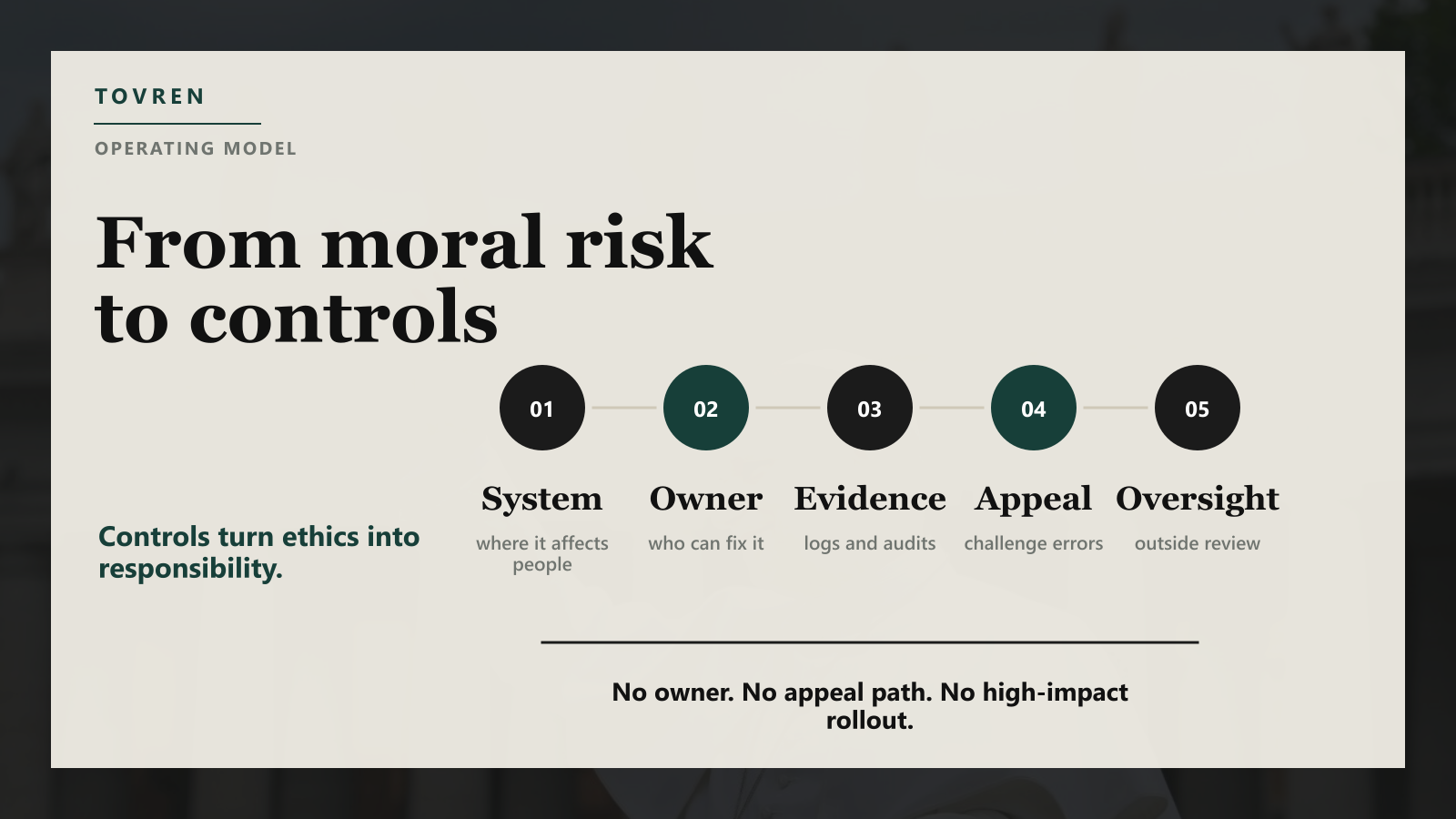
The encyclical is not a compliance framework, but AI companies can translate it into concrete operating controls. The useful move is to stop treating “ethics” as a slide in the investor deck and start treating it as deployment infrastructure.
- Map every high-impact decision point. Identify where your model affects employment, credit, education, healthcare, public services, safety, reputation, pricing, eligibility, or access to opportunity.
- Name the accountable human owner. For each high-impact use, assign a person or team responsible for monitoring, explaining, correcting, and pausing the system.
- Build appeal and correction paths. Affected people need a way to challenge errors. A “model output” should not become a wall no one can climb.
- Audit what the system optimizes. Ask what the model measures, ignores, rewards, penalizes, and treats as success. That is where hidden moral choices live.
- Slow down high-risk deployments. The encyclical explicitly rejects the idea that prudence is anti-progress. In high-impact settings, slower rollout can be responsible engineering.
- Separate safety from marketing. Publish actual risk thresholds, incident processes, evaluation methods, and limitations. Avoid turning “responsible AI” into a brand slogan.
- Invest in interpretability and observability. If even builders have limited understanding of model internals, then monitoring, interpretability research, red-teaming, logging, and post-deployment evaluation are not optional.
- Measure labor effects before and after launch. Track de-skilling, surveillance creep, task fragmentation, wage effects, contractor conditions, and whether AI is augmenting workers or simply extracting more from them.
- Put hard gates around defense and security use. Any use connected to targeting, surveillance, autonomous force, or irreversible harm needs a separate governance channel, not a generic enterprise-sales process.
- Design for plural oversight. Include workers, affected communities, civil society, educators, domain experts, and regulators before standards are locked in.
This is also where local and open-weight AI strategies become relevant. Local deployment is not automatically more ethical, but it can reduce some dependency and data-control risks when used carefully. For readers evaluating that path, Tovren’s local AI setup guide is a useful practical companion to the broader governance question.
What users and businesses should check before adopting AI tools
For most readers, the takeaway is not “avoid AI.” It is to stop adopting AI tools as if procurement, governance, and human impact can be solved later.
| Question to ask before adoption | Why it matters | Good answer looks like |
|---|---|---|
| Will this AI advise, decide, or act? | The risk changes sharply when AI moves from suggestion to decision or autonomous action. | The tool’s role is documented, with human approval required for high-impact actions. |
| Can a person appeal the result? | Opaque automation becomes dangerous when it affects people without recourse. | There is a clear process for review, correction, escalation, and remedy. |
| What data goes into the system? | AI adoption can quietly create privacy, confidentiality, and vendor-dependency risks. | Data-use terms are explicit; sensitive data is minimized; training and retention policies are understood. |
| Does the system provide evidence? | AI can sound authoritative while mixing facts, assumptions, and errors. | Outputs include sources, confidence signals, citations where appropriate, and a verification workflow. |
| How will this affect workers? | Productivity tools can become monitoring tools or job-cutting tools without transition planning. | The business has a worker-impact plan, retraining path, and policy against hidden surveillance creep. |
| Could users form unhealthy dependence? | Systems that simulate empathy, friendship, or care can be useful but risky for vulnerable users. | The tool has boundaries, crisis routing where relevant, and does not pretend to replace human relationships. |
| Is this appropriate for children or students? | Instant answers can weaken attention, effort, and learning if used badly. | There are age limits, teacher guidance, verification exercises, and “when not to use AI” rules. |
| Can we leave this vendor? | AI dependence can become lock-in through data, workflows, agents, and integrations. | There is exportability, fallback tooling, documentation, and a migration plan. |
What the document is not
It is not anti-technology. The encyclical says technology can heal, connect, educate, and protect. Its concern is not the existence of AI, but the power structures and deployment choices around it.
It is not a technical benchmark. It does not rank models, test reasoning scores, compare tool pricing, or evaluate chatbot performance. It asks what kind of society those tools are building.
It is not enforceable law. No company will be fined because it violates Magnifica Humanitas. Its power is different: it gives regulators, civil society, workers, educators, and religious communities a shared vocabulary for judging AI systems.
It is not an endorsement of Anthropic. Chris Olah’s participation matters because it links frontier-AI interpretability to moral scrutiny. It does not certify any company as safe.
It is not only for Catholics. The encyclical is written from Catholic social doctrine, but its AI-policy concerns are not denominational: labor, truth, war, children, accountability, and concentrated private power are public issues.
The policy bottom line
Magnifica Humanitas gives AI governance a moral grammar that is broader than “alignment,” stricter than “innovation,” and more socially grounded than “move fast but be responsible.”
Its most important contribution is not a new technical rule. It is a reframing: AI risk is not only about rogue models, benchmark jumps, or bad prompts. It is about the ordinary deployment of powerful systems into workplaces, schools, media ecosystems, public services, consumer platforms, and military institutions before accountability catches up.
That is why the encyclical should worry Big Tech. It treats the AI race as a test of legitimacy. If a handful of companies build systems that shape knowledge, labor, childhood, public services, and security, then the public will eventually ask a basic question: who gave them that authority?
Five reader actions
- For AI builders: create a public-facing deployment-risk policy that names high-impact use cases, refusal zones, monitoring processes, and appeal mechanisms.
- For employers: run a labor-impact assessment before replacing, monitoring, scoring, or restructuring work with AI.
- For regulators: focus first on automated decisions that affect rights, access, safety, children, public services, and military force.
- For business buyers: require evidence, audit logs, data-use clarity, recourse workflows, and exit options before signing AI vendor contracts.
- For everyday users: use AI as an assistant, not an authority. Verify important claims, avoid emotional dependency, and keep humans in the loop for decisions that affect people’s lives.
Sources
- Vatican full text: Magnifica Humanitas
- Holy See Press Office bulletin on the encyclical release
- Vatican presentation announcement listing Christopher Olah as a speaker
- Pope Leo XIV address at the presentation and promulgation of Magnifica Humanitas
- Anthropic: Chris Olah’s remarks on Pope Leo XIV’s encyclical
- Associated Press report on Pope Leo XIV’s AI encyclical
- Axios analysis of Pope Leo XIV’s AI warnings
FAQ
Why does an AI encyclical matter outside religion?
It signals broader pressure on AI companies around labor, human dignity, education, privacy, and platform power.
What should companies do with this signal?
Companies should review AI governance, transparency, workforce impact, and accountability before public scrutiny increases.
Is this a technical AI issue?
It is partly technical, but the larger issue is social trust, policy, and institutional accountability.