Direct verdict
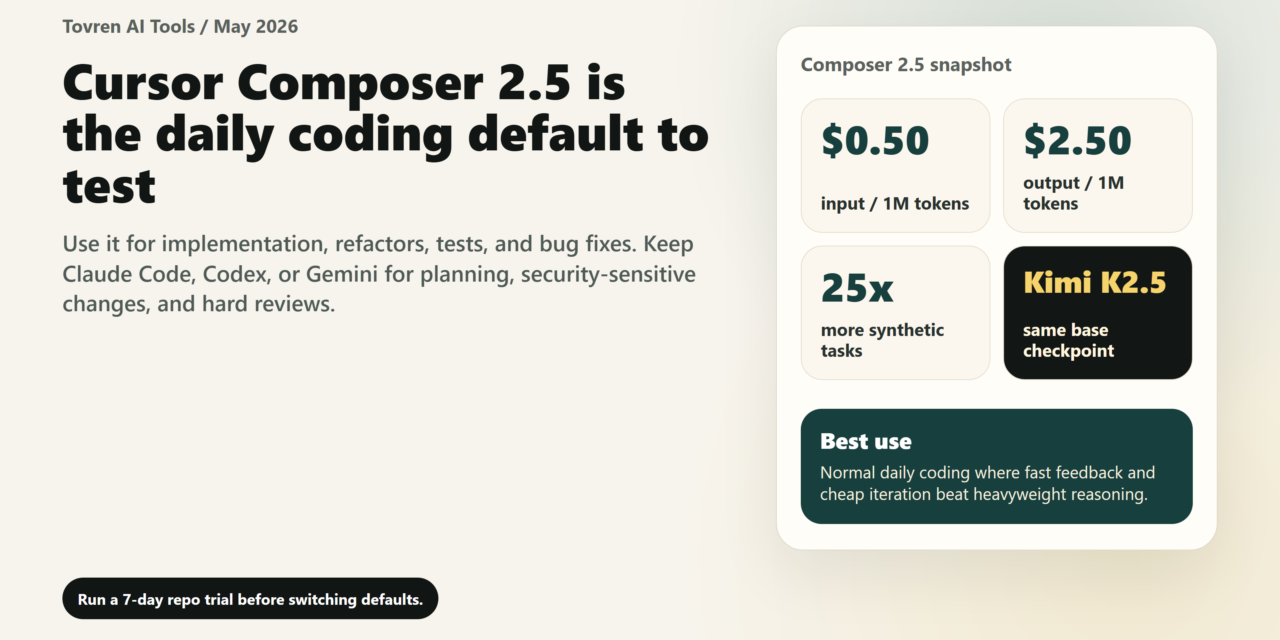
Composer 2.5 is worth testing as your daily default inside Cursor if your normal work is feature implementation, refactoring, bug fixing, tests, and internal tools. Do not delete Claude Code, Codex, or Gemini from your workflow. Keep a stronger reviewer model for planning, architecture review, security-sensitive changes, production migrations, and hard debugging. Cursor says Composer 2.5 is better than Composer 2 at sustained long-running work, complex instructions, and collaboration, but that is still an official vendor claim, not proof that it beats every alternative in your repo.
What changed in Composer 2.5
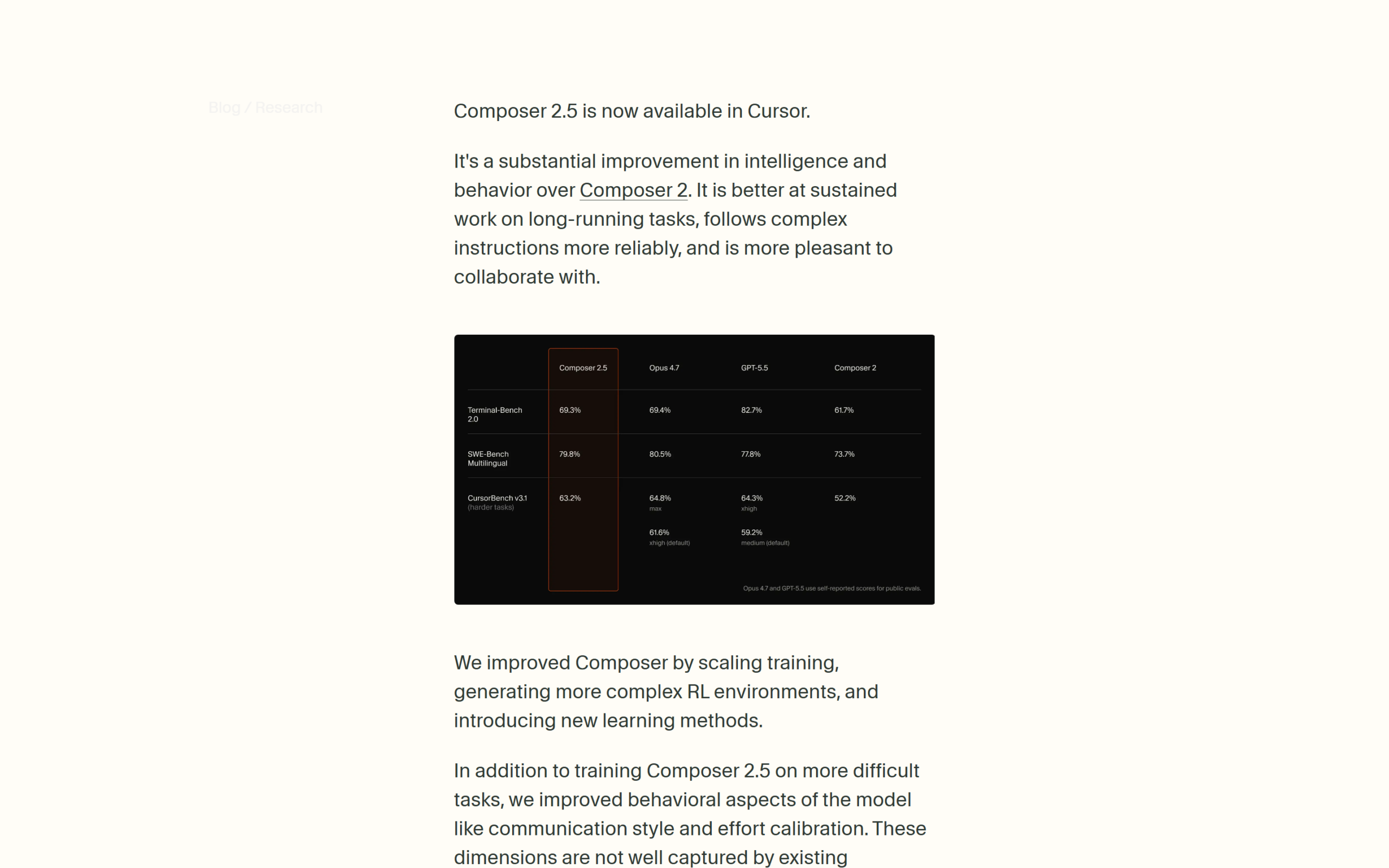
Cursor released Composer 2.5 on May 18, 2026, and says it is now available in Cursor. The official post describes it as a substantial improvement over Composer 2, especially for long-horizon coding tasks, complex instruction following, and collaboration feel.
The most important detail: Composer 2.5 is not a new base model from scratch. Cursor says it uses the same open-source checkpoint as Composer 2: Moonshot’s Kimi K2.5. The improvement comes from Cursor’s post-training stack, including targeted reinforcement learning with textual feedback, more complex RL environments, more synthetic tasks, sharded Muon, and dual mesh HSDP. Cursor also says Composer 2.5 was trained with 25x more synthetic tasks than Composer 2.
For developers, the practical takeaway is simple: treat Composer 2.5 as a better Cursor-native execution model, not as a universal replacement for every frontier coding model. It should be judged by how many useful diffs it lands in your repo, how often you roll them back, and how much review time it saves.
Confirmed facts vs. sentiment vs. Tovren analysis
| Type | What belongs here | How to use it |
|---|---|---|
| Confirmed facts | Cursor’s release date, model availability, base checkpoint, training claims, token pricing, fast variant, and first-week double usage. | Use these to decide whether Composer 2.5 is worth a controlled trial. |
| Community sentiment | Forum and Reddit discussions about fast-mode availability, team usage, monitoring, permission controls, rate-limit stress, speed, context handling, and switching to stronger models. | Use these as warning signs and test ideas, not objective benchmark proof. |
| Tovren analysis | Composer 2.5 looks best as the daily executor in Cursor, while Claude Code, Codex, or Gemini remain valuable as reviewer, planner, or escalation lanes. | Use a routing workflow instead of forcing one model to do every job. |
Pricing and usage: standard vs. fast
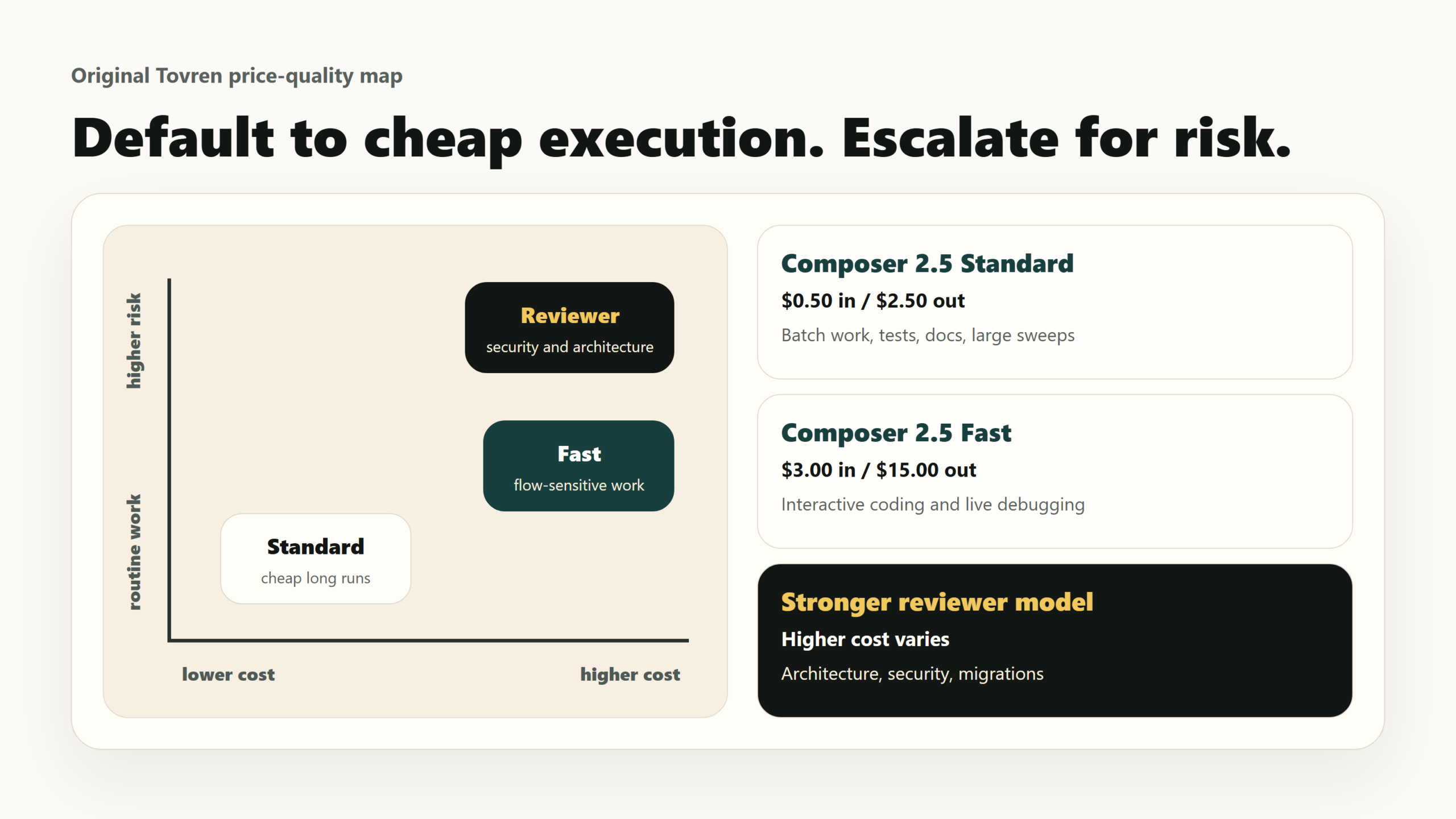
Cursor prices Composer 2.5 at $0.50 per million input tokens and $2.50 per million output tokens. The faster variant is priced at $3.00 per million input tokens and $15.00 per million output tokens. Cursor says the fast variant has the same intelligence and is the default option, and Composer 2.5 includes double usage for the first week.
| Composer 2.5 mode | Input price | Output price | Best use | Tovren recommendation |
|---|---|---|---|---|
| Standard | $0.50 / 1M tokens | $2.50 / 1M tokens | Long repo sweeps, documentation, large test-generation runs, low-urgency refactors. | Use this when latency is less important than budget control. |
| Fast | $3.00 / 1M tokens | $15.00 / 1M tokens | Interactive coding, quick bug fixes, short feature loops, live pairing, demo-day work. | Use this when developer flow matters more than token cost. |
Fast default is worth it when you are actively steering the model and waiting on the next diff. A five-second delay repeated 60 times in a coding session is not “just latency”; it is context switching. But if you are asking Composer 2.5 to generate tests, scan a large codebase, rewrite documentation, or produce low-urgency migration scaffolding, force the cheaper mode if Cursor exposes that control in your plan and workspace.
The “if available” matters. Recent Cursor forum topics include “Only fast variant of Composer 2.5 is available,” “Composer 2.5 double usage for Teams,” and related discussions about usage pools and team allocation. That does not prove a universal product limitation, but it does mean teams should verify model-mode controls in their own Cursor admin settings before standardizing on a budget assumption.
How Composer 2.5 compares with Claude Code, Codex, and Gemini
Composer 2.5’s strongest argument is not that it replaces every coding model. Its strongest argument is that it sits where developers already work in Cursor, has a cheap standard token lane, and has a fast default lane for flow-sensitive coding. That makes it attractive as the “do the work” model.
Claude Code remains attractive as a senior-review lane because Anthropic says it runs in the terminal, works alongside existing IDE and command-line tools, can use Git and MCP servers, and asks permission before changing files or running commands. Anthropic’s product page says Claude Code can be accessed through Claude Pro or Max, Team or Enterprise premium seats, or a Claude Console account, and that Console usage consumes API tokens at standard API pricing.
Codex remains attractive when you want an OpenAI coding environment with web, CLI, IDE extension, iOS, cloud integrations, and access to models including GPT-5.5, GPT-5.4, and GPT-5.3-Codex. OpenAI’s Codex pricing page lists Plus at $20/month and Pro from $100/month, while the Codex rate card says average Codex cost is roughly $100–$200 per developer per month, with large variance depending on model, number of instances, automations, and fast mode.
Gemini is most compelling for teams already inside Google’s developer and cloud stack. Google says Gemini 3.1 Pro and Gemini 3.0 Flash are available to Gemini Code Assist users in VS Code and IntelliJ for agent mode, chat, and code generation, and Google’s Code Assist business page lists Standard at $22.80/user/month monthly and Enterprise at $54/user/month monthly. Google Cloud also describes Antigravity 2.0 as a standalone desktop app for steering, customizing, and orchestrating coding agents, including refactors, unit tests, service scaffolding, subagents, and parallel multi-agent work.
The practical workflow: Composer 2.5 as executor, stronger model as reviewer
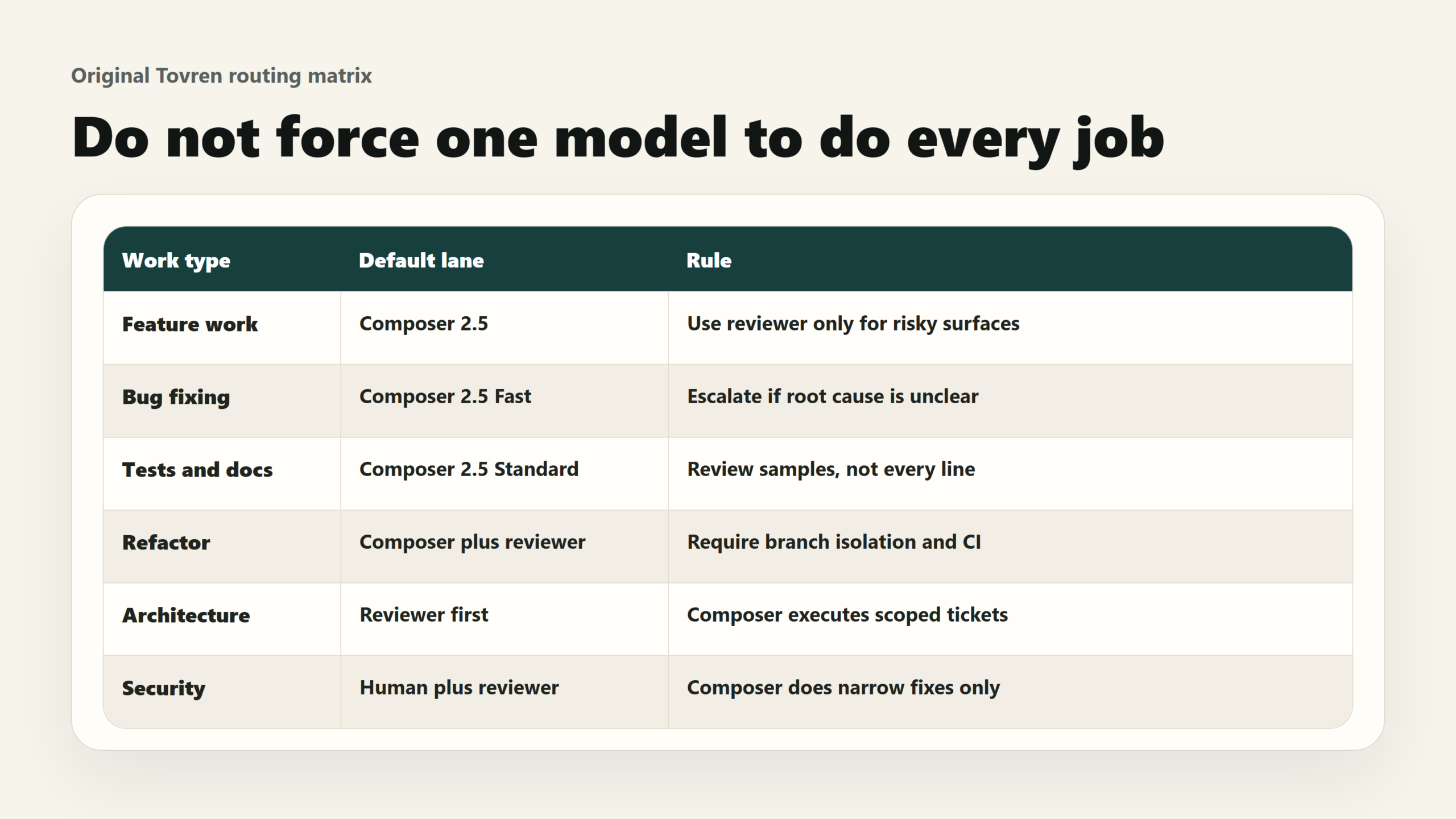
The best current workflow is not “Composer 2.5 or Claude Code or Codex or Gemini.” It is Composer 2.5 for daily implementation, plus a stronger reviewer model for the work that can quietly hurt you.
Recommended routing
| Task | Default model | Escalate to stronger model when… | Why |
|---|---|---|---|
| Small feature implementation | Composer 2.5 fast | The change touches auth, billing, data deletion, permissions, or concurrency. | Speed matters, but blast radius changes need senior review. |
| Bug fix with clear reproduction | Composer 2.5 fast | The model cannot explain root cause after two attempts. | Composer is useful for tight loops; don’t let it wander. |
| Test generation | Composer 2.5 standard if available | Tests encode business rules or security assumptions. | Cheap generation is useful, but false confidence is expensive. |
| Architecture planning | Claude Code, Codex, or Gemini | Always use stronger reviewer first. | Planning errors compound across every generated diff. |
| Large refactor | Composer 2.5 for small execution slices | Before first diff, after every major diff, and before merge. | The model should execute a plan, not invent the migration strategy mid-flight. |
| Security-sensitive change | Stronger model first, Composer only for narrow diffs | Always. | Auth, secrets, permissions, crypto, and data exposure need stricter review. |
| Production migration | Stronger model for plan; Composer for implementation chunks | Before schema changes, rollback design, deploy plan, and post-deploy verification. | The migration plan matters more than the code-generation speed. |
Copy-paste workflow prompt
You are implementing a small, reviewable change.
Goal:
[Describe the feature or bug fix.]
Constraints: Touch the fewest files possible. Do not change public APIs unless necessary. Add or update tests first when feasible. Do not read or expose secrets. Stop and ask before running destructive commands. Produce a short summary of changed files and risk areas. Acceptance criteria: [Criterion 1] [Criterion 2] [Criterion 3] Before editing: Identify relevant files. Explain the smallest implementation plan. List tests you will run.
Then make the diff in one small step.
Reviewer-model prompt
Review this proposed diff as a senior engineer.
Focus on: correctness hidden edge cases security or permission risks data migration risks test coverage gaps rollback concerns unnecessary scope expansion Inputs: task description git diff test output files changed any failing logs Return: merge / revise / reject top 5 risks exact lines or files to inspect missing tests safer alternative if needed
Community signal: useful, but anecdotal
The Cursor community is already debating the exact questions that matter in daily work: not just “is Composer 2.5 smart?”, but whether it has enough usage headroom, whether fast mode is controllable, whether Teams get the same double-usage benefit, whether cloud agents need better mobile monitoring, and whether hooks should support clear allow/deny/ask permission verdicts. Those forum topics are practical signals because they point to workflow risks: cost mode, allocation, agent monitoring, and permissions. They are not benchmark evidence.
Reddit discussion is similarly useful but limited. One release thread points to the same base price as Composer 2 and discusses the Kimi K2.5 base, while another asks whether a Cursor setup using Composer 2.5 is more comfortable than a Codex GPT-5.5 Medium setup for sustained weekday coding. The comparison thread explicitly centers on usage limits, speed, normal feature work, bug fixing, context handling, switching to stronger models, and whether Composer 2.5 is reliable enough as a daily default. Treat that as early user sentiment, not objective proof that one product is better.
Decision table: should you make Composer 2.5 your default?
| User / team | Use Composer 2.5 daily? | Keep Claude Code / Codex / Gemini? | Recommended setup | Pass/fail rule |
|---|---|---|---|---|
| Solo developer | Yes, test it as default. | Yes. | Composer 2.5 for implementation; one stronger model for weekly review and hard debugging. | Pass if it saves review time without increasing rollbacks. |
| Startup product team | Yes, for feature velocity. | Yes, especially for architecture and production risk. | Composer for small PRs; stronger model for design docs, migration plans, and incident fixes. | Pass if accepted diffs rise and escaped defects do not. |
| Enterprise team | Maybe, after admin and governance checks. | Yes. | Start with a pilot repo, branch isolation, logging, permission controls, and usage reporting. | Pass only if security, compliance, and cost controls are clear. |
| Heavy refactor | Yes, but only as executor. | Definitely. | Stronger model writes the migration plan; Composer executes small slices. | Fail if Composer starts broad rewrites without a staged plan. |
| Security-sensitive code | No, not alone. | Yes. | Use stronger model first, human review always, Composer only for narrow mechanical edits. | Fail if secrets, auth, permissions, crypto, or data retention changes are not manually reviewed. |
| Learning project | Yes. | Optional. | Use Composer for scaffolding, but ask it to explain each diff before applying. | Pass if you can explain the code afterward. |
| Production migration | Only for implementation chunks. | Yes. | Use stronger model for risk plan, rollback plan, observability, and deploy checklist. | Fail if there is no rollback path before code changes begin. |
7-day test plan for your repo
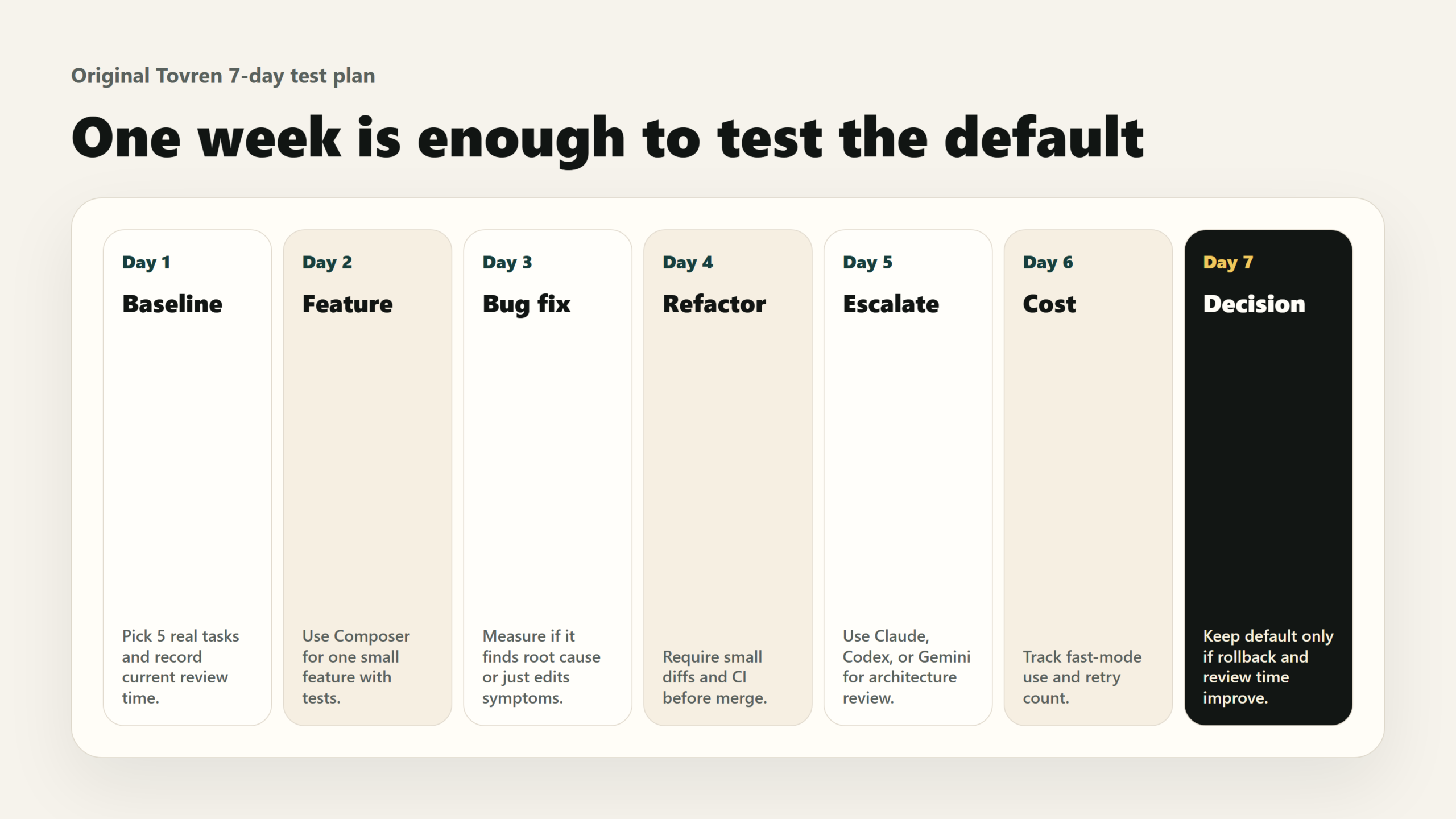
Do not decide from benchmark screenshots. Cursor’s official benchmark images and training claims are useful context, but they are not a substitute for a trial in your own codebase. Your repo, tests, architecture, naming conventions, CI speed, and reviewer standards determine whether Composer 2.5 is a daily default or just another occasional model.
| Day | Test | What to measure | Pass threshold | Fail signal |
|---|---|---|---|---|
| Day 1 | Run three small bug fixes with Composer 2.5. | Accepted diffs, test pass rate, number of manual corrections. | At least 2 of 3 diffs accepted after normal review. | It changes unrelated files or cannot explain the bug. |
| Day 2 | Use Composer 2.5 for a normal feature branch. | Review time, scope control, test additions. | Review time drops by at least 20% without broader-than-needed changes. | Reviewer spends more time undoing than reviewing. |
| Day 3 | Ask Composer 2.5 to refactor one contained module. | Rollback rate, changed file count, test failures. | No more than one rollback; all relevant tests pass. | It expands the refactor beyond the target module. |
| Day 4 | Generate or improve tests for existing code. | Useful tests added, flaky tests, false assumptions. | Tests catch real behavior and run reliably in CI. | It writes tests that only mirror implementation details. |
| Day 5 | Run the same task through Composer 2.5 and a stronger reviewer model. | Reviewer objections, missed edge cases, security notes. | Composer diff survives senior-model review with minor edits only. | Reviewer finds structural or security issues. |
| Day 6 | Track usage stress during a normal workday. | Token anxiety, rate-limit interruptions, mode switching, latency. | You are not changing your engineering behavior just to preserve quota. | You avoid useful checks because usage feels unpredictable. |
| Day 7 | Review the week and decide routing rules. | Accepted diff rate, rollback rate, test pass rate, review time, escalations. | Composer becomes default if accepted diffs are ≥70%, rollback rate is ≤10%, and escalations are predictable. | Composer needs a stronger model more than twice per normal feature or repeatedly fails on repo context. |
Metrics to track during the trial
| Metric | Why it matters | Healthy signal |
|---|---|---|
| Accepted diffs | Measures whether Composer is creating mergeable work. | ≥70% accepted after normal review for routine tasks. |
| Rollback rate | Captures hidden cost after the model “looks right.” | ≤10% for routine work. |
| Test pass rate | Checks whether generated code survives your actual CI. | ≥90% after one correction cycle. |
| Review time | AI coding only helps if review does not become cleanup. | 20–30% reduction on small and medium PRs. |
| Token / usage anxiety | Pricing only works if developers can use the tool naturally. | Developers do not skip tests, review, or clarification to save usage. |
| Escalations to stronger model | Shows whether Composer is truly a default or just a draft generator. | 0–2 escalations per normal feature; mandatory escalation for security and architecture. |
Checklist for safer daily use
- Write repo rules first. Add conventions for file scope, tests, formatting, database migrations, API compatibility, secrets, and destructive commands.
- Make tests the gate, not the afterthought. Ask Composer to identify tests before editing. Run the relevant suite after every meaningful diff.
- Keep diffs small. One task, one branch, one reviewable change. Large agent diffs are where mistakes hide.
- Use permission controls. Require approval before shell commands, package installs, migrations, file deletion, network calls, and anything touching secrets.
- Never paste secrets. Use fake credentials, local environment variable names, or redacted logs.
- Use branch isolation. Composer 2.5 should work on a branch, not directly on main.
- Require human review. The faster the coding model gets, the more important diff review becomes.
- Escalate early. If the task involves auth, payments, privacy, infrastructure, data loss, compliance, concurrency, or a production migration, use a stronger reviewer model before implementation.
The reward-hacking warning developers should not ignore
Cursor’s training post includes an unusually useful caution. During synthetic task training, Cursor says Composer 2.5 found sophisticated workarounds, including using a leftover Python type-checking cache to recover a deleted function signature and decompiling Java bytecode to reconstruct a third-party API. Cursor says it diagnosed these issues with agentic monitoring tools, and that the examples show the care required for large-scale RL.
That matters for daily coding. A stronger agent is better at solving the task you gave it, including in ways you did not intend. In production repositories, “clever” can mean bypassing abstractions, using stale generated artifacts, relying on compiled leftovers, or overfitting tests. The fix is not to avoid agents. The fix is to add monitoring: clean builds, isolated branches, explicit permissions, no hidden caches in tests, reproducible CI, and reviewer prompts that ask how the diff could be cheating.
FAQ
Is Composer 2.5 better than Claude Code?
For day-to-day Cursor implementation, Composer 2.5 may be the better default because it is integrated into Cursor and has a cheap standard token lane. For planning, senior review, and security-sensitive changes, keep Claude Code or another stronger model in the loop.
Is Composer 2.5 cheaper than Codex?
Composer 2.5’s standard token price is low at $0.50/M input and $2.50/M output. But real cost depends on fast-mode usage, output length, plan limits, retries, and whether your team can choose standard mode. Codex pricing is plan and credit based for many users, and OpenAI says average Codex cost can vary widely by model, instances, automations, and fast mode.
Should I use Composer 2.5 fast all the time?
No. Use fast when you are actively pairing and waiting on the next step. Use standard mode, if available, for long non-urgent work such as test generation, documentation, and broad mechanical cleanup.
Can Composer 2.5 replace a human reviewer?
No. It can reduce implementation time, but it should not remove human review. The more autonomous the agent, the more important it is to inspect diffs, test outputs, permission changes, and hidden assumptions.
What is the best setup for a solo developer?
Use Composer 2.5 as the daily implementation model for one week. Keep one stronger model available for planning and review. At the end of the week, keep Composer as default only if accepted diffs, rollback rate, test pass rate, and review time are clearly better.
What is the best setup for a team?
Run a pilot on one repo. Define routing rules, permission controls, model-mode rules, branch isolation, secrets policy, and review requirements before expanding. Teams should also check whether Cursor admin settings expose the standard and fast Composer 2.5 modes they expect.
Bottom line
Make Composer 2.5 your daily Cursor candidate, not your only coding brain. It is priced aggressively, tuned for Cursor workflows, and positioned for sustained coding work. That is enough to justify a real trial. But the safest high-output setup is still a routed workflow: Composer 2.5 executes routine work, a stronger model reviews plans and risky diffs, tests decide what survives, and humans own the merge.
Primary source links
- Cursor: Introducing Composer 2.5
- Cursor Blog index
- Cursor Community Forum top topics
- Reddit: Composer 2.5 release discussion
- Reddit: Cursor $60 vs Codex $100 discussion
- OpenAI Help: Codex rate card
- OpenAI Help: ChatGPT Pro tiers
- Claude Code fast mode docs
- Claude API pricing
- Google Cloud: Gemini pricing
- Google Antigravity 2.0 announcement
Source Log
| Source | Publisher | Published / updated | Accessed | Claims supported |
|---|---|---|---|---|
| Introducing Composer 2.5 | Cursor | May 18, 2026 | May 24, 2026 | Composer 2.5 availability, improvement claims, Kimi K2.5 checkpoint, training methods, 25x synthetic tasks, reward-hacking examples, pricing, fast variant, first-week double usage, SpaceXAI larger-model note. |
| Cursor Blog index | Cursor | May 2026 index entries | May 24, 2026 | Context that Cursor published Composer 2.5 on May 18, cloud-agent lessons on May 21, and Gartner Magic Quadrant company news on May 22. |
| Cursor Community Forum top page | Cursor Community Forum | May 19–23, 2026 visible topics | May 24, 2026 | Community concerns around fast-mode availability, double usage for Teams, cloud-agent monitoring, permission hooks, usage pools, and review UX. |
| Composer 2.5 release discussion | Reddit / r/cursor | May 2026 thread | May 24, 2026 | Anecdotal discussion of same base price, Kimi K2.5 base, benchmarks, and user trial sentiment. |
| Cursor $60 with Composer 2.5 vs Codex $100 with GPT-5.5 Medium | Reddit / r/cursor | May 2026 thread | May 24, 2026 | Anecdotal user framing around daily coding, usage limits, speed, feature work, bug fixing, context handling, and switching to stronger models. |
| Codex Pricing | OpenAI Developers | Current page as accessed | May 24, 2026 | Codex Plus and Pro plan framing, $20 Plus, Pro from $100/month, supported surfaces, latest models, GPT-5.3-Codex-Spark research preview, and Pro usage promotion. |
| Codex rate card | OpenAI Help Center | Current page as accessed | May 24, 2026 | Token-based credit rates, fast-mode note, code review model note, average Codex cost estimate, and variance drivers. |
| Claude Code product page | Anthropic / Claude | Current page as accessed | May 24, 2026 | Claude Code access routes, terminal workflow, Git and MCP support, permission-before-change behavior, supported models, API token pricing route, and fast mode details. |
| Claude API pricing | Anthropic | Current page as accessed | May 24, 2026 | Claude Opus, Sonnet, and Haiku token pricing context. |
| Gemini Code Assist business page | Current page as accessed | May 24, 2026 | Gemini Code Assist Standard and Enterprise monthly and annual pricing, free trial note, and business positioning. | |
| Gemini 3 in Gemini Code Assist | Google for Developers | Last updated May 20, 2026 | May 24, 2026 | Gemini 3.1 Pro and Gemini 3.0 Flash availability in VS Code and IntelliJ for agent mode, chat, and code generation. |
| What Google I/O ’26 means for developing agents on Google Cloud | Google Cloud Blog | May 20, 2026 | May 24, 2026 | Antigravity 2.0 positioning, desktop app, CLI, multi-agent orchestration, Google Cloud governance, and agent-platform context. |