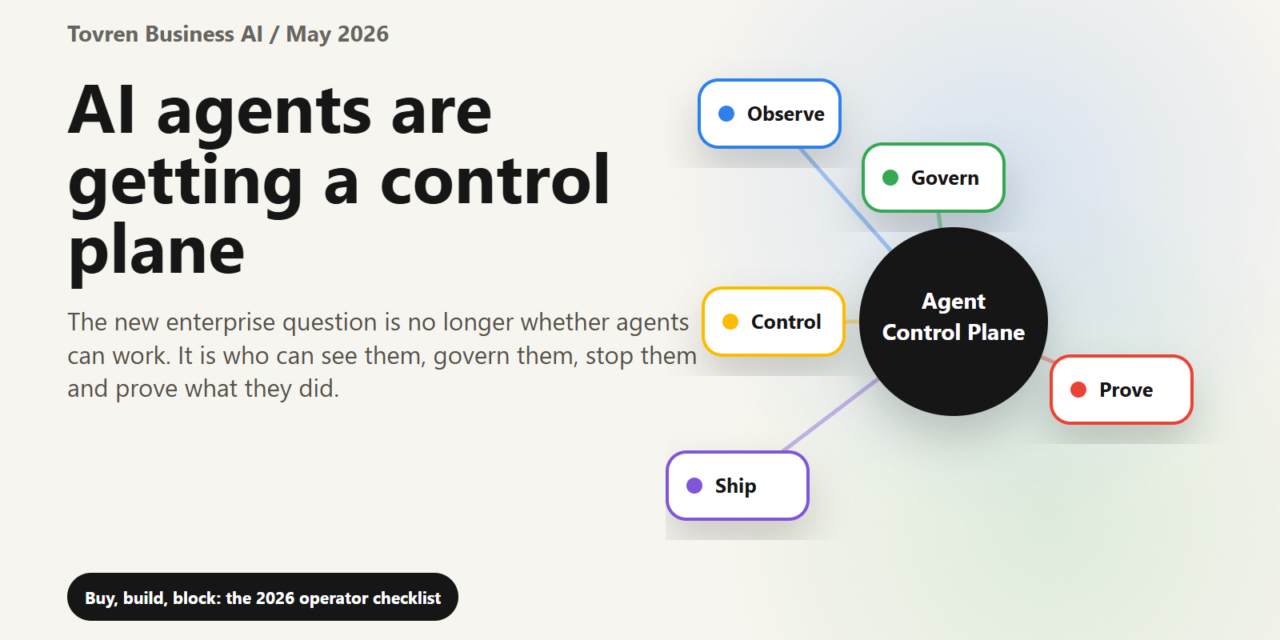
Short answer: An AI agent control plane is useful when agents can touch tools, data, or production workflows. Buy or build one only if it gives you policy, approval, logging, rollback, and cost controls that normal chat tools cannot provide.
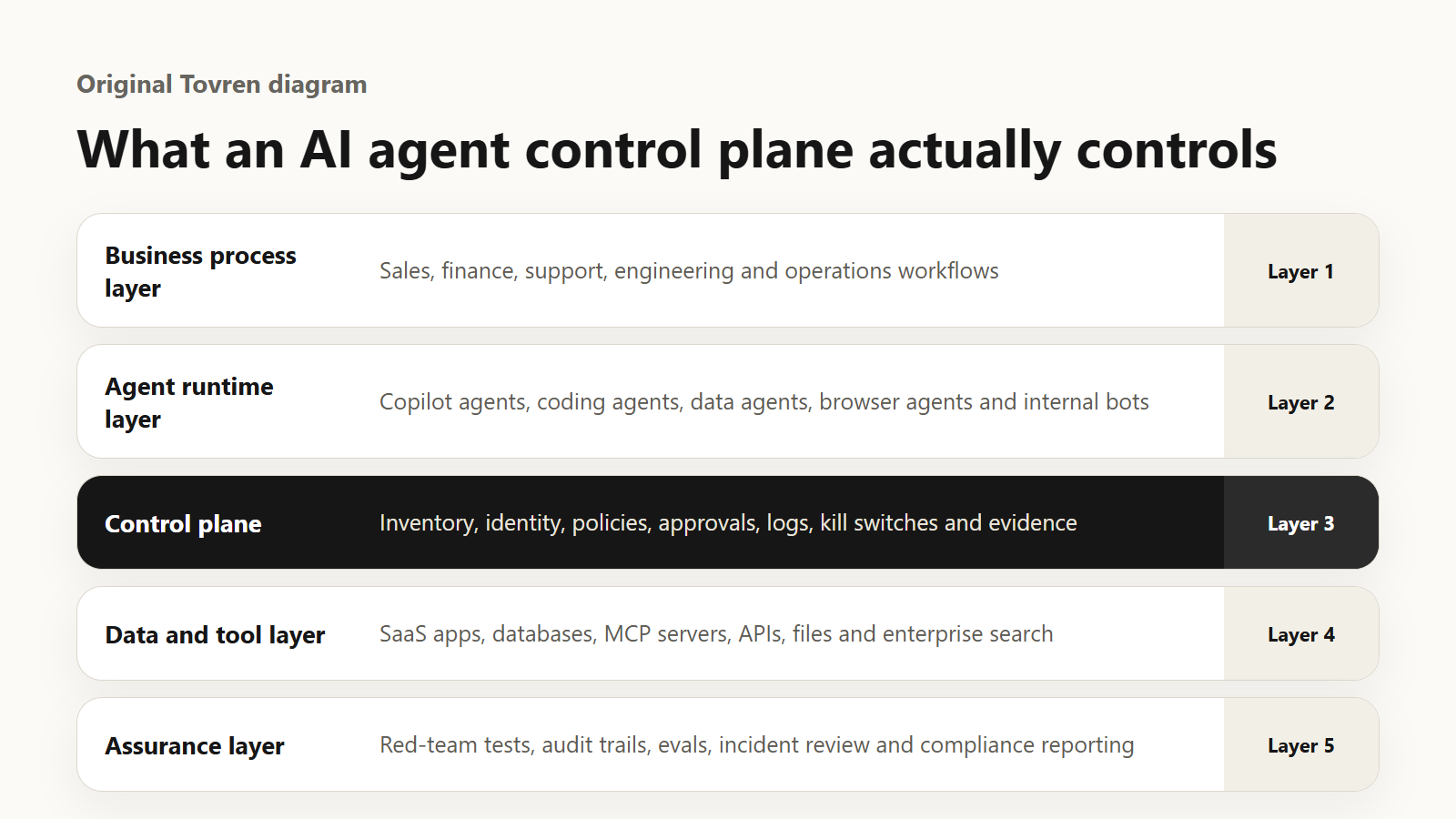
Verdict: enterprise AI is moving from “which model should we use?” to “who controls what the agent is allowed to do?” The businesses that win in 2026 will not be the ones with the most agents. They will be the ones with the clearest control plane: inventory, identity, permissions, context, runtime policy, endpoint visibility, evaluation, audit evidence, and kill switches.
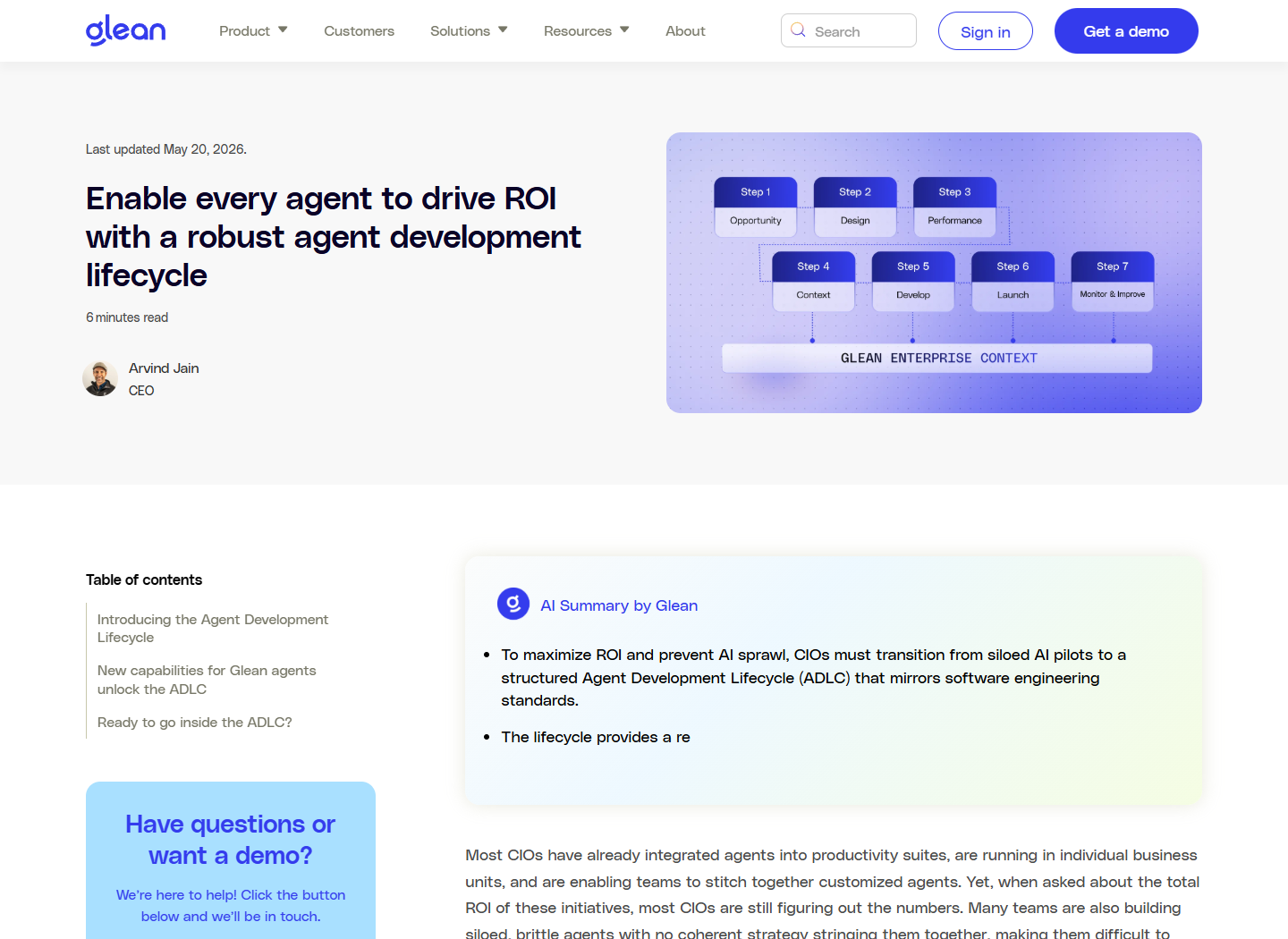
That sounds less glamorous than a frontier model demo. It is also where the real enterprise stack is forming. In May 2026 alone, Glean introduced an Agent Development Lifecycle for building and measuring agents; Collibra launched AI Command Center as an AI control plane; Operant launched Endpoint Protector for shadow AI, coding agents, and MCP workflows; and Microsoft disclosed both its open-source Agent Governance Toolkit and MDASH, a multi-model agentic security harness. These are not identical products. Together, they point to the same conclusion: agents are becoming operational infrastructure.
The shift: agents are no longer chatbots
A chatbot returns text. An agent can call tools, use context, trigger workflows, write code, interact with systems of record, and sometimes run autonomously. That changes the enterprise risk model. The old control points — SaaS admin settings, EDR, CASB, DLP, model selection, and annual AI review boards — do not fully answer the new question: what exactly is each agent doing, on whose authority, with which data, through which tool, and with what evidence trail?
Microsoft’s 2026 Work Trend Index makes the adoption pressure visible: active agents in the Microsoft 365 ecosystem grew 15x year over year, and Microsoft argues that IT needs to treat agents as managed entities with identities, permissions, policy enforcement, and lifecycle management. That is the heart of the control-plane problem.
The provocative version: your enterprise AI stack is no longer just an LLM, a prompt library, and a few workflow automations. It is becoming an operating layer for non-human workers.
Confirmed facts vs. Tovren analysis
| Confirmed fact | What it means | Tovren analysis |
|---|---|---|
| Glean’s ADLC spans Opportunity, Design, Performance, Input, Develop, Launch, and Monitor & Improve. | Agent programs are being packaged like software delivery lifecycles, not one-off prompt experiments. | Use lifecycle discipline before procurement. A tool cannot save an agent with no owner, metric, or business process. |
| Collibra describes AI Command Center as a unified control plane with registry, trust signals, traceability, dashboards, and compliance templates. | Data governance platforms are expanding into AI operations and agent oversight. | Buy a registry/control plane if you already have multiple teams shipping agents faster than governance can track them. |
| Operant Endpoint Protector targets AI tools, coding agents, and MCP-connected workflows directly at endpoints. | Agent risk is shifting to laptops, IDEs, MCP clients, and local tool loops, not only cloud APIs. | Endpoint AI security becomes mandatory when developers or business users run agents that touch code, files, credentials, or customer data. |
| Microsoft AGT is an MIT-licensed toolkit for runtime policy, identity, sandboxing, SRE, compliance, and marketplace governance. | Some control-plane functions can be built or embedded as policy-as-code. | Build your policy layer if agents are custom, regulated, or deeply integrated with internal systems. |
| Microsoft MDASH used more than 100 specialized AI agents and helped find 16 Windows vulnerabilities, including four critical RCE flaws. | Agent systems can perform consequential security work at scale. | If defenders can operationalize agent swarms, businesses must assume attackers, insiders, and over-permissioned internal agents can too. |
What businesses should buy in 2026
1. Buy an AI asset registry before buying more agents. You need a single place to answer: what agents exist, who owns them, what data they use, what tools they can call, what business process they affect, and whether they are approved for production. Collibra’s AI Command Center is explicitly aimed at that registry/control-plane problem, consolidating AI use cases, models, and agents into a governed view and linking systems to data, policies, and use cases.
2. Buy lifecycle tooling if business teams are building agents. If your sales, support, finance, HR, and engineering teams are all making agents, you need more than a sandbox. Glean’s ADLC points to the practical minimum: opportunity selection, design, performance metrics, context, development, launch governance, and monitoring. Its product announcements also include debug and trace views, an expanded agent sandbox, agent library controls, access policies, and agent insights.
3. Buy endpoint and MCP defense where agents touch workstations. This is the layer many AI governance programs still miss. Operant argues that shadow AI has moved beyond browser tabs into AI IDEs, coding agents, MCP clients, plugins, and encrypted tool channels. Endpoint Protector is positioned to discover, detect, and defend across prompts, MCP servers, tools, skills, and plugins at the endpoint. If your developers use coding agents or your teams are experimenting with MCP-connected assistants, endpoint-level agent visibility should be on the 2026 shortlist.
4. Buy evidence, not slogans. Ask vendors for audit trails, policy logs, tool-call traces, approval workflows, model/data lineage, incident response hooks, and retention controls. Collibra’s product resources describe assessments, registry assets, automated traceability, AI Trust Score, and dashboards for performance, risk, and governance health. Those are the right nouns. Procurement should now test whether they work in your environment.
Pricing note: expect enterprise pricing opacity. Glean documents Enterprise Flex as per-user/per-month seats plus pooled usage credits, but dollar prices were not listed in the verified documentation. Operant says pricing is usage-based and not by number of users, but also routes buyers to request pricing. Microsoft AGT is open source under MIT license, but you still pay to operate it.
What businesses should build
Build your policy baseline. Even if you buy a control plane, you must define the rules. Which agents can read customer data? Which can write to Salesforce, Workday, ServiceNow, SAP, GitHub, or production infrastructure? Which actions require human approval? Which secrets, files, and data classes are never allowed in prompts?
Microsoft’s Agent Governance Toolkit is useful here because it treats governance as runtime enforcement, not a PDF policy. The toolkit includes a stateless policy engine, cryptographic identity, execution rings, SRE practices, compliance mapping, plugin lifecycle management, and reinforcement-learning training governance. Its GitHub examples show simple allow/deny decisions for tool use, such as allowing web search while blocking shell execution.
Build an evaluation and incident loop. A production agent should have acceptance tests, red-team cases, fallback behavior, ownership, SLOs, monitoring, and a rollback path. That is not bureaucracy. That is the only way to know whether an agent is improving work or quietly creating risk.
Build a context architecture. Agents fail when they use stale, overbroad, or unauthorized context. Collibra’s MCP Server positioning and Glean’s enterprise context framing both show that context is becoming a governed resource, not a pile of documents. The policy should be simple: an agent’s access must never exceed the user, service account, or process it represents.
What businesses should block
Block unregistered production agents. Block direct write access to systems of record until tool calls are logged, scoped, and reversible. Block unmanaged MCP servers. Block shell execution from untrusted agents. Block agents that can read secrets, customer records, payroll data, source code, or legal documents without a documented purpose and owner. Block “temporary” agents that become permanent business infrastructure without review.
Also block the fake comfort of prompt-only governance. OWASP’s 2026 agentic risk framework identifies critical risks for autonomous systems that plan, act, and make decisions across workflows. Polite instructions in a system prompt are not the same as runtime policy, least privilege, traceability, and human approval.
Comparison table: the 2026 agent control-plane stack
| Layer | Buy | Build | Block |
|---|---|---|---|
| Inventory | AI registry for agents, models, use cases, owners, and lifecycle status. | Internal naming, tagging, and ownership standards. | Agents without owner, business case, or production status. |
| Identity and access | Integration with IdP, IAM, data catalog, and app permissions. | Agent identity model and least-privilege policy. | Shared service accounts and standing admin privileges. |
| Runtime policy | Inline guardrails, tool-call controls, approval workflows. | Policy-as-code, test cases, exception handling. | Direct writes, shell execution, and sensitive data access without enforcement. |
| Context | Governed enterprise search, MCP gateway, lineage-aware data access. | Context freshness, scope, and permission rules. | Flat document dumps and uncontrolled connectors. |
| Endpoint/MCP | Endpoint visibility for AI tools, coding agents, and MCP clients. | MCP allowlist, logging, approval, and revocation process. | Unknown MCP servers and plugins with broad tool access. |
| Evidence | Dashboards, trace logs, assessments, risk scores, audit exports. | Incident playbooks and compliance evidence schema. | Agents that cannot explain what they did and why. |
A 30-day action plan
Days 1–7: Freeze the sprawl. Name an agent owner in IT or AI platform engineering. Inventory obvious agents: Copilot agents, Glean agents, Salesforce/ServiceNow/Zendesk assistants, coding agents, MCP clients, internal LangChain/LangGraph/CrewAI builds, and automation tools with LLM steps. Create three statuses: experiment, limited production, and production.
Days 8–14: Define the minimum control plane. For every production or limited-production agent, capture owner, business process, data classes, model or agent platform, tools, permissions, human approval points, logs, and rollback method. Choose whether your near-term registry lives in Collibra, ServiceNow, Jira, a data catalog, a GRC tool, or a temporary spreadsheet. The destination matters less than making invisible agents visible.
Days 15–21: Add runtime enforcement. Pick three non-negotiable policies: no secrets in prompts, no direct writes to systems of record without approval, and no unmanaged MCP/tool execution. Use your existing IAM, DLP, endpoint tooling, or a purpose-built agent security layer. For custom agents, evaluate Microsoft AGT or a comparable policy-as-code layer.
Days 22–30: Run a control-plane pilot. Select two high-value agents and one risky shadow-agent pattern. Put them through registration, policy review, test cases, trace review, monitoring, and incident simulation. The goal is not to create a committee. The goal is to prove that your organization can answer four questions in under ten minutes: what agents exist, what they can do, what they did, and who can stop them.
Checklist table: minimum viable agent governance
| Control | Pass condition | Owner |
|---|---|---|
| Agent registry | Every production agent has owner, purpose, lifecycle stage, data scope, and system access documented. | AI platform / IT |
| Least privilege | Agent permissions are narrower than or equal to the human/process authority they represent. | Security / IAM |
| Tool-call logging | Every tool call records agent, user or service identity, input, output, timestamp, and decision path. | Engineering |
| Human approval | High-impact writes, external messages, financial actions, legal actions, and infrastructure changes require approval. | Business owner |
| Endpoint visibility | Security can see AI IDEs, MCP clients, local agents, plugins, and sensitive prompt/tool activity. | CISO |
| Evaluation suite | Each agent has regression tests, abuse cases, context-freshness checks, and failure thresholds. | AI engineering |
| Kill switch | Security or platform operations can disable an agent, connector, tool, or MCP server quickly. | Platform operations |
Source-backed takeaway
The control-plane thesis is not hype. Glean is formalizing an agent lifecycle. Collibra is selling a unified AI control plane. Operant is pushing endpoint and MCP defense. Microsoft is open-sourcing runtime governance and using agentic systems for serious security work. These are separate moves, but the pattern is clear: agent governance is becoming the enterprise AI stack.
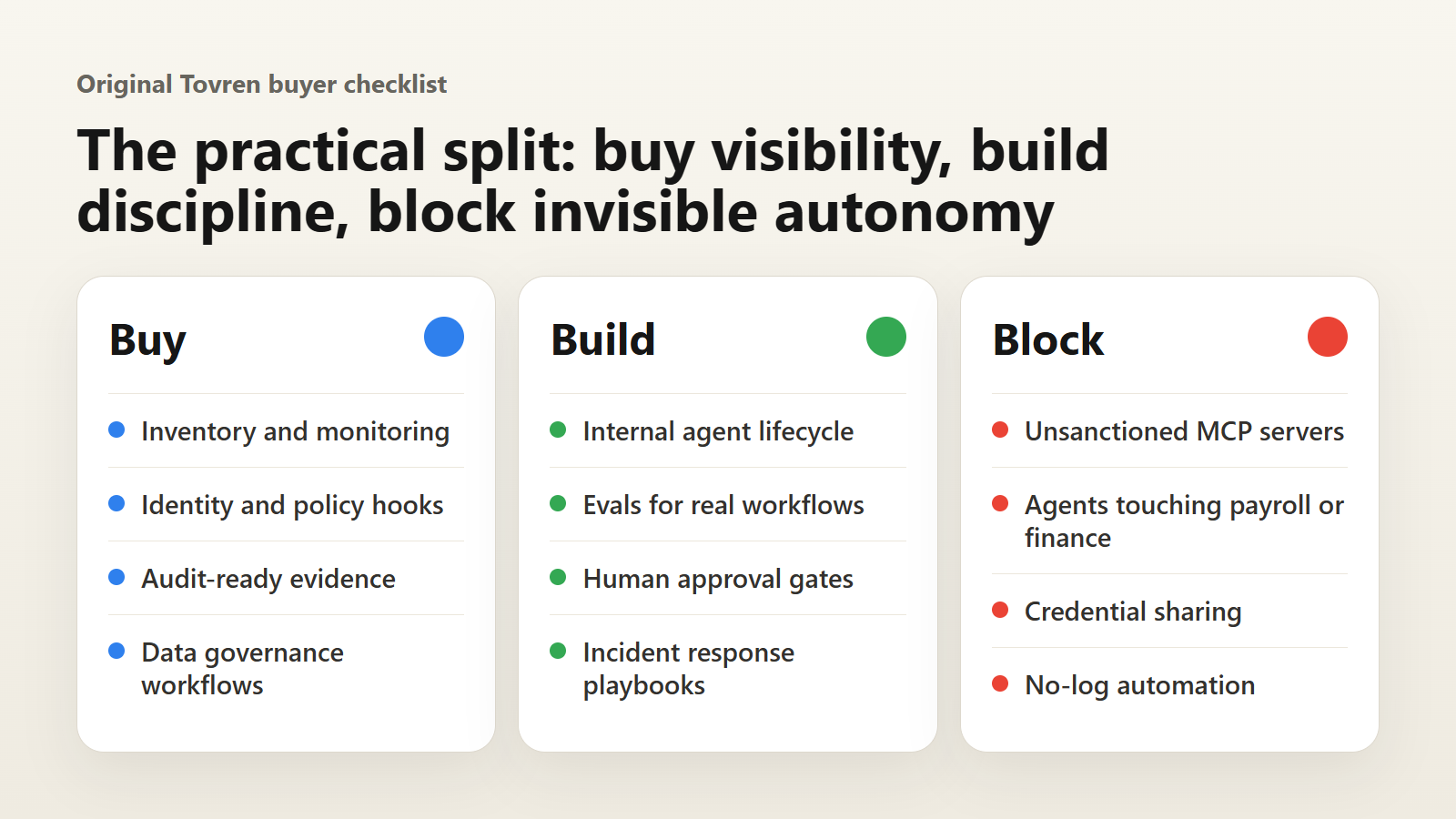
The best 2026 strategy is not “buy one platform and declare governance solved.” Buy the layers that give visibility and control fastest. Build the policies and evidence model you must own. Block agent behaviors that your organization cannot observe, explain, or reverse. That is the practical line between agentic AI as leverage and agentic AI as unmanaged shadow infrastructure.
Related Tovren Hubs
For follow-up reading, browse Business AI, Automation & Agents, Policy & Risk, and AI Tools.
Source Log
Last verified: May 20, 2026. GPT Pro Extended generated the article package in the Tovren Editorial OS project; Codex then checked source links, cleaned malformed browser extraction characters, inserted vetted visuals, and verified WordPress rendering.
- Glean: Agent Development Lifecycle press release – May 12, 2026 ADLC launch, enterprise agent governance and measurement framing.
- Glean: robust agent development lifecycle – ADLC stages and product framing around agent ROI, monitoring and lifecycle discipline.
- Collibra: AI Command Center – AI Command Center positioning as a control plane, registry, trust signals and compliance workflow.
- Collibra launch announcement – May 6, 2026 launch details and enterprise agentic AI oversight claims.
- Operant AI Endpoint Protector announcement – May 4, 2026 endpoint visibility for AI tools, coding agents and MCP workflows.
- Microsoft Security: MDASH – May 12, 2026 multi-model agentic scanning harness, 100+ agents and Windows vulnerability findings.
- Microsoft Open Source: Agent Governance Toolkit – April 2, 2026 MIT-licensed open-source runtime governance toolkit.
- GitHub: microsoft/agent-governance-toolkit – Repository, license, packages and policy-enforcement examples.
- Microsoft 2026 Work Trend Index – May 5, 2026 report citing 15x year-over-year growth in active Microsoft 365 agents.
FAQ
What is an AI agent control plane?
An AI agent control plane is the operational layer that inventories agents, manages identity and permissions, enforces runtime policies, monitors tool calls, records audit evidence, and lets teams approve, suspend, or retire agents.
Is agent governance the same as model governance?
No. Model governance focuses on models, datasets, validation and compliance. Agent governance also covers actions: tools, permissions, workflows, memory, context, identity, approvals and runtime behavior.
Should enterprises buy or build agent governance?
Usually both. Buy registry, dashboard, security and integration layers when speed and coverage matter. Build internal policies, approval rules, evaluation suites, ownership models and evidence standards.
What should be blocked first?
Unregistered production agents, unmanaged MCP servers, direct writes to systems of record, shell execution from untrusted agents, and agents with broad access to secrets, customer data, payroll data, legal materials or source code.