GENE-26.5 robotics is a serious signal, not a purchase decision. Genesis AI’s May 2026 launch deserves attention because the company is claiming a robotics foundation model for human-level physical manipulation, backed by a $105 million seed round and a full-stack robotics strategy. But for executives, operations leaders, warehouse buyers, manufacturing teams, lab automation managers, robotics engineers, and AI builders, the useful question is narrower: can the demo predict performance in your facility, with your objects, your cycle-time requirements, your safety constraints, and your data-rights standards?
The answer today is: treat GENE-26.5 as an early pilot candidate, not a production-ready automation system. The public materials describe a foundation model system, a dexterous hand, a data engine, and a demo video. They do not, based on the verified sources provided for this article, establish production reliability, safety certification, facility integration maturity, long-duration uptime, or commercial service-level guarantees.
TL;DR: what buyers should do now
- Do not buy from the demo alone. The demo examples are useful for screening technical direction, not for validating deployment reliability.
- Ask for task-specific evidence. Require test results on your object types, workcell constraints, lighting, clutter, tolerances, throughput, and failure modes.
- Separate vendor claims from buyer verification. Genesis calls GENE-26.5 a robotic brain with human-level physical manipulation capability; buyers should translate that into measurable task success rates.
- Run a 30-day pilot only if the task is bounded. Start with one repeatable manipulation workflow, not a general-purpose robot mandate.
- Prioritize safety and non-routine conditions. OSHA notes that many robot accidents occur during programming, maintenance, testing, setup, or adjustment, so the pilot must test those moments, not just normal operation.
- Interrogate data rights early. TechCrunch reported that Genesis says the model is trained on massive amounts of human-based internet videos, while the press release did not mention compensation. Buyers should clarify training data, customer data use, retention, and indemnity before sharing operational data.
The news hook: what Genesis AI announced
Genesis AI announced GENE-26.5 on May 6, 2026. In its official press release, the company describes GENE-26.5 as the first robotic brain to give robots human-level physical manipulation capabilities. Genesis also describes itself as a global full-stack robotics company.
The company says GENE-26.5 is an AI foundation model purpose-built for robotics and designed to absorb massive amounts of data and environments. Genesis says the system combines two proprietary components: a human-scale dexterous robotic hand that enables direct skill transfer from humans to robots, and a new data engine.
Genesis also says it released a video showing complex robotic tasks and that it will soon unveil its first general-purpose robot. The company says it raised $105 million in seed funding and is backed by Eclipse, Khosla Ventures, Bpifrance, HSG, Eric Schmidt, Xavier Niel, Daniela Rus, and Vladlen Koltun.
Its official blog frames GENE-26.5 as the company’s first robotic foundation model system and the initial public release in the GENE family. Genesis says manipulation is the core robotics problem and argues that robotics requires tight coordination between sensors, actuators, control, data, and the model itself.
What the demo reportedly showed
TechRadar reported that Genesis’s demo showed robot hands performing tasks such as wiping egg yolk while preparing eggs, solving a Rubik’s Cube, lab-assistant work, and making a smoothie. These examples matter because they point to dexterity, hand-object interaction, sequential manipulation, and tool-like use. They should not be treated as proof that the system can run safely and economically in a warehouse, factory, or lab.
That distinction is the core buyer issue. A robotics demo can be impressive for three different reasons: the hardware is capable, the model generalizes, or the task was carefully staged. Buyers need to know which one they are looking at.
| Item | What is known from the provided sources | Buyer interpretation | What not to assume |
|---|---|---|---|
| GENE-26.5 launch | Genesis announced GENE-26.5 on May 6, 2026. | This is a fresh market entry from a well-funded robotics company. | Do not assume commercial maturity from launch timing. |
| Vendor claim | Genesis describes it as a robotic brain for human-level physical manipulation. | Use this as a hypothesis to test against measurable manipulation tasks. | Do not treat “human-level” as a verified operational benchmark. |
| Architecture claim | Genesis says it combines a dexterous robotic hand and a new data engine. | The company is pursuing a full-stack approach, not only a software layer. | Do not assume it will fit existing robot arms, grippers, PLCs, or safety systems without integration testing. |
| Reported demo tasks | TechRadar reported examples including egg-yolk wiping, Rubik’s Cube solving, lab-assistant work, and smoothie making. | The demo suggests dexterity and complex manipulation are central to the pitch. | Do not assume cycle time, uptime, safety, repeatability, or cost per successful pick. |
| Funding | Genesis says it raised $105 million in seed funding. | The company may have resources to build hardware, data, and robot systems. | Do not equate funding with validated customer ROI. |
Demo versus reality: the buyer’s translation table
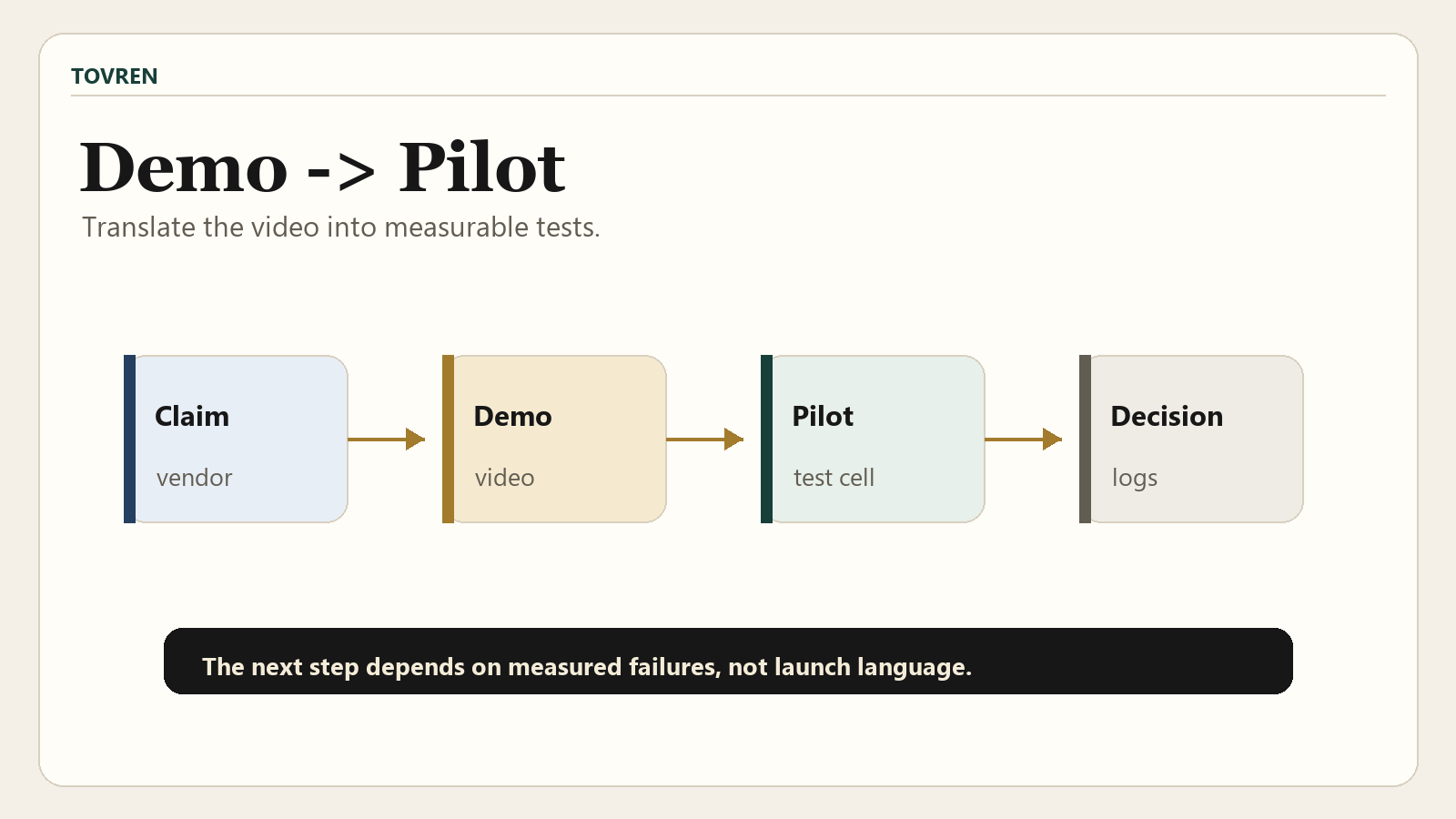
The right way to read a robotics foundation model demo is to translate every visible capability into a deployment question. A demo answers “can this be shown?” A buyer needs to answer “can this run repeatedly, safely, economically, and maintainably under our constraints?”
| Demo signal | Why it matters | Business verification step | Pass condition |
|---|---|---|---|
| Dexterous hand manipulation | Many valuable automation tasks involve irregular objects, soft materials, tools, or fine contact. | Test your exact object set, including damaged, wet, slippery, reflective, flexible, and partially occluded items. | Consistent success across the long tail, not only clean examples. |
| Human-to-robot skill transfer claim | Could reduce programming burden if it works reliably. | Have your operator teach a task, then test whether another unit or shift can reproduce it. | Low setup time, reproducible behavior, and clear rollback when the learned skill fails. |
| Foundation model framing | Suggests broader generalization than task-specific robotics programming. | Run out-of-distribution tests: changed lighting, altered object placement, unfamiliar packaging, and interrupted sequences. | Graceful degradation, not unsafe improvisation. |
| Lab-assistant work | Lab automation needs precision, contamination control, traceability, and safe handling. | Test with dummy labware, labels, lids, liquid volumes, and exception handling before live samples. | Auditable step logs and safe stop behavior during uncertain actions. |
| Food-preparation examples | Food tasks involve deformable objects, hygiene, contact, and cleaning. | Test cleaning, residue, tool switching, object slippage, and sanitation workflow boundaries. | Clear separation between manipulation ability and deployable food-process compliance. |
Who should pay attention now?
GENE-26.5 is most relevant to teams that have valuable manipulation tasks where traditional automation is too brittle, too expensive to reprogram, or too limited by conventional grippers. It is less relevant to teams that only need high-speed, fixed-path, already-solved automation.
Likely early-fit environments
- Warehouses with varied SKUs, irregular packaging, returns processing, kitting, or exception handling.
- Manufacturing lines with delicate parts, mixed-model assembly, rework, inspection support, or tool handling.
- Labs with repetitive manipulation, sample handling, consumable loading, and human-assistant tasks.
- AI builders evaluating whether robotics foundation models can become an integration layer for embodied AI systems.
Teams that should wait
- Teams that require certified production deployment evidence before any pilot.
- Teams whose tasks already work well with conventional robotics at lower cost and lower uncertainty.
- Teams without a safe pilot cell, data-governance process, or robotics maintenance owner.
- Teams looking for a general-purpose humanoid or robot worker that can be dropped into an uncontrolled workplace without integration work.
The buyer checklist before believing the demo
Use this checklist before approving an evaluation, pilot, or procurement conversation. The point is not to dismiss the technology. The point is to make the demo falsifiable.
| Checklist area | Question to ask Genesis or any robotics vendor | Evidence to request | Decision threshold |
|---|---|---|---|
| Task match | Which of our target tasks are directly represented in your test data or prior demos? | Task videos, task definitions, object lists, environmental assumptions, and failure cases. | At least one narrow task can be tested with your real objects in a controlled pilot. |
| Repeatability | What is the success rate across hundreds or thousands of repetitions? | Run logs, failure taxonomy, retry behavior, and recovery statistics. | Performance is stable enough to justify operator-supervised testing. |
| Cycle time | How long does the full task take, including perception, planning, grasping, retry, and handoff? | End-to-end timing data, not only edited demo clips. | Throughput can approach the economic target for the workcell. |
| Integration | What sensors, actuators, controllers, safety systems, and APIs are required? | Integration guide, supported hardware list, network requirements, and maintenance model. | No hidden rebuild of the facility is required for a small pilot. |
| Safety | How does the system behave during setup, testing, maintenance, blocked motion, and unexpected human presence? | Risk assessment, safety architecture, emergency-stop behavior, logs, and operator training materials. | Non-routine conditions are explicitly tested before live operation. |
| Data rights | Will our video, sensor, operator, or task data be used to train future models? | Contract language covering retention, model training, opt-out, deletion, audit, and indemnity. | Data use is explicit, limited, and acceptable to legal, security, and operations. |
| Commercial maturity | What is available now: demo access, pilot system, developer kit, managed service, or production robot? | Availability timeline, pilot terms, support plan, spare-parts plan, and service commitments. | The offer matches your risk appetite and deployment timeline. |
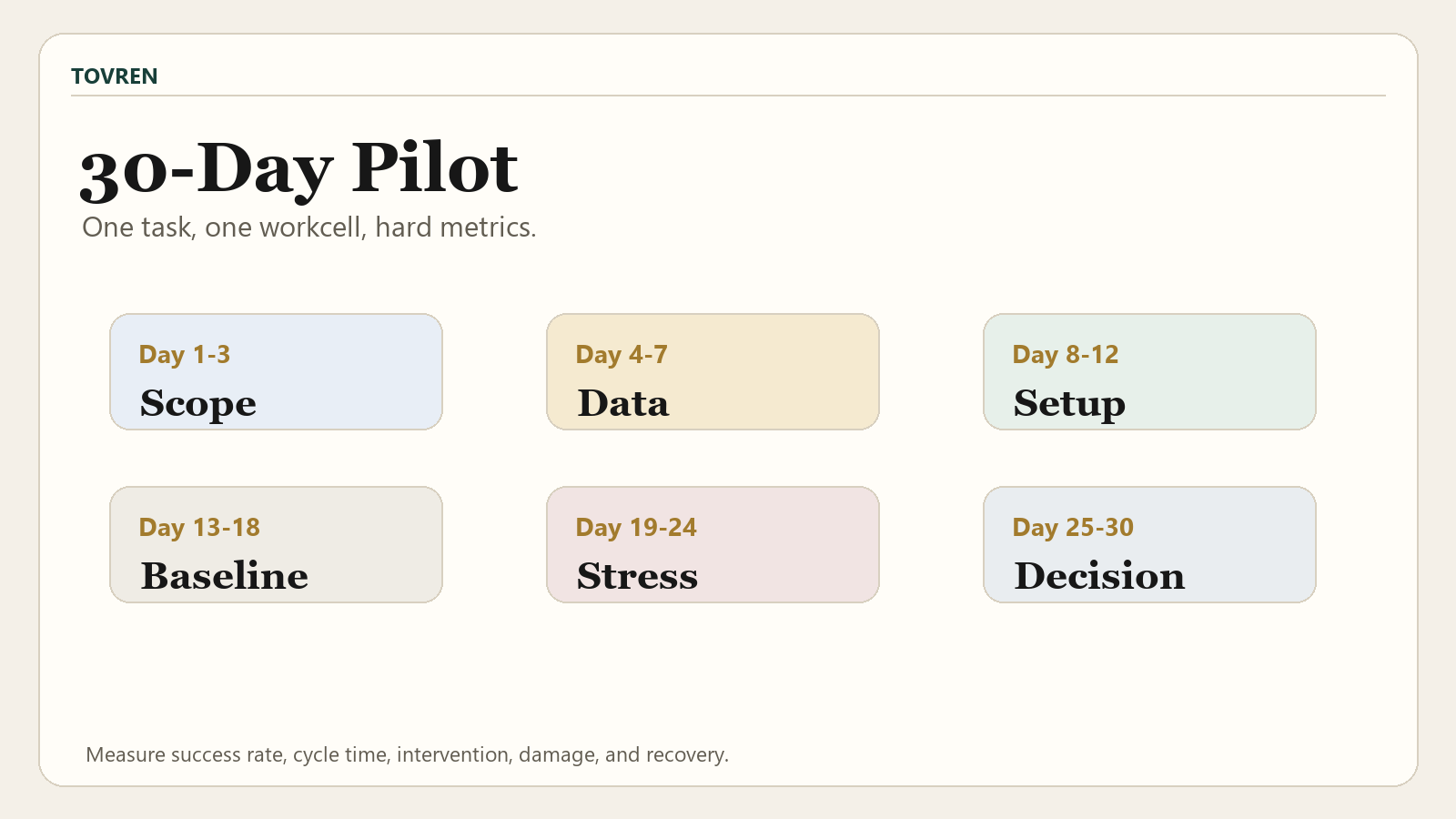
30-day pilot plan for GENE-26.5 robotics evaluation
A useful pilot should be deliberately narrow. Do not ask a robotics foundation model to “automate our warehouse.” Ask it to perform one bounded manipulation task under measured conditions, then expand only if the evidence supports it.
| Phase | Days | Buyer work | Vendor work | Exit criteria |
|---|---|---|---|---|
| Scope lock | 1-3 | Select one task, object set, environment, safety boundary, and success metric. | Confirm whether the task is technically suitable for evaluation. | Written pilot charter with no vague “general robot” goals. |
| Data and safety review | 4-7 | Define what video, sensor, production, and operator data can be shared. | Provide data-use terms, safety materials, and integration requirements. | Legal, security, operations, and safety owners approve the test conditions. |
| Controlled setup | 8-12 | Prepare a test cell, sample objects, lighting variants, and exception cases. | Install or simulate the system and define logging. | System can run in a controlled environment with safe stop and observable logs. |
| Baseline testing | 13-18 | Measure current human or existing automation performance. | Run the same task with the robotics system. | Comparable data exists for success rate, cycle time, intervention rate, and damage rate. |
| Stress testing | 19-24 | Introduce lighting changes, object variation, clutter, partial occlusion, and interruptions. | Document model behavior, recovery, retries, and unsafe or uncertain states. | Failures are classified and repeatable enough to analyze. |
| Business review | 25-30 | Estimate ROI, staffing impact, maintenance burden, facility changes, and compliance work. | Provide roadmap, pricing structure, support terms, and next-step proposal. | Decision: stop, extend pilot, negotiate limited deployment, or revisit later. |
Benchmark design: what to measure
A robotics foundation model benchmark should not be a highlight reel. It should measure whether the system can complete a real workflow with acceptable reliability, latency, safety behavior, and recovery. For a practical approach to model evaluation discipline, Tovren’s guide to AI model benchmarks is relevant, but robotics needs additional physical-world metrics.
| Metric | Definition | Why it matters | How to test it |
|---|---|---|---|
| Task success rate | Percentage of completed workflows without human intervention. | Shows whether the system can perform the job, not just individual motions. | Run repeated trials across representative and edge-case objects. |
| Intervention rate | How often a human must pause, reset, guide, clean, repair, or rescue the robot. | High intervention can destroy ROI even when demo success looks strong. | Track every assist, including minor resets and object repositioning. |
| Cycle time | Total time from task start to verified completion. | Determines throughput and staffing economics. | Measure end-to-end time, including perception, planning, retries, and handoff. |
| Damage or contamination rate | Frequency of broken items, spills, residue, incorrect handling, or contamination risk. | Critical for labs, food handling, fragile goods, and manufacturing quality. | Inspect outputs and workcell after every run. |
| Recovery quality | How the system behaves after uncertainty, slippage, collision risk, dropped objects, or unexpected human action. | Real workcells fail; safe recovery matters more than perfect demos. | Introduce controlled exceptions and score stop, retry, escalation, and logging behavior. |
| Generalization | Performance under new object poses, lighting, packaging, tool placement, or sequence variation. | Foundation model claims should translate into robustness beyond memorized setups. | Hold back test cases that are not shown during setup. |
Data-rights questions buyers should ask
Genesis’s official blog says its training approach uses heterogeneous, partially observed data, including ego-centric streams, glove data, robot data, and Internet language/video data. TechCrunch reported that Genesis says the model is trained on massive amounts of human-based internet videos, while the press release did not mention compensation.
For buyers, the immediate issue is not to adjudicate the whole training-data debate. The immediate issue is to prevent your operational data, facility video, worker behavior, proprietary processes, or customer materials from becoming ambiguous training inputs.
| Question | Why it matters | Minimum acceptable answer |
|---|---|---|
| Will our pilot data be used to train or fine-tune any model? | Facility video and manipulation data can reveal proprietary process details. | Explicit opt-in or opt-out terms, written in the contract. |
| What data is collected during the pilot? | Robotics systems may capture video, sensor streams, operator actions, object states, logs, and failure events. | A complete data inventory with retention periods. |
| Can we delete our data after the pilot? | Failed pilots should not create long-term data exposure. | Deletion rights, deletion timeline, and confirmation process. |
| Are worker images, motions, or demonstrations captured? | Human skill-transfer workflows may involve employee behavior and biometric-adjacent motion traces. | Clear worker notice, consent workflow where required, and minimization controls. |
| Who owns task demonstrations created by our operators? | Operator demonstrations may encode proprietary know-how. | Customer ownership or tightly limited vendor license. |
| What indemnity applies to training-data or output-related disputes? | Foundation model sourcing can become a legal and procurement risk. | Clear allocation of responsibility and exclusions. |
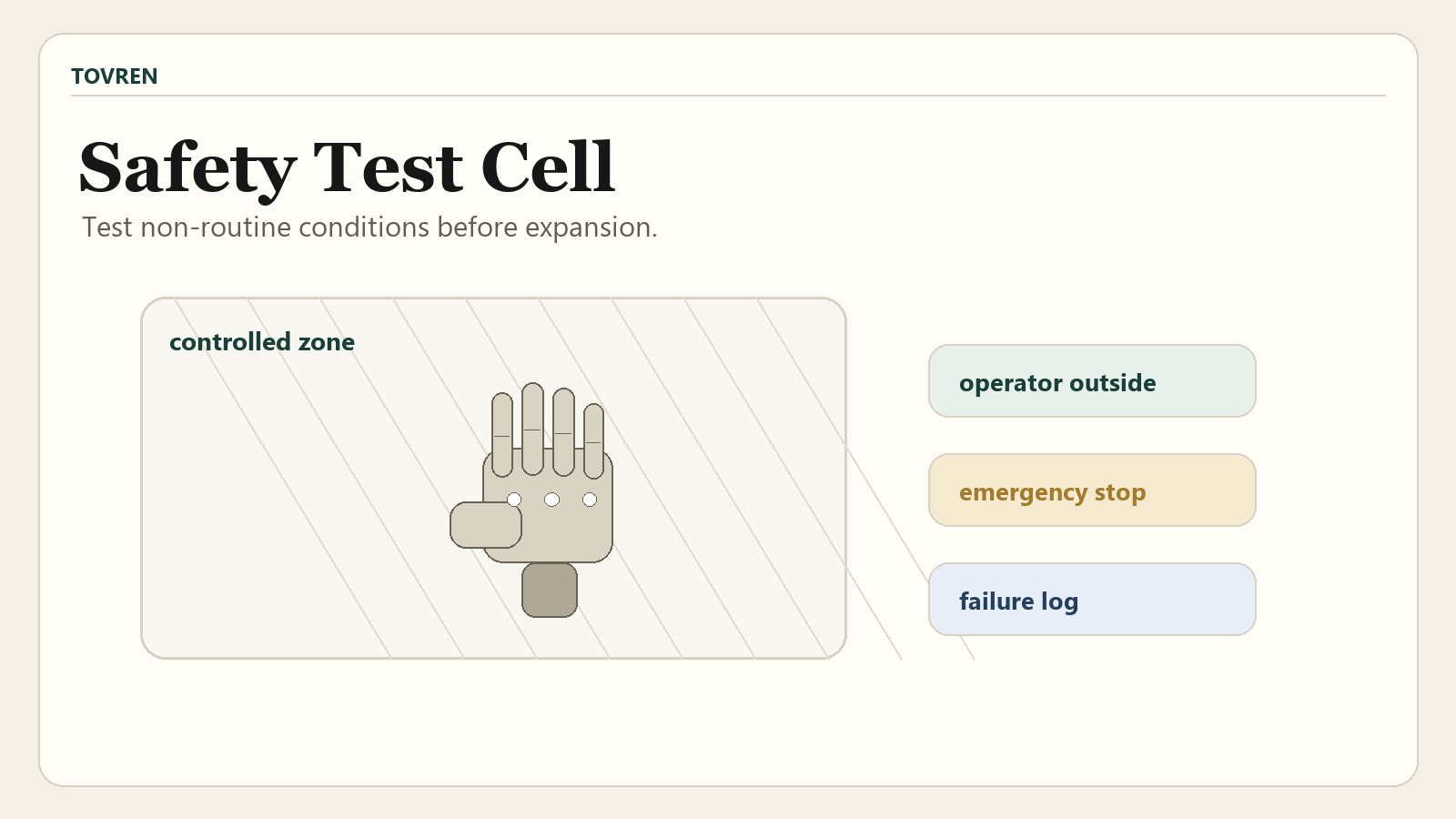
Workplace safety checks cannot be optional
The NIST AI Risk Management Framework is voluntary guidance intended to improve the ability to incorporate trustworthiness considerations into the design, development, use, and evaluation of AI products, services, and systems. For GENE-26.5 robotics evaluations, that means buyers should treat trustworthiness as an operational test requirement, not a policy slide.
OSHA’s robotics overview defines industrial robots as programmable multifunctional mechanical devices that perform tasks through variable programmed motions. OSHA also notes that many robot accidents occur during non-routine conditions such as programming, maintenance, testing, setup, or adjustment. This is directly relevant to foundation-model robotics because early pilots involve exactly those non-routine conditions.
| Safety area | Test before pilot expansion | Evidence to retain | Stop condition |
|---|---|---|---|
| Workcell boundary | Verify physical separation, safe approach paths, and emergency access. | Cell layout, safety review notes, photos, and sign-off. | Unclear human entry zones or blocked emergency stop access. |
| Non-routine operation | Test setup, calibration, maintenance, object loading, and troubleshooting. | Incident logs, near-miss logs, operator feedback, and vendor response. | Unsafe motion or unclear state during human intervention. |
| Uncertainty behavior | Observe what the system does when perception, grasping, or planning confidence drops. | Confidence logs, stop/retry decisions, and escalation records. | Continues acting aggressively when uncertain. |
| Emergency stop and recovery | Confirm stop behavior and restart procedure after interruptions. | Test video, restart checklist, and recovery logs. | Restart creates unexpected motion or loses task state. |
| Operator training | Train the people who will load, supervise, clean, reset, or maintain the system. | Training records, role definitions, and escalation plan. | Only the vendor knows how to operate the system safely. |
Red flags that should slow or stop a pilot
- Only edited demo clips are available. Ask for uncut trials, failure clips, and logs.
- The vendor cannot define availability. Clarify whether the product is a video demo, pilot platform, developer system, managed service, or purchasable robot.
- “Human-level” is not translated into metrics. Require success rate, cycle time, intervention rate, generalization tests, and safety behavior.
- Failure cases are hand-waved. A serious robotics vendor should be able to explain how the system fails.
- Data terms are vague. Do not share facility video, operator demonstrations, or proprietary workflows without written terms.
- Safety review is delayed until after technical validation. In robotics, safety is part of technical validation.
- The task is too broad. “Automate lab work” or “handle warehouse exceptions” is not a pilot scope. “Load this consumable tray under these conditions” is.
How this fits into the enterprise AI stack
GENE-26.5 should not be evaluated like a chatbot, but enterprise AI governance still applies. Buyers should connect the robotics pilot to runtime evaluation, access control, logging, change management, and escalation policy. Tovren’s guide to AI agent evaluations and runtime governance is useful for designing pass/fail criteria, while the AI agent control-plane guide explains why oversight layers matter when AI systems act in operational environments.
For companies exploring local deployment, edge inference, or data-sensitive agent systems, Tovren’s coverage of Dell and Nvidia deskside agentic AI is also relevant. Robotics buyers should ask whether the system depends on cloud services, local compute, vendor-managed inference, or hybrid execution. Those choices affect latency, privacy, uptime, and incident response.
For enterprise automation leaders, the same lesson appears in software-heavy autonomous enterprise pilots: define the business workflow before adopting the agent. Tovren’s SAP autonomous enterprise pilot guide offers a parallel playbook for keeping pilots bounded, measurable, and accountable.
Procurement verdict
GENE-26.5 is worth tracking and may be worth piloting for teams with difficult manipulation problems, but it is not enough evidence for production procurement. The public launch establishes a credible ambition: a full-stack robotics company, a foundation model system, a dexterous hand, a data engine, high-profile backing, and a demo aimed at complex manipulation.
What it does not establish is the buyer’s hard evidence: performance on your objects, in your environment, under your safety rules, with your throughput economics, your data constraints, and your maintenance reality. That evidence can only come from a controlled pilot with measurable pass/fail criteria.
The best buyer posture is skeptical engagement: request access, narrow the task, define the benchmark, protect the data, test non-routine safety conditions, and make the next step depend on logs rather than launch language.
FAQ
Is GENE-26.5 robotics production-ready?
The verified sources for this article do not establish that GENE-26.5 is production-ready. Genesis announced the model system, described its capabilities, released a demo video, and said it will soon unveil its first general-purpose robot. Buyers should require task-specific pilot evidence before treating it as deployable automation.
What makes GENE-26.5 different from a normal industrial robot?
Genesis describes GENE-26.5 as an AI foundation model purpose-built for robotics, combined with a human-scale dexterous robotic hand and a new data engine. That is different from a conventional fixed-task robot pitch, but buyers still need to test integration, repeatability, safety, and economics.
What should a warehouse or manufacturing buyer test first?
Start with one bounded manipulation task. Test task success rate, cycle time, intervention rate, damage rate, recovery behavior, and performance under changed lighting, object position, clutter, and partial occlusion. Do not begin with a broad “general-purpose robot” pilot.
What are the biggest risks in a GENE-26.5 pilot?
The biggest risks are over-reading the demo, unclear data rights, weak safety testing, poor integration assumptions, and failure to measure non-routine conditions such as setup, maintenance, testing, adjustment, and recovery.
How should buyers evaluate Genesis AI’s training-data claims?
Buyers should ask what data was used, what data will be collected during the pilot, whether customer data can train future models, whether operator demonstrations are captured, and what deletion, opt-out, audit, and indemnity terms apply. The goal is to protect operational and worker data before sharing it.
Source log
| Source | Publisher | Date noted in provided facts | Exact URL | Claims supported |
|---|---|---|---|---|
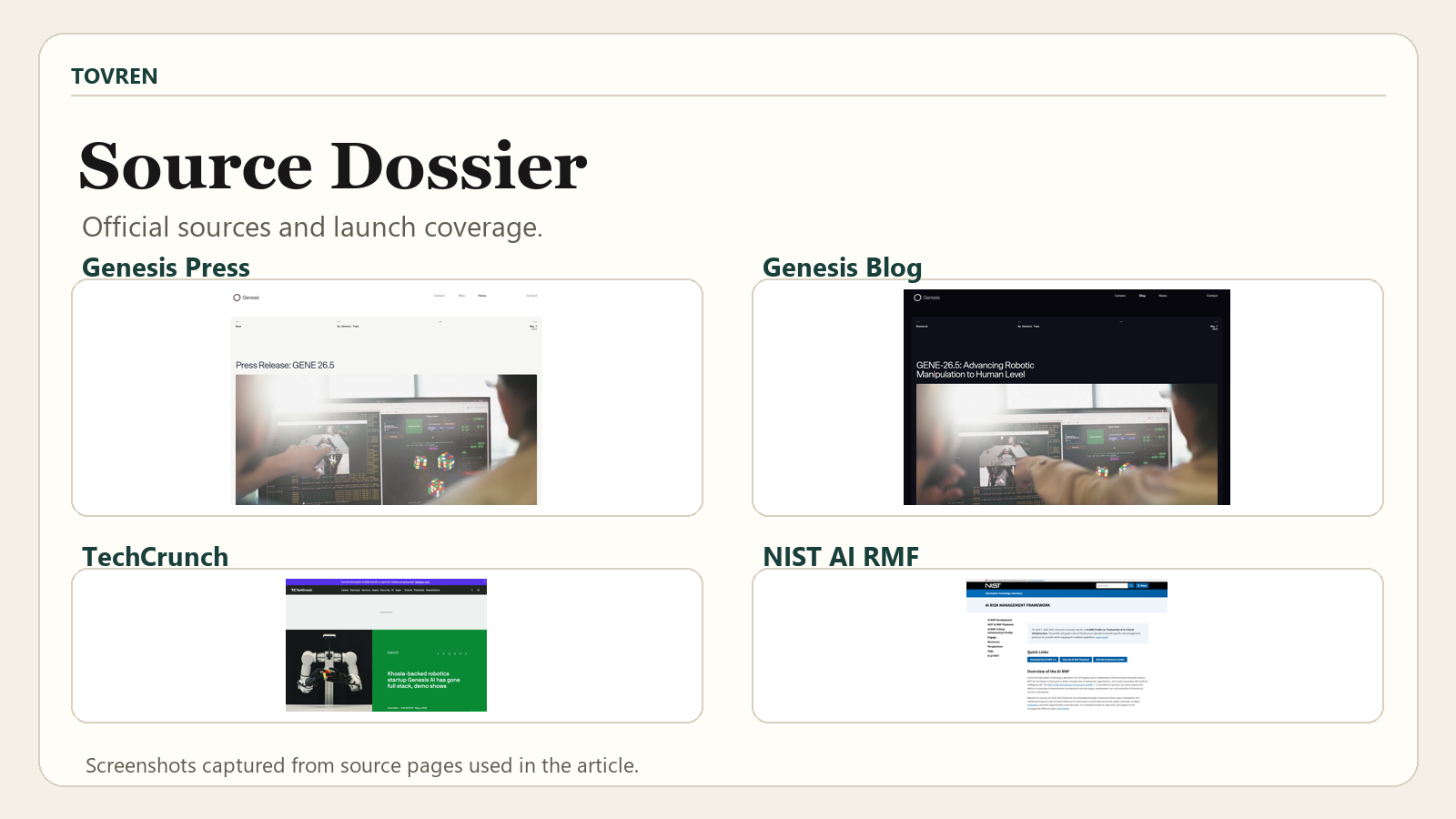
| GENE-26.5 press release | Genesis AI | May 6, 2026 | https://www.genesis.ai/press/press-release-gene-265 | Launch date, vendor description, foundation model claim, dexterous hand, data engine, demo video, general-purpose robot statement, $105 million seed funding, named backers. |
| GENE-26.5 official blog | Genesis AI | Not specified in provided facts | https://www.genesis.ai/blog/gene-26-5-advancing-robotic-manipulation-to-human-level | First robotic foundation model system, initial GENE family release, manipulation framing, coordination between sensors, actuators, control, data, and model, training data categories. |
| Khosla-backed robotics startup Genesis AI has gone full-stack | TechCrunch | May 6, 2026 | https://techcrunch.com/2026/05/06/khosla-backed-robotics-startup-genesis-ai-has-gone-full-stack-demo-shows/ | $105 million seed round, GENE-26.5 naming context, internet video training report, compensation-not-mentioned observation. |
| Robot hand demo coverage | TechRadar | May 6, 2026 | https://www.techradar.com/ai-platforms-assistants/a-robot-hand-wiping-some-egg-off-its-fingers-with-a-towel-is-the-most-bizarrely-human-thing-youll-see-a-robot-do-all-week-and-its-just-the-beginning | Reported demo examples: wiping egg yolk, Rubik’s Cube, lab-assistant work, smoothie making. |
| AI Risk Management Framework | NIST | Not specified in provided facts | https://www.nist.gov/itl/ai-risk-management-framework | Voluntary guidance for incorporating trustworthiness considerations into AI design, development, use, and evaluation. |
| Robotics overview | OSHA | Not specified in provided facts | https://www.osha.gov/robotics | Industrial robot definition and note that many robot accidents occur during non-routine conditions such as programming, maintenance, testing, setup, or adjustment. |
| Robotics hazards | OSHA | Not specified in provided facts | https://www.osha.gov/robotics/hazards | References for recognizing hazards related to workplace robotics. |
| GENE-26.5 Reddit discussion | Reddit r/singularity | May 2026 | https://www.reddit.com/r/singularity/comments/1t5lxmh/genesis_ais_gene265/ | Community-interest signal only; not used as a factual source. |
| GENE-26.5 Reddit discussion | Reddit r/robotics | May 2026 | https://www.reddit.com/r/robotics/comments/1t5lzo1/genesis_ais_gene265/ | Community-interest signal only; not used as a factual source. |
Fact-check notes
- The article treats “human-level physical manipulation” as a Genesis AI claim, not an independently verified benchmark result.
- The reported demo tasks are attributed to TechRadar and treated as examples shown in a demo, not proof of production reliability.
- The article does not claim Genesis AI’s first general-purpose robot is available now; it states that Genesis says it will soon unveil it.
- The article does not infer pricing, availability, safety certification, customer deployments, uptime, or service-level terms because those facts were not provided.
- Reddit discussions are used only as community-interest signals, not factual evidence.
WordPress checklist
- Primary category: AI News.
- Category ID: 26.
- Slug: genesis-ai-gene-265-robotics-foundation-model-buyer-checklist.
- Focus keyword: GENE-26.5 robotics.
- Use the hero image brief above with TOVREN masthead, 16:9 ratio, low text, no dense labels, and no text overflow.
- Add internal links to Tovren’s AI agent governance, model benchmark, local agentic AI, control-plane, and autonomous enterprise pilot articles.
- Confirm all external source URLs before publication if outbound links are added in WordPress.
- Use the FAQ JSON-LD below for structured data.
- Set refresh reminder for 30, 60, and 90 days after publication.
Refresh triggers
- Genesis AI releases pricing, API access, pilot terms, developer kits, or commercial availability for GENE-26.5.
- Genesis unveils its first general-purpose robot.
- Independent labs, customers, or robotics researchers publish third-party benchmarks or teardown analysis.
- New safety documentation, certifications, or deployment case studies become available.
- Material information emerges about GENE-26.5 training data, compensation, licensing, or customer-data use.
- Major robotics competitors publish comparable dexterous manipulation demos or production deployments.