Short answer: Google Core Update AI Blog Recovery Checklist is worth acting on only when it changes a real workflow, cost, risk, or buying decision. Use the checks below to decide whether to test it now, monitor it, or ignore it.
Bottom line: if your AI blog traffic dropped this week, do not start by rewriting every article, deleting half the site, or publishing twenty more generic posts about AI agents. Start by diagnosing the drop. A ranking loss, CTR loss, AI search displacement, crawl issue, indexing problem, seasonal dip, and topic-demand shift can all look like the same traffic crash in analytics. They require different fixes.
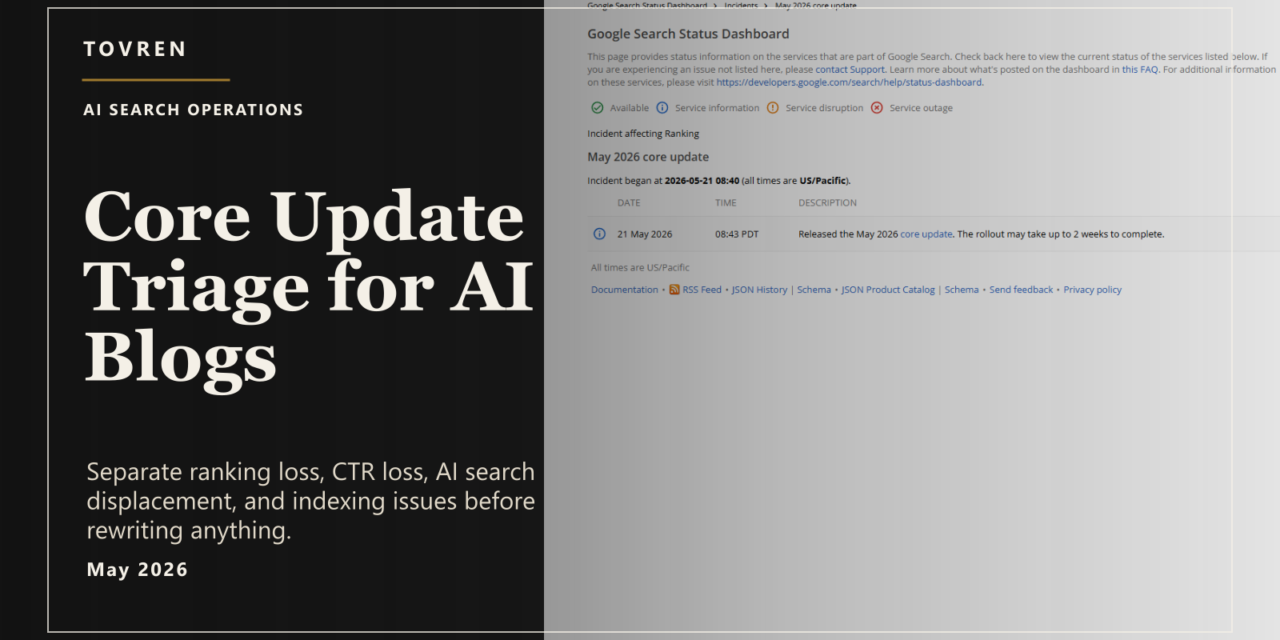
As of May 26, 2026 in Asia/Seoul, Google’s Search Status Dashboard lists a May 2026 core update affecting ranking, with rollout taking up to two weeks. That rollout window matters because noisy early data can tempt publishers into the wrong fix.
For AI publishers, the blunt version is this: publishing more generic AI articles is not a recovery strategy. If the pages losing traffic are shallow explainers, rewritten press releases, tool roundups without testing, or model-news summaries with no original value, adding more of the same only increases the surface area of the problem.
The Search Console Split That Matters
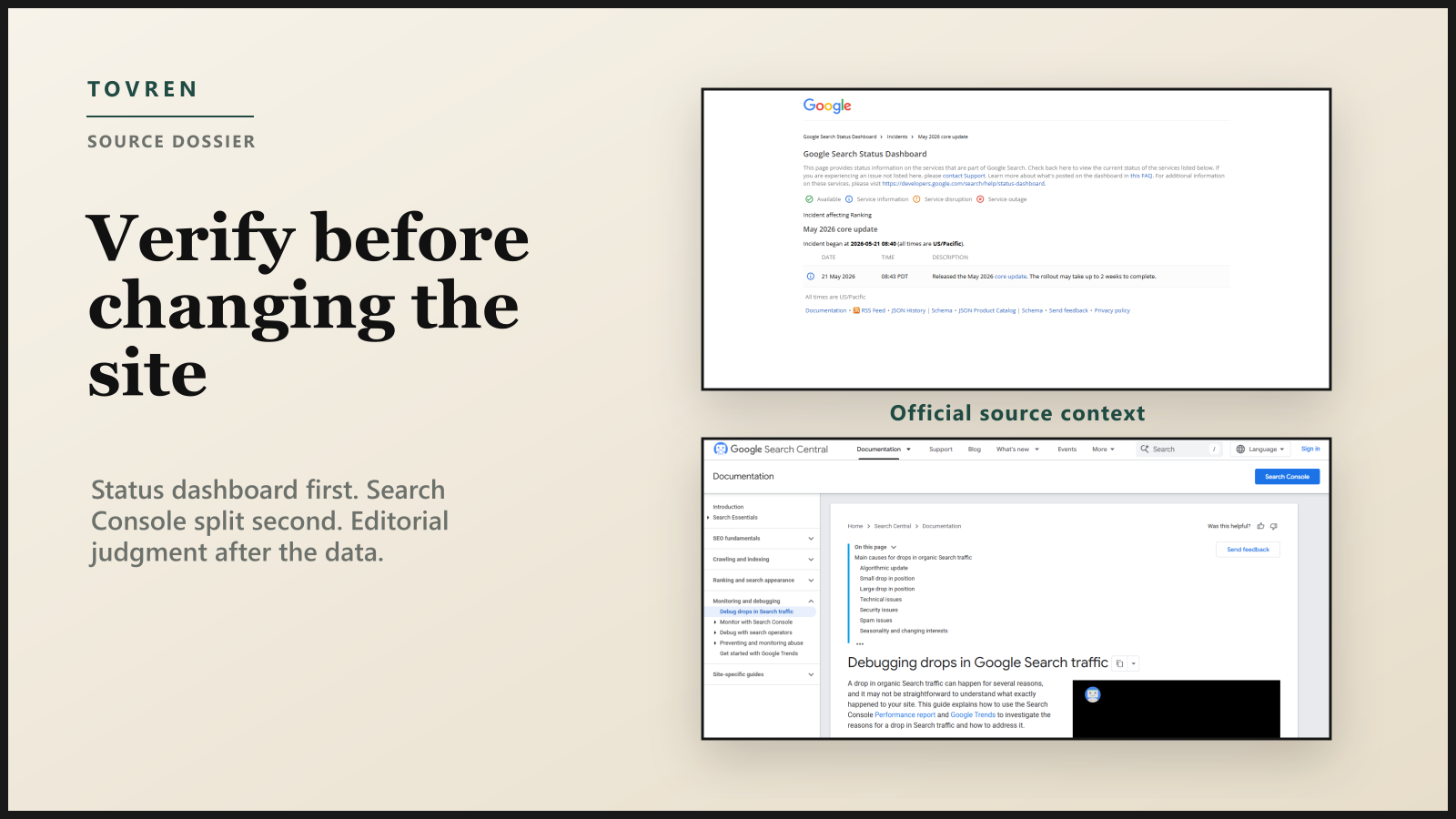
Open the Search Console Performance report. Turn on four metrics: clicks, impressions, average CTR, and average position. Then compare the affected period with a similar previous period. Do this by query, by page, by country, by device, and by search type. Do not diagnose from total clicks alone.
| Pattern in Search Console | Most likely problem | What it means | First fix |
|---|---|---|---|
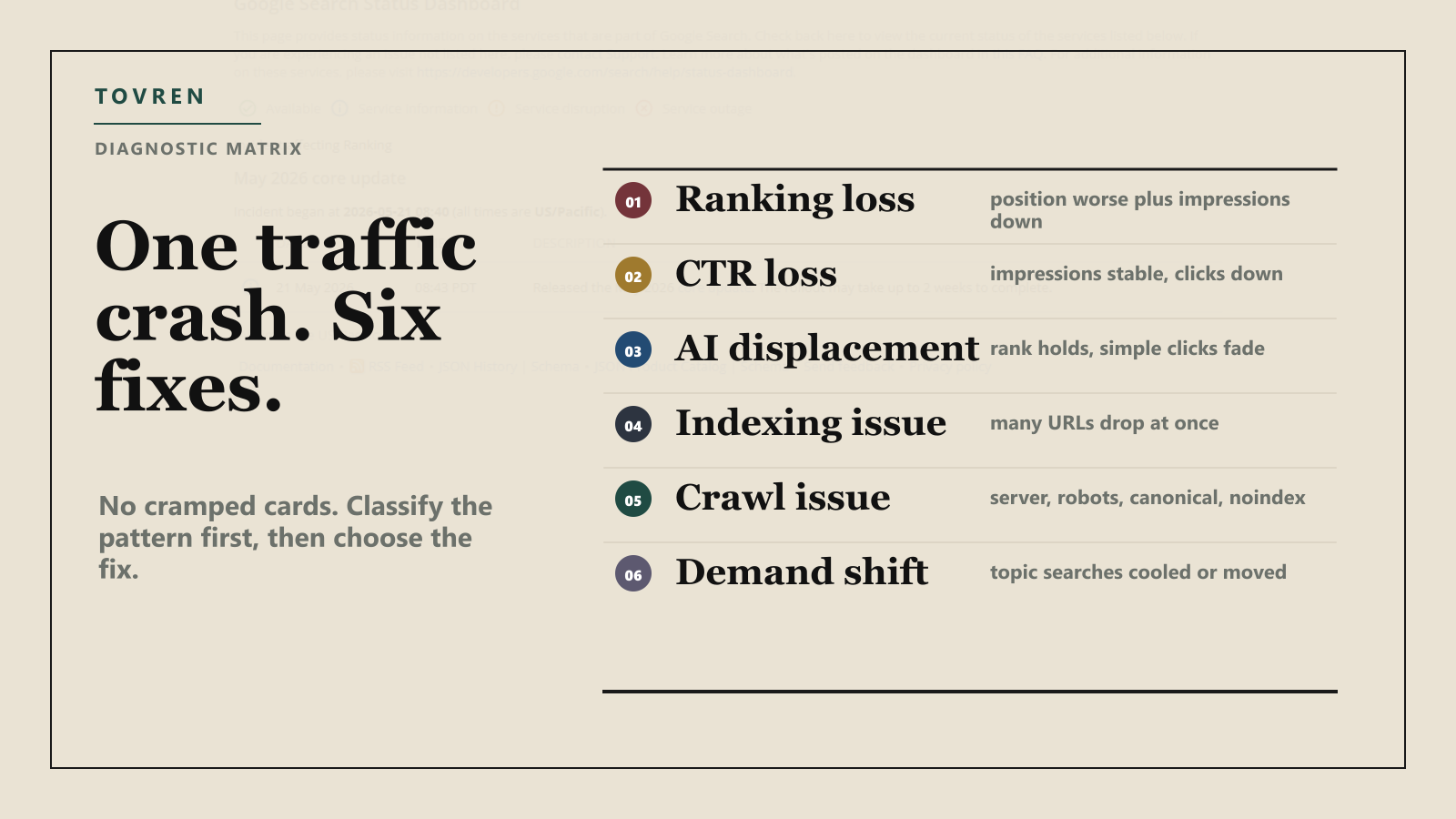
| Clicks down, impressions down, average position worse | Ranking loss | Google is showing you less often or lower for important queries. | Audit content quality, query fit, competing pages, and page clusters before rewriting. |
| Impressions stable, position stable, CTR down | CTR loss | You still appear, but fewer searchers choose you. | Rewrite titles, snippets, intros, and value promises. Do not rewrite the whole page first. |
| Position mostly stable, CTR down on simple answer queries | AI search displacement | The query may now satisfy more users directly in the search experience. | Move toward tools, templates, screenshots, workflows, comparisons, and original testing. |
| Clicks and impressions drop suddenly for many URLs | Indexing or crawl issue | Google may be unable to crawl, index, or serve affected pages correctly. | Check Page indexing, URL Inspection, Crawl Stats, robots, canonicals, noindex, and server errors. |
| Clicks and impressions drop, position stable, trend repeats yearly | Seasonality or demand shift | The audience may be searching less, or searching differently. | Use a 16-month view and compare query demand before changing content. |
This split prevents expensive mistakes. A CTR problem needs better packaging. A ranking problem needs quality and relevance work. An indexing issue needs engineering. AI search displacement needs stronger formats. A demand shift needs editorial repositioning, not panic rewriting.
Audit These 9 Signals Before Rewriting Everything
| # | Signal | Where to check | What to look for | Action |
|---|---|---|---|---|
| 1 | Update timing | Google Search Status Dashboard | Did the drop begin after the May 2026 rollout started? | Tag affected dates. Avoid conclusions from one noisy day. |
| 2 | Clicks versus impressions | Performance report | Are both down, or only clicks? | Both down suggests visibility loss. Clicks-only decline suggests CTR or search behavior. |
| 3 | Average position | Queries and Pages tabs | Did important queries fall from top positions to page two or beyond? | Prioritize pages with large sustained position drops. |
| 4 | CTR movement | Performance report | Did CTR fall while impressions stayed steady? | Fix title, meta description, article angle, freshness cues, and SERP promise. |
| 5 | Query class | Queries export | Are losses concentrated in news, pricing, alternatives, setup, or troubleshooting terms? | Protect commercial and workflow queries first. Basic explainers are easiest to displace. |
| 6 | Page cluster | Pages export | Is the drop site-wide, category-wide, or limited to a few posts? | Do not apply a site-wide rewrite if only one cluster lost visibility. |
| 7 | Search type | Search type filter | Did Web, Image, Video, or News-style traffic move differently? | Separate formats. A Web drop is not the same as image or news visibility loss. |
| 8 | Indexing and crawl health | Page indexing, URL Inspection, Crawl Stats, server logs | Any spike in excluded pages, server errors, canonical changes, blocked resources, or noindex tags? | Fix technical issues before touching copy. |
| 9 | Seasonality and topic demand | 16-month Search Console view and Google Trends | Did demand fall across the topic, not just your site? | Shift coverage toward rising adjacent queries and evergreen workflows. |
Ranking Loss Versus CTR Loss Versus AI Search Displacement
A ranking loss means Google is ranking other pages above yours for queries where you used to win. For AI blogs, this often hits thin posts that summarize tool announcements without testing the tool, quoting official specs, comparing limits, or showing real outputs. If a “best AI tool” article contains no screenshots, pricing checks, test methodology, or use-case decision table, it is vulnerable.
A CTR loss means you still appear, but fewer people click. That can happen when your title is vague, your snippet does not answer intent, or the search page contains stronger competing formats. Fix the packaging first. A page titled “Claude vs ChatGPT: Full Comparison” is weaker than “Claude vs ChatGPT for Legal Summaries: Accuracy, Cost, Workflow, and Failure Cases.” The second title tells a serious reader why the click is worth it.
AI search displacement is different. Search Console will not label it for you. Treat it as a pattern: rankings are not collapsing, but clicks fall on broad informational queries where users may get enough answer from the results page or from AI-heavy search behavior. The response is not to make a longer generic explainer. The response is to publish assets that deserve a click: calculators, prompt packs, setup guides, comparison tables, screenshots, source logs, templates, and failure checks.
For example, a generic post on AI browsers is weak. A working prompt pack for browser agents is stronger. See Tovren’s AI browser agent prompt pack for the type of practical asset that gives readers something to use, not just something to skim. Pair this audit with Tovren’s Google AI Mode SEO playbook when you are designing content that must survive low-click informational search.
What AI Publishers Should Stop Doing This Week
Stop doing these before you diagnose the data:
- Stop mass-publishing generic AI news summaries. If five sites can produce the same article from the same announcement in ten minutes, it is not a durable asset.
- Stop rewriting pages that still rank well. A small position movement is not a mandate to rebuild the article.
- Stop changing dates without substantial updates. Freshness cosplay is not the same as a better page.
- Stop deleting whole categories because traffic dipped. Deletion is a last-resort move for content that cannot be salvaged.
- Stop chasing word count. Google’s helpful-content guidance warns against writing to a supposed preferred word count.
- Stop producing tool roundups without using the tools. Best-tool pages need testing criteria, current limits, pricing checks, screenshots, and who-should-use-it guidance.
- Stop confusing AI output with expertise. An AI-written explanation of an AI tool is still generic unless an editor adds testing, judgment, evidence, and practical examples.
The replacement strategy is simple: fewer articles, higher proof. If you cover a local model setup, show the actual hardware assumptions, VRAM limits, install steps, tradeoffs, and failure points. Tovren’s Qwen 36 27B VRAM local AI setup is the kind of technical topic where specificity can beat generic commentary.
48-Hour Triage Checklist
| Time window | Task | Output | Do not do |
|---|---|---|---|
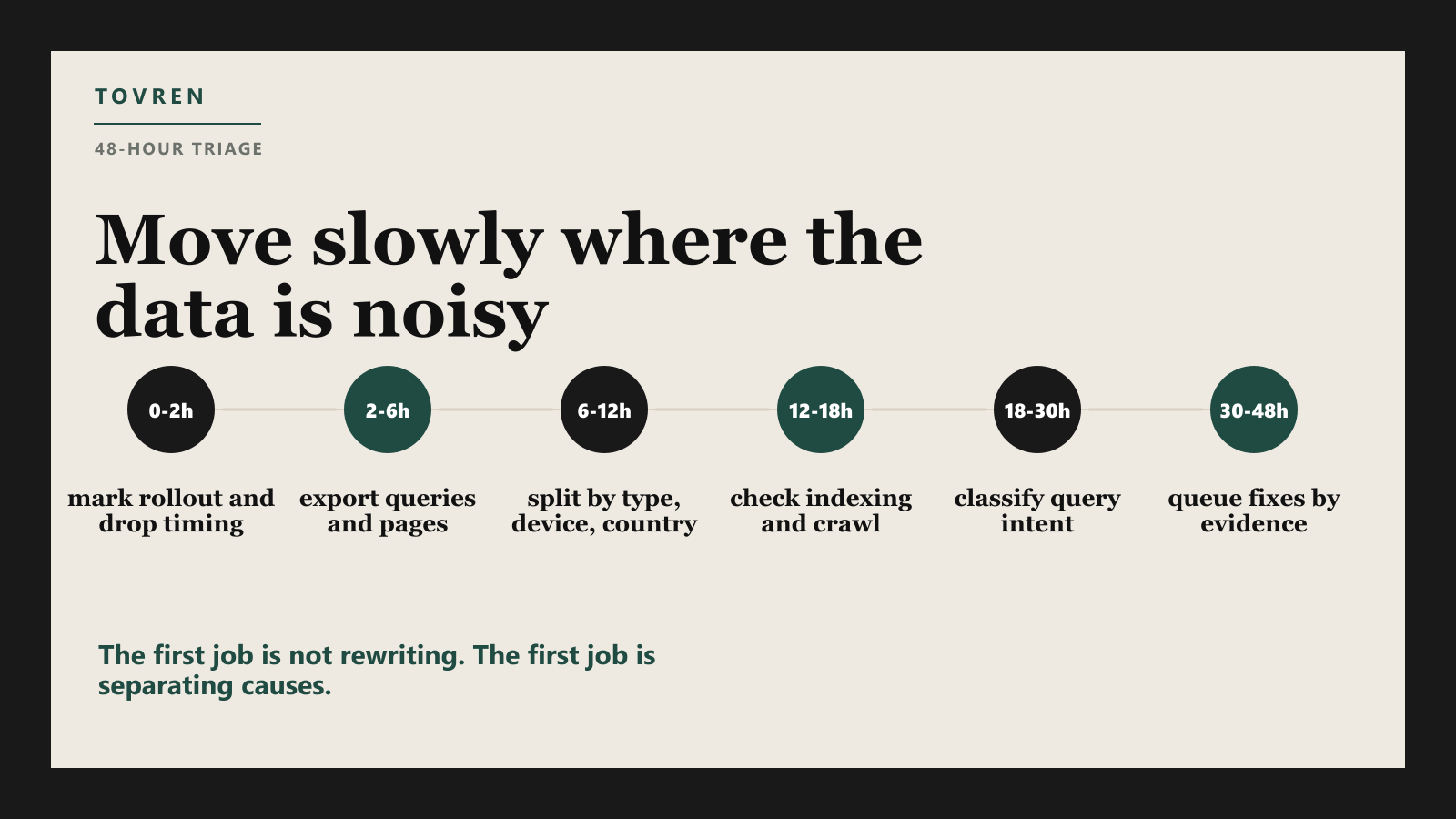
| Hour 0-2 | Confirm the Google rollout date and mark the first visible drop in Search Console. | One timeline with rollout start, traffic drop start, and any site changes. | Do not assume every drop is the core update. |
| Hour 2-6 | Export queries and pages with clicks, impressions, CTR, and average position. | Top 50 losing queries and top 50 losing URLs. | Do not use Google Analytics pageviews alone. |
| Hour 6-12 | Split the loss by Web, Image, Video, device, and country. | Segment table showing where the loss is concentrated. | Do not mix every search type into one conclusion. |
| Hour 12-18 | Check Page indexing, URL Inspection, Crawl Stats, robots, canonicals, noindex, server errors, and security issues. | Technical issue list ranked by severity. | Do not rewrite content before fixing crawl or indexing problems. |
| Hour 18-30 | Classify affected queries by intent: news, definition, pricing, alternatives, tutorial, setup, troubleshooting, template. | Intent map of the lost traffic. | Do not treat a “what is” query like a buyer or workflow query. |
| Hour 30-40 | Compare affected queries over 16 months and check whether demand moved across the topic. | Seasonality and demand-shift notes. | Do not rewrite for a market that simply cooled down. |
| Hour 40-48 | Assign each losing URL to one fix: no action, title refresh, technical repair, content upgrade, consolidation, or deletion review. | Recovery queue with owner, evidence, and next step. | Do not launch a site-wide rewrite sprint. |
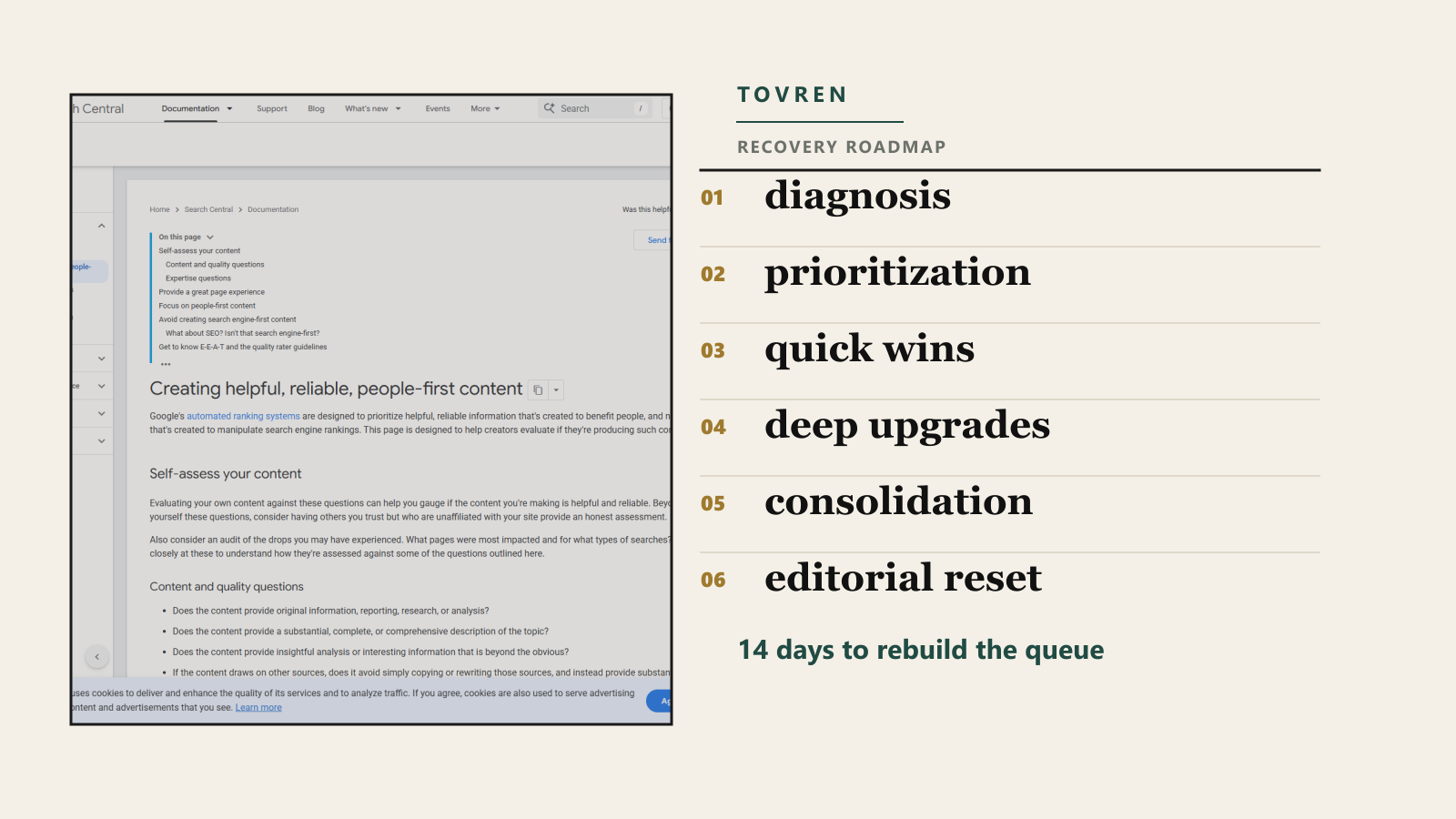
14-Day Recovery Plan
This is a recovery plan, not a promise that rankings will return in 14 days. Google’s own traffic-drop guidance separates algorithmic updates from technical issues, spam or security problems, seasonality, and changing interests. The goal of the next two weeks is to stop guessing, fix obvious issues, and rebuild the editorial plan around evidence.
| Days | Focus | Actions | Success metric |
|---|---|---|---|
| 1-2 | Diagnosis | Complete the Search Console split, technical checks, and affected-query export. | Every major traffic loss has a suspected cause, not a guess. |
| 3-4 | Prioritization | Group URLs by traffic value, business value, fix difficulty, and evidence strength. | A ranked queue of 10-25 pages, not a panic list of the whole site. |
| 5-7 | Quick wins | Fix titles, snippets, broken metadata, internal links, outdated pricing, missing screenshots, and obvious factual gaps. | CTR candidates and stale pages are updated without changing URL structure. |
| 8-10 | Deep upgrades | Add first-hand testing, tables, prompts, setup steps, output examples, failure cases, and decision criteria. | Each upgraded page has original value beyond rewritten source material. |
| 11-12 | Consolidation | Merge overlapping AI explainers, redirect weak duplicates, and preserve the strongest URL when intent overlaps. | Fewer thin pages compete against each other. |
| 13-14 | Editorial reset | Replace generic AI news volume with tutorials, comparisons, pricing explainers, workflow templates, and troubleshooting guides. | The next publishing calendar is built around user tasks, not generic AI trends. |
When To Rewrite, Refresh, Or Leave The Page Alone
Rewrite only when the evidence says the page no longer deserves the query. That usually means a large, sustained position loss, weaker usefulness than competing pages, outdated facts, missing original experience, or a mismatch between query intent and page format.
Refresh when the page still ranks but underperforms on CTR. Change the title, meta description, opening answer, comparison table, date-sensitive sections, and internal links. Keep the URL stable unless there is a clear structural reason to change it.
Leave the page alone when it still performs well and only shows minor volatility. Google’s traffic-drop guidance warns that small position shifts can happen without requiring radical changes. For a strong page, unnecessary rewriting can damage what already works.
What A Better AI Blog Article Looks Like Now
A recoverable AI article should answer a real task. It should tell the reader what to use, who should avoid it, what it costs, what the limits are, what steps to follow, what output to expect, and what can go wrong. It should cite official sources when discussing products, models, pricing, or Google systems. It should include tables because readers compare. It should include examples because readers need proof. It should include failure modes because AI workflows fail in predictable ways.
For AI publishers, the editorial bar is no longer “can we explain this topic?” It is “can we help a reader make a better decision or complete a task faster than competing pages?” If the answer is no, the article is probably not worth publishing.
Official Sources Used
- Google Search Status Dashboard: May 2026 core update
- Google Search Central: Debugging drops in Google Search traffic
- Google Search Console Help: Performance report
- Google Search Central: Creating helpful, reliable, people-first content
Final Rule
Do not reward a traffic drop with more generic output. Audit first. Fix technical blockers first. Separate ranking loss from CTR loss. Treat AI search displacement as a format problem, not a word-count problem. Then upgrade only the pages where the evidence shows a real usefulness gap.
The AI publishers most likely to recover are not the ones that publish the most. They are the ones that can prove their pages are useful, current, tested, specific, and worth clicking.
FAQ
What should an AI blog check after a Google core update?
Check Search Console by page and query, identify CTR drops versus ranking drops, and refresh pages that are thin, stale, or too generic.
Should traffic recovery start with new posts?
No. Refresh high-impression existing pages first because they already have search visibility and can recover faster.
What content usually needs fixing?
Pages with weak titles, vague intros, missing sources, thin examples, poor internal links, or no original visuals usually need fixing.