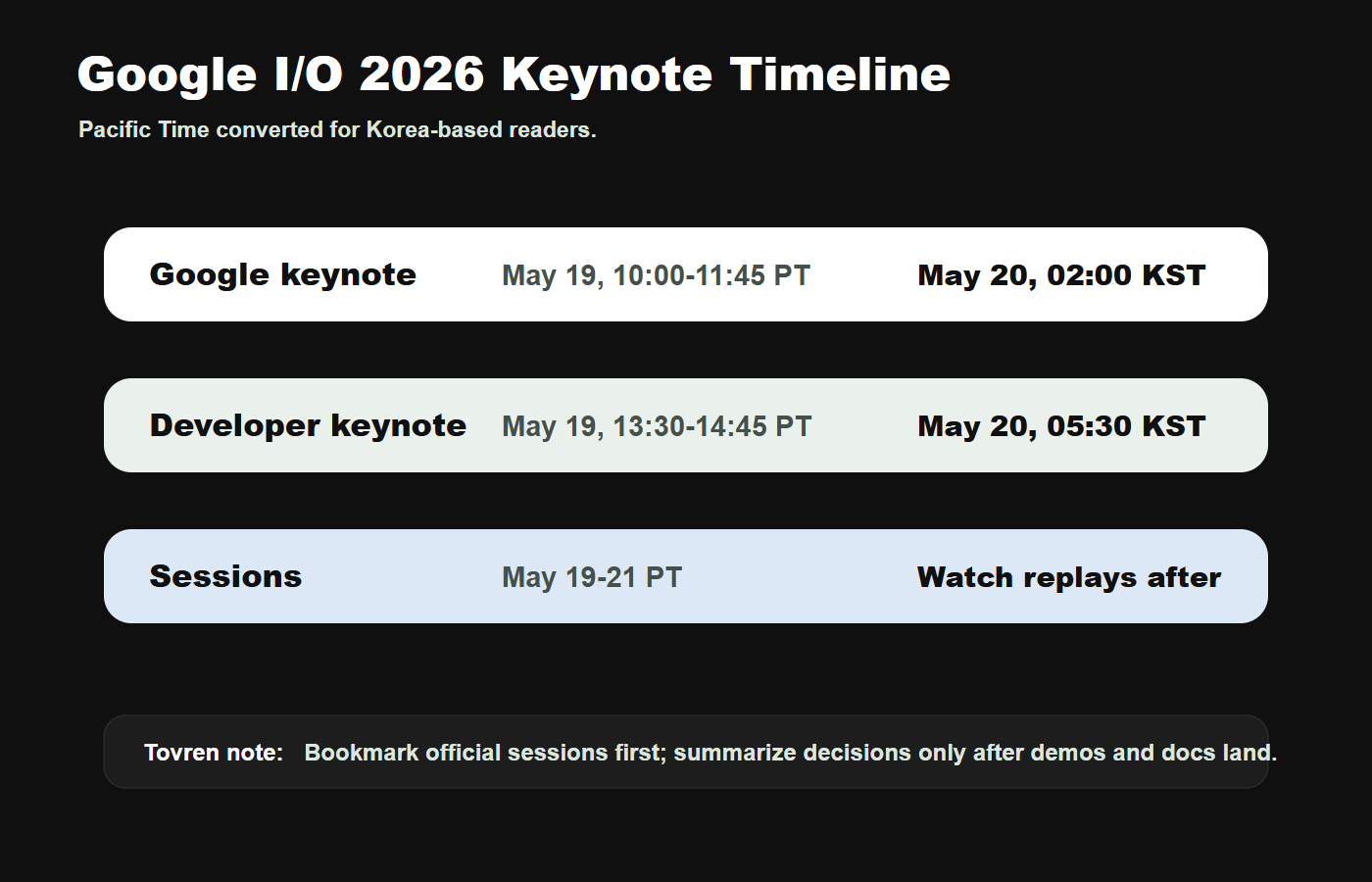
Updated May 18, 2026, Asia/Seoul. Google I/O 2026 starts May 19 in Pacific Time, which puts the main Google keynote at May 20, 2026, 2:00 a.m. KST for Korea-based readers. The practical way to watch this year is not to guess a model name. Watch for how Google connects Gemini, agentic coding, Android, Chrome, Cloud, XR, and Googlebook into products that developers and businesses can actually use.
Bottom line: Google has officially framed I/O 2026 around AI updates across Gemini, Android, Chrome, Cloud, and agentic development. After The Android Show: I/O Edition, the highest-value questions are now concrete: what ships, what remains preview-only, what gets developer documentation, and what has enough governance for teams to trust.
What Google has officially confirmed
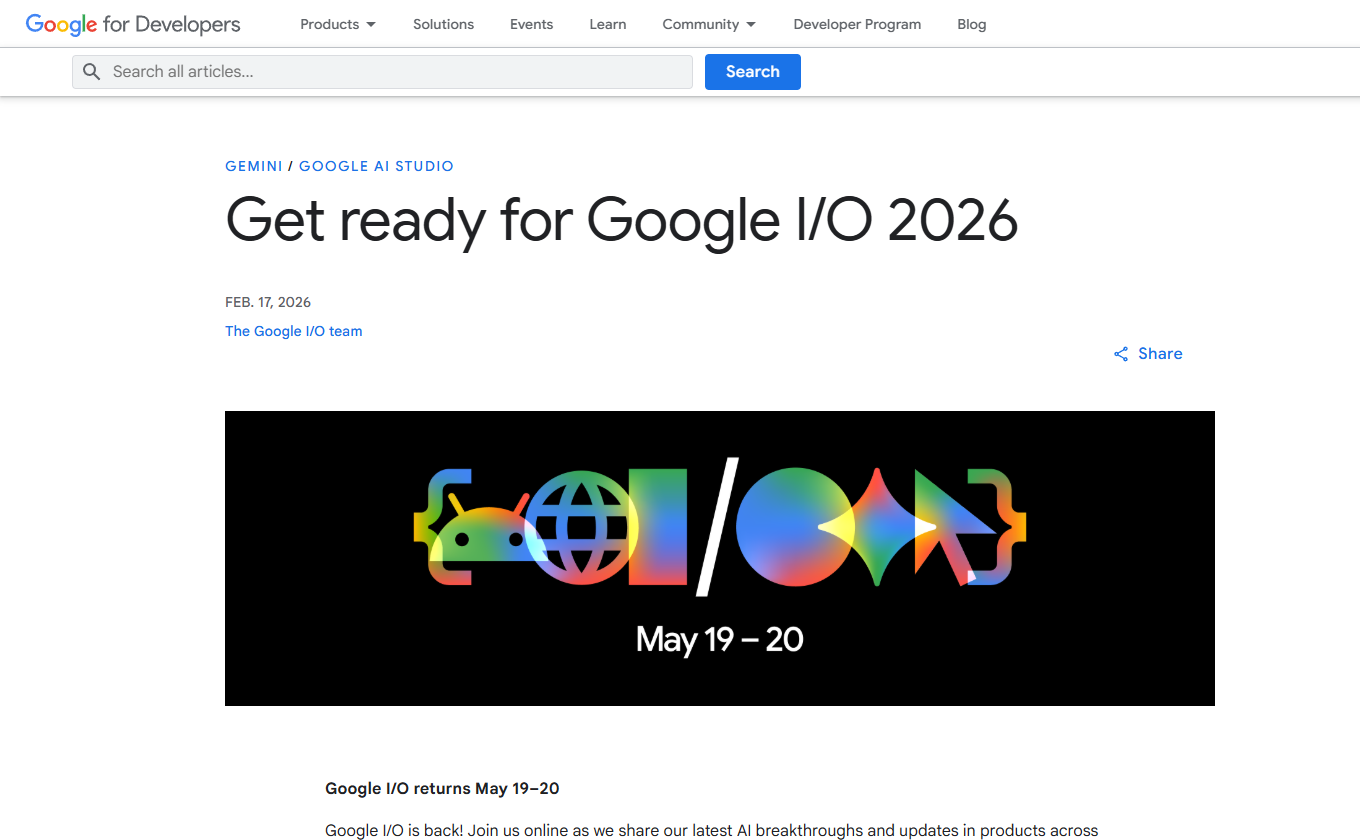
Google’s official I/O post says the event runs May 19-20 and will cover the company’s latest AI breakthroughs and product updates, including Gemini, Android, Chrome, Cloud, and more. A later Google Developers Blog schedule post says the Google keynote starts at 10:00 a.m. PT on May 19, followed by the Developer keynote at 1:30 p.m. PT.
| Confirmed official signal | Why it matters | What to check during I/O |
|---|---|---|
| Gemini model updates | Model capability only matters if it changes real workflows. | Context, tool use, latency, cost, multimodal quality, and product access. |
| Agentic coding | Google is explicitly pointing developers toward autonomous workflows. | Can the tools debug, run tests, inspect state, and explain changes? |
| Android and Chrome | AI is moving closer to the phone and browser surfaces people use daily. | Permission boundaries, local privacy, app handoffs, and developer APIs. |
| Cloud | Enterprise buyers need deployment paths, not only demos. | Evaluation, observability, security, and cost controls for agents. |
| Glasses preview and Googlebook follow-up | Google is signaling more ambient, device-level AI interfaces. | Availability, partner hardware, app model, and whether developers can build for it. |
What changed after The Android Show
The Android Show: I/O Edition narrowed the watchlist. Google already previewed a more proactive Android built around Gemini Intelligence, announced Googlebook as a new laptop category designed around Gemini, described Gemini in Chrome on Android, and said I/O would bring more Android updates plus a sneak peek at glasses that are expected later this year.
That means I/O should not be read as a blank-slate launch event. It is more useful as an integration checkpoint. The question is whether Google can make the Android, Chrome, Cloud, and Gemini pieces feel like one coherent AI platform rather than separate product demos.
1. Gemini: look past the model-name race
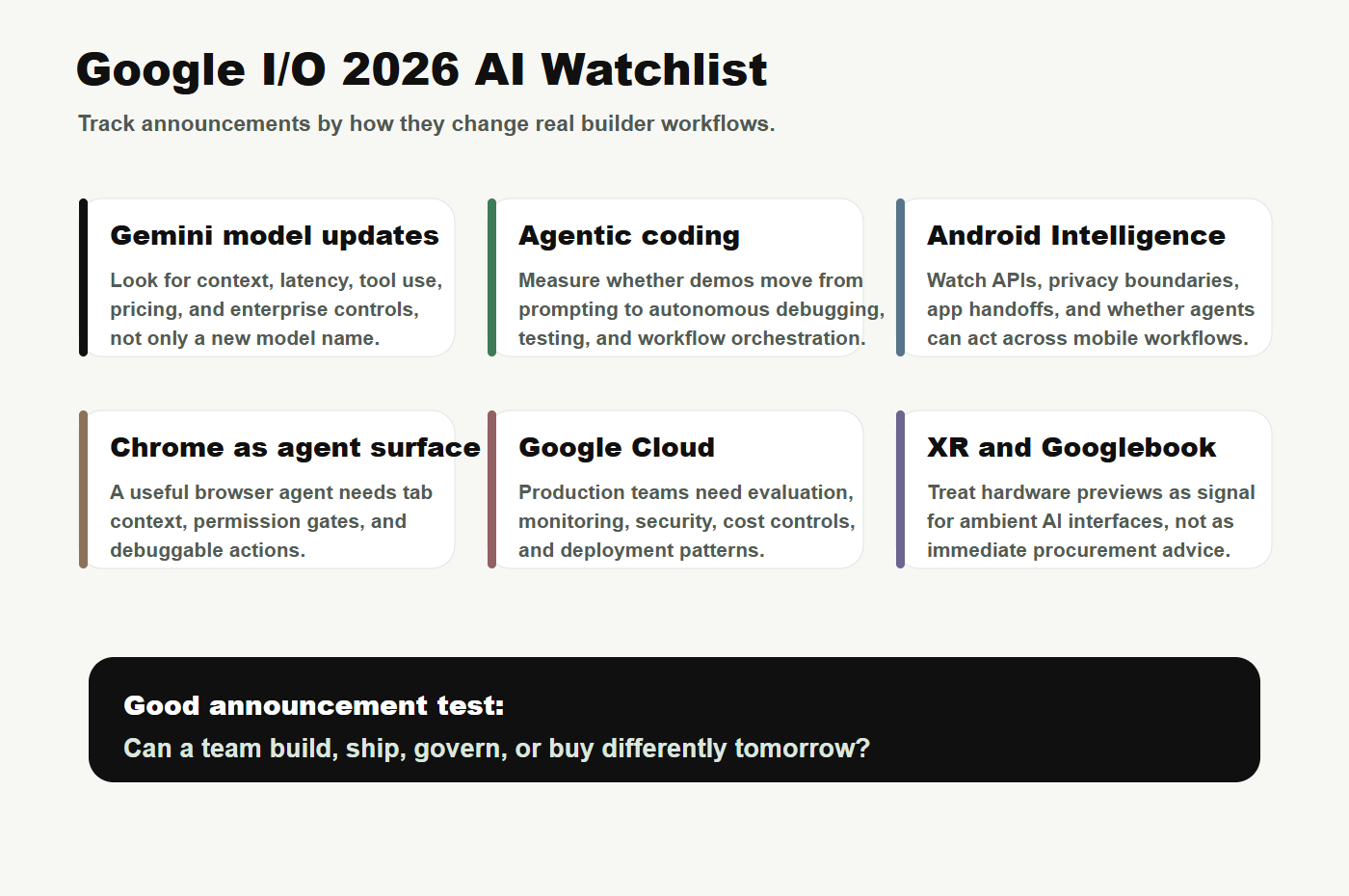
If Google announces a new or updated Gemini model, the headline will spread quickly. Builders should go one level deeper. The useful signals are benchmark transparency, context size, tool reliability, multimodal quality, response speed, price, regional availability, enterprise controls, and whether the same model is available in consumer products, AI Studio, Vertex AI, and Workspace-like surfaces.
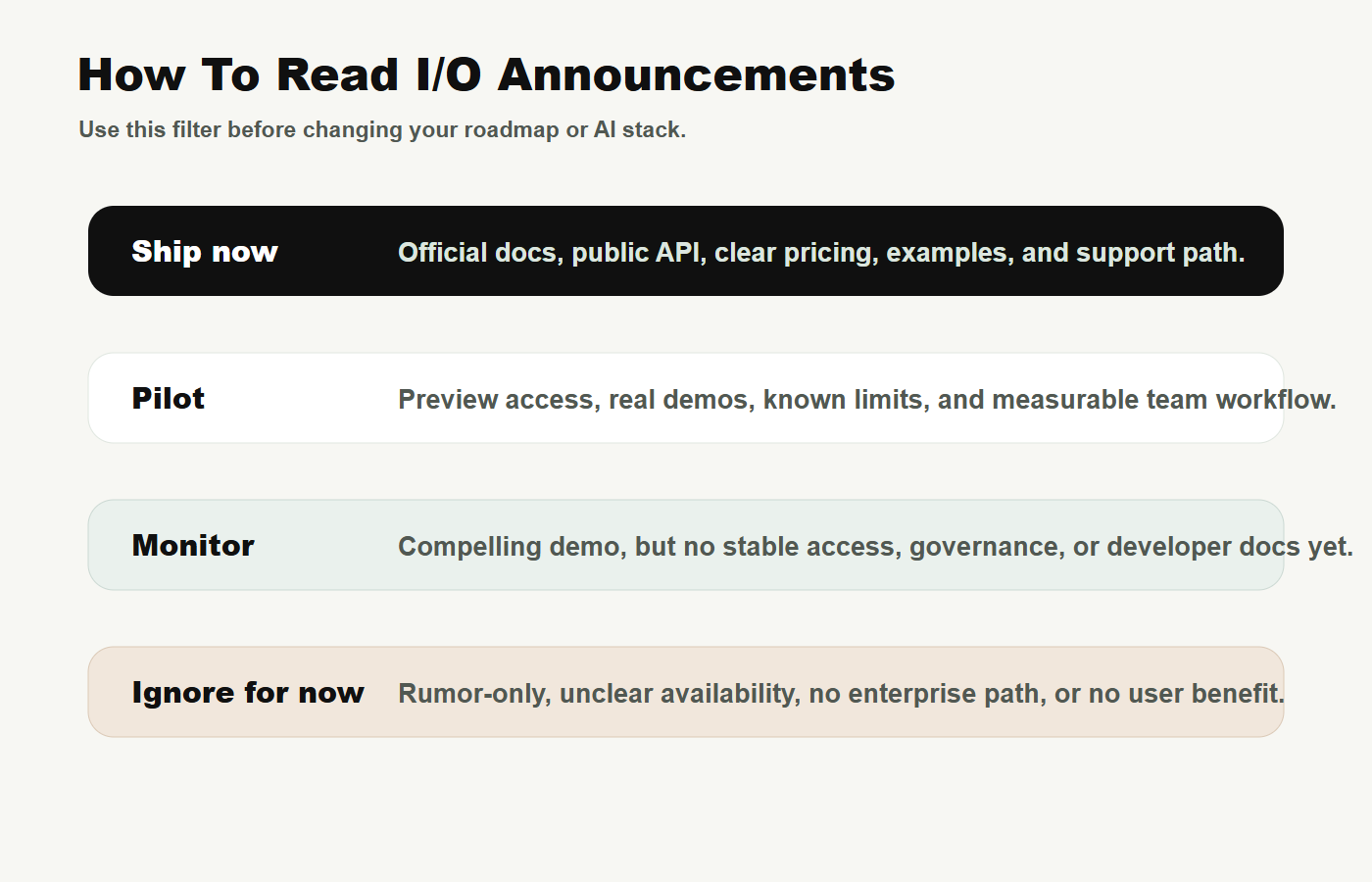
A model that wins demos but lacks stable API access, clear pricing, or reliable tool execution is still a “monitor” item for serious teams. A smaller model update with better latency, evaluation tools, and deployment support may matter more.
2. Agentic coding: watch the debugging loop
The official schedule specifically mentions agentic coding and the future of development. The strongest announcement would not be another code-completion demo. It would show an agent that can move through a complete engineering loop: understand a repo, propose a plan, edit files, run tests, inspect failures, revise, summarize the diff, and keep a human approval gate before risky actions.
For developers, the decision criteria are simple. Ask whether Google’s tools can handle local project context, CI output, browser debugging, test generation, dependency constraints, and secure permissioning. If the demo only shows greenfield app generation, treat it as inspiration. If it shows repair, verification, and review, it becomes operationally relevant.
3. Android and Chrome: agents closer to daily work
Android and Chrome are where consumer AI becomes habit. Gemini Intelligence on Android suggests Google wants AI to move from “ask a chatbot” to “act across the device.” Chrome on Android matters for the same reason: the browser has page context, account context, forms, tabs, and tasks that people already use.
The risk is permission confusion. The opportunity is a more useful assistant layer. Good announcements should explain what an agent can see, what it can do, what it cannot do, how users approve actions, and how developers can build or block integrations.
4. Cloud: the production bridge
Cloud announcements are less flashy than keynote demos, but they decide enterprise adoption. Watch for evaluation harnesses, agent observability, model routing, security controls, governance templates, cost monitoring, and reference architectures for production agents. If Google wants Gemini to compete inside business workflows, it needs to make the path from prototype to controlled deployment boring in the best possible way.
5. XR, glasses, and Googlebook: hardware as interface strategy
Googlebook is interesting because it reframes the laptop around Gemini Intelligence instead of treating AI as a sidebar. Glasses and XR are similar strategic signals. They point to a future where AI becomes an interface layer across screens, cameras, voice, and context.
For now, buyers should avoid jumping to procurement conclusions. The practical questions are availability, partner hardware, developer tools, app compatibility, privacy model, and whether the experience works outside polished demos. Developers should watch for SDKs, sample apps, and platform constraints.
How teams should prepare before the keynote
- Write your watchlist before the stream. Pick three questions that matter to your team: model access, coding agents, Android workflows, Chrome automation, Cloud deployment, or device strategy.
- Separate official facts from expectation. Google has confirmed the event themes and schedule. Anything about exact model names, pricing, or launch dates should wait for the keynote, docs, or product pages.
- Bookmark the docs first. Demos are useful, but docs reveal access rules, limits, examples, and supported regions.
- Score announcements by actionability. If you can pilot it this week, it belongs in “ship now” or “pilot.” If it is demo-only, keep it in “monitor.”
- Check governance before workflow changes. Any agent that can browse, code, email, schedule, buy, or modify files needs clear permission and review controls.
- Schedule a 48-hour refresh. The best details often land after the keynote in docs, session videos, codelabs, and developer blog posts.
FAQ
When is Google I/O 2026?
Google I/O 2026 runs May 19-20 in Pacific Time. The Google keynote starts May 19, 2026 at 10:00 a.m. PT, which is May 20, 2026 at 2:00 a.m. KST.
Will Google announce a new Gemini model?
Google’s official I/O materials say to expect the latest Gemini model updates, but they do not confirm a specific model name in advance. Treat exact model-name predictions as unconfirmed until Google publishes the keynote or docs.
What should developers watch most closely?
Agentic coding, AI Studio or Vertex AI access, Chrome developer tooling, Android APIs, and any evaluation or deployment tooling that makes AI agents safer to ship.
What should business teams watch?
Business teams should focus on Gemini availability, Workspace or Cloud integrations, governance, pricing, security controls, and whether announcements can improve a real workflow within 30 days.
Source note
This article package was generated through the Tovren Editorial OS project in ChatGPT Pro Extended mode, then checked against current official Google sources before publication.
Source log
- Google Developers Blog: Get ready for Google I/O 2026 – official event dates, AI themes, Gemini, Android, Chrome, Cloud, and agentic coding framing.
- Google Developers Blog: Livestream schedule revealed – official Google keynote and Developer keynote times, plus developer-session themes.
- Google I/O 2026 official site – official event registration, keynotes, and program hub.
- Google Blog: The Android Show: I/O Edition 2026 – Android Show announcements, Gemini Intelligence, Chrome on Android, Googlebook, and glasses preview signal.
- Google Blog: Introducing Googlebook – official Googlebook positioning, Gemini Intelligence features, partner hardware, and launch-window context.
Related Tovren reads
- How to Use OpenAI Codex from the ChatGPT iOS App
- ChatGPT Projects vs Custom GPTs: Which Should Teams Use in 2026?
- Business AI Stack 2026: ChatGPT vs Copilot vs Claude vs Gemini
Refresh triggers
- Refresh immediately after the May 19 PT Google keynote.
- Refresh when Google publishes new Gemini model pages, AI Studio docs, Vertex AI docs, Android developer docs, Chrome developer docs, or Cloud agent docs from I/O.
- Refresh if Google confirms pricing, access limits, supported regions, partner hardware, or launch timing for Googlebook, glasses, or XR features.
- Refresh within 48 hours after I/O because session videos and codelabs often clarify what the keynote only previews.