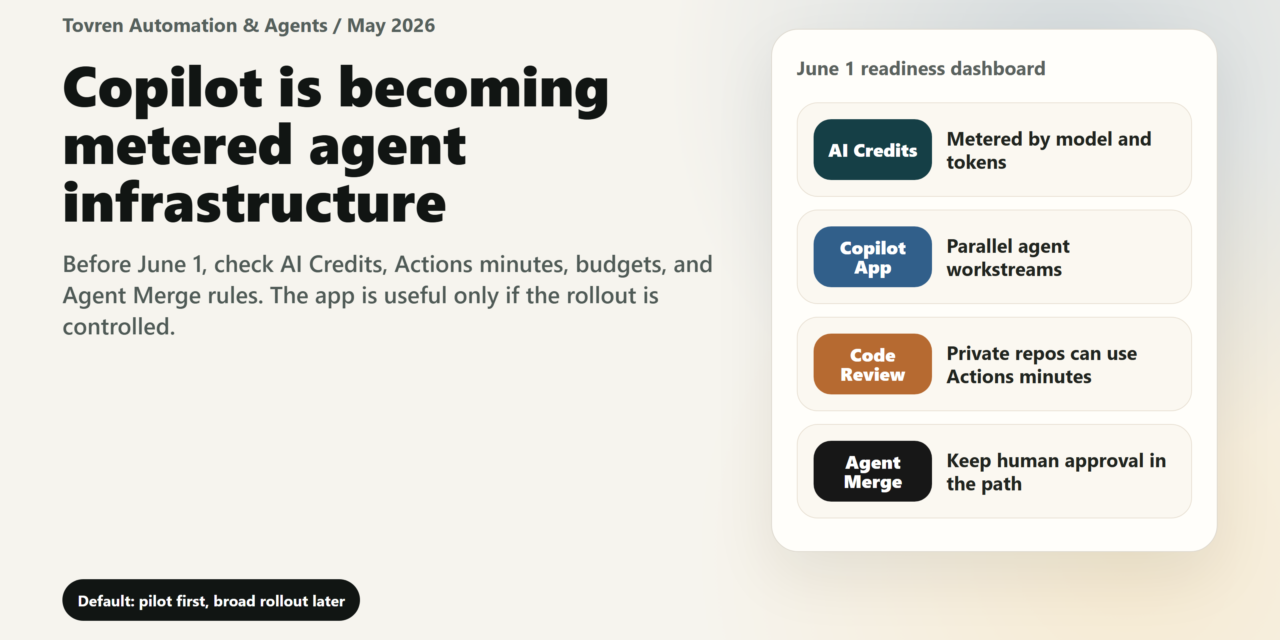
Short answer: GitHub Copilot billing changes matter because agentic coding can turn casual usage into real spend. Teams should review plan limits, premium request behavior, and developer workflows before June billing changes affect budgets.
GitHub Copilot usage-based billing starts on June 1, 2026, and teams should treat the Copilot App technical preview as agent infrastructure, not a harmless desktop upgrade. Use it if you are an individual developer testing isolated issues or an admin running a controlled pilot. Avoid broad rollout if you have not reviewed AI credit exposure, model token usage, cached-token accounting, Copilot code review’s Actions-minute impact on private repositories, budgets, and protected-branch rules. Do this before June 1: download the usage report, preview projected spending, set budgets, restrict Agent Merge, and require human approval before merge. The product is promising; the billing and governance surface is now materially larger.
Verdict
Use it if you want to test agent-driven development on low-risk issues, documentation updates, tests, refactors, dependency cleanup, or internal tooling where a human still reviews the pull request.
Avoid it if your organization has not modeled AI Credits, has weak GitHub Actions budget controls, allows direct merges to protected branches, or cannot separate experimental agent work from production-critical repositories.
Do not enable broad Agent Merge until you have required human review, CI checks, CODEOWNERS approval where appropriate, branch protection, budget owners, and a visible way to identify high-consumption users, models, surfaces, and repositories.
What is confirmed
GitHub announced that all Copilot plans transition to usage-based billing on June 1, 2026. The old premium request unit model is being replaced by GitHub AI Credits, and usage is calculated from token consumption, including input tokens, output tokens, and cached tokens, using the listed API rates for each model.
GitHub’s individual billing documentation says GitHub AI Credits are the billing unit for Copilot usage and that 1 AI credit equals $0.01 USD. It also says interaction cost depends on the model and the number of tokens consumed; long agent sessions across multiple files cost more than quick chat-style interactions.
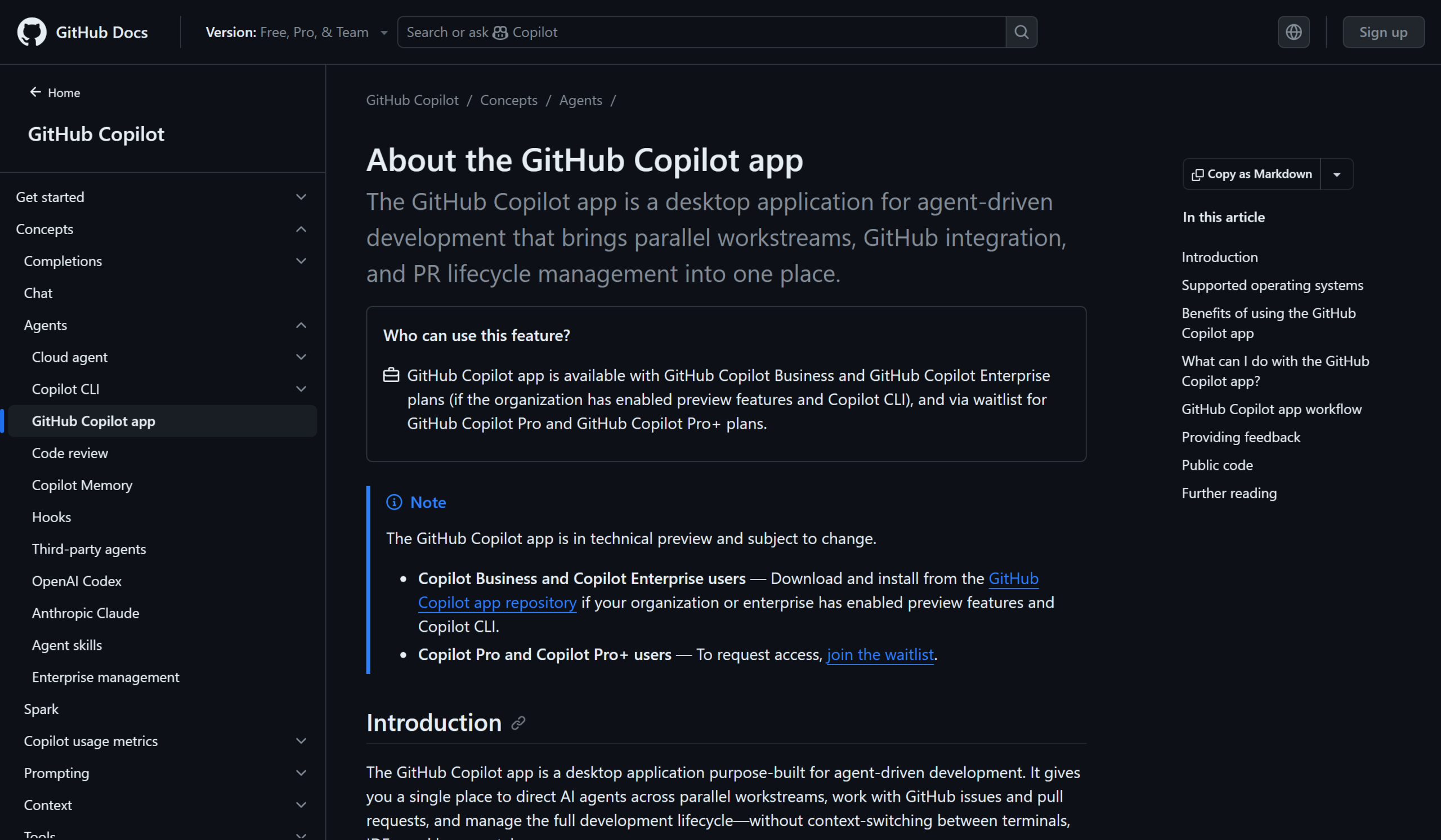
GitHub also released the Copilot App in technical preview. It is a desktop application for agent-driven development that brings parallel workstreams, GitHub integration, and pull request lifecycle management into one place. GitHub says Business and Enterprise access requires preview features and Copilot CLI to be enabled; Pro and Pro+ users use a waitlist.
The app can run several isolated agent workflows in parallel, choose session modes, create branches, write code, run tests, create pull requests, review pull requests, check CI, and merge from inside the app. GitHub’s changelog also describes Agent Merge as a way for the agent to address review comments, fix failing checks, and merge once conditions are met.
Copilot code review has its own billing risk. Starting June 1, 2026, GitHub says each Copilot code review will consume AI Credits and, for private repositories, GitHub Actions minutes. Public repositories are unchanged for Actions minutes. The changelog lists Copilot Pro, Pro+, Business, and Enterprise in the affected plans.
What is community sentiment, not confirmed fact
Reddit threads in r/GithubCopilot during May 2026 show users asking how the billing preview works, whether token-based billing changes the value of Copilot, and whether alternatives are safer for heavy agent use. A separate r/ExperiencedDevs thread posted in May 2026 drew attention because one user claimed their company’s projected Copilot spend could become a major IT budget line. Treat this as sentiment only. It is useful evidence that users are worried about cost visibility; it is not proof of typical customer bills.
Tovren analysis: Copilot is becoming metered agent infrastructure
The important shift is not just “GitHub changed billing.” The real shift is that Copilot is moving from predictable subscription expectations toward infrastructure-like consumption. A quick autocomplete-heavy workflow remains different from a long-running agent workflow that reads repository context, writes code, loops through tests, responds to reviews, and possibly merges a PR.
That means engineering teams need to stop evaluating Copilot only as a per-seat developer assistant. For agentic work, the unit of risk becomes a combination of model choice, token volume, cached context, number of parallel sessions, code review runs, Actions minutes, repository scope, and merge permissions.
The Copilot App may be valuable because it gives developers a single control surface for issues, branches, pull requests, CI, and agent sessions. But the same convenience can create invisible spend and review risk if teams treat it like a normal IDE extension. The safest default is controlled testing, not organization-wide activation.
Do this before June 1
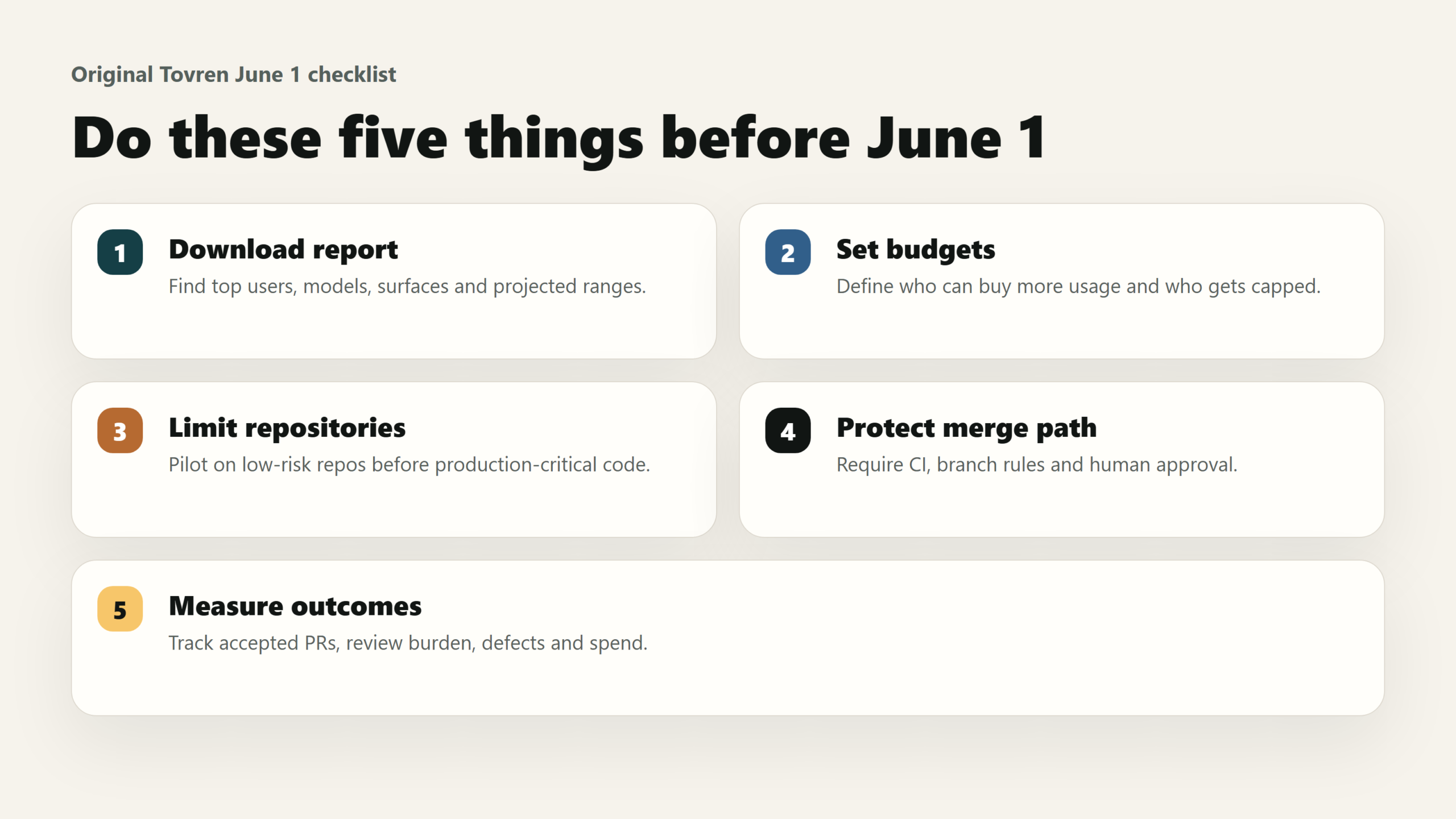
- Download the usage report. GitHub says admins can download detailed usage reports, including AI credit quantity and estimated cost columns under usage-based billing. Use this before you debate policy.
- Identify top consumers, models, and surfaces. GitHub’s April report guidance says the report helps identify top consumers, model usage, surfaces driving consumption, and monthly AI credit ranges before June 1.
- Use the billing preview, but do not treat it as a final invoice. GitHub says projected spend is illustrative and actual usage may differ.
- Review and adjust budgets. Existing enterprise-level budgets for premium requests carry over to AI Credits where applicable, but GitHub tells admins to review whether those limits still reflect what they want.
- Check private repository code review exposure. Copilot code review can consume both AI Credits and Actions minutes on private repositories from June 1.
- Restrict Agent Merge. Allow it only where branch protection, required checks, human review, and rollback paths are already working.
- Publish internal rules. Tell developers which models, repositories, session modes, and merge paths are approved for the pilot.
Practical decision table
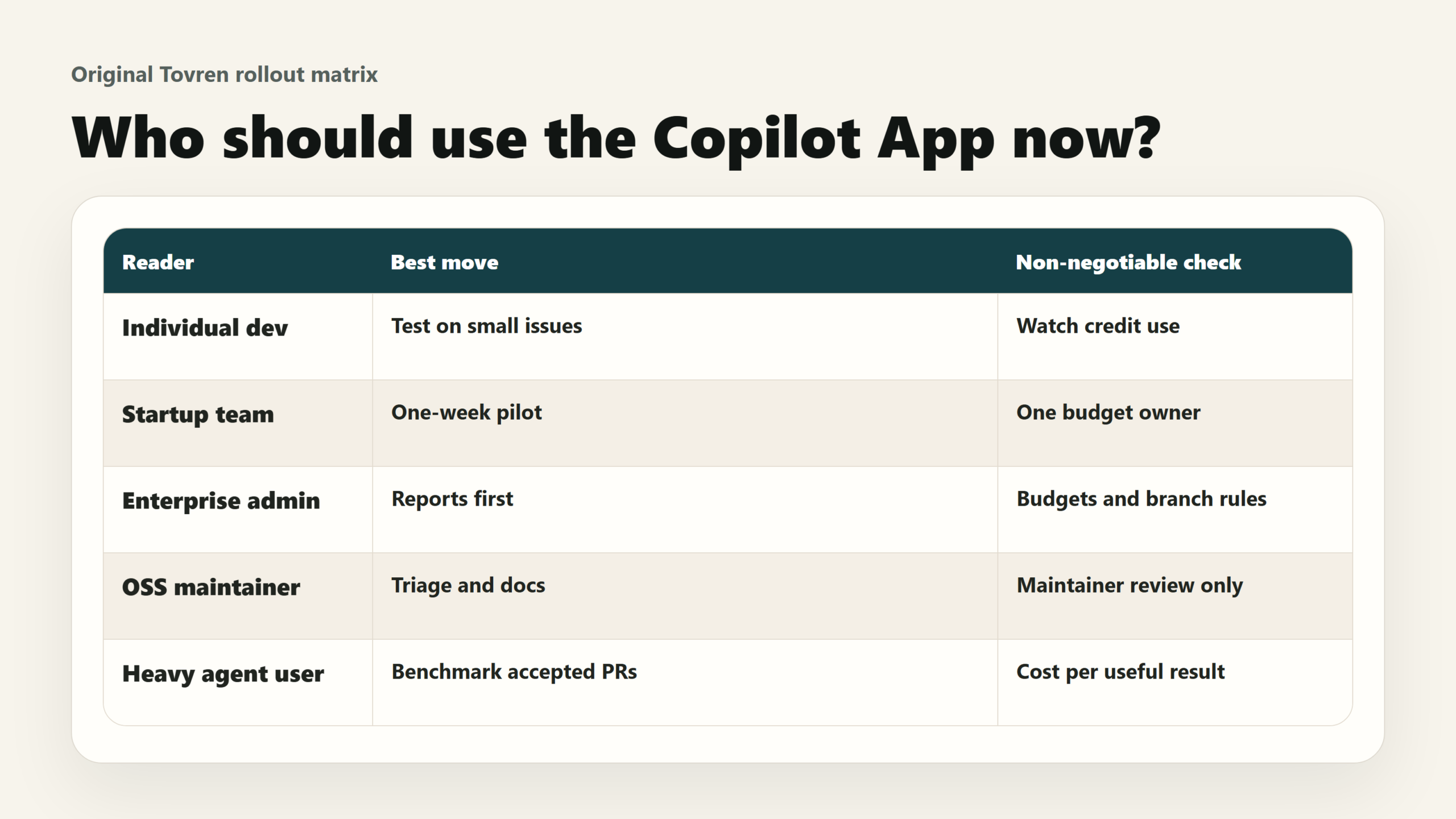
| Reader type | Use it if… | Avoid or delay if… | Recommended action |
|---|---|---|---|
| Individual developer | You want to test the Copilot App on personal projects, small fixes, tests, docs, or isolated issues. | You expect long autonomous sessions and have not checked how AI Credits work. | Test with a budget, prefer small tasks first, and watch credit usage after each session. |
| Startup team | You have a small repo set, clear PR review rules, and one owner watching spend daily. | Your team has no billing owner or lets AI-generated PRs merge with minimal review. | Run a one-week pilot on non-critical repos before enabling broad access. |
| Enterprise admin | You can download reports, map usage by user/model/surface, and enforce budgets by org or cost center. | You have many private repos, many autonomous users, and unclear Actions-minute ownership. | Freeze broad rollout until budgets, reporting, branch protection, and review policy are updated. |
| Open-source maintainer | You mainly work in public repositories and need help triaging issues or preparing routine PRs. | You cannot review generated code carefully or track provenance-sensitive changes. | Use it for triage, docs, and tests; keep maintainer review mandatory before merge. |
| Heavy agent user | You already understand model costs, token usage, and can justify agent sessions against output quality. | You expect old subscription-style unlimited use for multi-hour sessions. | Set personal or team budgets, benchmark tasks, and compare cost per accepted PR. |
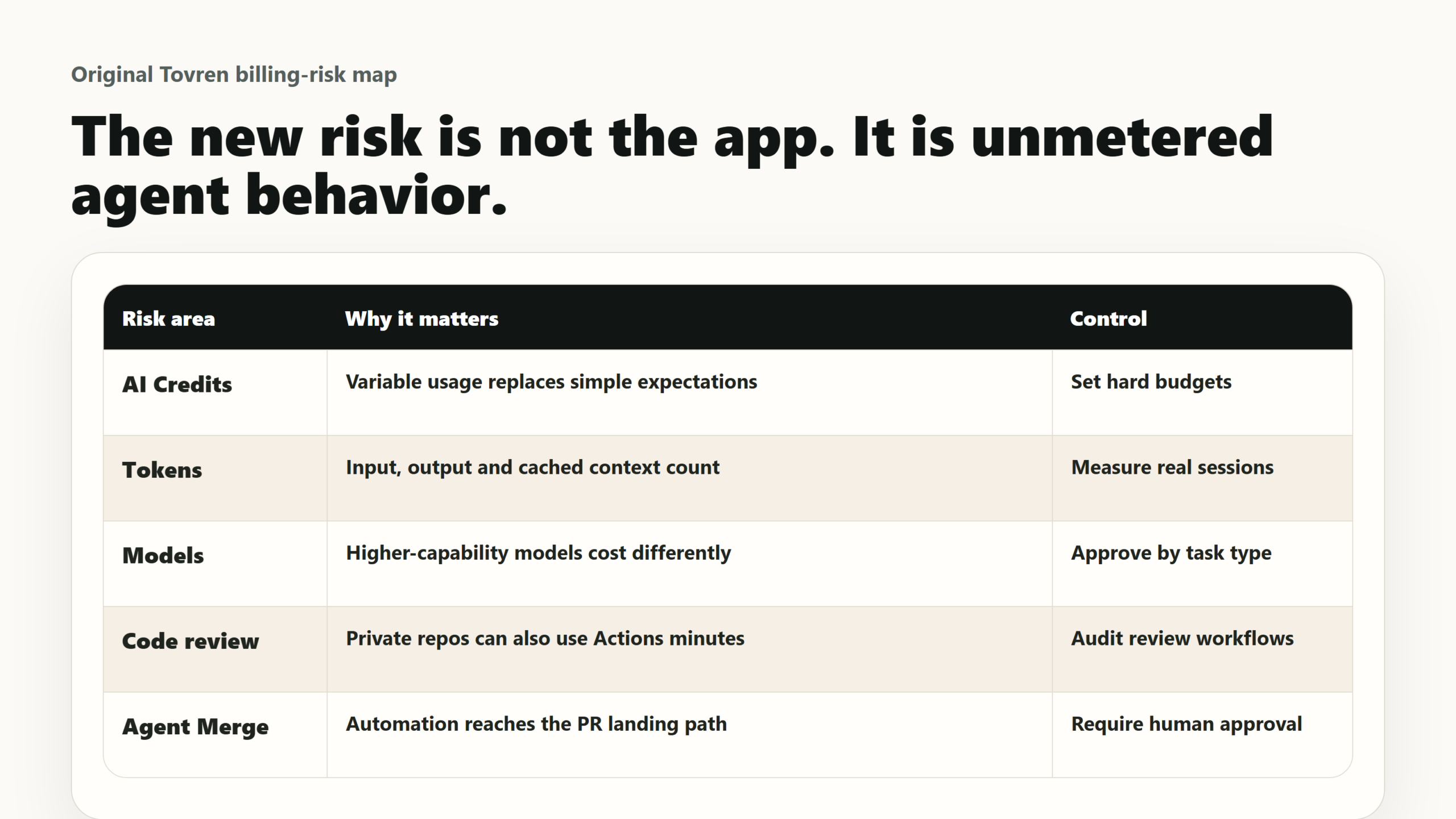
Billing-risk table
| Risk area | What changes | Why it matters | Safeguard |
|---|---|---|---|
| AI Credits | Copilot usage consumes GitHub AI Credits from June 1, 2026. | Teams need to manage variable usage, not only seat subscriptions. | Set budgets and review projected spend before June 1. |
| Model token usage | Usage depends on model choice and token volume. | Longer, more complex sessions can cost more than simple chat or autocomplete workflows. | Define approved models by task type and review high-consumption sessions. |
| Cached tokens | Cached tokens are included in the token-consumption calculation. | Large context reuse can still be part of the billing picture. | Measure real sessions instead of estimating from prompt length alone. |
| Code review Actions minutes | Copilot code review consumes Actions minutes on private repositories from June 1. | Code review can hit both AI Credits and GitHub Actions budgets. | Audit private repos using Copilot code review and confirm Actions spending limits. |
| Budget controls | Budgets become the main way to prevent unlimited additional usage. | Without caps, heavy agent users can surprise finance and platform teams. | Use enterprise, cost-center, org, or user-level controls where available. |
| Agent Merge | The agent can help fix review comments, failing checks, and merge when conditions are met. | Merge automation changes both delivery speed and governance risk. | Do not allow broad Agent Merge until protected branches and human approval are enforced. |
Safe rollout plan: 7 days
Day 1: Inventory access. List who has Copilot, which organizations have previews enabled, whether Copilot CLI is enabled, which repositories use Copilot code review, and which teams are likely to try the Copilot App.
Day 2: Pull the usage data. Download the usage report and identify the top users, top models, and top surfaces. Do not average everything across the company; heavy users matter more than the mean.
Day 3: Classify workflows. Separate safe pilot tasks from restricted tasks. Safe tasks include docs, tests, small bugs, dependency cleanup, internal scripts, and non-critical refactors. Restricted tasks include auth, payments, security-sensitive code, deployment logic, regulated data workflows, and production incident changes.
Day 4: Set budgets and alerts. Assign budget owners. Decide whether teams may purchase additional usage, who approves it, and when usage should be capped instead of extended.
Day 5: Pilot the Copilot App. Use a small group of developers on a limited repository set. Test Interactive and Plan modes first. Delay Autopilot and Agent Merge until you know how review, CI, and spend behave.
Day 6: Lock merge rules. Require branch protection, CI checks, CODEOWNERS where useful, and human review. Make it clear that “agent opened the PR” never means “agent owns the merge decision.”
Day 7: Decide with evidence. Review accepted PRs, rejected PRs, elapsed time, review burden, AI Credit consumption, Actions minutes, defects, and developer feedback. Expand only if the pilot produced useful work without budget or review surprises.
Who should avoid broad rollout
Avoid broad rollout if your organization cannot answer four questions: who can spend, what they can spend on, who approves agent-created changes, and what happens when the agent is wrong.
Also avoid broad rollout if your repositories lack branch protection, if your review culture already rubber-stamps PRs, if your Actions-minute spend is poorly monitored, or if finance expects Copilot to remain a flat subscription-like expense regardless of agent use.
Finally, avoid broad Agent Merge for sensitive repositories. Merge automation is not inherently bad, but it should be earned. Start with low-risk repos, require human approval, and keep rollback paths simple.
Recommended policy for teams
Policy line: “Developers may test the GitHub Copilot App on approved repositories and approved task types. Agent-created pull requests require human review. Agent Merge is disabled by default except for approved low-risk repositories with protected branches, required checks, and budget monitoring.”
This is the right balance for June 2026. It does not block experimentation. It blocks accidental infrastructure-scale usage before the organization understands the bill.
FAQ
What is changing with GitHub Copilot billing on June 1, 2026?
GitHub Copilot moves to usage-based billing with GitHub AI Credits. Usage is calculated from token consumption, including input, output, and cached tokens, using model-specific rates.
What is one GitHub AI Credit worth?
GitHub’s documentation says 1 AI credit equals $0.01 USD.
Do code completions consume AI Credits?
GitHub says code completions and next edit suggestions are not billed in AI Credits and remain included for paid plans.
Should individual developers test the GitHub Copilot App?
Yes, if they test it on isolated, reviewable work and watch usage. The app is a technical preview, so behavior and availability can change.
Should teams enable the Copilot App broadly?
No. Teams should first review AI Credit exposure, Actions-minute exposure, budget controls, repository permissions, protected branches, and human-review rules.
Does Copilot code review affect GitHub Actions minutes?
Yes, starting June 1, 2026, GitHub says Copilot code review will consume Actions minutes on private repositories in addition to AI Credits. Public repositories are unchanged for Actions minutes.
Is Agent Merge safe?
Agent Merge can be useful in narrow conditions, but it should not be broadly enabled until CI, branch protection, human review, and budget controls are in place. Treat it as merge automation, not a convenience toggle.
Source Log
| Source | URL | Date | Claim support |
|---|---|---|---|
| GitHub Changelog — GitHub Copilot app is now available in technical preview | https://github.blog/changelog/2026-05-14-github-copilot-app-is-now-available-in-technical-preview | Published May 14, 2026 | Supports technical preview status, GitHub-native desktop agent workflow, parallel sessions, Agent Merge, and Business/Enterprise preview plus Copilot CLI policy requirement. |
| GitHub Docs — About the GitHub Copilot app | https://docs.github.com/copilot/concepts/agents/github-copilot-app | Accessed May 23, 2026 | Supports desktop app description, parallel workstreams, GitHub integration, PR lifecycle management, supported operating systems, session modes, and PR creation/review/CI/merge workflow. |
| GitHub Blog — GitHub Copilot is moving to usage-based billing | https://github.blog/news-insights/company-news/github-copilot-is-moving-to-usage-based-billing/ | Published April 27, 2026 | Supports June 1 transition, AI Credits replacing premium request units, token-based calculation including input/output/cached tokens, preview bill experience, and admin budget-control framing. |
| GitHub Docs — Preparing your organization for usage-based billing | https://docs.github.com/en/copilot/how-tos/manage-and-track-spending/prepare-for-usage-based-billing | Accessed May 23, 2026 | Supports usage report download, AI credit quantity and estimated gross amount columns, preview spend tool, illustrative-not-final warning, budget review, pooled AI credit planning, and internal communication steps. |
| GitHub Changelog — April reports are now available to prepare for usage-based billing | https://github.blog/changelog/2026-05-12-april-reports-are-now-available-to-prepare-for-usage-based-billing | Published May 12, 2026 | Supports report use for April activity, top consumers, models, surfaces, monthly AI credit ranges, and warning that reports are directional estimates rather than recalculated bills. |
| GitHub Changelog — GitHub Copilot code review will start consuming GitHub Actions minutes on June 1, 2026 | https://github.blog/changelog/2026-04-27-github-copilot-code-review-will-start-consuming-github-actions-minutes-on-june-1-2026 | Published April 27, 2026 | Supports AI Credits plus Actions-minute billing for Copilot code review, private repository Actions-minute impact, public repository exception, affected plan list, and recommended budget/usage review steps. |
| GitHub Docs — Usage-based billing for individuals | https://docs.github.com/en/copilot/concepts/billing/usage-based-billing-for-individuals | Accessed May 23, 2026 | Supports GitHub AI Credits as billing unit, 1 AI credit = $0.01 USD, token categories, model/token cost drivers, AI-credit-billed features, and code completions/next edit suggestions not being billed in AI Credits. |
| Reddit community threads — r/GithubCopilot and r/ExperiencedDevs | https://www.reddit.com/r/GithubCopilot/ and https://www.reddit.com/r/ExperiencedDevs/ | Observed May 2026 search results | Sentiment only: supports cautious mention that some developers are confused or frustrated about billing preview, token billing, alternatives, cost visibility, and company budget risk. Not used as proof of typical cost outcomes. |