Short answer: Google Search Agents Are Coming This is worth acting on only when it changes a real workflow, cost, risk, or buying decision. Use the checks below to decide whether to test it now, monitor it, or ignore it.
Bottom line: Google is turning Search into a place where users can ask, refine, monitor, compare, book, and buy without restarting their journey on a publisher or brand site. This is not only an SEO traffic story. It is an answer-selection, source-attribution, product-data, and agent-readiness story.
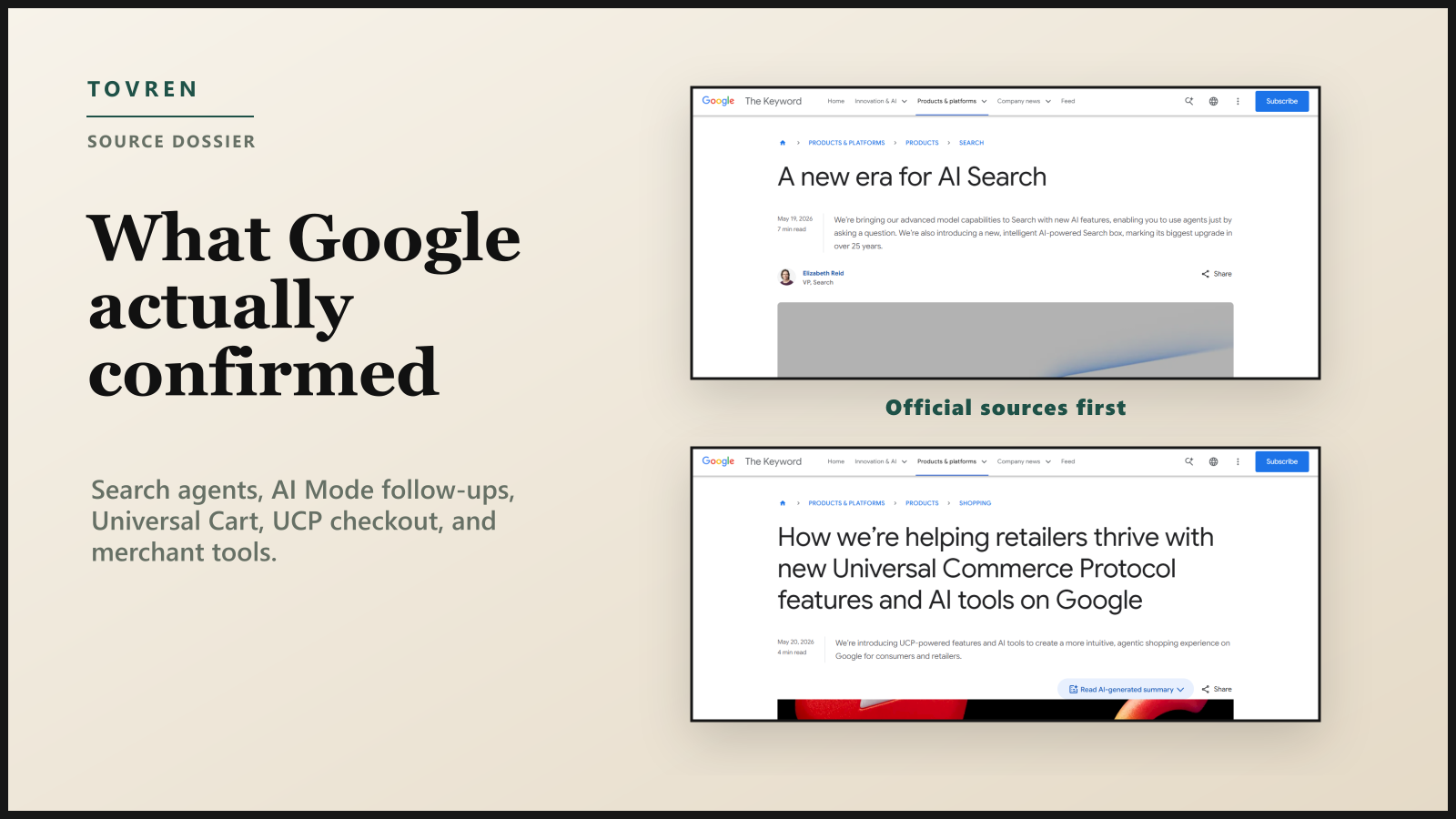
As of May 28, 2026, the confirmed changes come from Google’s official Search I/O 2026 Search announcement, its Google I/O 2026 announcement roundup, the Shopping and Universal Commerce Protocol update, the Ads and Commerce post on agentic shopping, and Google’s Search Central guidance for AI features.
The practical implication is simple: if your content, products, offers, and business facts are not machine-readable, current, distinctive, and easy to cite, you may still be indexed but become less likely to be chosen in the new Search flow.
What Google Actually Announced
Google’s Search update has three layers: AI Mode as the deeper-search surface, information agents that monitor the web in the background, and shopping agents that can move users closer to checkout inside Google surfaces.
| Announcement | What changed | Who should act now |
|---|---|---|
| AI Mode scale and model upgrade | Google says AI Mode has passed 1 billion monthly users and is moving to Gemini 3.5 Flash as the default model globally. | Publishers, SEO teams, ecommerce teams, PPC teams |
| AI-powered Search box | The Search box is being reworked for longer prompts and multimodal inputs including text, images, files, videos, and Chrome tabs. | Content, product, support, and documentation teams |
| AI Overview to AI Mode follow-ups | Users can move from an AI Overview into a conversational AI Mode follow-up flow without starting a new search. | Publishers and brands dependent on informational clicks |
| Information agents | Users will be able to create agents that monitor web sources, blogs, news, social posts, and real-time data, then send synthesized updates. | News, review, local, finance, sports, shopping, and niche authority sites |
| Agentic booking and business calls | Google is expanding booking-style tasks and says some categories will allow Google to call businesses on a user’s behalf in the U.S. | Local services, hospitality, beauty, home repair, pet care |
| Universal Cart and UCP checkout | Google is building a cross-surface cart across Search, Gemini, and later other services, with UCP-powered checkout using Google Pay or transfer to merchant sites. | Retailers, marketplaces, DTC brands, affiliate publishers |
| Merchant Center AI tools | Google announced AI performance insights, conversational attributes, and Ask Advisor in Merchant Center. | Retail media, product feed, ecommerce analytics, and Google Ads teams |
| Business Agent and Direct Offers | Eligible retailers can activate a branded shopping agent in Merchant Center, while Direct Offers will test sponsored deals in AI Mode. | Retailers already active in Merchant Center and Google Ads |
The most important detail is not any single feature. It is the direction of travel. Search is becoming less like a page of ranked links and more like a task environment where answers, follow-up questions, comparisons, actions, and purchases can sit in one flow.
Confirmed Versus Speculation
SEO, PPC, Reddit, and AI-agent communities are already debating zero-click risk, follow-up flows, agent-mediated shopping, and whether brands must optimize to be cited or chosen by agents. Treat that as a serious planning concern, not as a confirmed traffic forecast. Google has not published a universal “AI agents will reduce publisher traffic by X%” number.
| Topic | Confirmed by Google | Planning assumption | Not confirmed |
|---|---|---|---|
| Information agents | They will monitor web and real-time sources and launch first for Google AI Pro and Ultra subscribers this summer. | Freshness, distinct source identity, and update cadence will matter more. | Exact ranking or citation rules for agent updates. |
| AI Mode follow-ups | Users can continue from AI Overviews into AI Mode with context. | More research journeys may happen before a click occurs. | That all categories will lose traffic equally. |
| Search Console reporting | Google’s Search Central guidance says AI feature appearances are counted inside normal Web performance reporting. | Teams should monitor CTR, query shifts, and landing-page changes closely. | A standalone “agent picked us” report for every site. |
| Shopping agents | Universal Cart, UCP checkout, Business Agent, Direct Offers, and Merchant Center AI tools are announced or rolling out. | Feed quality, offer clarity, price accuracy, and product Q&A will influence discovery. | That every merchant will immediately qualify for UCP checkout or Business Agent. |
| Zero-click impact | Google says links remain part of AI Mode and AI Overviews. | Some informational journeys may produce fewer but more qualified clicks. | A guaranteed traffic collapse or guaranteed traffic lift. |
Why The Publisher Risk Is More Than Lower Clicks
Publishers should not reduce this to “AI answers may reduce CTR.” That is too narrow. The deeper risk is that Google’s AI layer may become the user’s research workspace, update feed, and decision assistant. In that environment, your page may be used as evidence, compared against other sources, summarized into a user-facing answer, and replaced by a follow-up prompt before the reader ever recognizes your brand.
That changes the publisher job. The old target was ranking for a query and earning the click. The new target is being useful enough to be selected as a supporting source, memorable enough to earn direct demand, and valuable enough that the user still wants your original page after seeing the answer. Tovren’s Google AI Mode SEO playbook should sit next to this article as the tactical companion.
The highest-risk publisher pages are generic explainers, thin “best” lists, recycled definitions, undifferentiated news rewrites, and affiliate pages with weak original testing. The more Google can synthesize your page without losing much value, the less leverage that page has. The safer pages include original data, hands-on comparisons, named expert judgment, live trackers, proprietary calculators, screenshots, decision trees, and content that answers “what should I do next?” better than a summary can.
There is also an analytics risk. If impressions rise, clicks fall, and conversions hold steady, a traffic-only dashboard will call the channel a failure. If clicks fall and conversions fall, the business needs a recovery plan. The first step is separating algorithmic volatility from AI-mode behavior. For sites already hit by search volatility, pair this work with the Google May 2026 core update AI blog traffic recovery guide before rewriting your entire content strategy.
What Ecommerce Teams Should Audit This Week
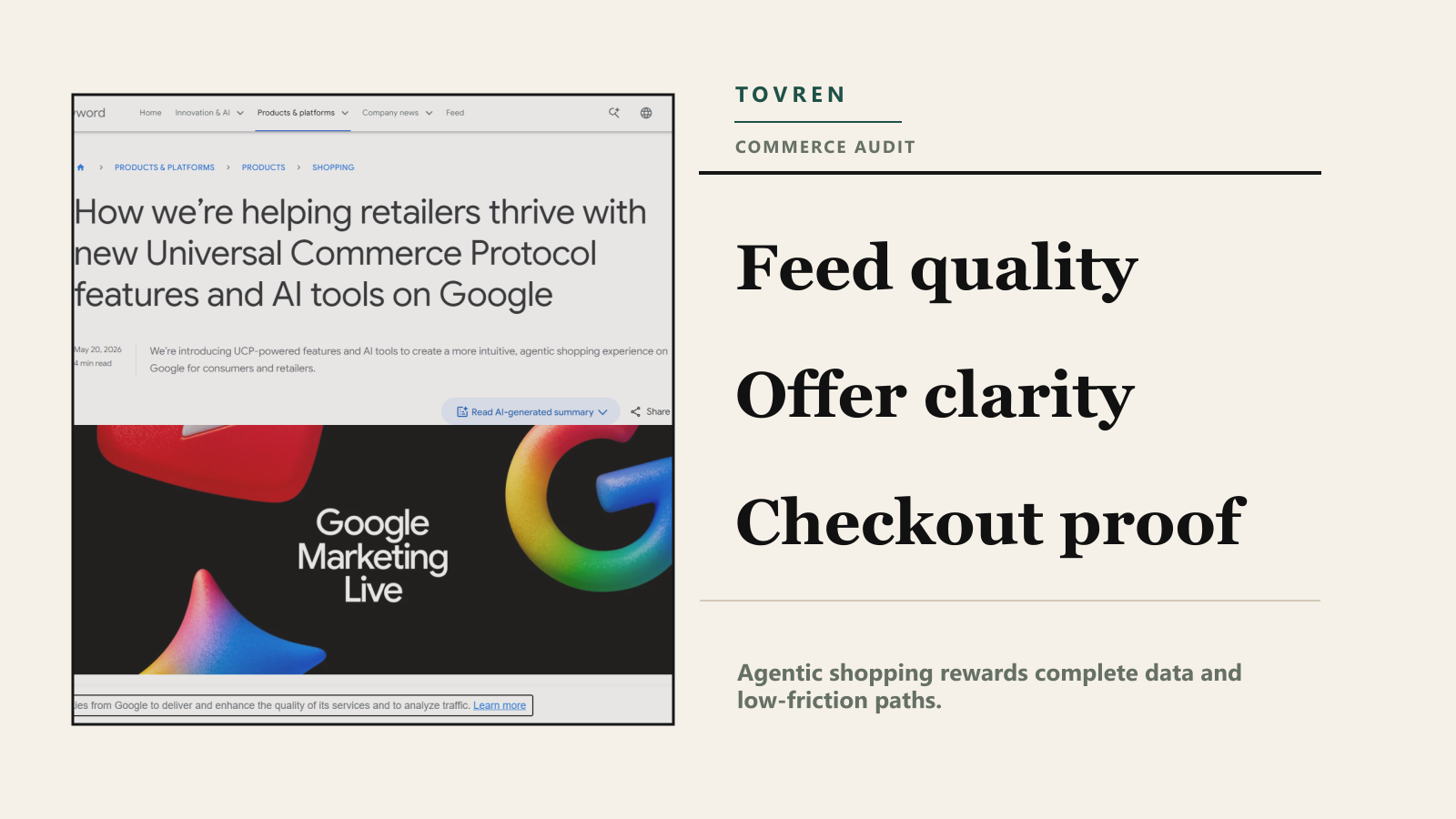
For ecommerce teams, the action is concrete: make sure Google can understand what you sell, who it is for, what problem it solves, what it costs, whether it is available, why it is better than substitutes, and what happens after purchase.
| Audit area | Question to answer | Action this week | Owner |
|---|---|---|---|
| Merchant Center feed | Are price, availability, variants, GTINs, shipping, and return data complete? | Fix disapprovals, missing identifiers, stale availability, and inconsistent pricing. | Feed manager |
| Product descriptions | Do descriptions answer conversational shopping prompts? | Add use cases, compatibility, substitutions, materials, sizing, care, and buyer-fit details. | Merchandising |
| Product pages | Can a user or agent compare products without guessing? | Add comparison tables, FAQs, review summaries, pros and cons, and visible specifications. | SEO and product content |
| Offers and promotions | Are discounts, bundles, and shipping incentives structured clearly? | Prepare offer data for paid and organic discovery, especially for high-intent categories. | PPC and ecommerce |
| Checkout path | Would agentic checkout reduce friction or create attribution gaps? | Map Google Pay, PayPal, wallet, cart, analytics, and post-purchase tracking implications. | Product and analytics |
| Business Agent readiness | Could a branded agent answer product questions accurately? | Prepare approved brand voice, product facts, support policies, and escalation rules. | Customer experience |
| Visual assets | Can Google understand products visually? | Refresh images, alt text, video demos, and comparison visuals for top SKUs. | Creative and SEO |
Search Console And Analytics Signals To Watch
Do not wait for perfect AI-agent reporting. Google’s guidance says AI Overviews and AI Mode are included in Search Console’s normal Web performance data. That helps, but it also means teams need disciplined proxy analysis.
| Signal | Where to check | What it may indicate | Response |
|---|---|---|---|
| Impressions up, CTR down | Search Console query and page reports | More AI or expanded-search visibility without proportional clicks. | Separate informational queries from commercial and branded queries. |
| Longer query patterns | Search Console query exports | Users are asking more specific, conversational questions. | Create answer blocks, comparison sections, and buyer-fit content. |
| Landing-page mix changes | Search Console pages report | Google may be surfacing deeper pages instead of category hubs. | Improve internal links from surfaced pages to money pages. |
| Organic traffic down, conversion rate up | GA4 organic segment | Clicks may be fewer but more qualified. | Report revenue, signups, and assisted conversions, not just sessions. |
| Brand search lift | Search Console and Google Trends | Users may discover you in AI answers, then search your brand directly. | Strengthen brand SERP, homepage messaging, and newsletter capture. |
| Merchant Center share-of-voice changes | Merchant Center AI performance insights when available | Your brand may be gaining or losing visibility on AI shopping surfaces. | Audit feed completeness, offers, reviews, descriptions, and media. |
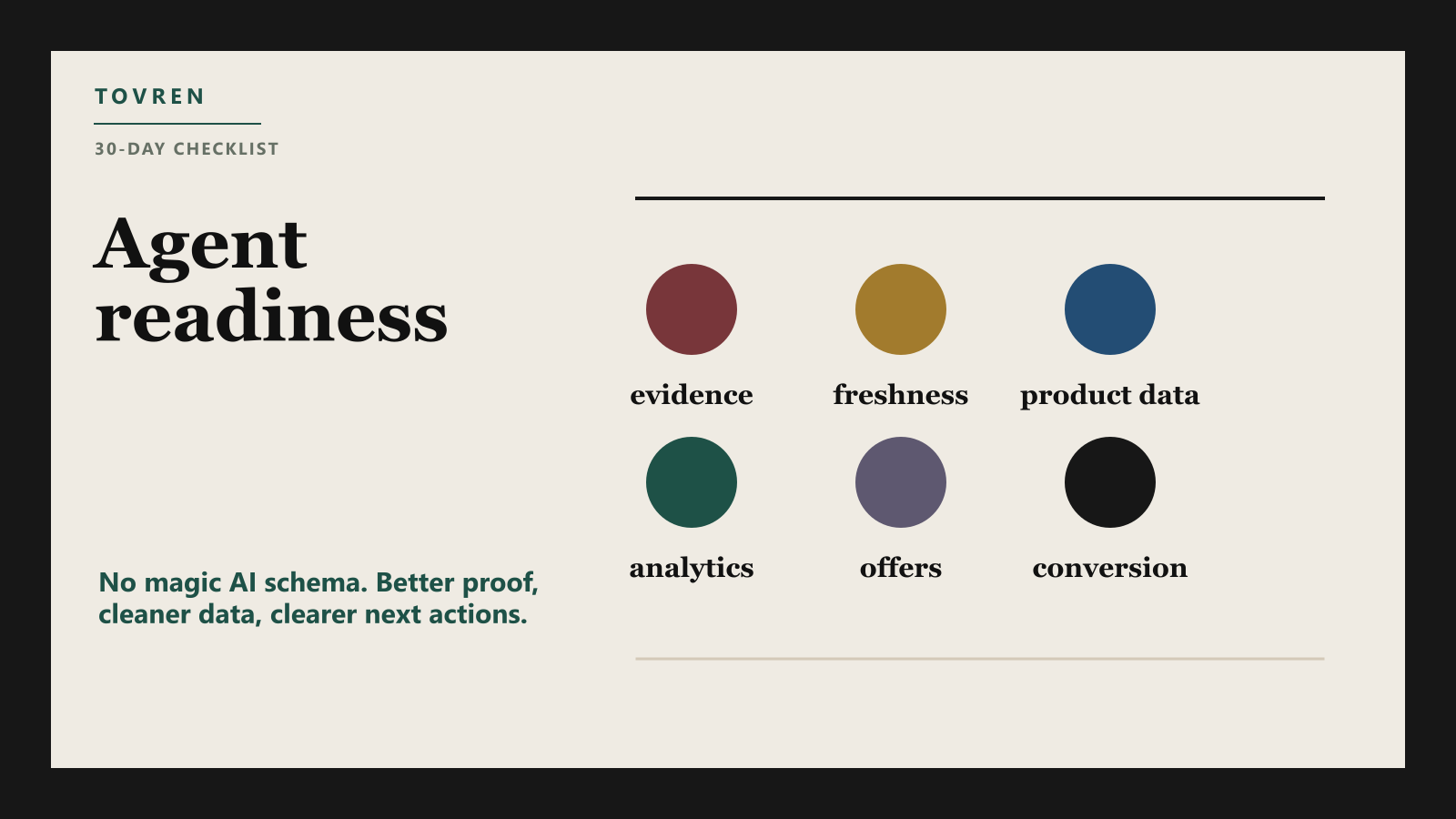
Agent Readiness Checklist
Agent readiness is not a magic schema file. Google says standard SEO fundamentals still apply to AI features, with no special schema requirement for AI Mode or AI Overviews. The practical work is cleaner fundamentals plus better evidence.
| Requirement | Publisher action | Ecommerce action |
|---|---|---|
| Clear entity identity | Strengthen author bios, editorial policies, citations, dates, and topical expertise pages. | Make brand, manufacturer, category, and product relationships obvious. |
| Freshness | Add visible update dates, change logs, and “what changed” sections. | Keep price, stock, delivery, warranty, and return details current. |
| Extractable answers | Use concise answer sections, tables, FAQs, and decision frameworks. | Add product-fit guidance, compatibility tables, and objection handling. |
| Original value | Publish tests, benchmarks, screenshots, interviews, and proprietary data. | Show real demos, review analysis, bundles, comparison data, and buyer outcomes. |
| Technical access | Check crawlability, indexation, snippets, canonical tags, and internal links. | Validate product structured data, Merchant Center diagnostics, and image access. |
| Human conversion path | Capture newsletter, community, tool, and direct-return audiences. | Capture email, cart recovery, loyalty, post-purchase, and customer support signals. |
Teams testing AI browser and agent workflows should also pressure-test how their pages are interpreted outside Google. The AI browser agent prompt pack for Comet, Gemini, and Spark is useful for simulating how agentic systems extract facts, compare options, and decide what to do next.
30-Day Action Plan
| Window | Priority | Deliverable | Success measure |
|---|---|---|---|
| Days 1-3 | Baseline measurement | Annotate the May 19 and May 20 Google announcements in analytics. Export Search Console by query, page, country, and device. | Clean benchmark for impressions, CTR, clicks, conversions, and revenue. |
| Days 4-7 | Risk segmentation | Classify top pages as informational, comparison, commercial, local, product, or support. | List of pages most exposed to AI answer substitution. |
| Days 8-14 | Content and feed upgrades | Update top pages with answer blocks, tables, original evidence, visible dates, and better internal links. Fix Merchant Center issues. | Improved crawlable evidence and product-data completeness. |
| Days 15-21 | Agent simulation | Run AI Mode-style prompts and agent prompts against your category, brand, and product pages. | Documented gaps in facts, trust, comparison clarity, and next-step guidance. |
| Days 22-26 | Commercial readiness | Prepare offers, product Q&A, checkout tracking, Business Agent inputs, and customer-support escalation rules. | Ready-to-activate assets for agentic shopping and Merchant Center tools. |
| Days 27-30 | Executive reporting | Build a dashboard covering AI-era visibility proxies, organic value, conversion quality, brand demand, and merchant visibility. | Leadership sees decisions, not just traffic anxiety. |
The practical move is not to panic-publish “AI SEO” pages. It is to make your best pages more useful to people and more legible to systems. For publishers, that means original evidence, strong identity, and content worth visiting after a summary. For ecommerce teams, it means complete product data, conversational descriptions, clean Merchant Center setup, reliable offers, and checkout paths that can survive agent-mediated discovery.
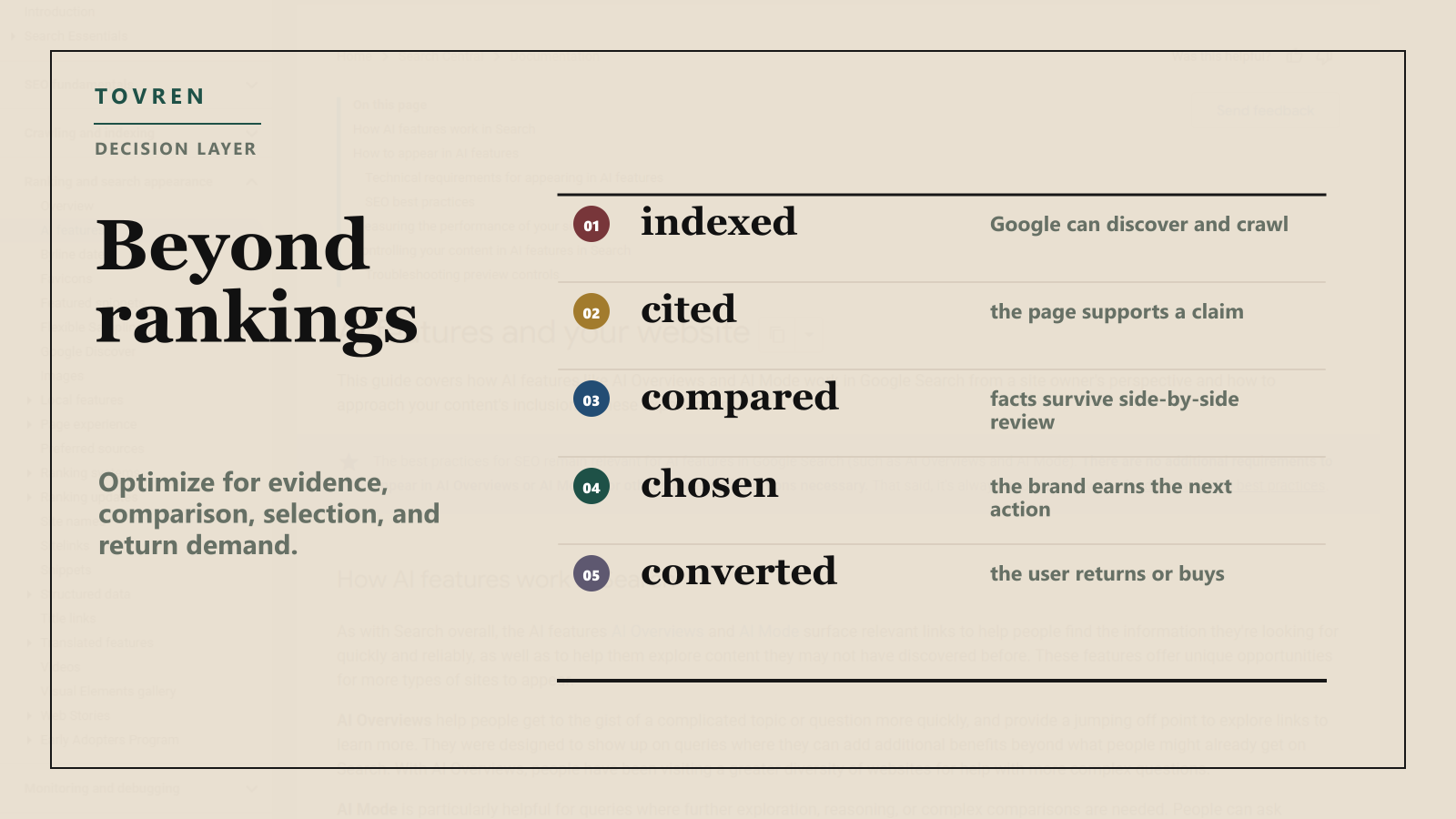
Google’s summer rollout will not affect every site equally. But the direction is clear enough to act now: stop treating Search as only a traffic channel. Treat it as a decision layer where your content, products, and brand facts must be easy to verify, compare, cite, and choose.
FAQ
What are Google Search agents likely to change?
They can move search from reading results toward delegated research, comparison, shopping, and task completion.
What should publishers and merchants prepare?
They should make product data, pricing, availability, policies, and comparisons clear enough for both humans and agents.
Does this replace traditional SEO?
No. It raises the value of crawlable, trustworthy, current pages that answer specific user tasks.