Updated: May 19, 2026
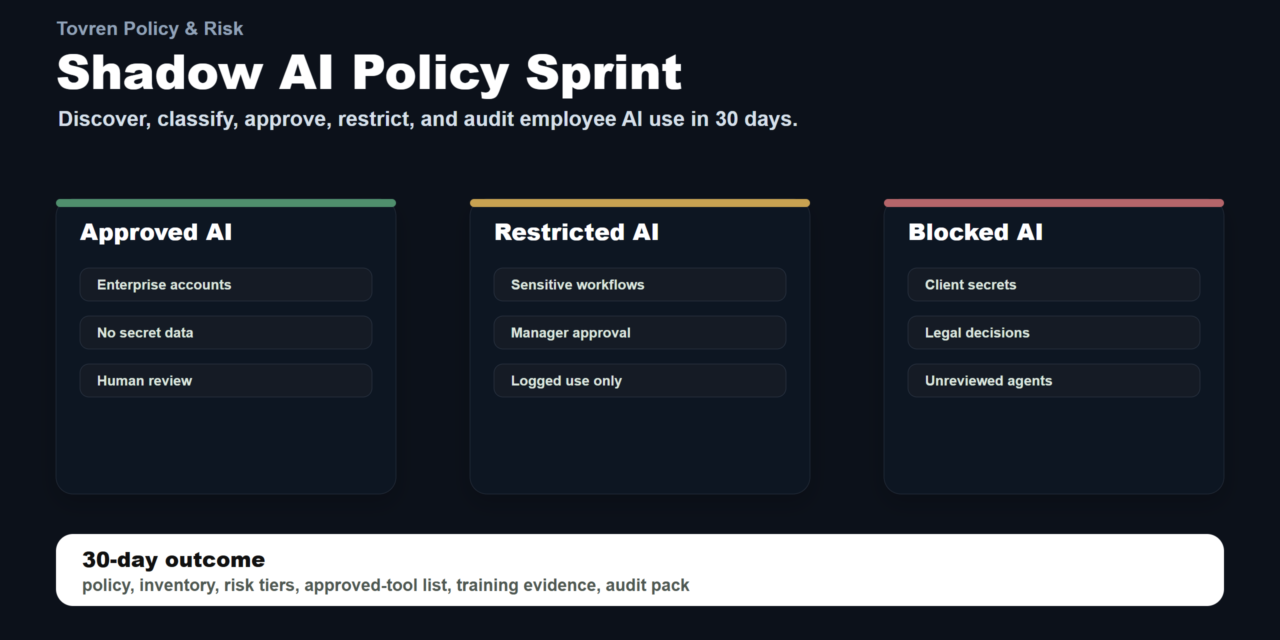
Bottom line: your employees are probably already using AI tools faster than your policy, procurement process, or security stack can track. The answer is not a blanket ban. The answer is a 30-day sprint that discovers shadow AI, classifies use cases, approves safe workflows, blocks dangerous ones, and creates evidence for audits, customers, regulators, and internal leadership.
This guide is not legal advice. AI regulation, privacy law, employment law, procurement obligations, and sector-specific rules vary by jurisdiction. Treat this as an operational governance template and verify legal conclusions with qualified counsel.
What changed: shadow AI is becoming an audit problem
Shadow AI used to sound like a productivity side issue: employees used an AI chatbot, design assistant, meeting bot, coding tool, spreadsheet copilot, summarizer, or browser extension without asking IT. In 2026, that is too narrow. The real issue is that AI use now touches confidential data, customer information, source code, HR decisions, vendor contracts, knowledge bases, customer support, marketing claims, analytics, and automated workflows.
That makes shadow AI a cross-functional risk. Security cares about data leakage. Legal cares about privacy, IP, employment and disclosure obligations. Procurement cares about vendor terms. HR cares about fairness and training. Operations cares about output quality. Leadership cares about speed without an avoidable breach.
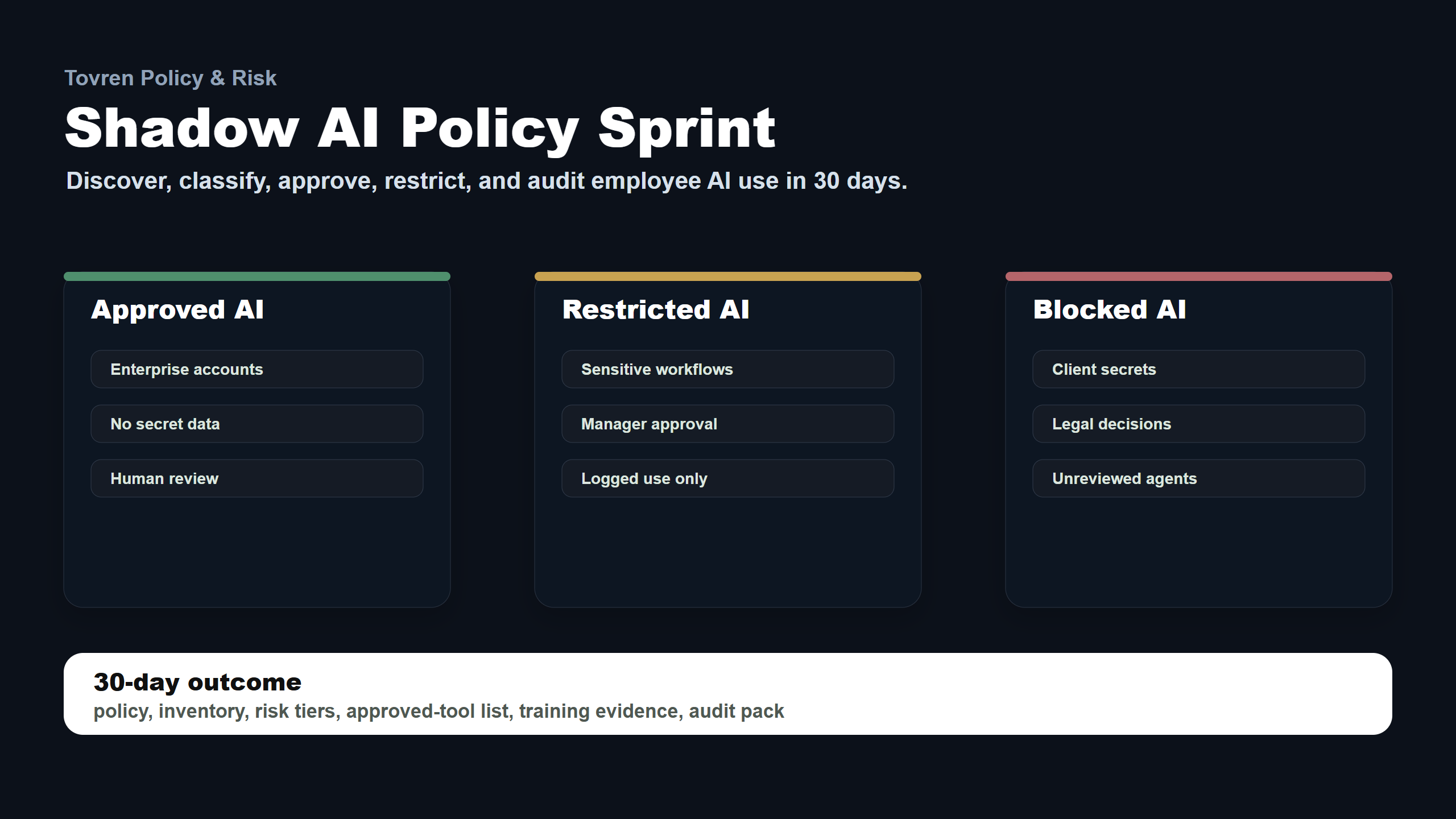
The fresh policy signal is clear. The European Commission’s AI Act page confirms that prohibited practices and AI literacy obligations have applied since February 2025, GPAI governance obligations became applicable in August 2025, transparency rules come into effect in August 2026, and updated high-risk timelines now include December 2027 for certain Annex III high-risk areas and August 2028 for AI systems integrated into regulated products. The Commission also published draft guidance on high-risk AI classification on May 19, 2026.
Confirmed facts, current rules, estimates, risks and editorial opinion
| Type | What we know | How teams should use it |
|---|---|---|
| Confirmed fact | The EU AI Act is a risk-based legal framework for AI systems, with obligations phased in over time. | Build an AI inventory and classify use cases now, especially HR, biometric, education, credit, critical infrastructure, public-service and customer-impact workflows. |
| Current rule | AI literacy obligations under the EU AI Act have been in application since February 2, 2025 for providers and deployers in scope. | Do not publish a policy without role-based training. A policy people never learn is not a control. |
| Current rule | EU AI Act transparency obligations are scheduled for August 2026. | Prepare disclosure rules for chatbots, AI-generated content, deepfakes, and public-facing AI outputs. |
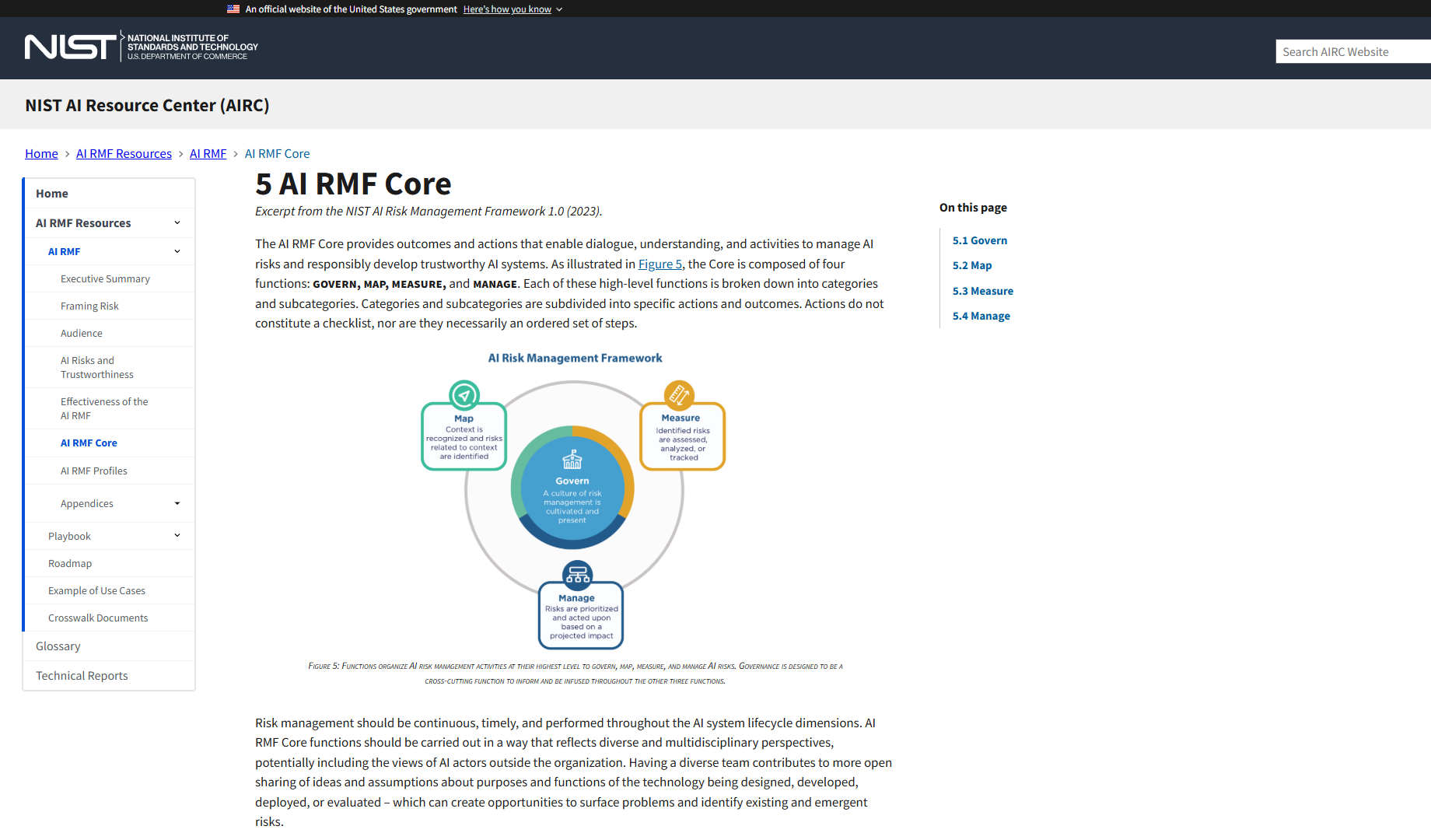
| Current guidance | NIST AI RMF organizes AI risk work around Govern, Map, Measure and Manage. | Use the four functions as the workflow for a 30-day policy sprint. |
| Current standard | ISO/IEC 42001 provides requirements and guidance for an AI management system. | Use ISO/IEC 42001 as the long-term management-system model if customers, regulators, or enterprise buyers expect formal governance evidence. |
| Risk evidence | IBM’s 2025 breach research reported that one in five organizations experienced a breach due to shadow AI, and high levels of shadow AI added an average of USD 670,000 in breach costs. | Use this as a board-level business case for discovery, access controls, DLP, policy, training and monitoring. |
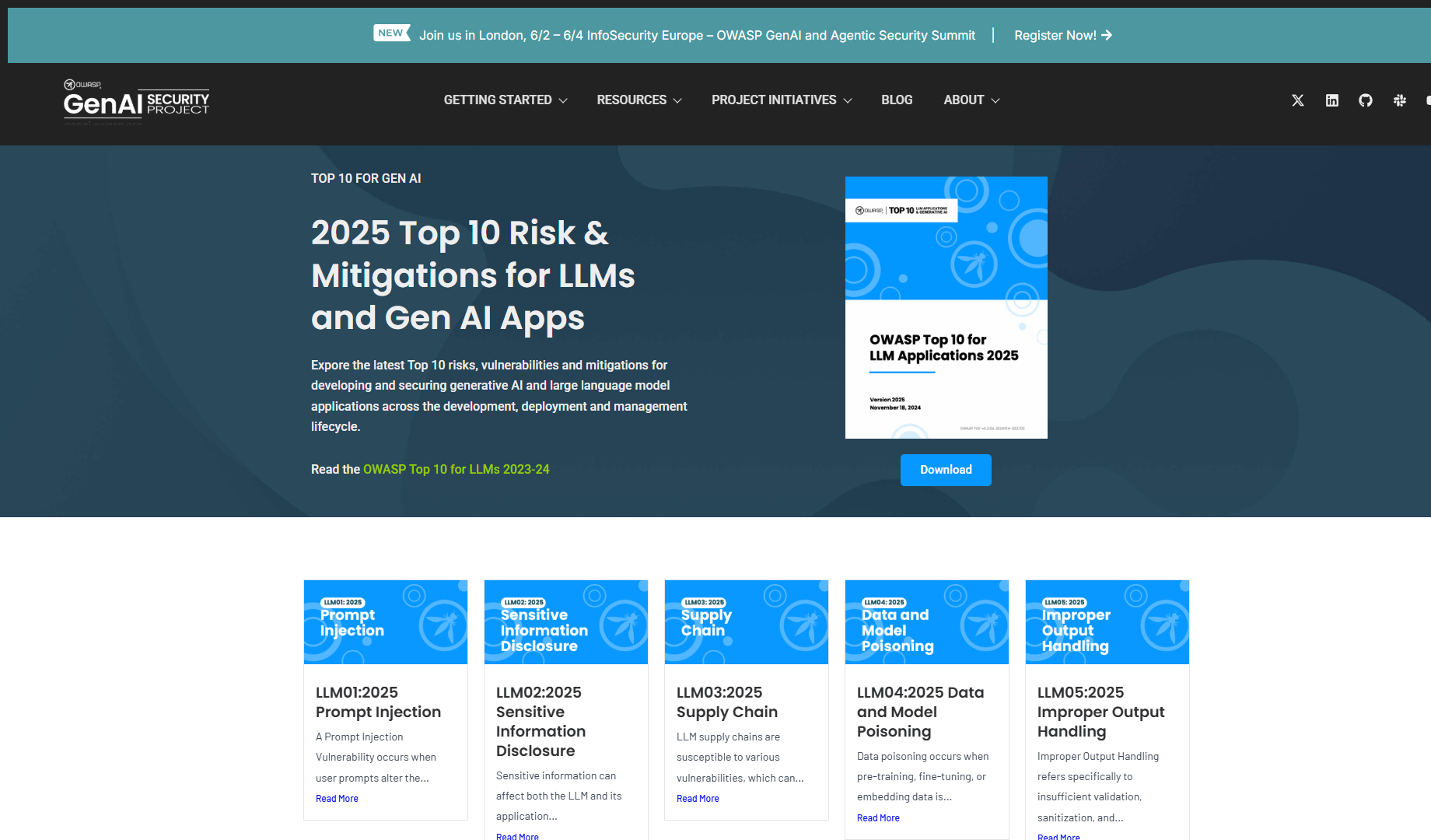
| Security risk | OWASP’s 2025 LLM list includes prompt injection, sensitive information disclosure, supply chain, excessive agency, misinformation and other risks. | Employee AI rules should cover both what people type into tools and what AI outputs are allowed to trigger downstream. |
| Editorial opinion | The best policy is not “ban AI.” It is “approve useful low-risk AI, restrict sensitive AI, and require review for high-impact use cases.” | Give employees a safe path, or they will create their own path. |
Who this guide is for
This guide is for security leaders, legal teams, HR leaders, IT administrators, founders, operations managers, compliance owners, procurement teams, and AI champions who need a usable policy quickly. It is especially useful for companies that:
- allow employees to use public or enterprise AI tools;
- handle customer data, employee data, confidential documents, contracts, code, financial data, healthcare data, regulated records, or proprietary workflows;
- sell to enterprise customers that ask about AI governance in security questionnaires;
- operate in or sell into the EU, UK, US, Korea, Japan, Australia, Singapore, Canada, or other markets where privacy and AI governance expectations are rising;
- use AI-enabled SaaS tools where AI features may be embedded inside existing products.
This guide is not enough for companies deploying high-risk AI systems, regulated medical devices, biometric systems, credit decisioning tools, employment-screening systems, public-sector systems, autonomous agents with production privileges, or AI systems that make legally or similarly significant decisions. Those teams need deeper legal, privacy, safety, security and domain review.
The 30-day shadow AI policy sprint
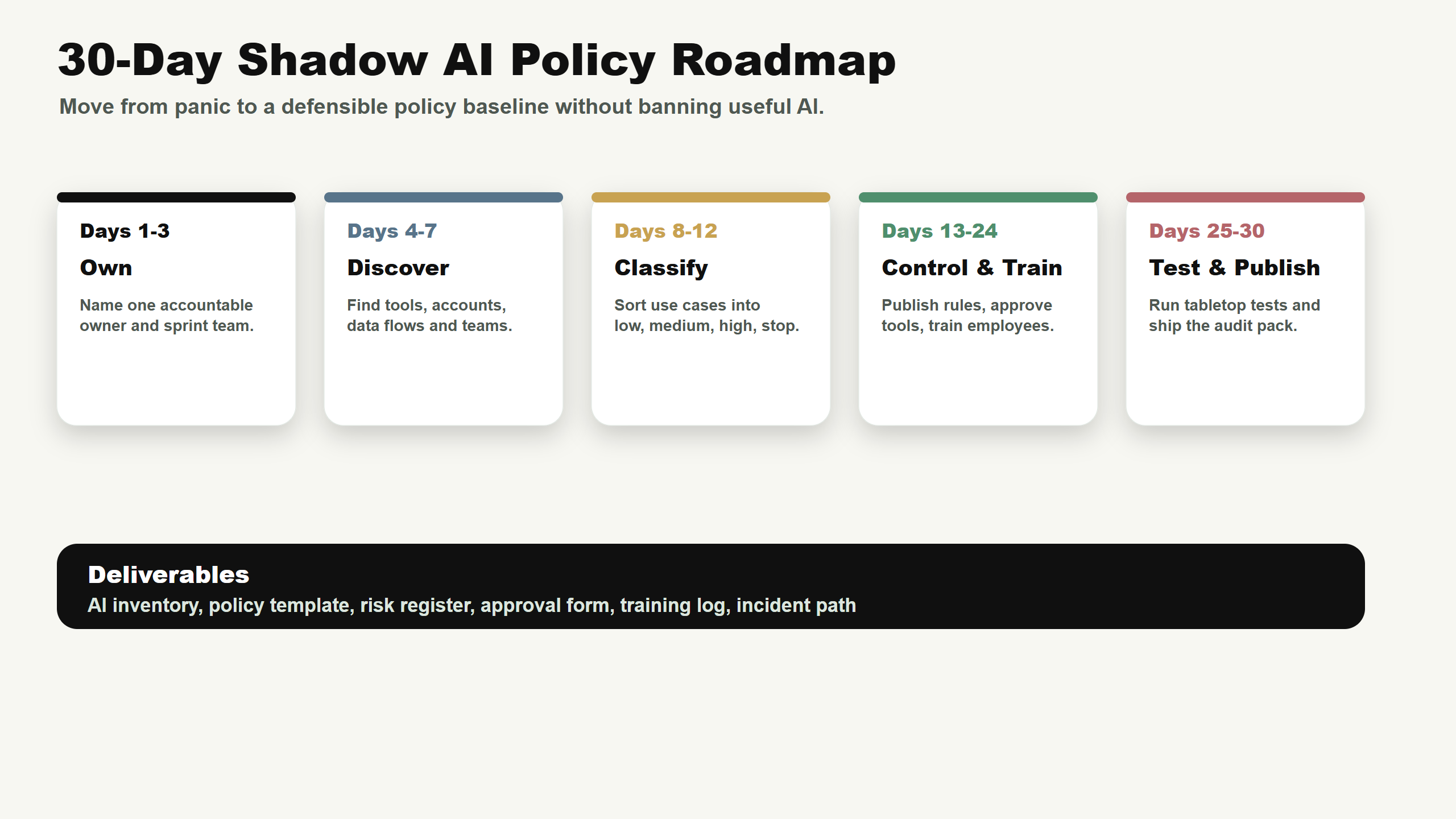
Days 1–3: appoint the owner and set emergency guardrails
Start with ownership. A shadow AI policy cannot be owned only by legal, only by IT, or only by an innovation team. Create a small AI risk working group with one accountable owner and representatives from security, legal/privacy, HR, procurement, IT, and at least one business team that actively uses AI.
| Task | Output | Owner |
|---|---|---|
| Name the AI risk owner | One accountable decision-maker | Executive sponsor |
| Create interim rules | “Do not paste sensitive data into unapproved AI tools” notice | Legal + Security |
| Open an intake channel | Form for employees to request AI tools and report current use | IT + Operations |
| Define data classes | Public, internal, confidential, regulated, restricted | Security + Privacy |
The first message to employees should not be threatening. It should be practical: “We want you to use AI safely. Until approved tools and rules are published, do not enter customer data, employee data, source code, contracts, financial data, health data, credentials, unreleased strategy, or confidential documents into personal or unapproved AI tools.”
Days 4–7: discover the AI you already have
Do not rely on self-reporting alone. Employees may not know that a note-taking app, browser extension, document editor, CRM assistant, spreadsheet plugin, design suite, customer-support platform, or coding extension uses AI. Build the first inventory from multiple signals.
- Identity: SSO logs, OAuth grants, app consent events, domain signups.
- Endpoint/browser: browser extensions, local apps, AI coding tools, unsanctioned plugins.
- Network/security: CASB, secure web gateway, DNS, proxy and DLP alerts.
- Finance: expense claims, corporate-card spend, software reimbursements.
- Collaboration: Slack/Teams mentions, shared workflows, meeting bots.
- Procurement: SaaS tools that added AI features after purchase.
Days 8–12: classify use cases, not just tools
A tool can be safe in one workflow and risky in another. A chatbot used to rewrite a public blog headline is different from the same chatbot used to summarize an unreleased acquisition memo or evaluate job candidates.
| Tier | Use case | Default decision | Examples |
|---|---|---|---|
| Green | Low-risk productivity with no sensitive data | Allow with basic rules | Brainstorming, grammar cleanup, public research summaries, public marketing drafts |
| Yellow | Internal business work with controlled data | Allow only in approved enterprise tools | Internal document summarization, sales call notes, coding assistance on non-sensitive repos |
| Orange | High-impact or regulated workflow | Require legal/security/privacy review | HR screening, customer scoring, financial analysis, legal drafting, medical or safety-related support |
| Red | Prohibited or unacceptable workflow | Block unless counsel approves a lawful exception | Workplace emotion recognition, unauthorized biometric classification, covert monitoring, external sharing of restricted data |
Days 13–18: set controls that match the risk
Policy without technical controls becomes a PDF nobody follows. At minimum, approved AI use should include identity, data, logging and review controls.
| Control area | Minimum control | Stronger control |
|---|---|---|
| Identity | Use corporate accounts for approved tools | SSO, MFA, SCIM, role-based access, app approval workflow |
| Data entry | Ban restricted data in unapproved tools | DLP, prompt inspection, data masking, approved secure AI gateway |
| Vendor terms | Review retention, training, confidentiality and region terms | Contractual AI addendum, audit rights, deletion terms, subprocessors review |
| Output reliance | Human review before customer, legal, HR or financial use | Documented validation, reviewer sign-off, QA sampling, change logs |
| Agents and automation | No autonomous write access without review | Least privilege, sandboxing, approval gates, transaction limits, monitoring |
| Incident response | Report accidental data entry into unapproved AI tools | AI-specific incident playbook, vendor notification steps, evidence preservation |
Days 19–24: train by role, not by slogan
“Use AI responsibly” is not training. Give people role-specific examples.
| Role | Training focus | Example rule |
|---|---|---|
| Sales | Customer data, call notes, CRM AI features | Do not paste non-public customer details into personal AI tools. |
| Marketing | AI-generated content, disclosure, copyright, factual checking | AI-assisted public claims must be fact-checked against primary sources. |
| Engineering | Code privacy, dependency risk, prompt injection, AI-generated code review | AI-generated code must pass the same review and security checks as human-written code. |
| HR | Employment decisions, fairness, explainability, sensitive data | Do not use AI to rank, reject or profile candidates without formal review. |
| Legal | Confidentiality, privilege, hallucinations, jurisdictional limits | AI outputs are drafting aids, not legal conclusions. |
| Executives | Board papers, confidential strategy, M&A, investor data | Strategic confidential data belongs only in approved enterprise environments. |
Days 25–30: publish, test and create the audit pack
By day 30, publish a simple policy and store evidence. The goal is not perfection. The goal is a defensible baseline.
- Approved AI tool list
- Restricted and blocked tool list
- AI use-case inventory
- Tool approval form
- Risk register
- Training record
- Incident response path
- Vendor review checklist
- Review date and policy owner
Copy-paste employee AI usage policy template
Use this as a starting point. Adapt it with legal, privacy, HR, security and sector-specific review.
Company AI Use Policy — Short Version
We encourage responsible use of AI tools that improve productivity, quality and decision-making. Employees may use approved AI tools for approved use cases, subject to this policy and all company confidentiality, privacy, security, IP and records obligations.
Do not enter restricted information into unapproved AI tools. Restricted information includes customer personal data, employee personal data, health data, payment data, credentials, source code from restricted repositories, legal privileged material, confidential contracts, unreleased financials, M&A materials, security vulnerabilities, regulated records and non-public strategy.
Use corporate accounts for approved tools. Personal AI accounts must not be used for company work unless explicitly approved.
Human review is required. AI outputs must be checked before use in customer communications, legal work, HR decisions, financial analysis, security decisions, code deployments, public claims or any workflow that could affect a person’s rights, access, employment, safety, credit, eligibility or services.
High-impact use requires review. AI use in hiring, performance management, education, credit, insurance, healthcare, biometrics, law enforcement, migration, critical infrastructure, legal decision support, safety systems, automated customer decisions or public-sector services must be reviewed by the AI risk owner before use.
Report incidents quickly. If restricted data is entered into an unapproved AI tool, if an AI tool behaves unexpectedly, or if AI output causes or may cause harm, report it through the security incident channel immediately.
Training is required. Employees using AI tools must complete role-appropriate AI literacy and safe-use training.
AI tool approval form
| Question | Required answer | Why it matters |
|---|---|---|
| Tool name and vendor | Name, URL, product tier | Identifies the system and terms to review. |
| Business owner | Named accountable person | Prevents orphaned AI tools. |
| Use case | Specific workflow, not generic “productivity” | Risk depends on the use case. |
| Data entered | Public, internal, confidential, regulated, restricted | Drives privacy, security and vendor review. |
| Account type | Personal, team, enterprise, SSO | Personal accounts are a common shadow AI blind spot. |
| Training and retention terms | Does vendor train on inputs? How long is data retained? | Determines whether sensitive data can be used. |
| Output use | Drafting aid, internal decision support, external output, automated action | Determines human review and documentation needs. |
| Security controls | SSO, MFA, audit logs, admin controls, DLP, encryption | Supports access control and incident review. |
| Regulatory category | Minimal, transparency, high-impact, potential high-risk | Flags legal review needs. |
| Decision | Approved, approved with restrictions, rejected, needs review | Creates audit evidence. |
| Review date | 30, 90, 180 or 365 days | AI tools and vendor terms change quickly. |
Shadow AI risk register template
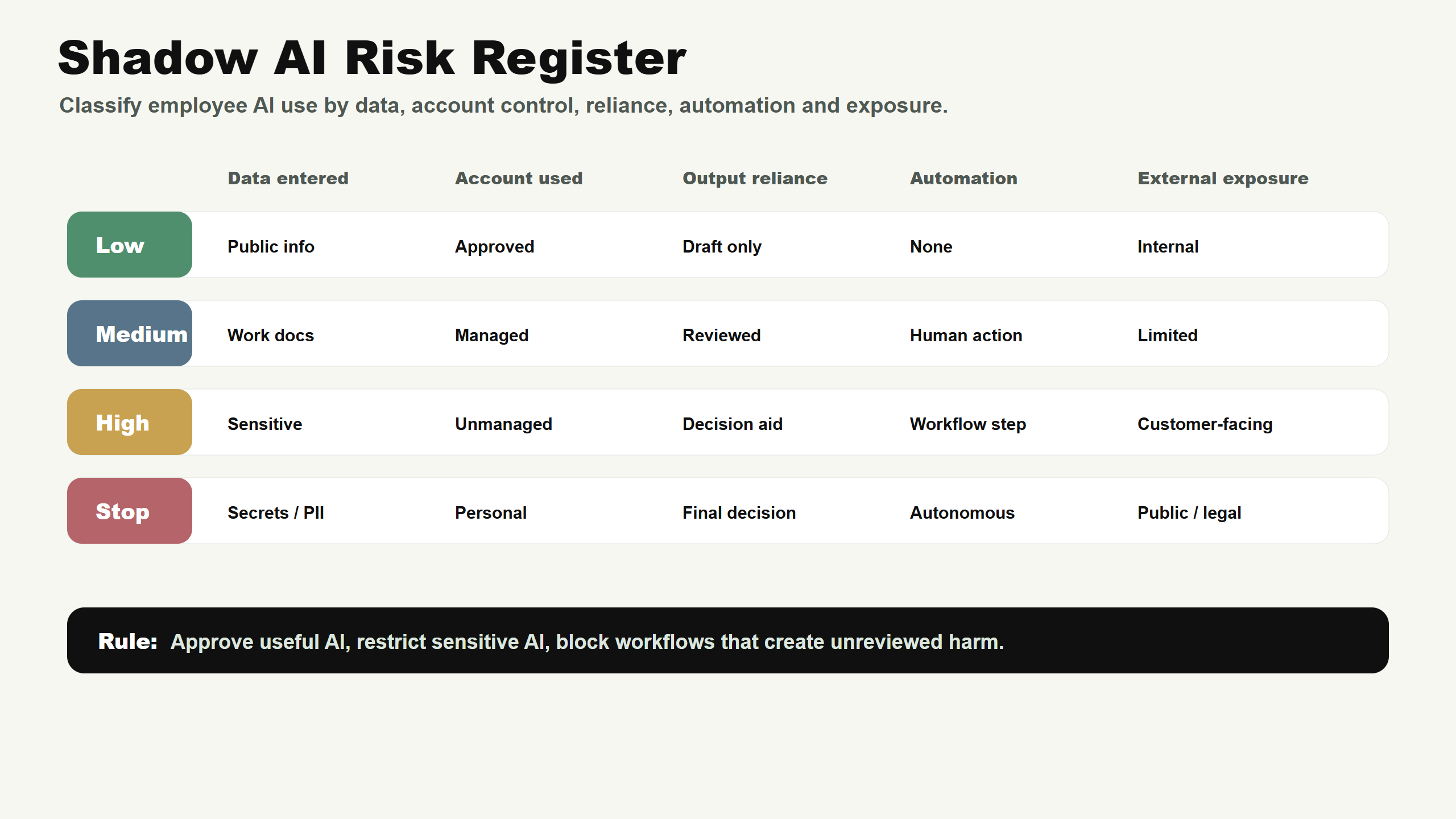
| Risk | Trigger | Control | Evidence | Owner |
|---|---|---|---|---|
| Confidential data leakage | Employee pastes restricted data into a public AI tool | DLP, training, approved enterprise AI, incident reporting | DLP logs, training records, approved tool list | Security |
| Unreviewed AI output | AI-generated output used in customer, legal, HR or financial context | Human review, output validation, sign-off rules | Review checklist, approval notes | Business owner |
| Vendor terms mismatch | Tool trains on company inputs or lacks retention controls | Vendor review, contract terms, tool restrictions | Vendor assessment, DPA, AI addendum | Procurement + Legal |
| Prompt injection | AI tool reads external web pages, emails, documents or tickets | Input filtering, tool isolation, least privilege, user confirmation | Security architecture review | Engineering + Security |
| Excessive agency | AI agent can send emails, change records, deploy code or call APIs | Approval gates, least privilege, sandboxing, transaction limits | Agent permission matrix, test logs | Engineering |
| Regulatory misclassification | AI used in employment, credit, education, healthcare, biometrics or public services | Legal review, high-risk classification assessment, documentation | Classification memo, counsel review | Legal + AI risk owner |
Framework crosswalk: EU AI Act, NIST AI RMF, ISO 42001 and OWASP
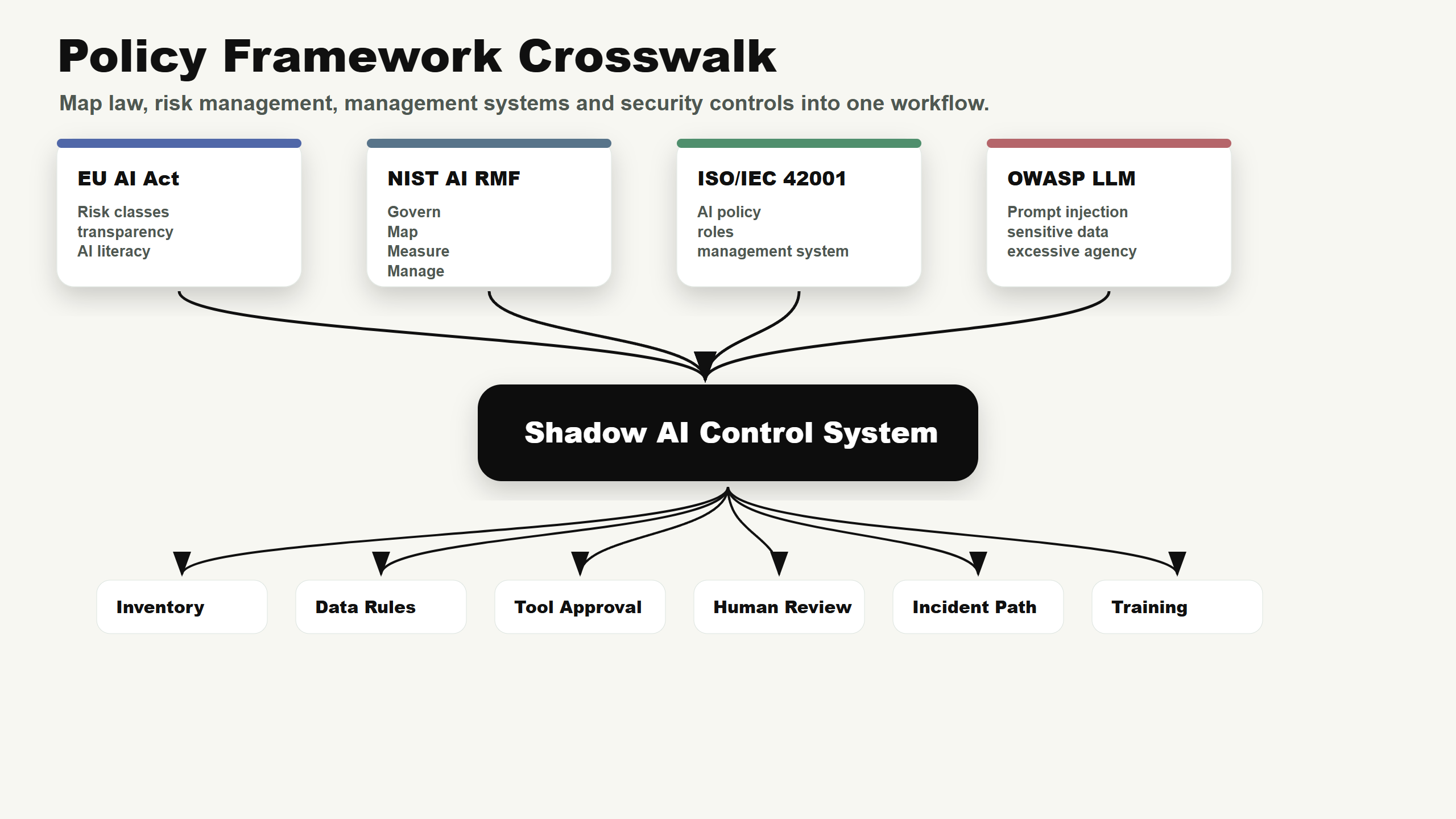
| Policy task | EU AI Act angle | NIST AI RMF angle | ISO/IEC 42001 angle | OWASP angle |
|---|---|---|---|---|
| AI inventory | Know which systems and use cases may fall into AI Act categories | Map context and intended use | Maintain AI system management processes | Identify LLM apps, plugins, agents and data flows |
| Data-use rules | Support transparency, risk and rights obligations where applicable | Measure privacy, safety and security risks | Manage data governance and lifecycle controls | Reduce sensitive information disclosure |
| Tool approval | Identify deployer/provider obligations and high-risk candidates | Govern accountability and risk ownership | Define policies, objectives and responsibilities | Review supply chain and model/plugin dependencies |
| Human review | Support oversight for high-impact uses | Manage residual risk and response | Monitor performance and continual improvement | Reduce overreliance, misinformation and unsafe output handling |
| Agent controls | Assess safety, rights and impact where AI takes action | Measure and manage system-specific risk | Control lifecycle and operational monitoring | Address excessive agency, prompt injection and unbounded consumption |
What to approve first
Start with AI workflows that are useful, low-risk and easy to govern. This gives employees a safe alternative to personal accounts.
| Approve early | Approve with restrictions | Do not approve without formal review |
|---|---|---|
| Writing drafts from public or non-sensitive inputs | Summarizing internal documents in enterprise-approved tools | AI candidate ranking or employee performance scoring |
| Meeting agenda drafts | Meeting transcription involving customers or employees | Emotion recognition in workplace or education settings |
| Public research summaries with source checking | Code assistance in approved environments | AI decisions affecting credit, insurance, healthcare or access to services |
| Internal brainstorming | Customer support response drafts with human approval | Autonomous agents with production write access |
Common failure modes and fixes
| Failure | Why it happens | Fix |
|---|---|---|
| Policy is too vague | Employees do not know what data or tools are allowed | Publish approved tools, blocked data types and examples by role. |
| Policy is too strict | Employees use personal accounts anyway | Approve safe workflows quickly and make compliant AI easier than shadow AI. |
| No inventory | AI features appear inside existing SaaS tools | Review AI features during SaaS renewals and maintain an AI register. |
| No vendor review | Teams buy AI tools with cards or expense claims | Route AI spend through procurement and block reimbursement for unapproved tools. |
| No output validation | Teams treat AI drafts as finished work | Require human review for external, legal, HR, financial, code and safety-related outputs. |
| No incident path | Employees hide mistakes | Create a no-blame reporting path for accidental data entry or unsafe AI behavior. |
What to buy or build
Do not buy an “AI governance platform” before you know your control gaps. Most teams need a combination of process, training and technical controls.
- AI inventory: system register, owner, use case, data class, vendor, review date.
- Discovery: identity logs, CASB/SSE, browser visibility, SaaS management, expense monitoring.
- Data protection: DLP, prompt inspection, redaction, approved enterprise AI gateway.
- GRC evidence: risk register, policies, approvals, training records, vendor reviews.
- Developer controls: code review, dependency scanning, model/plugin review, agent permission gates.
- Training: role-based AI literacy, not generic awareness slides.
The monetization opportunity is clear for vendors: buyers are not looking only for “responsible AI” messaging. They need discovery, workflow approval, vendor evidence, DLP, audit trails and training that employees actually follow.
FAQ
What is shadow AI?
Shadow AI is the use of AI tools, AI features, AI agents or AI-enabled SaaS systems without formal approval, visibility or governance. It includes obvious tools such as chatbots and coding assistants, but also embedded AI inside meeting apps, document tools, CRM platforms, design suites, browser extensions, spreadsheet add-ons and workflow automation tools.
Is banning public AI tools enough?
No. A ban may reduce obvious usage, but it often pushes employees toward personal accounts, browser extensions, copy-paste workarounds or AI features embedded in other SaaS tools. A safer approach is to approve useful low-risk workflows, provide enterprise-controlled alternatives and block specific dangerous behaviors.
Does the EU AI Act apply to companies outside Europe?
It can, depending on the role, market, users, system and output. Do not rely on a generic blog answer for this. If your company provides, deploys, imports, distributes or uses AI systems connected to the EU market or EU users, ask counsel to assess scope and obligations.
Do we need ISO/IEC 42001 certification?
Not necessarily. Many teams can use ISO/IEC 42001 as a management-system reference without seeking certification. Certification may become useful when enterprise customers, regulators, procurement teams or high-risk sectors ask for formal evidence of AI governance.
How often should an AI policy be reviewed?
Review it at least quarterly in 2026, and immediately after major vendor term changes, new AI features in core SaaS tools, new regulatory guidance, material incidents, new high-impact use cases, or major model capability changes.
Who should own AI governance?
One accountable business owner should coordinate the program, but the controls must be cross-functional. Security, legal, privacy, HR, procurement, IT, engineering and business teams all own part of the risk.
Source log
| Source | Publisher | Date / update | URL | Claim supported | Access date |
|---|---|---|---|---|---|
| AI Act | European Commission, Shaping Europe’s Digital Future | Last update: May 11, 2026 | https://digital-strategy.ec.europa.eu/en/policies/regulatory-framework-ai | AI Act overview, risk categories, timelines, transparency rules, GPAI tools, governance and high-risk application dates. | May 19, 2026 |
| Draft Commission guidelines on the classification of high-risk AI systems | European Commission | Publication: May 19, 2026 | https://digital-strategy.ec.europa.eu/en/library/draft-commission-guidelines-classification-high-risk-ai-systems | Fresh guidance on high-risk classification under Article 6 AI Act. | May 19, 2026 |
| Living repository to foster learning and exchange on AI literacy | European Commission | Publication: February 4, 2025 | https://digital-strategy.ec.europa.eu/en/library/living-repository-foster-learning-and-exchange-ai-literacy | AI literacy obligation under Article 4 and repository disclaimer. | May 19, 2026 |
| AI Risk Management Framework | NIST | Updated page includes July 26, 2024 GenAI Profile and April 7, 2026 critical infrastructure concept note | https://www.nist.gov/itl/ai-risk-management-framework | NIST AI RMF and GenAI Profile as voluntary risk-management resources. | May 19, 2026 |
| AI RMF Core | NIST AI Resource Center | Current resource | https://airc.nist.gov/airmf-resources/airmf/5-sec-core/ | Govern, Map, Measure and Manage functions. | May 19, 2026 |
| ISO 42001 explained | ISO | 2026 page | https://www.iso.org/home/insights-news/resources/iso-42001-explained-what-it-is.html | ISO/IEC 42001 as the international standard for AI management systems and its governance objectives. | May 19, 2026 |
| ISO/IEC 42001:2023 — AI management systems | ISO | Standard page | https://www.iso.org/standard/42001 | Requirements and guidance for establishing, implementing, maintaining and improving an AI management system. | May 19, 2026 |
| IBM report: AI breaches and access controls | IBM Newsroom | July 30, 2025 | https://newsroom.ibm.com/2025-07-30-ibm-report-13-of-organizations-reported-breaches-of-ai-models-or-applications%2C-97-of-which-reported-lacking-proper-ai-access-controls | Shadow AI breach cost, one-in-five breach statistic, policy gap, PII/IP exposure. | May 19, 2026 |
| Trust, attitudes and use of artificial intelligence: A global study 2025 | KPMG / University of Melbourne | 2025 | https://kpmg.com/xx/en/our-insights/ai-and-technology/trust-attitudes-and-use-of-ai.html | AI at work survey findings: reliance on AI output and mistakes due to AI. | May 19, 2026 |
| 2025 Top 10 Risk & Mitigations for LLMs and Gen AI Apps | OWASP GenAI Security Project | 2025 | https://genai.owasp.org/llm-top-10/ | LLM and generative AI risks including prompt injection, sensitive information disclosure, supply chain, excessive agency and misinformation. | May 19, 2026 |
When to revisit this policy
- European Commission finalizes or updates high-risk AI classification guidance.
- European Commission publishes or finalizes transparency guidance under Article 50.
- EU AI Act implementation timeline changes again through omnibus, delegated acts or guidance.
- NIST releases a new AI RMF profile, especially for critical infrastructure or agentic AI.
- ISO publishes updates, amendments or certification guidance for ISO/IEC 42001.
- OWASP updates LLM, GenAI or agentic AI risk lists.
- Major AI vendors change data-retention, training, enterprise privacy or admin-control terms.
- New breach research quantifies shadow AI, AI agent, prompt injection or sensitive-data exposure costs.