Short answer: The practical Google AI Mode SEO playbook is not a secret formatting trick. Make pages crawlable, useful, current, visual, and answer-first; then measure Search Console, engagement, and conversions instead of chasing unsupported GEO shortcuts.
Verdict: Google’s new AI search guidance is a reality check for the “GEO hacks” industry. If your plan is to add an llms.txt file, chop every article into artificial chunks, rewrite pages only for bots, or manufacture brand mentions, Google’s own guidance says you are probably solving the wrong problem. The practical playbook is less glamorous and more useful: make pages crawlable, publish non-commodity content, cover the real sub-questions behind a query, support text with useful images or video, and measure conversions instead of obsessing over a visibility signal Google does not yet separate cleanly for site owners.
This guide turns Google’s May 2026 generative AI search guidance into a practical workflow for publishers, SaaS teams, ecommerce operators, agencies, creators, and business owners who want to keep showing up as AI Mode and AI Overviews change how people search.
What changed
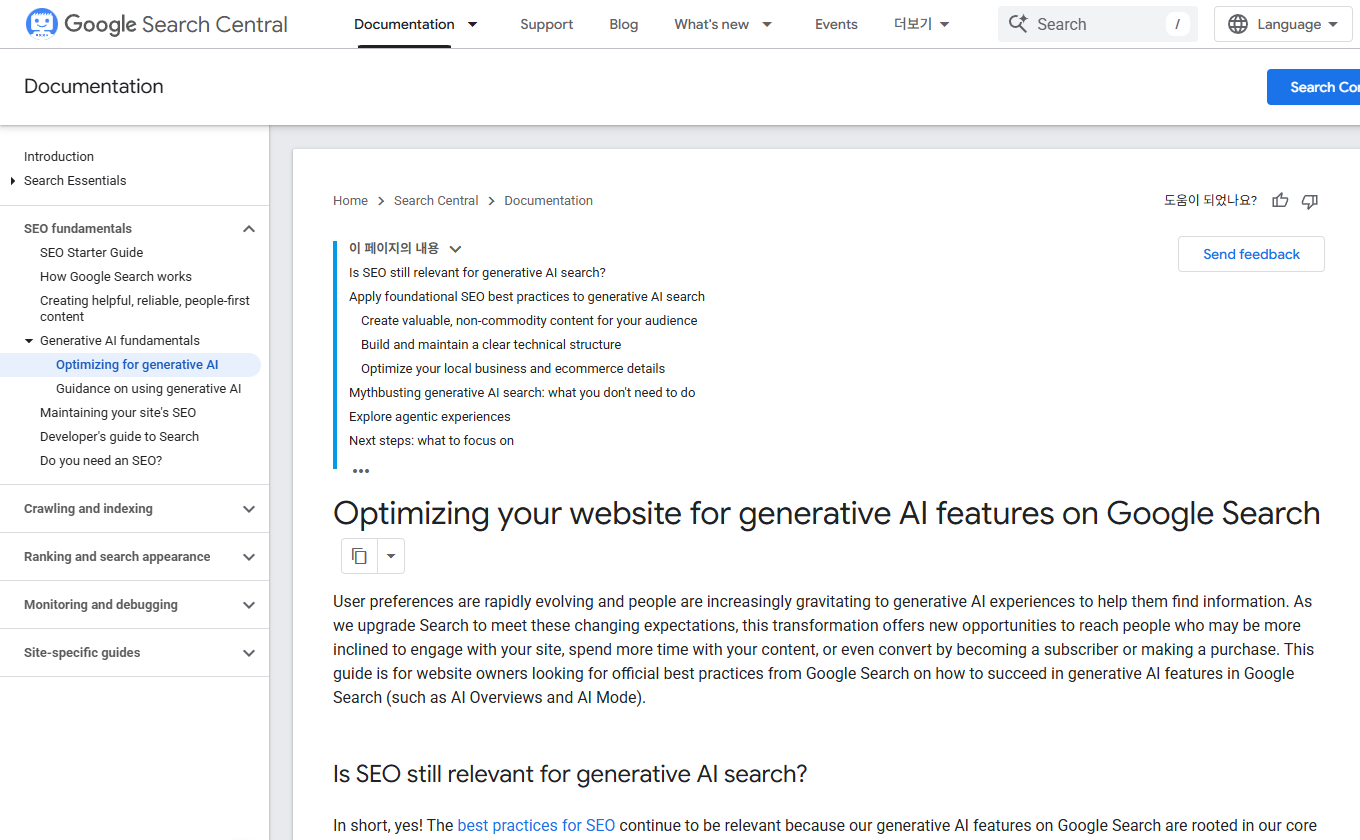
On May 15, 2026, Google Search Central published a new resource for website owners, SEOs, and developers on optimizing content for generative AI features in Search. Google says the new guide includes guidance on valuable non-commodity content, local and shopping information, images and video, AEO/GEO misconceptions, AI agents, and why SEO best practices remain foundational.
The important part is not that Google invented a new SEO playbook. It is that Google is telling site owners not to confuse AI-search visibility with a set of magic AI-only hacks.
The short version for busy site owners
| Question | Practical answer |
|---|---|
| Is SEO dead because of AI Mode? | No. Google says generative AI features in Search are still rooted in core Search ranking and quality systems. |
| Do you need special AI markup to appear? | No. Google says there are no additional technical requirements for AI Overviews or AI Mode beyond being indexed and eligible for snippets. |
Should you create an llms.txt file for Google AI Mode? |
Not as a Google AI Mode shortcut. Google says special machine-readable files or AI text files are not required to appear in generative AI search. |
| Should you target every possible fan-out query with a separate page? | No. Google warns against creating many variations primarily to manipulate rankings or generative AI responses. |
| What should you actually do? | Build crawlable, useful, expert-led pages that answer the main query and its real supporting sub-questions better than commodity content. |
Confirmed facts, estimates, rumors, and opinion
Because AI search advice is getting noisy fast, here is the evidence split cleanly.
| Claim type | What this article relies on | Status |
|---|---|---|
| Confirmed fact | Google published a new Search Central post on May 15, 2026 introducing a resource for optimizing for generative AI in Search. | Confirmed by Google Search Central. |
| Confirmed fact | Google says SEO best practices remain relevant because generative AI features are rooted in core Search ranking and quality systems. | Confirmed by Google Search Central documentation. |
| Confirmed fact | Google says AI Overviews and AI Mode may use query fan-out, issuing multiple related searches across subtopics and data sources. | Confirmed by Google Search Central documentation. |
| Confirmed fact | Google says pages must be indexed and eligible to show with a snippet to be eligible as supporting links in AI Overviews or AI Mode, and that there are no additional technical requirements. | Confirmed by Google Search Central documentation. |
| Confirmed fact | Google says site owners do not need new machine-readable AI files, special AI text files, or special schema.org markup to appear in these AI features. | Confirmed by Google Search Central documentation. |
| Estimate / analysis | The best practical workflow is a query fan-out content audit plus technical SEO, original evidence, and conversion tracking. | Tovren analysis based on Google guidance and current SEO-industry research. |
| Rumor | No rumors are used as a basis for recommendations in this article. | Not used. |
| Opinion | The phrase “GEO hacks” is useful shorthand for unsupported tactics sold as AI-search shortcuts. | Editorial opinion, not a Google label for every GEO practice. |
Why Google AI Mode changes SEO without replacing SEO
Traditional SEO often starts with one visible query: a person searches, Google ranks pages, and the user chooses a result. AI Mode is more complex. Google says AI Mode can divide a question into subtopics and search for each one simultaneously. Google also describes query fan-out as a set of concurrent related queries generated by the model to request more information and fetch additional relevant search results.
That matters because the page that wins may not be the page that merely repeats the exact keyword. A page may be useful because it answers one of the sub-questions behind the user’s larger task.
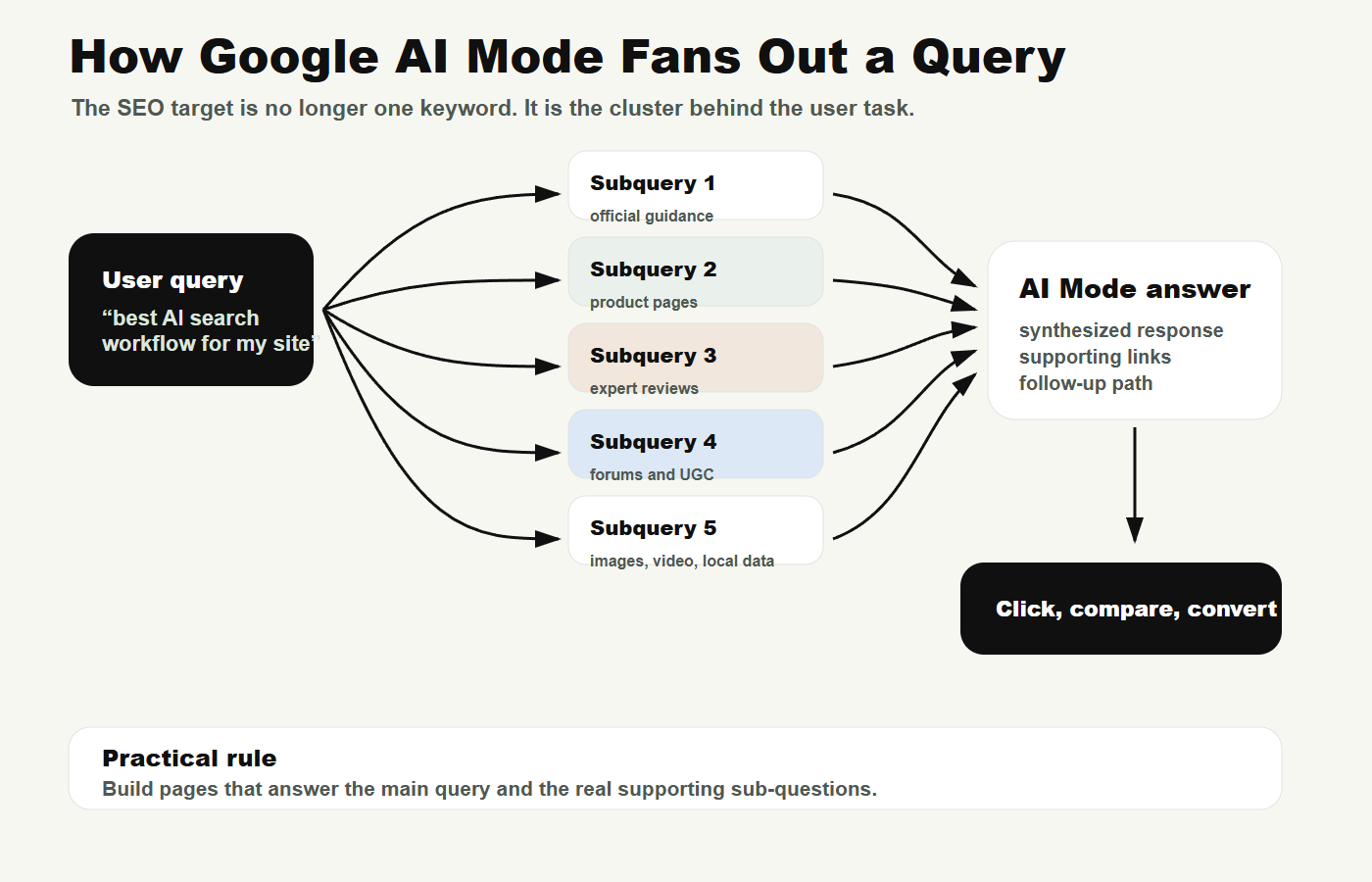
Example: one query becomes a content cluster
Suppose the search is:
“Best AI meeting assistant for a remote sales team using HubSpot and Google Meet.”
A traditional SEO page might target “best AI meeting assistant.” An AI Mode-style query fan-out audit should also cover:
- Which tools support Google Meet?
- Which tools integrate with HubSpot?
- Which tools are safe for sales-call recordings?
- Which tools summarize action items accurately?
- Which tools support team permissions and admin controls?
- Which tools are priced sensibly for a 10-person, 50-person, or 200-person team?
- Which tools handle multilingual calls?
- Which tools should regulated teams avoid?
This is why “write more keywords” is the wrong takeaway. The better takeaway is: map the task behind the query, then make the page genuinely useful for that task.
The AI Mode SEO audit: a 90-minute workflow
Use this workflow for any important page: a product comparison, tool review, pricing guide, tutorial, template page, local service page, ecommerce category, or high-value blog post.
Tools needed
- Google Search Console
- Google Analytics or your preferred analytics tool
- Your CMS or page editor
- A spreadsheet
- Your existing crawler or SEO audit tool
- An AI assistant for brainstorming sub-queries, not for inventing facts
| Step | Action | Good output | Common failure | Fix |
|---|---|---|---|---|
| 1 | Pick one page tied to revenue, subscribers, demos, purchases, or repeat readership. | A single URL with a clear business outcome. | Auditing an article because it is interesting but not commercially or editorially important. | Choose a page where visibility can turn into measurable action. |
| 2 | Write the main query and the reader’s real task. | One main query plus a sentence beginning “The reader wants to…” | Confusing keyword with intent. | Rewrite the task in human language before touching headings. |
| 3 | Generate a query fan-out map. | 8–15 supporting sub-questions grouped by buying, setup, risk, comparison, pricing, troubleshooting, proof, and alternatives. | Creating a separate thin page for every variation. | Fold related sub-questions into one strong page or a small, logical content cluster. |
| 4 | Check technical eligibility. | The page is indexed, crawlable, internally linked, snippet-eligible, fast enough, and not blocked by preview controls. | Trying to optimize content that Google cannot reliably crawl or show. | Fix indexation, robots, CDN, JavaScript rendering, internal links, canonical issues, and noindex/nosnippet mistakes first. |
| 5 | Upgrade the page from commodity to non-commodity. | Original testing, screenshots, examples, decision tables, current pricing/limits, firsthand notes, expert review, or a reusable template. | Publishing a generic “best tools” or “what is” page that could have been generated by any model. | Add evidence, examples, constraints, and practical judgment. |
| 6 | Add supporting media where it helps the reader. | At least one useful screenshot, chart, workflow diagram, comparison table, or short demo video. | Adding decorative AI images that do not help decision-making. | Use visuals that answer a question faster than text can. |
| 7 | Measure behavior, not just rankings. | Search Console trend, GA4 engagement/conversions, newsletter signups, clicks to tools, demo requests, or purchase events. | Assuming a page failed because clicks dropped while conversions improved. | Track AI-era success as visibility plus qualified action. |
Prompt: build a query fan-out map before editing the page
Use this prompt to prepare an audit. Do not let the model invent current facts, pricing, availability, or legal claims. Treat the output as a planning map, then verify with sources.
You are helping audit a page for Google AI Mode and AI Overviews visibility.

Target page URL: [paste URL]
Primary query: [paste query]
Reader type: [publisher / SaaS buyer / ecommerce shopper / local customer / developer / marketer]
Reader outcome: [what the reader wants to decide or do]

Task:
1. Generate 12 likely query fan-out sub-questions behind this query.
2. Group them by intent: definition, comparison, pricing, setup, risk, troubleshooting, alternatives, proof, local/ecommerce, and next action.
3. For each sub-question, identify whether the current page should answer it directly, link to a supporting page, add a table, add a screenshot, add a chart, or ignore it.
4. Flag any claims that require current verification from official sources.
5. Suggest a revised H2/H3 outline that helps humans first and search systems second.
6. Suggest 3 practical visuals that would make the page more useful.
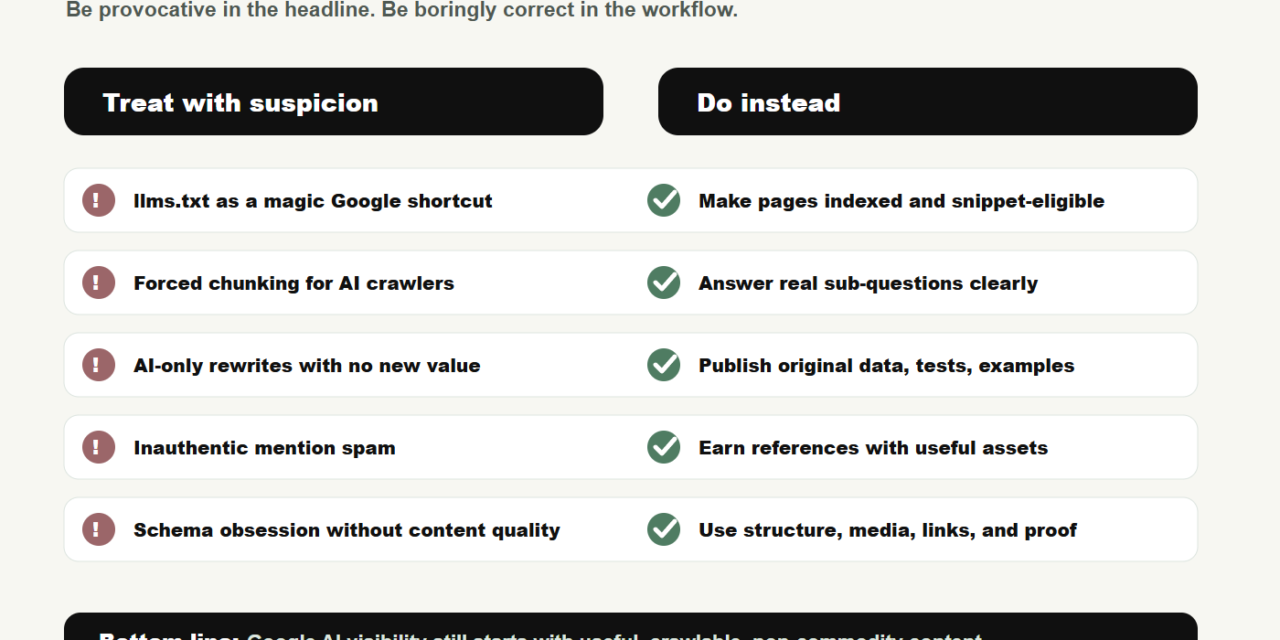
What to stop doing: five GEO tactics to treat with suspicion
Some AI-search tactics may still be useful for other platforms, internal knowledge systems, or future experiments. But for Google Search specifically, Google’s current guidance is clear enough to make these bad default priorities.
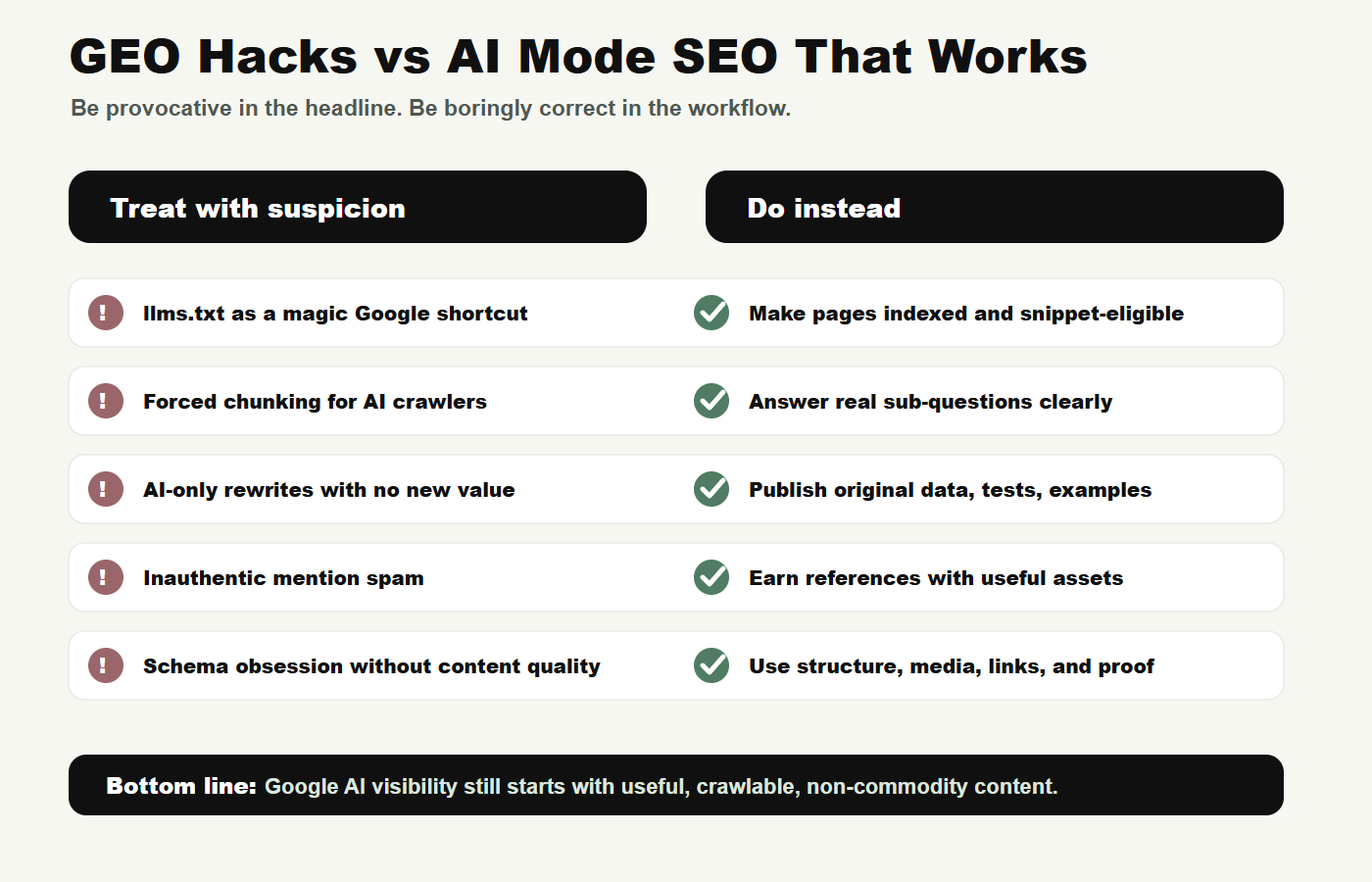
| Tactic | Why it is risky or low-priority | Do this instead |
|---|---|---|
llms.txt as a Google AI Mode shortcut |
Google says new machine-readable files, AI text files, markup, or Markdown are not needed to appear in generative AI search. | Make the actual page crawlable, internally linked, indexable, and useful. |
| Artificial “chunking” for AI systems | Google says there is no requirement to break content into tiny pieces for AI understanding. | Use clear headings and sections because they help readers navigate. |
| Writing in a strange AI-only style | Google says you do not need to write in a specific way just for generative AI search. | Answer directly, then add evidence, context, examples, and caveats. |
| Inauthentic brand mentions | Google says seeking inauthentic mentions is not as helpful as it may seem and that quality and anti-spam systems still matter. | Earn legitimate mentions through useful research, tools, templates, benchmarks, and expert contributions. |
| Schema obsession | Google says structured data is not required for generative AI search and that there is no special schema.org markup for it. | Use structured data where it supports existing rich-result eligibility, and ensure it matches visible page content. |
How to make a page more likely to be useful in AI Mode
There is no guaranteed way to be cited in AI Mode, and Google explicitly says crawling, indexing, or serving are not guaranteed even when a page follows requirements. The practical goal is not to “force” inclusion. The goal is to make your page a strong candidate when Google needs a source for a specific subtopic.
1. Start with snippet eligibility
Before editing copy, confirm the page can appear as a supporting link. Check:
- The URL is indexable.
- The canonical is correct.
- The page is not blocked by robots.txt, noindex, or CDN rules.
- The page is eligible to show a snippet.
- The main content is available as text, not only inside images, widgets, or inaccessible JavaScript.
- The page has internal links from relevant hub pages.
- The page has a useful title, meta description, visible author or organization context, and current publication/update date where relevant.
2. Replace generic summaries with non-commodity value
A commodity page says the same thing as everyone else. A non-commodity page adds something a reader cannot get from a generic model answer.
| Commodity content | Non-commodity upgrade |
|---|---|
| “Top 10 AI tools for meetings” | A tested comparison using the same meeting transcript, with screenshots, accuracy notes, pricing constraints, and who should avoid each tool. |
| “What is Google AI Mode?” | A practical audit showing how query fan-out changes content planning, with before/after page structure and measurement plan. |
| “Best CRM for small business” | A decision tree by team size, sales motion, integrations, implementation effort, data migration risk, and monthly cost. |
| “AI SEO tips” | A workflow with prompts, source checks, Search Console steps, GA4 conversion checks, and failure fixes. |
3. Build the page around sub-intents, not keyword stuffing
For an AI Mode-aware page, the outline should answer the main question early, then handle the supporting questions a human would naturally ask next.
A good structure usually includes:
- A direct verdict or recommendation near the top.
- A “who this is for / who should avoid it” section.
- A comparison table or decision matrix.
- Current pricing, limits, availability, or platform requirements when tools are mentioned.
- Step-by-step setup or usage instructions.
- Expected result: what good output looks like.
- Failure modes and fixes.
- Source log and update date.
- FAQ answering real follow-up questions.
4. Add useful media, not decorative AI art
Google’s guidance says generative AI search features can bring in relevant images and video, creating opportunities beyond web page links. For Tovren-style content, that means every important article should include visuals that help the reader decide or act.
Good visual candidates:
- A real screenshot of the tool, dashboard, documentation, pricing page, or setup step.
- A comparison chart built from verified data.
- A workflow diagram showing the exact process.
- A decision tree for choosing between tools.
- A troubleshooting table converted into a downloadable image.
Measurement: what to track when Search Console is not enough
Google says sites appearing in AI features such as AI Overviews and AI Mode are included in overall Search Console traffic and reported within the Performance report under the “Web” search type. That is useful, but it does not give every site owner a clean “AI Mode citation report.” So your measurement plan needs to combine Search Console with behavior and conversion data.
| Metric | Where to check | What it tells you | What it does not prove |
|---|---|---|---|
| Search impressions and clicks | Google Search Console | Whether Google Search visibility is rising or falling for target queries and pages. | It does not isolate every AI Mode or AI Overview appearance. |
| Engaged sessions | GA4 or analytics platform | Whether visitors who arrive are staying long enough to use the page. | It does not reveal whether the click came from an AI-generated answer unless separately detectable. |
| Conversion events | GA4, CRM, ecommerce analytics, newsletter platform | Whether the page produces signups, trials, purchases, demos, affiliate clicks, or downloads. | It does not prove the page was cited in AI Mode. |
| Brand mentions in AI answers | Manual checks or AI visibility tools | Whether your brand or URL appears in AI-generated answers for priority prompts. | Single checks can vary; treat them as directional, not absolute. |
| Content gap coverage | Spreadsheet audit | Whether the page answers the real fan-out sub-questions behind the query. | Coverage alone does not guarantee ranking or citation. |
Controls: how to limit what appears in AI features
Some publishers want maximum visibility. Others want tighter control. Google says AI is built into Search and that robots.txt directives for Googlebot manage access to crawling for Search. To limit what is shown from pages in Search, Google points to controls such as nosnippet, data-nosnippet, max-snippet, or noindex. These choices can affect normal Search visibility too, so use them carefully.
| Control | Use case | Trade-off |
|---|---|---|
noindex |
You do not want the page in Google Search. | The page should not appear in normal Search either. |
nosnippet |
You want to restrict snippets from the page. | Can reduce visibility and usefulness in normal search results. |
data-nosnippet |
You want to prevent specific page sections from being used in snippets. | Requires careful implementation and recrawl time. |
max-snippet |
You want to limit snippet length. | May affect how compelling your result appears. |
| Robots.txt blocking | You want to block crawling. | Can prevent Google from accessing content needed for Search visibility. |
Who should use this workflow
- Publishers trying to maintain visibility as AI answers reduce some classic click paths.
- SaaS teams writing tool comparisons, pricing pages, alternatives pages, and integration guides.
- Ecommerce teams with product categories, comparison pages, buying guides, and Merchant Center dependencies.
- Local businesses that need current Business Profile data, clear service pages, reviews, and location-specific answers.
- Agencies that need a defensible client workflow instead of vague “GEO” retainers.
- Creators and newsletter operators who need pages that convert readers into subscribers, not just views.
Who should avoid it
- Teams looking for a guaranteed AI Mode citation formula.
- Sites that cannot invest in original examples, screenshots, testing, or expert review.
- Publishers planning to mass-generate thousands of thin pages around fan-out variations.
- Brands trying to manufacture mentions rather than earn useful off-site references.
- Teams that want AI-search visibility but refuse to fix crawlability, internal linking, or stale content.
The practical publishing checklist
Before publishing or refreshing an AI Mode-sensitive page, run this checklist.
| Check | Pass condition |
|---|---|
| Answer-first intro | The first 150 words give a useful verdict, not a generic “AI is changing search” intro. |
| Query fan-out coverage | The page answers the main task and at least 6–10 supporting sub-questions. |
| Original value | The article includes testing, examples, screenshots, templates, decision criteria, or expert judgment. |
| Current facts | Prices, limits, availability, model names, dates, and policy claims are checked against primary sources. |
| Technical eligibility | The page is indexable, snippet-eligible, crawlable, internally linked, and not accidentally blocked. |
| Human readability | Headings, tables, lists, and visuals make the page easier for a person to use. |
| Media | The page includes at least one useful real screenshot and one original explanatory graphic when appropriate. |
| Measurement | Conversions, engaged sessions, and Search Console trends are tracked after publication. |
| Risk labeling | Facts, estimates, rumors, and editorial opinion are separated where the topic is sensitive or fast-changing. |
| Refresh trigger | The article has a clear date or event that should force a review. |
FAQ
Is GEO dead?
No. But the version of GEO that promises easy Google AI Mode wins through special files, artificial formatting, or manufactured mentions is weakly supported by Google’s public guidance. The useful version of GEO is basically disciplined SEO plus original value, entity clarity, source quality, and better measurement across AI answer surfaces.
Do I need an llms.txt file for Google AI Mode?
Not as a Google AI Mode requirement. Google’s guidance says site owners do not need new machine-readable files, AI text files, markup, or Markdown to appear in generative AI search. An llms.txt file may still be discussed for other contexts, but it should not outrank crawlability, indexation, original content, or page quality in your Google Search workflow.
What is query fan-out?
Query fan-out is the process where an AI search system breaks one user question into multiple related sub-queries, searches across subtopics or data sources, and uses those results to build a response. For site owners, the practical lesson is to answer the real supporting questions behind a reader’s task, not just repeat the visible keyword.
Can Search Console show AI Mode traffic separately?
Google says sites appearing in AI features are included in overall Search traffic in Search Console and reported in the Performance report under the “Web” search type. For now, treat Search Console as one input and combine it with analytics, conversion tracking, and manual or third-party AI visibility checks.
Should I create separate pages for every AI Mode sub-query?
No. That can easily become scaled content abuse if the pages are thin, repetitive, and created mainly to manipulate search systems. Use sub-query research to improve a strong page or build a small, useful content cluster where each page has a distinct reader purpose.
What is the best first action for a small website?
Pick one high-value page, map the top 10 supporting questions behind the main query, fix crawlability and snippet eligibility, add original evidence or examples, and track conversions. Do not start by adding experimental files or rewriting your whole site for bots.
Source log
| Source | Publisher | Date / update visible | URL | Claims supported |
|---|---|---|---|---|
| A new resource for optimizing for generative AI in Google Search | Google Search Central Blog | May 15, 2026 | https://developers.google.com/search/blog/2026/05/a-new-resource-for-optimizing | Google published a new resource for optimizing content for generative AI features in Search; guide covers non-commodity content, local/shopping/image/video, AEO/GEO misconceptions, AI agents, and SEO fundamentals. |
| Optimizing your website for generative AI features on Google Search | Google Search Central Documentation | Last updated May 15, 2026 | https://developers.google.com/search/docs/fundamentals/ai-optimization-guide | SEO remains relevant; AI features rely on RAG and query fan-out; AEO/GEO are still SEO from Google Search’s perspective; non-commodity content; technical structure; mythbusting special files, chunking, AI-only rewriting, inauthentic mentions, and schema overfocus. |
| AI features and your website | Google Search Central Documentation | Last updated Dec. 10, 2025 | https://developers.google.com/search/docs/appearance/ai-features | AI Overviews and AI Mode may use query fan-out; no additional technical requirements; pages must be indexed and snippet-eligible; AI feature traffic is included in Search Console Web performance; controls include nosnippet, data-nosnippet, max-snippet, and noindex. |
| Spam policies for Google web search | Google Search Central Documentation | Last updated May 15, 2026 | https://developers.google.com/search/docs/essentials/spam-policies | Spam includes attempts to manipulate Search systems into ranking content highly or manipulating generative AI responses in Google Search; scaled content abuse includes many unoriginal pages created primarily to manipulate rankings. |
| Get AI-powered responses with AI Mode in Google Search | Google Search Help | Accessed May 19, 2026 | https://support.google.com/websearch/answer/16011537 | AI Mode description, follow-up questions, query fan-out behavior, links, early-stage AI caveat, Gemini 3 Pro in AI Mode availability details. |
| Google AI Mode product page | Google Search | Accessed May 19, 2026 | https://search.google/ways-to-search/ai-mode/ | Public positioning of AI Mode as an AI-powered search experience with follow-up questions, multimodal input, web links, and Deep Search positioning. |
| What is query fan-out & how does it work for AI searches? | Search Engine Land | April 21, 2026 | https://searchengineland.com/guide/query-fan-out | Current industry demand and explanation of query fan-out as an SEO topic. |
| What Is Google AI Mode? (+ How to Optimize for It in 2026) | Semrush | February 13, 2026 | https://www.semrush.com/blog/google-ai-mode/ | Current SERP demand signal, commercial SEO-tool angle, and industry positioning around Google AI Mode optimization. |
| Are AI Mode and AI Overviews Just Different Versions of the Same Answer? | Ahrefs | December 15, 2025 | https://ahrefs.com/blog/ai-overviews-vs-ai-mode/ | Secondary research signal: AI Mode and AI Overviews can cite different sources; marketers should track them separately. Use as directional industry research, not Google policy. |
Refresh triggers
- Google updates the May 15, 2026 generative AI optimization guide.
- Google adds a dedicated Search Console filter or report for AI Mode or AI Overviews.
- Google changes AI Mode availability, model availability, or Search Labs requirements.
- Google changes guidance on
llms.txt, special AI markup, snippets, robots controls, or Google-Extended. - Google announces major AI Mode changes at I/O, Search On, or through Search Central.
- Reliable industry research shows a material shift in AI Mode citation overlap, click-through behavior, or conversion quality.
- Tovren publishes a newer AI search visibility benchmark or tool comparison that should be internally linked.
Schema suggestion: Use Article schema and FAQPage schema for the FAQ section. Add HowTo schema only if the final WordPress version turns the audit workflow into explicit ordered HowTo steps and the SEO plugin supports it cleanly.
FAQ
Do AI Mode pages need special formatting tricks?
No. The stronger default is crawlable pages with direct answers, original value, useful media, clear structure, and current source checks.
What should publishers measure after optimizing for AI Mode?
Measure Search Console trends, engaged sessions, conversions, internal clicks, and whether pages answer the real follow-up questions behind the query.
Are AI SEO shortcuts reliable?
Most shortcuts are weak unless they also improve the page for human readers and normal search systems.