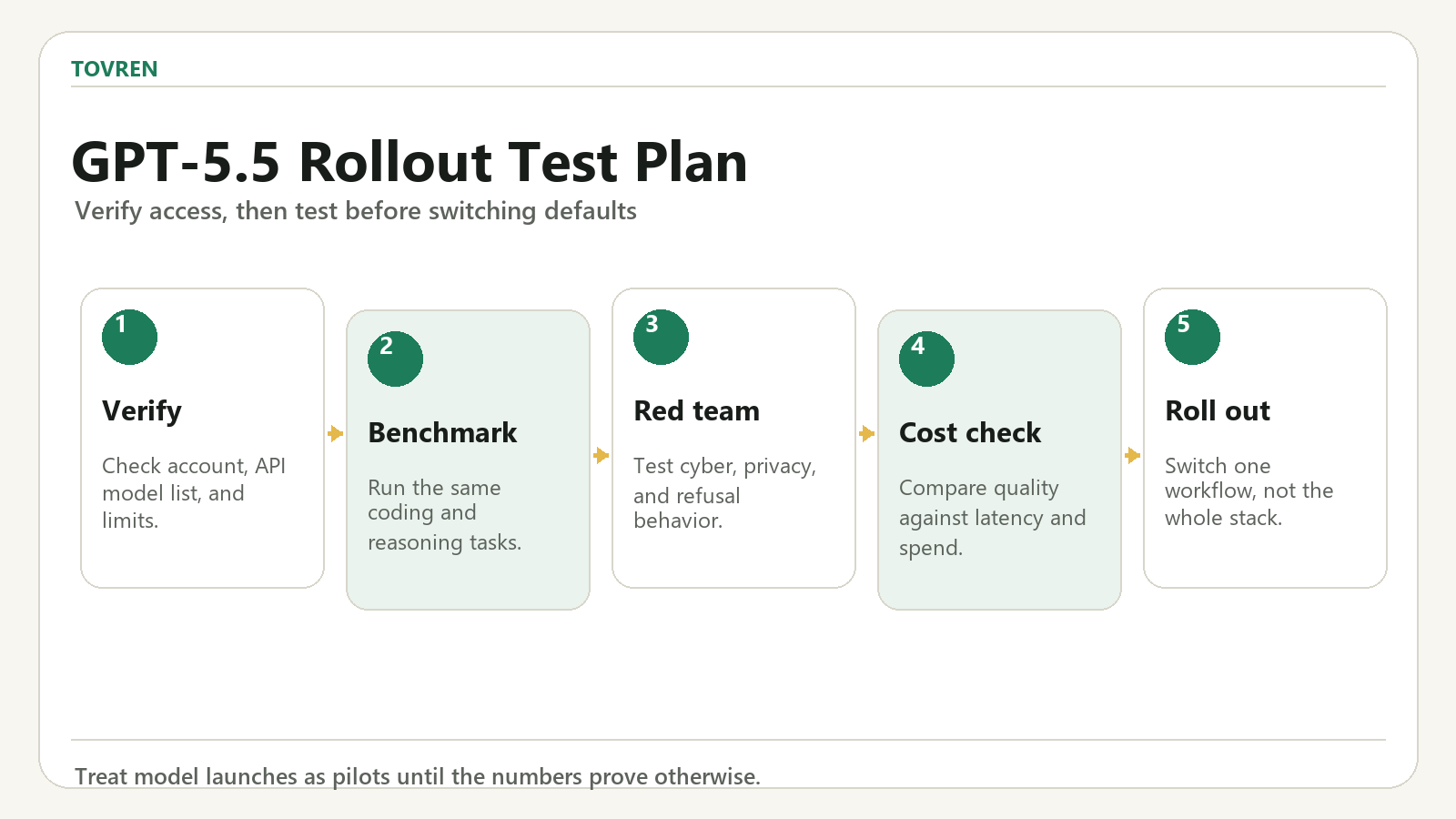
Short answer: Treat GPT-5.5 rollout claims as action-worthy only after you verify availability in your own ChatGPT or API account. If it appears, test it on coding, cyber, reasoning, and cost-sensitive tasks before replacing your current default model.
Updated May 12, 2026, Asia/Seoul. OpenAI’s most important model-release story this week is not a single benchmark jump. It is a two-track GPT-5.5 rollout: GPT-5.5 Instant is becoming the default ChatGPT model for everyday users, while GPT-5.5-Cyber is entering a limited preview for vetted defenders working on authorized security problems.
The confirmed news is direct. OpenAI says GPT-5.5 Instant is replacing GPT-5.3 Instant as ChatGPT’s default model for all users, and that paid users can still access GPT-5.3 Instant for three months through model settings before retirement. OpenAI also says GPT-5.5 Instant is available in the API as chat-latest. Separately, OpenAI has announced Trusted Access for Cyber with GPT-5.5 and GPT-5.5-Cyber, aimed at authorized defensive security work.
Featured photo: Focal Foto, “OpenAI OpenAI on a phone”, via Wikimedia Commons, licensed under CC BY-SA 4.0. Cropped and resized for Tovren; derivative image distributed under the same license.
At a Glance
- What changed: GPT-5.5 Instant is rolling out as the new default ChatGPT model, while GPT-5.5-Cyber is limited to vetted security users.
- Who should care: ChatGPT users, API developers using
chat-latest, enterprise AI owners, and security teams evaluating AI-assisted defensive workflows. - What is not confirmed: OpenAI has not publicly announced GPT-5.6 or GPT-6 timing in the reviewed official sources.
- Best action now: Re-test recurring prompts, inspect memory-source behavior, and pin production API models where automatic behavior changes are risky.
What OpenAI Confirmed
- GPT-5.5 Instant is becoming the default ChatGPT model. OpenAI says the model is rolling out to all ChatGPT users and replacing GPT-5.3 Instant as the default.
- GPT-5.3 Instant has a transition window for paid users. Paid users can keep using GPT-5.3 Instant for three months through model configuration settings before it is retired.
- OpenAI claims lower hallucination rates in internal testing. The company says GPT-5.5 Instant produced 52.5% fewer hallucinated claims than GPT-5.3 Instant on high-stakes prompts covering medicine, law, and finance, and reduced inaccurate claims by 37.3% on especially challenging user-flagged conversations.
- Memory transparency is expanding. OpenAI says memory sources will show users some of the saved memories, past chats, files, or connected context used to personalize an answer, with controls to delete or correct outdated information.
- GPT-5.5-Cyber is not a broad public release. OpenAI describes GPT-5.5-Cyber as a more specialized model for authorized cybersecurity workflows, made available through controlled access.
- GPT-5.5 Instant has higher safety significance than earlier Instant models. OpenAI’s GPT-5.5 Instant system card says it is the first Instant model the company is treating as High capability in its Cybersecurity and Biological & Chemical Preparedness categories.
What Is Still Unconfirmed
- No verified GPT-5.6 or GPT-6 date. Community speculation about future frontier releases should not be treated as product guidance until OpenAI publishes it.
- No general access to GPT-5.5-Cyber. The confirmed rollout is limited access for vetted defenders and authorized security workflows.
- No guarantee that internal factuality gains match every workflow. OpenAI’s numbers are useful, but high-stakes medical, legal, financial, and security use cases still need human review and independent testing.
- No uniform personalization rollout across every plan and region. OpenAI says availability can vary by plan, platform, source type, and region.
Why This Matters
Default models shape how AI is actually used. Most people do not manually compare model names before asking ChatGPT to draft an email, explain a spreadsheet, review a contract clause, summarize a meeting, analyze an image, or debug a script. If GPT-5.5 Instant becomes the default layer underneath those everyday tasks, the change will affect millions of routine decisions without users necessarily thinking of it as a model migration.
The cybersecurity rollout matters for a different reason. Frontier models are becoming more useful for vulnerability triage, secure code review, detection engineering, malware analysis, patch validation, and controlled red-team work. OpenAI is trying to separate normal ChatGPT access, trusted defensive access, and more specialized cyber-permissive access instead of releasing the same level of capability to everyone.
That makes this release less like a simple “new model is smarter” announcement and more like a reliability and governance update. The practical question is not only whether GPT-5.5 Instant scores better. It is whether teams can trust its behavior, understand when personalization is being used, control API drift, and keep security-capable use inside approved boundaries.
Who Is Affected Now
| Reader | What changed | What to do now |
|---|---|---|
| Everyday ChatGPT users | GPT-5.5 Instant is becoming the default model. | Expect more concise answers and stronger personalization. Check memory sources when an answer feels unusually tailored. |
| Paid ChatGPT users | GPT-5.3 Instant remains available temporarily. | Compare old and new outputs on recurring prompts before the three-month transition window ends. |
| API developers | chat-latest now points to GPT-5.5 Instant. |
Run regression tests for tone, length, refusal behavior, citation style, and tool-use assumptions. Pin a specific model where stability matters. |
| Enterprise AI owners | Personalization and connected-context behavior are becoming more visible. | Update model inventories, acceptable-use policies, user guidance, and regional rollout notes. |
| Security teams | Trusted Access for Cyber and GPT-5.5-Cyber add controlled access tiers. | Apply only for authorized workflows. Prepare evidence of identity, account security, asset ownership, logging, and approved-use scope. |
| Risk, legal, and compliance teams | OpenAI is treating GPT-5.5 Instant as High capability in cyber and bio/chemical preparedness categories. | Do not assume “default model” means “low-risk model.” Review safeguards, connectors, logging, and escalation paths. |
The Practical Read
For individuals, the best test is not a benchmark chart. It is the prompts you already repeat every week. Try the same requests you use for meeting notes, code review, spreadsheet logic, trip planning, policy drafts, screenshots, and research summaries. Look for three things: whether the answer is more directly usable, whether it omits necessary caveats, and whether personalization improves the result without introducing outdated context.
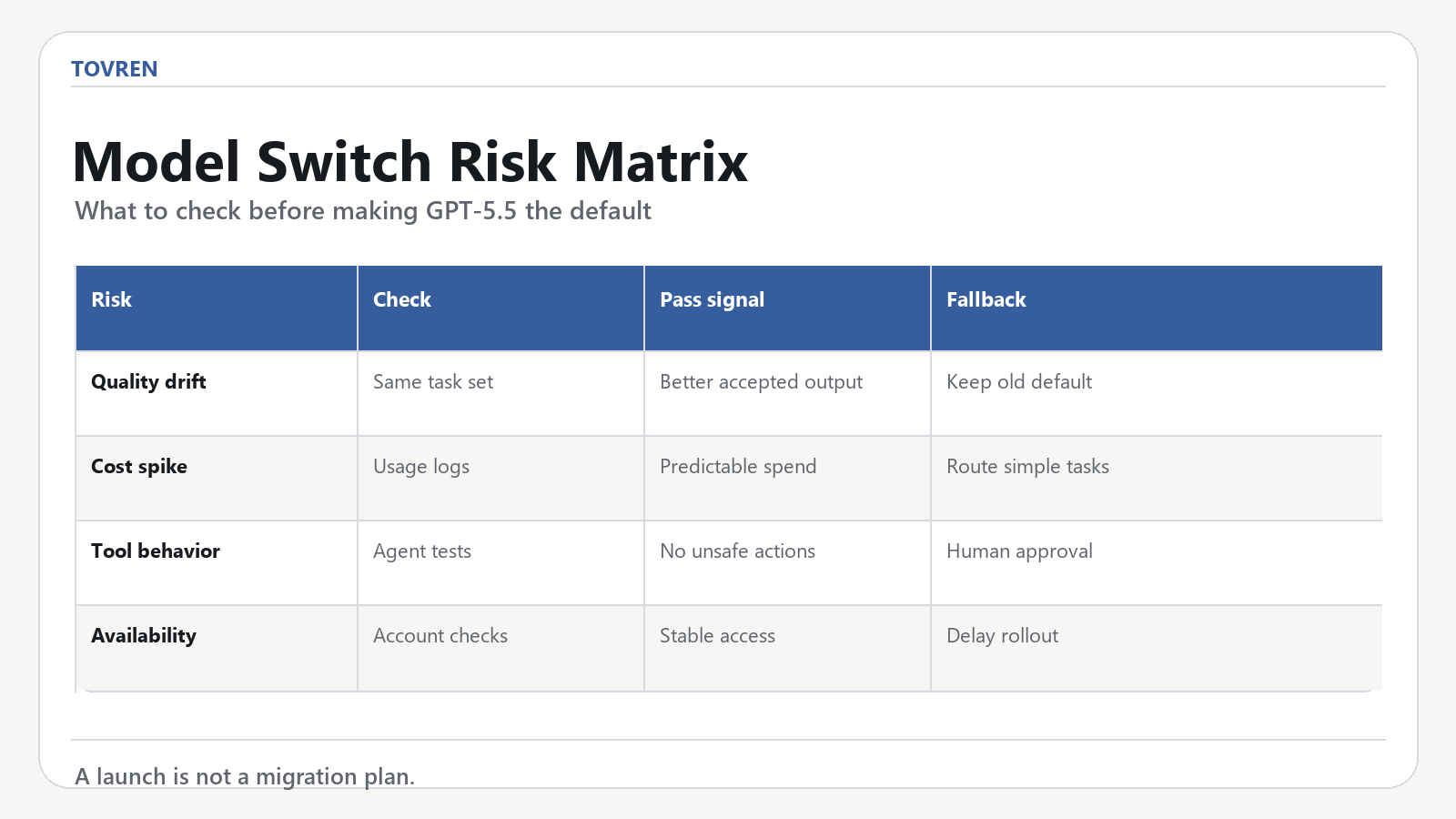
For product teams, the risk is silent behavior change. If an application uses chat-latest, OpenAI’s default model update can change response style and edge-case handling without a code change on your side. That can be useful for products that intentionally want automatic upgrades, but it is risky for regulated workflows, carefully tuned prompts, or customer-facing features with strict output requirements.
For enterprises, the new memory-source controls are worth documenting. Personalization can make ChatGPT more useful, but employees need to know how to inspect sources, remove stale memories, use temporary chats, and avoid relying on connected context that may vary across plans, regions, and devices.
What Security Teams Should Do
Security teams should treat GPT-5.5-Cyber as a governed access program, not a shortcut. Start by defining the workflows you can authorize: owned-code vulnerability research, patch validation, malware analysis in controlled environments, detection engineering, red-team simulations on approved assets, and incident-response support.
Then define the boundaries. High-risk activity should require asset ownership, written approval, logging, human review, and a clear prohibition on credential theft, malware deployment, destructive testing, persistence, stealth, or third-party exploitation. The stronger the model, the more important these operating rules become.
OpenAI says GPT-5.5 with Trusted Access for Cyber is the right starting point for most legitimate defensive workflows. GPT-5.5-Cyber is positioned for more specialized dual-use tasks where verified defenders still run into unnecessary refusals. That distinction matters because “cyber” is not one use case. Secure code review and live exploit validation carry very different risk profiles.
Three Checks Before You Rely on GPT-5.5 Instant
- Re-test high-stakes prompts. Lower hallucination claims are encouraging, but medical, legal, financial, security, and compliance outputs still need human verification.
- Inspect memory behavior. Use memory sources to see which saved memories, chats, files, or connected apps shaped a personalized answer. Delete or correct stale context.
- Avoid silent API drift. If your product uses
chat-latest, decide whether automatic model upgrades are acceptable. Pin a specific model where consistent behavior is more important than automatic improvement.
What To Watch Next
- Independent factuality tests: OpenAI’s internal hallucination numbers need third-party checks across languages, regions, and specialized domains.
- GPT-5.3 Instant retirement: Paid users have a three-month transition period, so teams should finish comparison testing before the old model disappears.
- API naming guidance: Developers should watch whether OpenAI clarifies long-term behavior for
chat-latestand stable GPT-5.5 Instant identifiers. - Trusted Access expansion: The key question is how broadly OpenAI expands GPT-5.5-Cyber and what evidence it requires for approval.
- Safety-card updates: Because OpenAI classifies GPT-5.5 Instant as High capability in certain preparedness categories, future safeguards and evaluation updates matter for enterprise buyers.
Bottom Line
GPT-5.5 is not just another name in the model picker. GPT-5.5 Instant changes the default ChatGPT experience for a broad user base, while GPT-5.5-Cyber tests a more controlled distribution model for powerful dual-use capabilities. The practical response is to test real workflows, verify high-stakes claims, inspect personalization sources, and treat cyber-capable access as a governed security program rather than a productivity perk.
Source Log
- OpenAI: GPT-5.5 Instant, published May 5, 2026.
- OpenAI: GPT-5.5 Instant System Card, published May 5, 2026.
- OpenAI: Scaling Trusted Access for Cyber with GPT-5.5 and GPT-5.5-Cyber, published May 7, 2026.
- Wikimedia Commons: OpenAI OpenAI on a phone, photo by Focal Foto, CC BY-SA 4.0.
FAQ
How should teams verify a GPT-5.5 rollout?
Check availability inside the actual ChatGPT or API account, then record model behavior, price, rate limits, and task results before changing defaults.
Should GPT-5.5 replace the current default immediately?
No. Pilot it on representative coding, cyber, reasoning, and writing tasks first, then compare quality, speed, and cost.
What is the biggest rollout risk?
The biggest risk is changing workflows based on hype before confirming access, pricing, reliability, and governance requirements.