Direct verdict
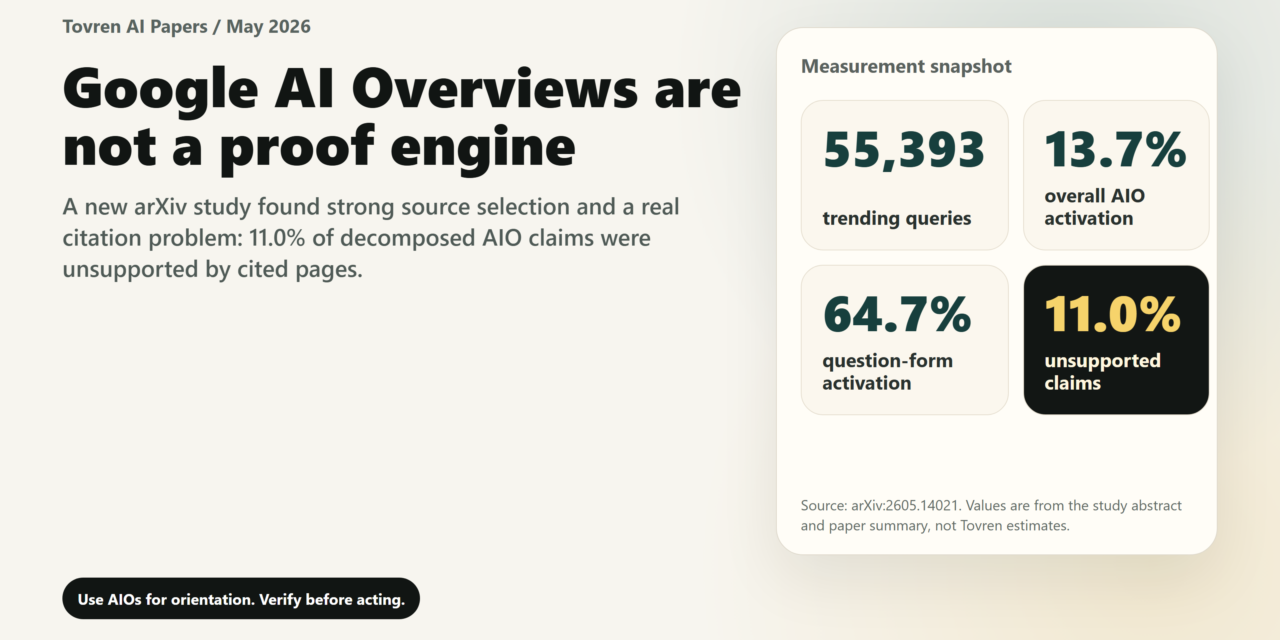
No — do not trust Google AI Overviews as final answers. Use them as a fast briefing layer, then verify any consequential claim against the linked source. Publishers and SEO teams should treat AIOs as a separate search surface now: track AIO activation and citations for priority queries, rewrite pages to be citation-ready, and reduce dependence on blue-link traffic. The new arXiv paper by Haofei Xu, Umar Iqbal, and Jacob M. Montgomery found that 11.0% of 98,020 atomic AIO claims were unsupported by cited pages, even though AIO-cited domains were often more credible than classic first-page results.
Why this paper matters
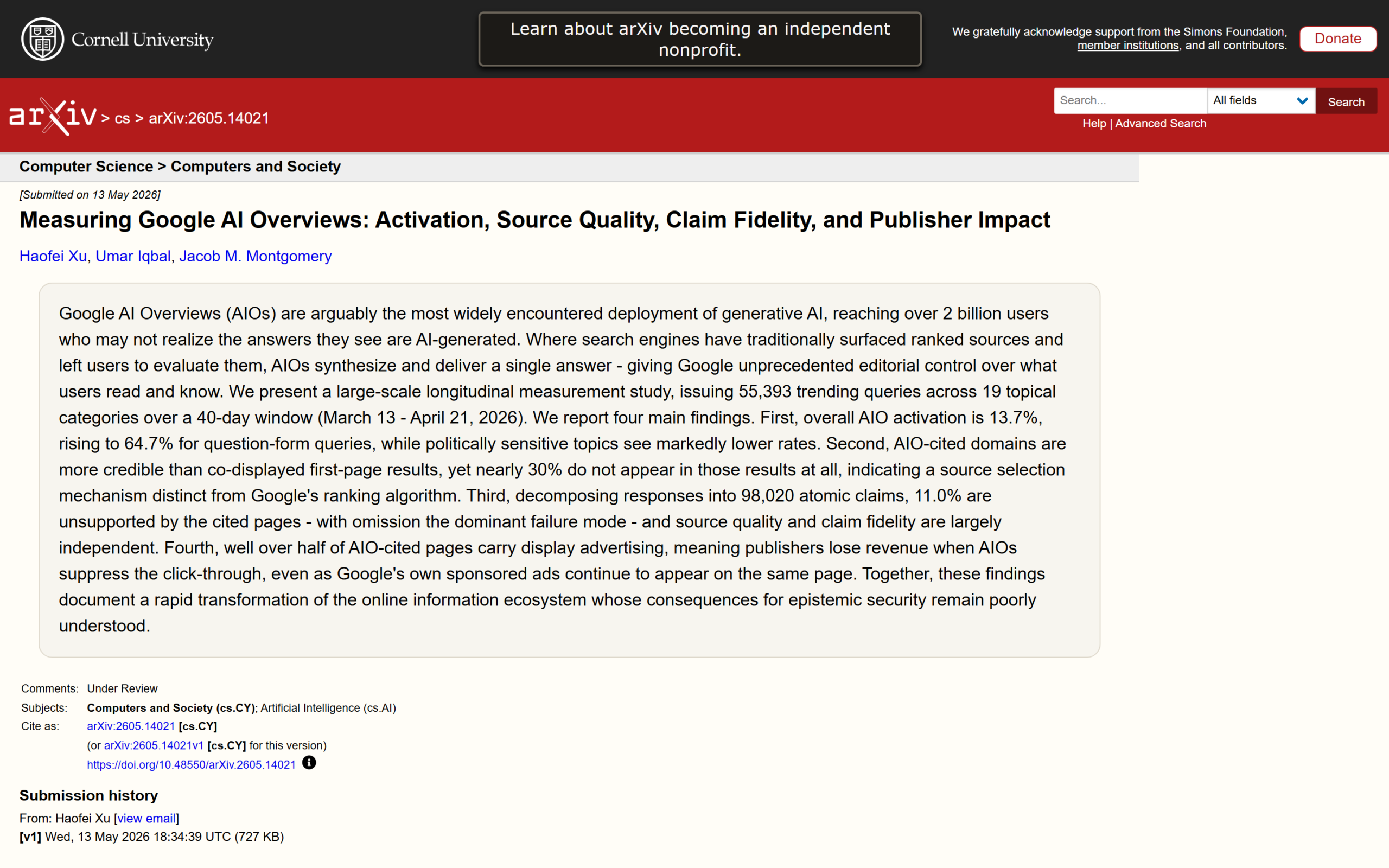
Measuring Google AI Overviews: Activation, Source Quality, Claim Fidelity, and Publisher Impact, submitted to arXiv on May 13, 2026, is one of the most useful independent measurements of Google AI Overviews because it studies the full chain: when AIOs appear, which sources they cite, whether cited pages support generated claims, and what publisher business models are exposed when users do not click.
The authors issued 55,393 trending queries across 19 topical categories from March 13 to April 21, 2026. Overall AIO activation was 13.7%, but activation rose to 64.7% for question-form queries. That is the operational takeaway for normal users and SEO teams: AIO exposure is not evenly distributed. It concentrates around natural-language questions — exactly the format people use when they want explanation, synthesis, or advice.
Practical paper findings table
| Evidence bucket | What is confirmed | Practical meaning | What to do now |
|---|---|---|---|
| Confirmed paper findings | The study measured 55,393 trending queries across 19 categories. AIOs appeared on 13.7% of queries overall and 64.7% of question-form queries. Politically sensitive topics had lower activation rates. Nearly 30% of AIO-cited domains did not appear anywhere in the co-displayed first-page results. The authors decomposed responses into 98,020 claims and found 11.0% unsupported by cited pages, with omission as the dominant failure mode. | Google AIOs are not just “rank one plus a summary.” They use a partly distinct source-selection layer, and citation does not guarantee that the cited page supports the generated sentence. | Readers should verify high-stakes claims. SEO teams should monitor AIO citations separately from organic rank and audit whether their pages are being cited accurately. |
| Google official context | At Google I/O 2026, Google said AI Mode had surpassed more than 1 billion monthly users, Gemini 3.5 Flash became the default model in AI Mode globally, follow-ups from AI Overviews into AI Mode were live across desktop and mobile worldwide, and information agents would roll out first to Google AI Pro and Ultra subscribers this summer. | AI Search is no longer a side experiment. Google is making AIOs, AI Mode, agents, and conversational follow-ups part of the default search journey. | Treat AI Search visibility as a board-level distribution issue, not a technical SEO side quest. |
| Google link-discovery update | On May 6, 2026, Google said it was adding article suggestions, news subscription labels, public-discussion previews, more inline links next to relevant AI-response text, and desktop previews for linked sites. It also said it uses techniques such as query fan-out to find relevant sites for generative AI Search. | Google knows source discovery is a pressure point. More links may help, but the paper shows link presence is not the same as claim fidelity or publisher traffic recovery. | Publishers should make pages easier to cite and preview, but should not assume Google’s link UI changes will restore old click-through rates. |
| Community/search sentiment | SEO and publisher communities remain worried about click loss, citation opacity, and limited control over AI use of publisher content. Reuters reported an EU publisher complaint over AI Overviews; AP reported UK proposals for publisher opt-out and transparency; industry coverage has documented publisher concerns about traffic declines. | The concern is not just “AI answers are wrong.” The deeper issue is economic: Google can use publisher material to answer the query while the publisher may lose the visit. | Use community sentiment as a risk signal, not as proof for your own site. Measure your own query set, citations, CTR, and revenue exposure. |
| Tovren analysis | AIOs are better sourced than many critics imply, but less reliable than Google’s product framing suggests. The paper’s sharpest point is that source quality and claim fidelity are largely independent: better sources do not automatically produce better grounded answers. | The winning strategy is not “write more SEO content.” It is to become the clearest, most verifiable, most updateable source for a narrow set of claims and decisions. | Build an AIO monitoring workflow, improve claim-level clarity on key pages, and create assets that users still need to click for: tools, data, templates, calculators, comparisons, and original reporting. |
What this means for readers
Google AI Overviews are useful for orientation, definitions, quick comparisons, and finding related angles. They are not reliable enough to be your final authority on health, finance, law, elections, safety, travel disruptions, pricing, or time-sensitive news.
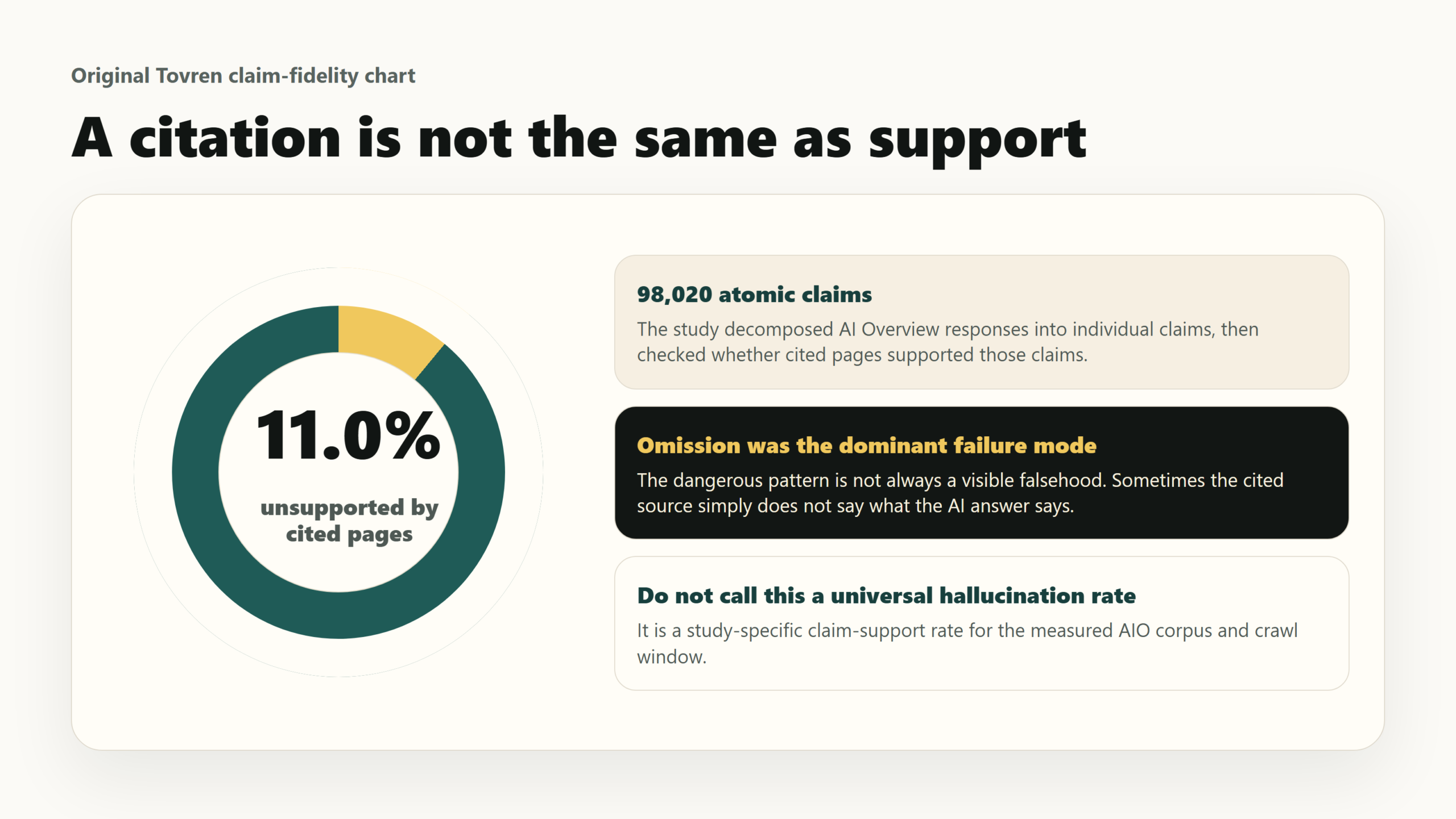
The practical rule is simple: read the AIO, then check the cited page before acting. The paper’s dominant failure mode was omission: the AIO made a claim that the cited source did not mention. That matters because a citation can create a false feeling of verification.
Reader verification ladder
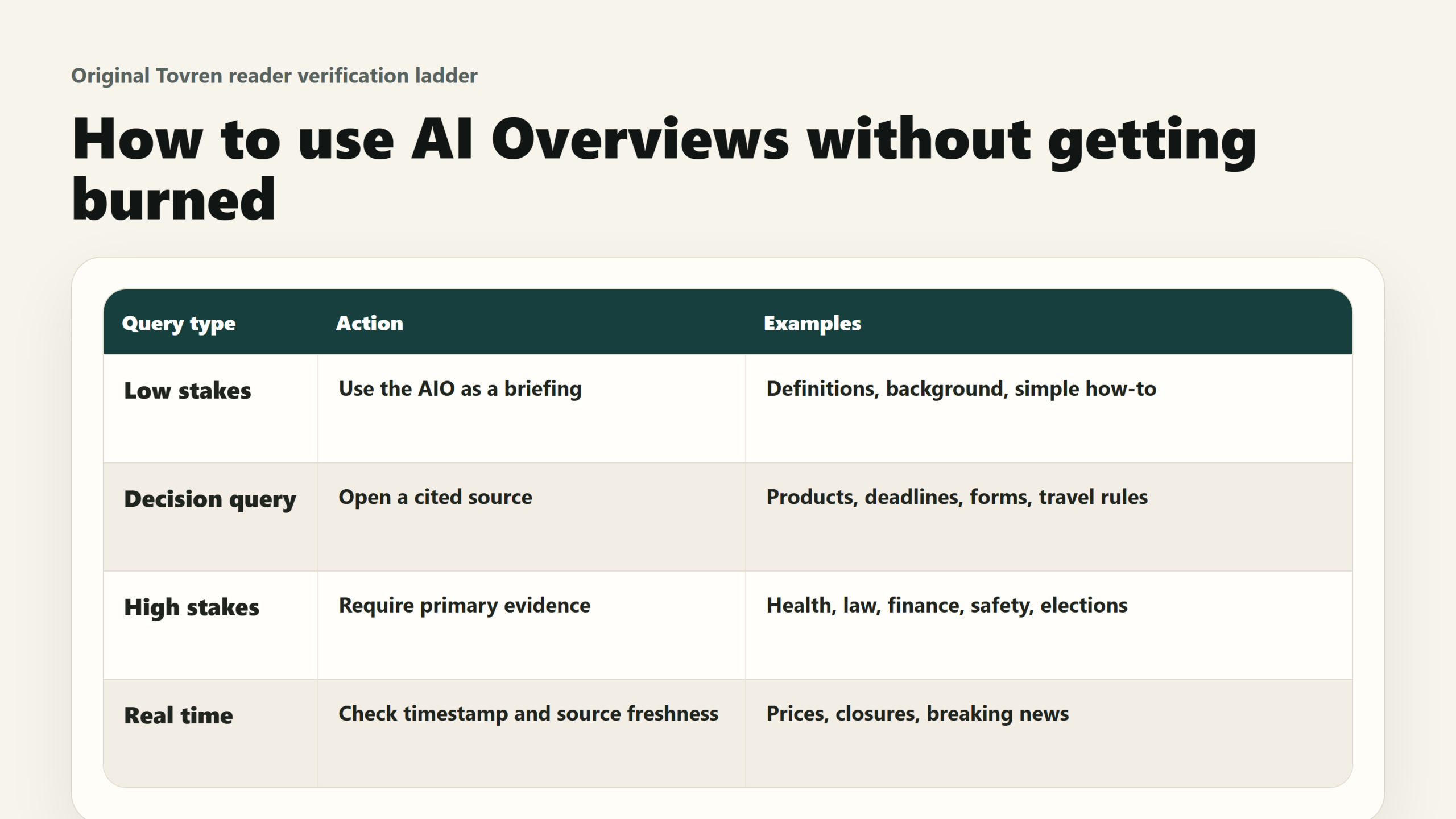
- Low-stakes query: Use the AIO as a starting summary. Examples: “what is a transformer model,” “best way to clean a keyboard,” or “how does a rice cooker work.”
- Decision query: Open at least one cited source and confirm the exact claim. Examples: product comparisons, school deadlines, tax forms, insurance rules, or travel requirements.
- High-stakes query: Ignore the AIO until verified by primary sources. Examples: medical advice, legal obligations, investment decisions, election procedures, emergency guidance, or anything involving children’s safety.
- Real-time query: Check timestamps and primary data. Weather, sports, local closures, prices, and breaking news are especially vulnerable to stale or mismatched source evidence.
What this means for publishers and SEO teams
Classic rankings still matter, but they no longer describe the whole search surface. The paper found that 29.8% of AIO reference domains did not appear anywhere on the corresponding first page. That means an AIO citation can come from outside the visible page-one ranking set, and a page-one ranking can still fail to become an AIO source.
The right SEO response is not to chase “AI-friendly” fluff. The right response is to make important pages easier for retrieval systems and readers to verify. Put the decisive facts near the top. Use clear headings. State dates, prices, eligibility rules, limits, and exceptions explicitly. Keep comparison tables and methodology notes in text, not only in images. Give each page a reason to exist beyond a summary: original tests, proprietary data, expert interviews, calculators, downloadable checklists, or updated examples.
The publisher risk is concrete. The paper did not directly measure traffic loss, but it measured revenue exposure: 30,994 of 61,212 AIO reference URLs, or 50.63%, displayed visible ads, and the authors describe that as a conservative lower bound because social and video platforms were not scrape-analyzed. If AIOs satisfy the user without a visit, ad-supported pages lose the pageview while still supplying the raw material for the answer.
Google’s May 6 link updates are worth using, especially inline links, article suggestions, subscription labels, and previews. They are not a strategy by themselves. A publisher still needs to know which queries trigger AIOs, whether its pages are cited, whether citations match the actual page, and whether AIO-bearing queries are losing CTR even when rank is stable.
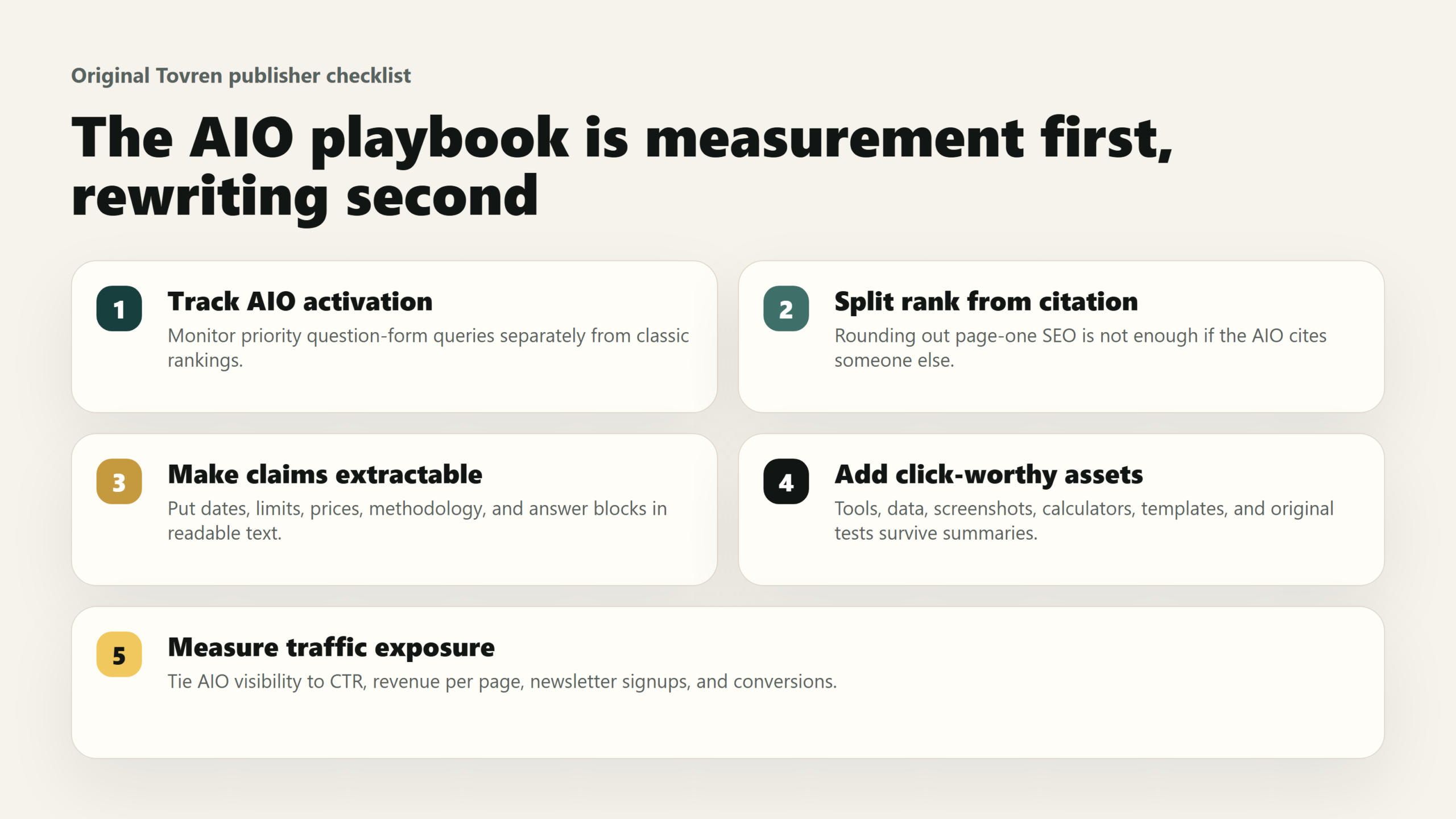
Five-step action checklist
- Build a priority AIO query panel. Select 100 to 500 queries across your highest-value topics. Include question-form variants because the paper found they triggered AIOs far more often than non-question queries. Track “AIO present,” cited domains, cited URLs, your classic rank, and your CTR.
- Separate AIO visibility from SEO rank. Create four buckets: ranks and cited, ranks but not cited, cited without ranking, and neither ranks nor cited. The “cited without ranking” bucket is the new opportunity; the “ranks but not cited” bucket is the new risk.
- Rewrite key pages for claim-level sourceability. Add short answer blocks, explicit dates, named entities, limitations, and concise tables. Make every important claim easy to quote, verify, and update. Remove vague copy that forces Google or any AI system to infer what you mean.
- Create click-worthy assets that summaries cannot replace. Prioritize original charts, calculators, downloadable templates, benchmark tables, local data, expert quotes, screenshots, and hands-on tests. If the page only says what dozens of other pages say, an AIO can satisfy the user without you.
- Diversify distribution and conversion paths. Push newsletter capture, direct traffic, brand search, community, syndication, social search, and partnerships. For subscription publishers, evaluate Google’s subscription-linking and source-discovery tools, but measure whether they increase actual sessions and subscribers, not just impressions.
What not to overclaim
- Do not say all AI Overviews are unreliable. The paper found 88.97% of verified claims were consistent with cited sources, and AIO-cited domains were systematically more credible than co-displayed first-page results.
- Do not say citations prove the answer. The study found 11.03% of verified claims were unsupported, including omitted, incorrect, and ambiguous claims.
- Do not say classic SEO is dead. AIO references overlapped with 70.2% of full first-page domains, so classic ranking still contributes to AIO visibility. It is just no longer sufficient.
- Do not claim this paper proves your site lost traffic. The authors explicitly say they do not measure traffic loss directly; they measure monetization characteristics of cited pages and Google ad coexistence on AIO-bearing pages.
- Do not generalize every rate globally. This was a 40-day study of trending queries, with a specific crawl setup and query corpus. Use the paper as a strong benchmark, then run your own monitoring for your market, language, and topic mix.
FAQ
Should readers trust Google AI Overviews?
Trust them as a starting point, not as the answer. For low-stakes learning, they are useful. For health, finance, law, politics, safety, pricing, or breaking news, open the source and verify the exact claim before acting.
Does an AIO citation mean the cited page supports the claim?
No. That is the paper’s most important reader-facing finding. The authors decomposed AIO responses into 98,020 claims and found that 11.0% were unsupported by cited pages. Omission was the dominant failure mode, meaning the cited page often did not mention the claim at all.
Can publishers get cited in AIOs without ranking on page one?
Yes. Nearly 30% of AIO-cited domains did not appear anywhere in the corresponding first-page results. That creates a new visibility path, but also makes AIO citation more opaque than classic ranking.
Should SEO teams optimize for AI Overviews differently from normal SEO?
Yes, but not by producing generic AI-written pages. Optimize for verifiable usefulness: concise answer blocks, original evidence, structured comparisons, clear dates, transparent methodology, and pages worth clicking after the summary.
What should publishers do first?
Start with measurement. Pick your most valuable informational and question-form queries. Track AIO activation, cited URLs, your classic rank, CTR, and revenue per page. Then rewrite the pages that rank but are not cited, and audit any cited pages where the AIO misrepresents your content.
Source Log
| Source | URL | Publisher / owner | Publication or update date | Access date | Claims supported |
|---|---|---|---|---|---|
| Measuring Google AI Overviews: Activation, Source Quality, Claim Fidelity, and Publisher Impact | https://arxiv.org/abs/2605.14021 | arXiv | Submitted May 13, 2026 | May 23, 2026 | Paper title, authors, submission date, abstract findings, query count, categories, activation rates, source overlap, claim fidelity, publisher ad exposure. |
| arXiv PDF: Measuring Google AI Overviews | https://arxiv.org/pdf/2605.14021 | arXiv | May 13, 2026 | May 23, 2026 | Detailed methodology, claim-label definitions, validation notes, source-quality analysis, economic impact details, limitations and concluding interpretation. |
| A new era for AI Search | https://blog.google/products-and-platforms/products/search/search-io-2026/ | May 19, 2026 | May 23, 2026 | AI Mode monthly users, Gemini 3.5 Flash in AI Mode, follow-ups from AI Overviews to AI Mode, information agents, Search agents. | |
| 100 things we announced at Google I/O 2026 | https://blog.google/innovation-and-ai/technology/ai/google-io-2026-all-our-announcements/ | May 20, 2026 | May 23, 2026 | Official Google I/O context: AI Mode scale, Gemini 3.5 Flash default model globally, seamless AI Overview-to-AI Mode follow-ups worldwide, information agents for Pro and Ultra subscribers. | |
| I/O 2026: Welcome to the agentic Gemini era | https://blog.google/innovation-and-ai/sundar-pichai-io-2026/ | May 19, 2026 | May 23, 2026 | Google CEO context on AI Overviews, AI Mode, Gemini app scale, and Google’s positioning of Search as a conversational AI product. | |
| 5 new ways to explore the web with generative AI in Search | https://blog.google/products-and-platforms/products/search/explore-web-generative-ai-search/ | May 6, 2026 | May 23, 2026 | Inline links, article suggestions, news subscription labels, public-discussion previews, desktop link previews, query fan-out, and source-discovery improvements. | |
| Google hit by European publishers’ complaint to EU over AI Overviews | https://www.reuters.com/world/european-publishers-council-files-eu-antitrust-complaint-about-googles-ai-2026-02-10/ | Reuters | February 10, 2026 | May 23, 2026 | Publisher and regulatory concern over AI Overviews, content use, compensation, and opt-out limitations. |
| UK proposes forcing Google to let publishers opt out of AI summaries | https://apnews.com/article/google-uk-britain-tech-online-regulation-f2bf8545f3b987aa1900a829c0d01390 | Associated Press | 2026 | May 23, 2026 | UK CMA proposals on publisher choice, source transparency, and attribution in AI-generated results. |
| Google AI Overviews linked to 25% drop in publisher referral traffic | https://digiday.com/media/google-ai-overviews-linked-to-25-drop-in-publisher-referral-traffic-new-data-shows/ | Digiday | August 15, 2025 | May 23, 2026 | Publisher-side traffic concerns and reported search referral declines used as community/search sentiment, not as direct proof for every site. |
| Google AI Overviews Impact On Publishers & How To Adapt Into 2026 | https://www.searchenginejournal.com/impact-of-ai-overviews-how-publishers-need-to-adapt/556843/ | Search Engine Journal | September 29, 2025 | May 23, 2026 | SEO community framing around click loss, zero-click search, publisher adaptation, and AIO visibility concerns. |