Short answer: Google I/O 2026 made Gemini, AI Mode, and agents the center of Google’s product strategy. Builders should test the search, coding, and agent changes now, but avoid rewriting workflows until the rollout reaches their accounts.
The 90-second version
Google I/O 2026 was the clearest “agentic Gemini” keynote yet. Google’s announcements were not centered on a single chatbot upgrade. They were about making Gemini the connective layer that can answer, create, monitor, code, shop, browse, summarize, remix, and eventually act across Google surfaces.
- Gemini 3.5 Flash is the practical core. Google says it is available now in the Gemini app, AI Mode in Search, Google Antigravity, the Gemini API in AI Studio and Android Studio, Gemini Enterprise Agent Platform and Gemini Enterprise. Gemini 3.5 Pro is planned for next month.
- Gemini Omni is Google’s new multimodal creation model. Omni Flash starts with video: text, image, video and some audio inputs can drive generated or edited video. It is rolling out now to Google AI Plus, Pro and Ultra subscribers through the Gemini app and Google Flow, and at no cost in YouTube Shorts Remix and YouTube Create starting this week. APIs are coming in the following weeks.
- Gemini Spark is the biggest assistant shift. Google describes Spark as a 24/7 personal AI agent that can work across Google apps, run in the background and ask before high-stakes actions. It is not broadly available yet: trusted testers first, then a U.S. beta for Google AI Ultra subscribers.
- Search is becoming more agentic. Gemini 3.5 Flash becomes the default model in AI Mode where AI Mode is available. Google also announced an intelligent Search box, follow-ups from AI Overviews into AI Mode, information agents, generative UI and custom mini apps.
- Developers got the most actionable surface. Antigravity 2.0, Antigravity CLI, Antigravity SDK, Managed Agents in the Gemini API and Android support in AI Studio are the announcements most likely to be testable quickly.
- The pricing story matters. Google added a $100/month AI Ultra plan, lowered the top AI Ultra tier from $250/month to $200/month, included 20TB storage and YouTube Premium in Ultra, and moved Gemini usage toward compute-based limits that refresh every five hours until a weekly cap.
- The skepticism is real. Google announced a lot. Some is live, some is U.S.-only, some is paid-only, some is beta/trusted tester, and the biggest claims about model speed and benchmark performance are Google-reported claims until independent testing catches up.
Tovren verdict: Google I/O 2026 was not a “Gemini app update.” It was Google trying to make Gemini the agent runtime for its entire consumer, developer and business stack. The useful response is not to chase every demo. Try Gemini 3.5 Flash, Search AI Mode, Omni in the surfaces you already use, and Antigravity if you build software. Wait on Spark unless you are in the U.S., willing to pay for AI Ultra and comfortable testing a background agent with access to your work context.
Confirmed announcements by surface
This table separates confirmed announcements from Tovren interpretation. “Available” means Google said the feature is live or rolling out now; “coming” means Google gave a future window; “unclear” means Google announced the feature but did not provide enough public detail to treat it as broadly available.
| Surface | Confirmed announcement | Timing / availability | Who should care first | Tovren analysis |
|---|---|---|---|---|
| Gemini models | Gemini 3.5 family; Gemini 3.5 Flash first; Gemini 3.5 Pro planned later. | 3.5 Flash available now; 3.5 Pro next month, according to Google. | Developers, power users, agent builders, enterprise AI teams. | 3.5 Flash is the engine underneath several agentic experiences. Treat benchmark claims as Google claims until independent tests update. |
| Gemini Omni | New multimodal creation model, starting with video generation and conversational video editing. | Rolling out now to paid Gemini/Flow users; YouTube Shorts/Create at no cost starting this week; APIs in coming weeks. | Creators, video marketers, YouTube Shorts users, agencies, media teams. | Most useful where remixing and rapid rough cuts matter. High-risk for synthetic media workflows unless provenance and permissions are managed. |
| Gemini app | Neural Expressive UI, Daily Brief, Gemini Spark, macOS app updates and new voice features. | UI rolling out globally now; Daily Brief starts in the U.S. for paid tiers; Spark trusted testers first, U.S. AI Ultra beta next week; some voice/macOS features later this summer. | Power users, business users, students, productivity-heavy Google users. | The app is moving from chat to persistent assistant. The strongest promise is convenience; the biggest concern is trust and app/data access. |
| Search | Gemini 3.5 Flash default in AI Mode, intelligent Search box, AI Overview follow-ups, information agents, generative UI and mini apps. | Some Search updates live now where AI Mode is available; information agents and U.S. booking/calling roll out this summer; mini apps start later for U.S. Pro/Ultra users. | SEO teams, publishers, researchers, shoppers, local businesses, power searchers. | This is the most important strategic surface because Search controls discovery, links, user intent and monetizable attention. |
| Antigravity / developers | Antigravity 2.0 desktop app, CLI, SDK, Managed Agents in Gemini API, AI Studio mobile pre-registration, Android vibe coding. | Many developer features available now or starting this week; bonus credits offer expires May 25, 2026. | Developers, technical leads, app builders, internal tools teams. | This is the most testable part of I/O 2026. The key question is reliability under real multi-step work, not demo polish. |
| Workspace | Voice features in Gmail, Docs and Keep; Google Pics; AI Inbox expansion; Workspace-integrated Gemini Spark. | Voice features and Pics roll out this summer to paid users/business preview; AI Inbox expands now in the U.S.; Spark for business preview soon. | Business users, operations teams, executives, assistants, sales/customer teams. | Useful if it reduces inbox/document overhead. Risky if teams allow agents to touch email/calendar workflows without approval policies. |
| Chrome / web | WebMCP proposal, Modern Web Guidance, Chrome DevTools for agents, Prompt API stable in Chrome 148, Gemini in Chrome on Android in late June. | Some developer tools available now; WebMCP origin trial starts in Chrome 149; Android browsing assistant launches late June for eligible devices/language settings. | Web developers, browser automation teams, product teams, agent-tool builders. | WebMCP is strategically important because it tries to make websites agent-legible instead of click-scraped. |
| YouTube | Ask YouTube conversational search; Gemini Omni in Shorts Remix and YouTube Create. | Ask YouTube available for U.S. Premium users 18+ through youtube.com/new; Omni remix rolls out now at no cost in Shorts Remix/Create. | Creators, Shorts editors, educators, video search users. | Creator controls, watermarking, opt-out and likeness detection are essential; remix features will be judged by consent and attribution, not only quality. |
| Shopping | Universal Cart, Universal Commerce Protocol expansion and Agent Payments Protocol. | Universal Cart rolls out in the U.S. this summer across Search and Gemini app; YouTube/Gmail follow later. | Shoppers, retailers, ecommerce teams, payment/product teams. | Agentic commerce could be useful, but checkout automation must prove trust, privacy, price accuracy and merchant accountability. |
| Android XR eyewear | Intelligent eyewear with Samsung, Gentle Monster and Warby Parker; audio glasses first; display glasses later. | Audio glasses later this fall; display glasses later. | Hardware watchers, AR/XR teams, accessibility and mobility users, Android ecosystem builders. | Google is trying to move Gemini from screens into ambient computing. The unanswered questions are price, battery, privacy norms and real-world reliability. |
| AI subscriptions | New $100/month AI Ultra plan; top AI Ultra cut from $250/month to $200/month; usage model shifts to compute-used limits. | Rolling out now and over coming days/weeks; Spark is U.S.-only for AI Ultra at launch. | Developers, creators, technical leads, heavy Gemini/Antigravity users. | Google is making a clearer paid ladder. The $100 tier is not cheap, but it may be rational for users who hit Pro limits or need Antigravity/Omni volume. |
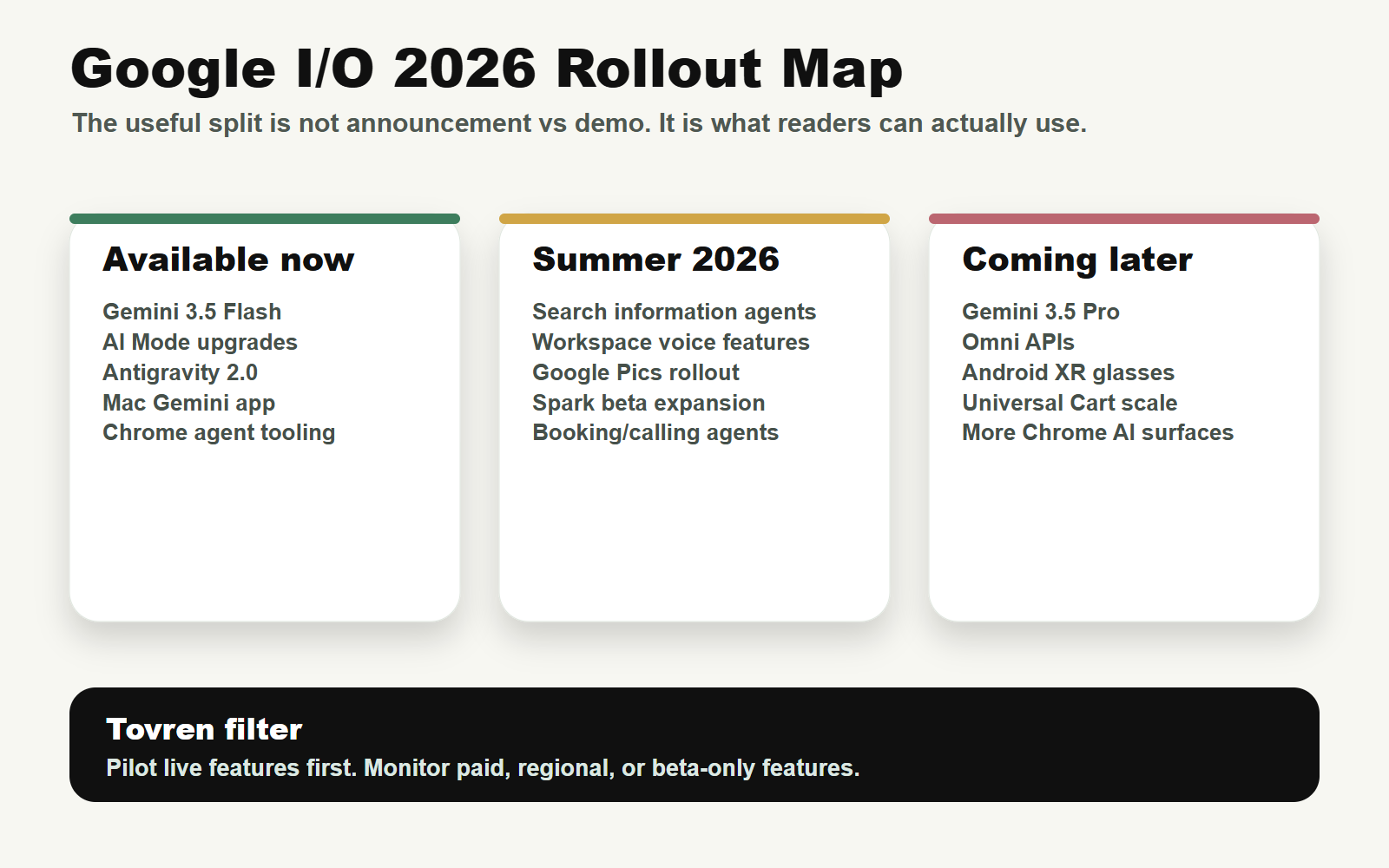
What is available now vs. this summer vs. later
| Available now / rolling out now | Coming this summer | Later / coming weeks or months |
|---|---|---|
|
|
|
Why this keynote matters: Gemini is becoming a layer, not a destination
Confirmed: Google announced Gemini 3.5, Gemini Omni, Gemini Spark, Search agents, Antigravity 2.0, Universal Cart, Workspace voice features, Chrome agent tooling, YouTube AI search/remixing and intelligent eyewear as part of the same I/O cycle.
Tovren analysis: The pattern is more important than any single feature. Google is trying to make Gemini work across three levels:
- Interface: Search box, Gemini app, Gmail, Docs, Chrome, YouTube, glasses.
- Model layer: Gemini 3.5 for reasoning/action and Gemini Omni for multimodal creation.
- Agent harness: Antigravity, Managed Agents, Spark, Search information agents and Chrome/browser automation.
That is why this event matters for more than AI enthusiasts. If Google can make agents useful inside existing products, most users will not “go to an AI app.” They will encounter AI inside the surfaces they already use to search, work, shop, browse, code and create.
Gemini 3.5: the model Google wants agents to run on
Confirmed: Gemini 3.5 Flash is the first model in Google’s new Gemini 3.5 family. Google says it is built for complex, agentic workflows and is available now to everyone in the Gemini app and AI Mode in Search, to developers through Antigravity and the Gemini API in AI Studio and Android Studio, and to enterprises through Gemini Enterprise Agent Platform and Gemini Enterprise.
Google’s claim, not independent proof: Google says 3.5 Flash outperforms Gemini 3.1 Pro on difficult coding and agentic benchmarks, including Terminal-Bench 2.1, GDPval-AA, MCP Atlas and CharXiv Reasoning. Google also says 3.5 Flash is four times faster than other frontier models when measured by output tokens per second.
What to do now: Developers should test 3.5 Flash on long-running, tool-using workflows: codebase migrations, issue triage, multi-file refactors, spreadsheet-to-doc workflows, customer-support routing, OCR-heavy invoice flows and app prototypes. Power users should test it in AI Mode and Gemini app with tasks that require iteration, not just Q&A.
What to be skeptical about: Benchmarks are not the same as dependable autonomy. The core question is whether 3.5 Flash can maintain state, use tools safely, recover from errors and ask for confirmation at the right moments in messy real workflows.
Gemini Omni: Google’s “create anything from any input” model starts with video
Confirmed: Gemini Omni is Google’s new multimodal creation model. The first version, Gemini Omni Flash, starts with video generation and editing. Google says users can combine images, audio, video and text as inputs, then generate or edit videos through conversational instructions.
Availability: Omni Flash is rolling out now to Google AI Plus, Pro and Ultra subscribers globally through the Gemini app and Google Flow. It is also rolling out at no cost to YouTube Shorts Remix and YouTube Create users starting this week. Developer and enterprise API access is planned for the coming weeks.
Creator use cases:
- Turn a rough clip into multiple stylized Shorts concepts.
- Edit lighting, background, motion or camera angle through natural language.
- Use reference images or footage to keep a visual direction consistent.
- Generate explainer videos from short prompts.
- Remix eligible Shorts while preserving link-back and creator controls.
Trust and provenance: Google says videos created with Omni include SynthID digital watermarking, and YouTube says Omni-remixed Shorts have digital watermarks, identifying metadata and links back to the original video. That matters because video models will quickly create copyright, likeness, impersonation and attribution issues.
Tovren analysis: Omni is likely to be most useful for early creative ideation, short-form remixing, moodboards, explainer drafts and quick edits. It is not automatically a replacement for professional post-production, especially when brand safety, factual accuracy, rights clearance or exact client requirements matter.
Gemini Spark: the boldest announcement, but not the one most people can use today
Confirmed: Gemini Spark is Google’s new 24/7 personal AI agent. Google says it runs on Gemini 3.5, uses the Antigravity harness, can work in the background, integrates with Workspace apps such as Gmail, Docs and Slides, and is designed to ask before high-stakes actions like spending money or sending emails.
Availability: Spark rolls out first to trusted testers, then as a beta for Google AI Ultra subscribers in the U.S. next week. Spark access is listed for the $100 and $200 AI Ultra tiers, U.S. only at launch.
Examples Google gave:
- Flag hidden subscription fees from monthly credit card statements.
- Watch school emails, extract deadlines and send a daily digest.
- Synthesize raw meeting notes, create a Google Doc and draft a project kickoff email.
- Use new MCP connections to services such as Canva, OpenTable and Instacart, with broader actions planned in the coming weeks.
Why it matters: Spark is Google’s answer to the question every AI assistant company is trying to solve: can a model move from “answer my question” to “do this ongoing job for me” without becoming unsafe, annoying or wrong?
What to be skeptical about: Background agents are useful only if they know when to stop. Watch for permission controls, audit logs, recoverability, hallucinated actions, messy app permissions, family/work boundary issues and whether “asks before high-stakes actions” covers enough real-world edge cases.
Search: the most consequential surface for everyone outside Google
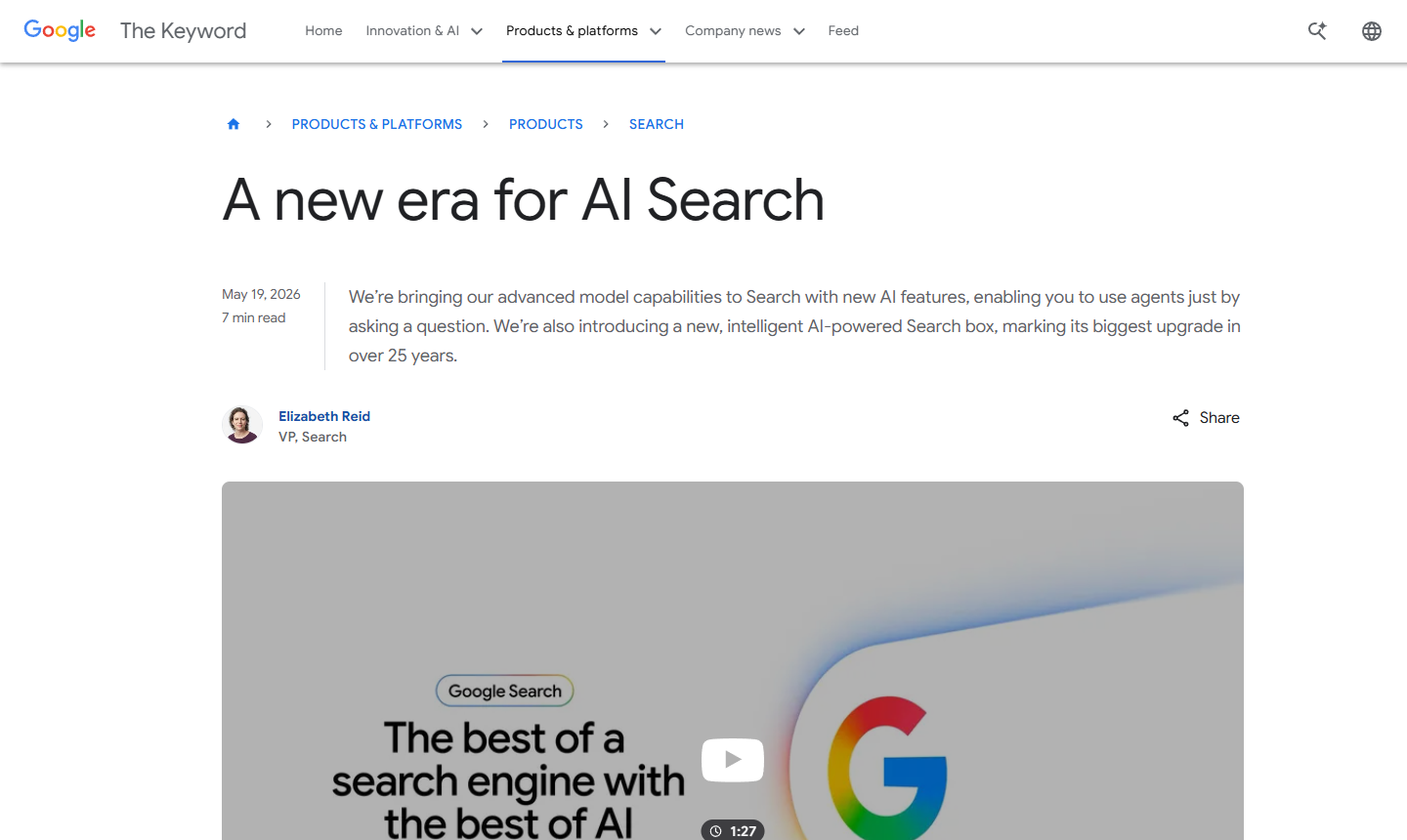
Confirmed: Google is making Gemini 3.5 Flash the default model in AI Mode globally where AI Mode is available. Google also announced an intelligent Search box, follow-up questions from AI Overviews into AI Mode, background information agents, agentic booking/calling, generative UI and custom mini apps or dashboards.
Available now: The intelligent Search box is starting to roll out where AI Mode is available. Follow-ups from AI Overviews into AI Mode are live across desktop and mobile worldwide. Personal Intelligence in AI Mode is expanding to nearly 200 countries and territories across 98 languages, with user-controlled app connections.
Coming this summer: Information agents launch first for Google AI Pro and Ultra subscribers. U.S. booking/calling capabilities for categories such as local experiences, services, home repair, beauty and pet care roll out this summer. Free generative UI in Search also comes this summer.
Coming later: Custom mini apps and dashboards start in the coming months, first for Google AI Pro and Ultra subscribers in the U.S.
Why Search agents matter for SEO and publishers
For SEO teams, the issue is not only rankings. Google is experimenting with Search as a task layer: monitoring, comparing, generating dashboards, surfacing actions and building custom interfaces around a query. That could change what users expect from search results.
- Content that only answers basic definitions is more exposed. AI Mode can absorb simple answers.
- Content with original tests, data, current pricing, troubleshooting and decision criteria becomes more valuable. AI systems need verifiable, fresh, citable material.
- Structured content matters more. Tables, timestamps, update logs, specs, availability and clear source links make content easier to parse and cite.
- Local and shopping sites need to watch agent access. Booking, calling and cart-like flows could route users around traditional browsing journeys.
Tovren recommendation: For any Google I/O follow-up coverage, include “what changed,” “what is live,” “who pays,” “what to test,” “limitations” and “last verified” dates. This is not just reader-friendly; it is AI-answer-friendly.
Antigravity and developer tools: the most immediately testable part of I/O 2026
Confirmed: Google announced Antigravity 2.0 as a standalone desktop app, Antigravity CLI, Antigravity SDK, Antigravity inside Gemini Enterprise Agent Platform, Managed Agents in the Gemini API, native Android support in AI Studio, Workspace integrations and an AI Studio mobile app available for pre-registration this week.
What developers should test first:
- Antigravity 2.0: Can multiple agents work in parallel without losing context or breaking your repo?
- Antigravity CLI: Does terminal-first agent work beat your current coding-agent workflow?
- Antigravity SDK: Can your team define repeatable agent behavior and run it in your preferred infrastructure?
- Managed Agents in Gemini API: Can a single API call spin up an agent with tools and code execution in an isolated Linux environment for practical workflows?
- AI Studio to Android: Can prompt-built Android prototypes survive beyond demo quality?
Cost note: Google tied Antigravity usage to AI Ultra plans. The new $100/month AI Ultra tier includes 5x higher usage limits than Pro in Gemini app and Antigravity, while the $200 tier includes 20x higher usage limits than Pro. Google also mentioned a limited $100 Antigravity bonus credit offer for AI Ultra users that expires May 25, 2026.
Tovren analysis: Antigravity is where Google’s agent strategy becomes measurable. The demo question is “Can it build?” The real question is “Can it safely maintain, debug, explain and hand off work in a production codebase?”
Workspace: voice, inbox triage, Google Pics and agentic office work
Confirmed: Google announced conversational voice capabilities in Gmail, Docs and Keep; a new image creation and editing tool called Google Pics; AI Inbox expansion; and Gemini Spark integrations for Workspace workflows.
Rollout timing: Gmail Live, Docs Live and Keep voice features roll out this summer to Google AI Pro and Ultra subscribers and in preview to Google Workspace business customers. Google Pics launches to a limited trusted tester group first, then rolls out globally this summer to Google AI Pro and Ultra subscribers and in preview for Workspace business customers. AI Inbox is available for AI Ultra subscribers and Workspace Enterprise Plus preview, and is expanding to Google AI Plus and Pro subscribers in the U.S.
Useful use cases:
- Ask Gmail Live for a flight gate, school update, client deadline or event detail.
- Dictate a messy idea into Docs Live and have it structured into a first draft.
- Brain-dump into Keep and get organized notes and lists.
- Use AI Inbox to surface relevant Docs/Sheets/Slides, draft replies and mark tasks done.
- Use Google Pics for object-level edits, text edits, translation and Workspace-integrated design tweaks.
What businesses should require: Before letting agents operate in Gmail, Calendar, Docs or Drive, set policies for approvals, sensitive recipients, external emails, document access, logging, retention and escalation. The value is time saved; the risk is invisible mistakes at office scale.
Chrome and the agentic web: WebMCP may matter more than it sounds
Confirmed: Chrome’s I/O 2026 updates include WebMCP, Modern Web Guidance, Chrome DevTools for agents, AI-assisted debugging, built-in AI APIs, Prompt API stability in Chrome 148, Gemini Nano support, Gemini in Chrome on Android, auto browse, Skills in Chrome, screen selection and voice input across the web.
Why WebMCP matters: Today, many web agents imitate a human clicking around a site. WebMCP proposes a more structured path: websites expose machine-readable tools, such as functions and forms, that browser-based agents can call with user authorization. If it works, it could make agents more reliable than brittle screen-scraping.
Developer timing: WebMCP’s experimental origin trial starts in Chrome 149. Modern Web Guidance is in early preview. Chrome DevTools for agents is available today for Antigravity and more than 20 coding agents. Prompt API is stable in Chrome 148 with Gemini Nano, multimodal inputs and structured output.
Tovren analysis: For web teams, the strategic question is no longer just “Is our site accessible to people and search engines?” It is also “Can authorized agents understand and safely use our product?” Expect more pressure to design websites with agent-legible workflows, clearer APIs and explicit permissions.
YouTube, Shopping and commerce: Gemini becomes a discovery and transaction layer
YouTube
Confirmed: Ask YouTube is a conversational video-search experience. It can answer more complex queries, support follow-ups and compile structured responses from long-form videos and Shorts. It is currently available for U.S. Premium members aged 18 and older through youtube.com/new, with broader rollout planned. Gemini Omni is also rolling out in YouTube Shorts Remix and YouTube Create.
Creator note: YouTube says Omni-remixed Shorts include digital watermarks, identifying metadata and links back to the original video, and that creators can opt out of visual remix in Shorts. Likeness detection is expanding to creators 18 and older.
Shopping
Confirmed: Universal Cart is an intelligent shopping cart that works across merchants and Google services. Google says it can track deals, price drops, price history, stock alerts, product compatibility, loyalty perks and payment benefits. It is built on Google Wallet and tied to Universal Commerce Protocol for checkout.
Rollout timing: Universal Cart rolls out across Search and the Gemini app in the U.S. this summer, with YouTube and Gmail to follow. Google says UCP checkout features will be tried soon with merchants including Nike, Sephora, Target, Ulta Beauty, Walmart, Wayfair and Shopify merchants such as Fenty and Steve Madden.
Tovren analysis: Agentic shopping is useful only if it keeps the buyer in control. The practical questions are whether the cart finds genuinely better deals, explains why it recommends alternatives, handles returns cleanly and avoids nudging users into purchases that benefit Google more than the shopper.
Android XR eyewear: Gemini leaves the phone screen
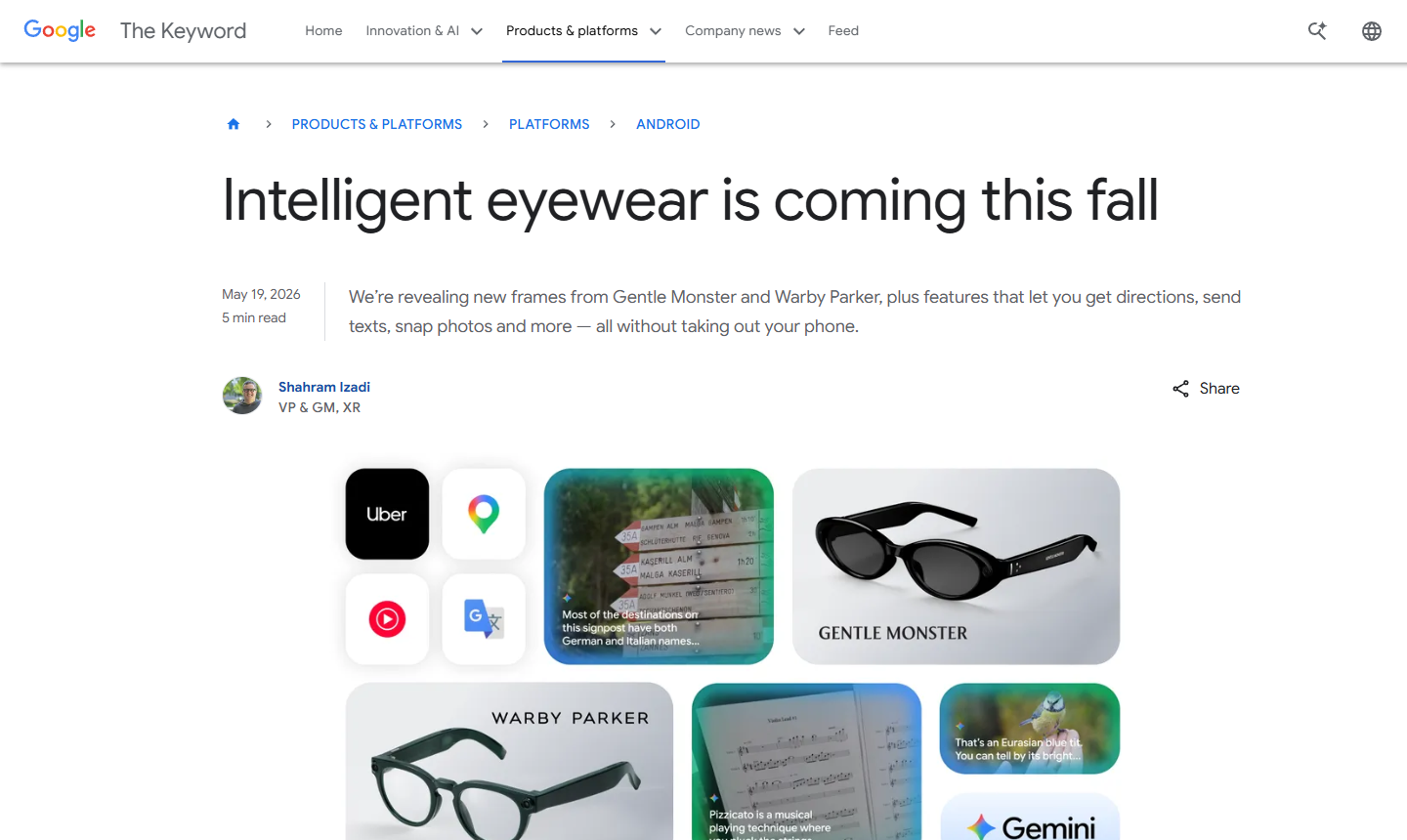
Confirmed: Google announced intelligent eyewear on Android XR with Samsung and eyewear brands Gentle Monster and Warby Parker. Google described two categories: audio glasses that provide spoken help and display glasses that show information. Audio glasses are launching first later this fall.
Features Google described:
- Ask Gemini about what you see.
- Get natural turn-by-turn navigation.
- Manage calls, texts, missed-message summaries and music.
- Capture and edit photos/videos with Nano Banana.
- Translate speech and written text.
- Handle multi-step tasks in the background, with final user confirmation.
- Use apps such as Uber and Mondly by voice; pair with Android and iOS phones.
What is still unknown: Price, battery life, camera privacy indicators, display quality, prescription support, regional availability, app compatibility, durability, real-world latency and how often users will actually want an always-available AI assistant on their face.
Subscriptions and pricing: what costs money
Confirmed: Google introduced a new $100/month AI Ultra plan and reduced the top AI Ultra plan from $250/month to $200/month. Google says the $100 plan is aimed at developers, technical leads, knowledge workers and advanced creators. The $100 tier includes 5x higher usage limits than Pro in Gemini app and Antigravity, Gemini 3.5 Flash integration, priority Antigravity access, 20TB storage and YouTube Premium individual. The $200 tier includes 20x higher usage limits than Pro.
| Plan / access path | What Google announced | Who it is for | Caution |
|---|---|---|---|
| Free / no subscription | Gemini 3.5 Flash in Gemini app and AI Mode; free generative UI in Search planned for summer; YouTube Omni remix at no cost in Shorts/Create. | General users, students, casual searchers, creators testing Shorts. | Availability varies by product, country, language and rollout stage. |
| Google AI Plus / Pro | Access to Omni in Gemini app/Flow, Daily Brief in the U.S., AI Inbox expansion in the U.S., some Workspace features. | Power users who already live in Gemini, Gmail and Docs. | Check exact local plan availability and limits before upgrading. |
| AI Ultra $100/month | 5x Pro usage in Gemini app and Antigravity, 20TB storage, YouTube Premium, priority Antigravity access, Spark U.S. beta eligibility. | Developers, technical leads, heavy creators, high-volume Gemini users. | Expensive if you only want casual chatbot access. Spark is U.S.-only at launch. |
| AI Ultra $200/month | 20x Pro usage in Gemini app and Antigravity, plus top-tier AI Ultra capabilities; Project Genie global for eligible $200 subscribers. | High-volume builders and creators pushing model/tool limits. | Wait for real usage data unless you already hit Pro/Ultra ceilings. |
| Enterprise / Workspace business | Gemini Enterprise Agent Platform, Gemini Enterprise, Workspace previews, Spark preview for business customers. | Organizations standardizing AI work across teams. | Governance, logging and permission design matter more than demo access. |
Usage model change: Google says it is moving from daily prompt limits to compute-used limits in the Gemini app. The new limits factor in prompt complexity, features used and chat length. Limits refresh every five hours until a weekly cap. Google also says AI Pro and Ultra subscribers can buy top-up AI credits for Antigravity, Google Flow and, later, the Gemini app.
What to try first
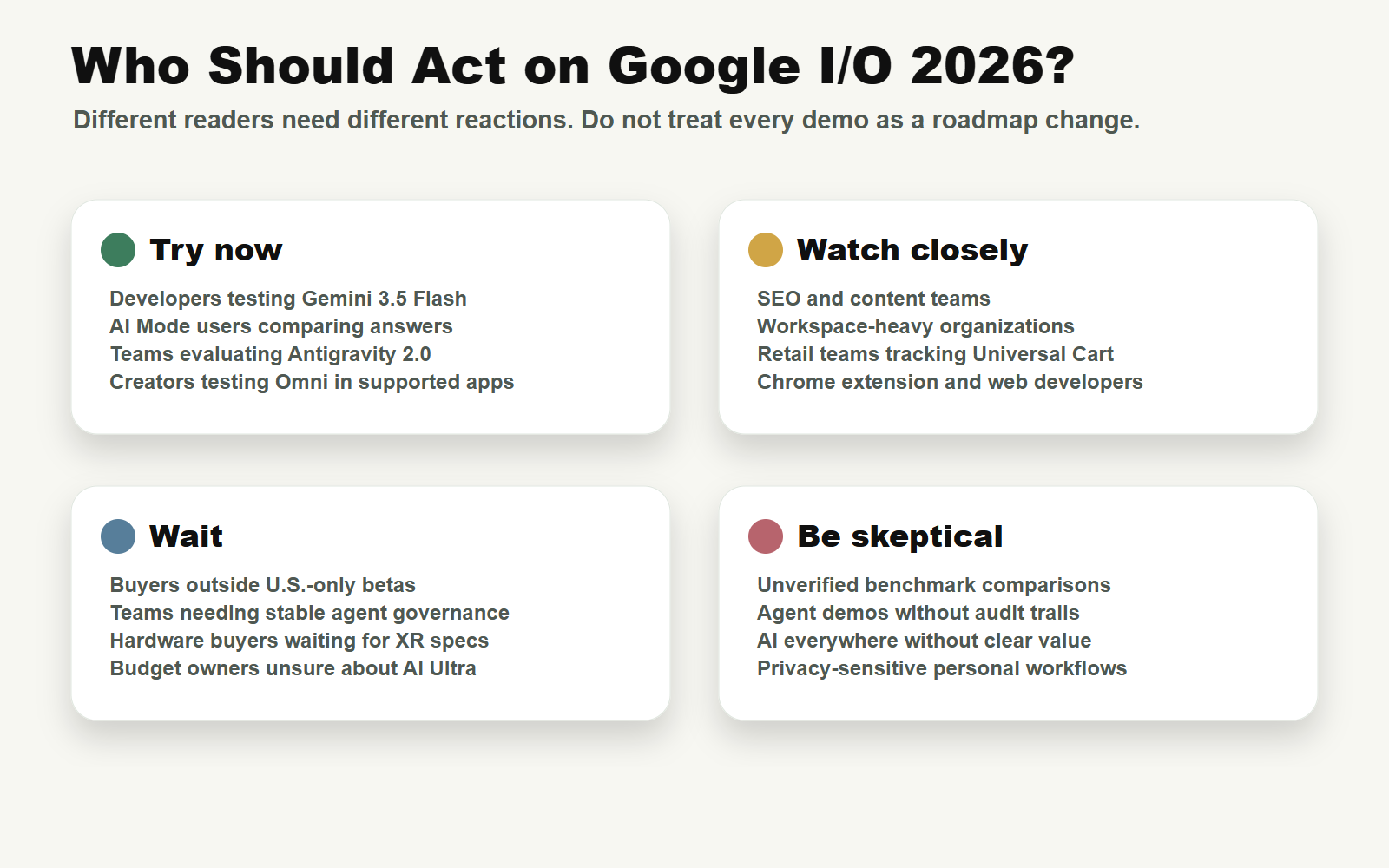
Do not try everything. Use this checklist based on who you are.
- General power users: Try Gemini 3.5 Flash in the Gemini app and AI Mode. Test real multi-step tasks, not trivia.
- SEO/content teams: Test AI Mode follow-ups, intelligent Search box behavior and how Google cites sources for complex queries in your niche.
- Developers: Try Antigravity 2.0 or Managed Agents on a low-risk repo or internal tool. Measure error recovery, code quality and time saved.
- Creators: Try Gemini Omni in Gemini/Flow if you have a paid plan, or in YouTube Shorts Remix/Create if available. Check watermarking and remix permissions.
- Workspace-heavy users: Watch AI Inbox and Docs/Gmail/Keep voice features. Start with personal workflows before team-wide rollout.
- Business operators: Build an approval policy for agents before enabling Spark-like workflows across email, calendar or payments.
- Retail/ecommerce teams: Track Universal Cart and UCP support. Think about how your product data, availability and checkout flows appear to agents.
Who should care now, and who can wait?
| Reader type | Care now? | Why | Recommended action |
|---|---|---|---|
| Developers / technical leads | Yes | Gemini 3.5 Flash, Antigravity 2.0, CLI, SDK and Managed Agents are testable now. | Run a controlled comparison against your current coding-agent workflow. |
| Creators / video editors | Yes, if you use Shorts or Flow | Gemini Omni is rolling out in creator surfaces and could speed ideation/remixing. | Test output quality, watermarking, rights and consistency before client work. |
| SEO / content teams | Yes | Search AI Mode, follow-ups, agents and generative UI affect discovery and source visibility. | Track your query categories in AI Mode and update content with tables, source logs and refresh dates. |
| Business users in Google Workspace | Watch closely | Voice tools, AI Inbox, Google Pics and Spark could reduce admin work, but many features are summer/preview. | Pilot with low-risk workflows and explicit approval rules. |
| Casual Gemini users | Maybe | Gemini 3.5 Flash and UI updates are useful, but paid tiers are probably overkill for light use. | Use the free/available surfaces first; upgrade only when you hit limits or need Omni/Antigravity volume. |
| Retailers / ecommerce teams | Watch closely | Universal Cart and agentic commerce may alter how users compare and buy. | Audit product feeds, pricing, availability, loyalty logic and checkout compatibility. |
| XR / hardware buyers | Wait | Android XR audio glasses are coming later this fall; price and battery are unknown. | Track reviews after shipping hardware appears. |
| Privacy-sensitive users | Wait or limit access | The most powerful features depend on connected apps, personal context and background agents. | Use opt-in controls carefully and avoid connecting sensitive accounts until permissions are clear. |
Community reaction: excitement, confusion and skepticism
Community signal, not factual proof: Early Reddit and AI community threads framed the keynote as Google’s “agentic Gemini” moment. Developers focused on Antigravity 2.0, CLI, SDK, pricing and limits. Gemini users wanted model and rollout comparison tables. Broader AI forums debated Google’s user metrics and whether the keynote showed genuine utility or another wave of AI pushed into every product.
The skeptical reaction is reasonable. Google announced a huge amount across many surfaces, and the real value will depend on rollouts, geographic access, plan limits, enterprise controls, latency, reliability and whether users trust agents with email, shopping, calendar and browser actions.
Tovren analysis: The biggest community need is not another hype recap. It is clarity. People want to know: “Can I use it now?”, “Do I have to pay?”, “Is it U.S.-only?”, “Is this a model, an app feature or an agent?”, and “What can go wrong?”
Risks and open questions
| Risk / unknown | Why it matters | What to watch |
|---|---|---|
| Agent reliability | Background agents can make mistakes at scale. | Approval prompts, logs, rollback, error handling and “ask before action” boundaries. |
| Pricing and limits | The new $100/$200 AI Ultra tiers are expensive for casual users. | Actual compute-based caps, top-up pricing and whether Pro users feel squeezed. |
| Geographic availability | Several features are U.S.-only or tied to where AI Mode is available. | Country/language rollout pages and support docs. |
| Search impact on publishers | AI Mode, agents and generative UI could change clicks, citations and user journeys. | Referral traffic, source citation quality and whether AI Mode sends meaningful clicks. |
| Synthetic media and likeness | Omni makes remixing and generated video easier. | Watermark enforcement, opt-out controls, creator complaints, impersonation cases. |
| Enterprise governance | Agents across Gmail, Docs, Drive, Calendar and web tools create data exposure risks. | Admin controls, audit trails, data retention, app permission scopes and compliance terms. |
| Benchmark translation | Google’s model claims may not match user workloads. | Independent benchmarks, coding-agent bakeoffs and long-horizon reliability tests. |
| XR privacy and social acceptance | Always-available eyewear can trigger recording, consent and safety concerns. | Hardware indicators, camera policy, battery, price, reviews and regional regulation. |
FAQ
What was the biggest announcement at Google I/O 2026?
The biggest strategic announcement was not one feature. It was Google’s attempt to make Gemini an agent layer across Search, the Gemini app, Workspace, Chrome, YouTube, Shopping, Android XR eyewear and developer tools. Gemini 3.5 Flash, Gemini Omni, Gemini Spark and Antigravity are the core pieces.
Is Gemini 3.5 Flash available now?
Yes. Google says Gemini 3.5 Flash is available now in the Gemini app, AI Mode in Search, Google Antigravity, the Gemini API in AI Studio and Android Studio, Gemini Enterprise Agent Platform and Gemini Enterprise. Availability may still vary by product, country, language and rollout stage.
When is Gemini 3.5 Pro coming?
Google said Gemini 3.5 Pro is planned for next month after I/O 2026. Treat that as a target window until Google publishes a specific release date.
What is Gemini Omni?
Gemini Omni is Google’s new multimodal creation model. The first version, Gemini Omni Flash, starts with video. It can use combinations of text, images, video and some audio references to generate or edit video through conversational prompts.
Is Gemini Omni free?
It depends on the surface. Google says Omni Flash is rolling out to Google AI Plus, Pro and Ultra subscribers through the Gemini app and Google Flow. YouTube says Omni remixing is rolling out at no cost in YouTube Shorts Remix and the YouTube Create app.
What is Gemini Spark?
Gemini Spark is Google’s new 24/7 personal AI agent. It is designed to work in the background, connect across Google products, handle complex tasks under user direction and ask before high-stakes actions such as sending emails or spending money.
Can most users access Gemini Spark now?
No. Spark is starting with trusted testers, then a beta for Google AI Ultra subscribers in the U.S. next week. It is not a broad global release at launch.
What changed in Google Search?
Google is making Gemini 3.5 Flash the default model in AI Mode where AI Mode is available. It also announced an intelligent Search box, follow-ups from AI Overviews into AI Mode, background information agents, agentic booking/calling, generative UI and custom mini apps or dashboards.
What should SEO teams do after Google I/O 2026?
SEO teams should track AI Mode results for their priority queries, publish content with fresh dates and source logs, add structured comparison tables and troubleshooting sections, and focus on original data, tests, pricing, screenshots and decision criteria that AI summaries cannot easily replace.
What is Google Antigravity 2.0?
Google Antigravity is Google’s agent-first development platform. At I/O 2026, Google announced Antigravity 2.0 as a standalone desktop app, plus CLI, SDK, enterprise integrations and Managed Agents in the Gemini API.
What is the new Google AI Ultra pricing?
Google introduced a new $100/month AI Ultra plan and reduced the top AI Ultra plan from $250/month to $200/month. The $100 plan includes 5x Pro usage limits in Gemini app and Antigravity, 20TB storage and YouTube Premium. The $200 tier includes 20x Pro usage limits.
Are the Android XR glasses available now?
No. Google said audio glasses are launching first later this fall, with display glasses later. Google showed partnerships with Samsung, Gentle Monster and Warby Parker, but many buyer details remain unknown.
Should I upgrade to AI Ultra?
Only if you are a heavy Gemini, Antigravity or Omni user, or you specifically need higher limits, 20TB storage, YouTube Premium and early access to Spark in the U.S. Casual users should try available free or lower-tier features first.
Source log
| Source | Publisher | Date shown | URL | Used for |
|---|---|---|---|---|
| Google I/O 2026: News and announcements | Google / The Keyword | May 19, 2026 | Source | Overall I/O package, 24-article collection, event framing, cross-surface announcements. |
| I/O 2026: Welcome to the agentic Gemini era | Google / The Keyword | May 19, 2026 | Source | Keynote framing, Google-reported token/developer/Search/Gemini momentum metrics. |
| Introducing Gemini Omni | Google / The Keyword | May 19, 2026 | Source | Gemini Omni capabilities, inputs, rollout surfaces, watermarking, API timing. |
| Gemini 3.5: frontier intelligence with action | Google / The Keyword | May 19, 2026 | Source | Gemini 3.5 Flash availability, Google-reported benchmarks, Gemini 3.5 Pro timing, Spark linkage. |
| The Gemini app becomes more agentic, delivering proactive, 24/7 help | Google / The Keyword | May 19, 2026 | Source | Gemini app user count, Neural Expressive, Daily Brief, Spark, macOS app and voice timing. |
| A new era for AI Search | Google / The Keyword | May 19, 2026 | Source | AI Mode, intelligent Search box, information agents, booking/calling, generative UI, Personal Intelligence. |
| Everything new in our Google AI subscriptions, fresh from I/O 2026 | Google / The Keyword | May 19, 2026 | Source | AI Ultra $100/$200 pricing, usage limits, storage, YouTube Premium, compute-used limits, top-up credits. |
| New ways to create and get things done in Google Workspace | Google / The Keyword | May 19, 2026 | Source | Gmail/Docs/Keep voice features, Google Pics, AI Inbox, Spark in Workspace. |
| Intelligent eyewear is coming this fall | Google / The Keyword | May 19, 2026 | Source | Android XR eyewear partners, audio/display glasses, feature list and timing. |
| Building the agentic future: Developer highlights from I/O 2026 | Google / The Keyword | May 19, 2026 | Source | Antigravity 2.0, CLI, SDK, Managed Agents, AI Studio, Android support, bonus credits. |
| 15 updates from Google I/O 2026: Powering the agentic web with new capabilities, tools, and features in Chrome | Chrome for Developers | Published May 19, 2026; last updated May 19, 2026 UTC | Source | WebMCP, Modern Web Guidance, Chrome DevTools for agents, Prompt API, Gemini in Chrome. |
| All the YouTube news from today’s Google I/O | YouTube Blog | May 19, 2026 | Source | Ask YouTube, Omni remixing, watermarking, creator opt-out, likeness detection. |
| Introducing the Universal Cart and more ways to help you shop | Google / The Keyword | May 19, 2026 | Source | Universal Cart, UCP, AP2, merchant examples and rollout timing. |
| Making it easier to understand how content was created and edited | Google / The Keyword | May 19, 2026 | Source | SynthID, C2PA Content Credentials, verification in Search/Gemini/Chrome, partner adoption. |
| Reddit community threads: r/google, r/google_antigravity, r/Bard, r/AIGuild, r/singularity | Checked May 20, 2026 | Community URLs sampled via Reddit search/open pages | Sentiment only: excitement, confusion, pricing concerns, demand for model/rollout tables, skepticism about AI everywhere. |
Refresh triggers
- May 25, 2026: Verify whether Antigravity $100 bonus credit offer expired as stated and update pricing section.
- Late May 2026: Check whether Spark beta opened for U.S. AI Ultra subscribers and whether plan limits changed.
- June 2026: Update when Gemini 3.5 Pro ships or if Google changes timing.
- June 2026: Check Gemini in Chrome on Android late-June rollout, device requirements and language limitations.
- Summer 2026: Update Search information agents, booking/calling, generative UI, Workspace voice features, Google Pics and Universal Cart availability.
- When Gemini Omni APIs launch: Add API pricing, model ID, rate limits, safety restrictions and example developer workflows.
- When Android XR audio glasses ship: Add price, countries, battery life, hardware specs, camera/privacy details and reviews.
- Monthly through Q3 2026: Re-check Google AI subscription plan pages for plan names, limits, compute-used cap details and top-up credit pricing.
- After independent testing: Update Gemini 3.5 Flash benchmark section with non-Google coding, agentic and multimodal tests.